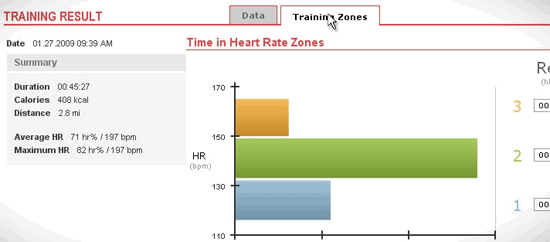
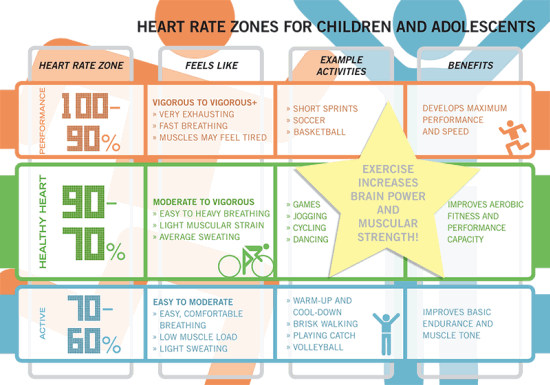
I'm noticing that Polar is now promoting a three heart rate zone system.
Welcome to the party Polar!
I subbed this morning and saw the sign on the right displayed. At first I didn't give it any notice, but then I did a double take; they're showing the five zones grouped into three… very interesting.
When I got back to my office I did an image search to see what else I could find. I haven't paid much attention to Polar, so some of this could have been occurring and I'm only seeing it now.
Exercise zones are ranges between the lower and upper heart rate limits expressed as beats per minute (bpm) or as percentages of your maximum heart rate (HRmax). HRmax is the highest number of heartbeats per minute during maximum physical exertion.
Heart Rate Target Zones
Exercise can be divided into three different: intensity zones. Each of these intensity levels corresponds to various health and fitness improving mechanisms in your body.
Here's what I found.
ACE promotes a Two Threshold & Three Zone System. Polar's personal training area clearly reflects this in the chart above.
Ignoring the fact that all of this is based on the antiquated Max Heart Rate – instead of a being based on aerobic or anaerobic thresholds – I see this as very good news for any of us trying to cut through the confusion and complexity caused by branded 5 or more zone systems. Instead we promote the simple and effective 3 Heart Rate Zone system anchored by both aerobic or anaerobic thresholds.
It's great to have Polar aboard – except they have a long way to go… please forgive my rant here 🙁
It defies explanation, how a company as large as Polar, can be so utterly clueless. Make sure you've completely swallowed whatever you're drinking before reading their page about; Determining Maximum Heart Rate.
Your heart rate has an upper limit, or maximum rate, called HRmax. HRmax is not a good predictor of fitness level or performance (it's mostly genetic), but it is used to quantify levels of intensity (as a % of HRmax). If HRmax isn't good for anything, why are you using it? It's like saying; this scale is wildly inaccurate… so go ahead and weigh yourself with it and we'll base your weight loss program on it.
You can determine maximum heart rate a number of ways:
1. Have your HRmax measured in a laboratory during a stress test. In a laboratory? OK sure, I have one down the street.
2. Do a maximal effort and record the highest heart rate (not recommended for untrained individuals). This will give you a fairly accurate maximum heart rate, but is difficult to do properly. Remember that HRmax depends on the activity, so establish HRmax in the sports you do most often. Huh? What's your definition of the word “fairly”? So if I'm “untrained” what do you suggest I do?
3. HR max-p score predicts your individual maximum heart rate. This feature is included in several Polar computer models. I get it – marketing types wrote this nonsense.
4. Estimate your maximum heart rate based on the formula 220 – age. This will give you a rough estimate, but is not nearly as accurate as the other methods described above. That's it? Those are your only choices?
For most individuals, maximum heart rate declines with age and values are usually between 170-200 bpm. This has been disproven years ago – why do they continue to say it?
We've been proponents of the Two Thresholds /Three Heart Rate Zone system for years here at ICI/PRO. We're not alone. ACE ( the American Council for Exercise) recommends this system as the most appropriate for the typical participant we see in class.
So which fitness club or cycling studio is looking today to hire a passionate & talented Indoor Cycling Instructor?
EVERY. CLUB. AND. EVERY. STUDIO.
How can I say that with such conviction, without actually surveying every club/studio on the planet?
That's easy 🙂 Every successful business owner/manager I know, is continuously looking to hire good people. It doesn't matter if they have a “help wanted” sign hanging in the window or not.
EVERY. BUSINESS. IS. LOOKING. FOR. GREAT. PEOPLE.
Why is this important for anyone interested in securing their first regularly scheduled class? Because, quite simply, it's important for you to understand (and more importantly believe) this when you approach a studio owner or manager. Having the perception that they're buying, what you're selling, is a great confidence builder.
So is 2017 going to be the year you land your first teaching gig? Or maybe the year when you'll decide to move beyond your comfort zone and audition at the hot, new studio opening down the street?
Either way, I'm thinking some of these articles will be helpful for you.
The Things You Wish You Knew in Your First Indoor Cycling Class
We know cycling is a great workout, but very few are willing to brave down pours or gusting winds when the weather isn’t cooperating. Pedaling to great music encouraged by a motivating coach seems rather appealing.
While indoor cycling group fitness classes have been around almost 30 years now, the popularity is still increasing dramatically. Cycling specific studios are opening up all over the globe. All levels of fitness enjoy the heart pumping caloric burn workout from pushing the pedals around and around. This workout is also incredibly popular with those limited to doing low impact workout for their back, hip and knee joints.
Here are a few pointers instructors and facilities could make their potential participants aware of in order to get them in the door and then successfully through their first indoor cycling class.
Help, I’m not fit enough!
It’s amazing how fit and intimidating everyone looks in an indoor cycling class. Potential newbies will likely believe that they are not fit enough to even join the class let alone actually live through the hour to tell the tale. Many facilities offer orientations for beginners including what classes are most suitable on the schedule. Instructors are real people and the best instructors are approachable and will make everyone feel welcome.
Will the instructor or anyone notice me if I sneak in late?
It’s really not a good idea to arrive to class late. Arriving a few extra minutes early can set up for success even if it’s just to give you some confidence. This also means you can pick your spot and perform a bike setup with time. The best place is always in the front row, perhaps not necessarily in the centre though on your first ride!
What about clothing? Do I need a cycling team kit?
The most important thing to remember about clothing is that it needs to be comfortable. You don’t have to wear cycling shorts and jerseys to reap the benefits of an indoor cycling class. Padded bike shorts, however, are a lot more comfortable underneath and cycling jerseys are really effective at wicking away the perspiration and keeping you cool. Never wear running shorts or thong underwear if you want to keep from being embarrassed or getting chaffed down under. Cycling shoes are not mandatory but did you know that you can get injured from wearing a running shoe? Running shoes have a very flexible sole and this can lead to some participants getting plantar fasciitis over time.
Simple bike set-up
Great instructors will always include tips in their intro on how to set up your bike. Basic bike set up will have your saddle height the same as your hip height so that your knees have a 10-20 degree bend at the bottom of the pedal stroke. If you are new to indoor cycling and you suffer from low back, neck or shoulder pain then raise the handlebars but not so high that you look like you are riding a Harley Davidson motor bike! If you are not clipped in then please don’t put your toes all the way to the end of the cage as this could cause cramping. Try to figure out in your bike set-up if your seat is too high or too low. Too low, and you won't be able to fully extend your legs, which detracts from the power of each pedal stroke. Too high, and your hips will rock back and forth to reach the bottom of each pedal stroke, which slows you down and can end up bruising your groin. To get the perfect seat height, stand next to the bike, hold your palm parallel to the ground, and place it at the top of your hipbone. The seat is the right height when your hand is in line with the seat and you can pedal comfortably.
What do all these terms mean?
It’s highly likely that you will hear words like resistance, RPM, cadence, functional threshold and power to name just a few of the common terms in an indoor cycling class. Experienced instructors will teach you what these terms but it is helpful to have a better understanding. Resistance refers to the amount of pressure on the flywheel or chain or what gear the bike is in. RPM stands for the number of pedal strokes or revolutions made per minute. This is also sometimes referred to as cadence. Functional threshold is maximal effort that one can undertake for 20 minutes without stopping. Power is also called watts and can be defined as a force multiplied by velocity.
There’s no wrong way to pedal, right?
“Most beginners focus way too much on pushing down. However, the upstroke is really what provides all the power concentrating on pulling up with each pedal stroke will increase momentum and make it easier to increase RPMs. And here's a bonus for clip-in shoes: When you’re actually clipped into the bike, you can focus less on keeping your feet in place and more on your stroke, improving pedaling form, cadence and ultimately power output.
And don't forget about your core: Just because your abs don't touch the pedals doesn't mean they're not involved in every stroke. The core plays a major role in indoor cycling – which means actively engaging it could help you benefit from your workout even more. To do so, lengthen your spine, roll your shoulders back, and envision lifting your ribs off your hips. Proper form, as it happens, forces you to activate your core. Breathing correctly also helps, if you breathe from your chest instead of your belly it will be impossible to engage your core muscles. While seated or hovering over the saddle, use your abs as much as possible to help support your lower back. Try to keep your back straight (it's OK if there's a slight curve when you're out of the saddle).
8. Don't skip the stretch
There's not too much science yet to prove that stretching reduces injury, helps muscles recover, or improves physical performance, according to L. Bruce Gladden, Ph.D., a professor of kinesiology at Auburn University in Alabama. But stretching out your hips, calves, and quads still feels really good – and you deserve to treat yourself after putting your body through the grinder. I encourage you to think of the post-class stretch as part of your 45-minute class. Even two minutes of stretching is immensely better than not stretching at all. Sealing your ride with a moment of calm is priceless.
Have you heard it? It’s been around a long time: “How you do anything is how you do everything.”
I feel sure whoever came up with that statement — bad grammar and all — never worked in the fitness industry, or as a nutritionist.
How many times have I run into training clients like Kathy the stockbroker? She was a fearless cyclist but, by all accounts, a rather cowardly stock broker.
Or Debra, a sugar addict whose lack of progress in our weight-loss program made the supervisor say, “I don’t understand. She trains well.” For this client, training was the easy part. Not only was she accustomed to working out regularly, she was down for the intense workouts, too. Nutrition, on the other hand, was her challenge.
Debra was conscientious about her workouts because she’d been using them for years to compensate for bad food habits and her sugar addiction. She was trying to burn all those excess sugar calories in tough fitness classes.
Where There’s No Law, There’s No Freedom
(Apologies to John Locke)
Rachel was a successful attorney and a partner in a thriving law firm. She was less successful at creating healthful meals, at least at first. She did get on the right nutrition track pretty easily, but exercise was the tougher obstacle.
You might wonder how someone who could get into a good law school, make it all the way through, pass the notoriously difficult California bar exam, and become a successful lawyer could possibly have difficulty fitting exercise into her life.
But it had never been part of her life before, so it was completely new. The idea of making time for it was new. Prioritizing it, working her appointments around her exercise session, even waking up a few minutes earlier to squeeze a modified workout into her busy day — were all new.
Rachel didn’t seem to see that she could use the same skills she’d used her entire professional life to launch her fitness “career.”
In fact, when she started working on a new case and knew her schedule would be hectic for at least 6 weeks, her plan was … to skip her workouts till that hectic time was over.
Rachel had no clear picture of the impact those 6 sedentary weeks would have had on her fitness. You can’t take 6 weeks off and expect to pick up where you left off when you quit. You’ll end up starting from square one, especially in the early stages of a fitness program.
We did finally get Rachel’s fitness program solidly entrenched in her schedule, but it was slow going. She started with one day a week, and occasionally a second. Moving to 3 days a week — the minimum for fitness maintenance — took a long time. But she did it and got results.
Perhaps you have participants who are doing similar things. Part 2 will cover a final extreme example and some suggestions for how to use this info to advantage.
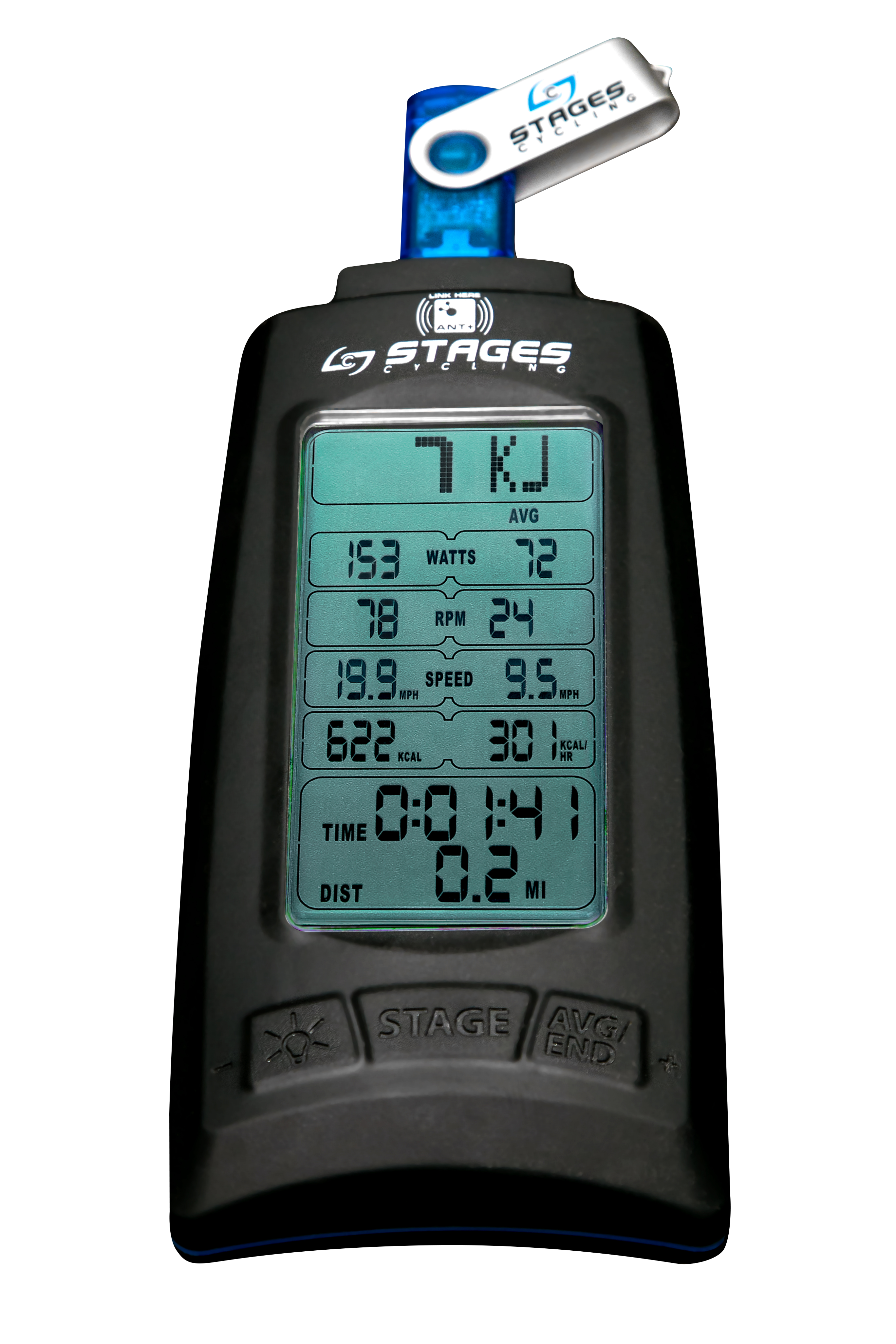
This is the first installment of a new series of posts I'll be sharing on all aspects of the States SC3 indoor cycling bike. The Stages SC3 has taken the indoor cycling world by storm and I believe it's important for all instructors who use this bike to have a clear understanding of all it's amazing features. Those who don't use this bike can also learn from many of its features. The science is the same no matter what bike you use.
I'm going to start with an overview its console than in future posts I'll explain the metrics that are displayed line by line.
Below is a video narrated by Stages Director of Education Cameron Chinatti that overviews the Stages SC3 Console.