Thank You to the 354 of you who have completed our survey!
It is greatly appreciated. Because I chose to keep the survey anonymous, if you asked me to contact you I don't know who's who. Please contact me directly.
My goal is to collect 1,000 responses. If you haven't yet, so please take two minutes to share your experiences. Click here to take the survey
This jumped out at me right away. 61% of respondents are reporting that the primary reason people aren't riding and training with heart rate monitors is that they don't see or understand the value.
Click image to enlarge
Which begs the questions; why not? and as Instructors and Studio Owners is there anything we can do to correct or effect this in a positive way?
My Grandfather loved this quote from Albert Einstein: The significant problems we have cannot be solved at the same level of thinking with which we created them. John Sr. (I'm actually the third John in my family) would typically remind me of this concept when I would come to him with some problem I had identified. I was interested in his ideas for creating an “Invention” that would be seen as the ultimate solution.
Back in the 90s I was coaching my daughters youth soccer teams. I, like most of the other dad-coaches, was going crazy trying to coordinate which player on the team played when, at what position and for how long. The basic requirement was each kid get equal playing time. With some help from another Dad, I had devised a rather complicated spread sheet at home. I was so proud of my solution 🙂 Now I'm prepared I thought. But when I would get to the game, someone would always be late, or wouldn't show up at all, messing up spreadsheet to the point of being useless. I then resorted to just randomly assigning players during the game. Inevitably some player (or parent) would feel that they weren't treated fairly… not good. I needed a solution and went to John Sr. looking for help.
After discussing and brainstorming solutions, we applied Einstein's thinking; where was my current thinking possibly preventing me from finding a solution to this problem? My desire to treat all the kids on my team fairly made sense and it was the leagues policy that each player receive equal playing time. So we decided that wasn't it. Maybe I could demand that parents have their kids there on time? I'd already tried that without success. How about my need to be prepared before the game? What if I could find a way to create the spread sheet a few minutes before the game actually started? No way. This was years before laptops were popular. What we decided I needed was some type of chart, where I could add the names of the players who were there on time, right before game time. It would also be necessary for me to adjust for players who showed up late or needed to leave early. The end result was the FairTurn Coaching Tool U.S Patent #6,260,845 which I have since sold to another company.
My goal with this survey was to begin applying this process of creative problem solving to the issue of why our students don't see the value of wearing a Heart Rate Monitor. The first step is understanding what we and our club's are doing now. Then we can step back to see if there is anything we are or are not doing currently, that could be contributing to this problem. The next step will be to think differently, in search of some potential solutions. Stay tuned.
Recently, I found myself at the local big box home improvement store looking for some primer paint. A helpful person asked if I had any questions. I explained that I had some pealing paint that I intended to scrape, prime and repaint. He suggested “brand X” as the best primer that they sold. Before I could ask if it would be possible to have the primer tinted, he moved off to help someone else. Content that I had the right paint, I carried a can of it over to the counter where they mixed custom colors. “What are you using this for?” asked the helpful person behind the counter. I told her the same thing I had told the earlier helpful person and asked if I could have it tinted. “This isn't what you want.” was her reply. She then began giving me a chemistry lesson that went way over my head. I listened politely before explaining I needed a few other things and would be right back.
I left the store with nothing but confusion.
In the survey I asked the question; What would you change, add or implement at your club or studio that you feel will increase Heart Rate monitor usage by members? 61% said they would implement Instructor training so everyone talks the same language.
Have we created a “Tower of Babel”?With 413 responses to the Heart Rate Training Survey it is clear that we have a language barrier that needs to be addressed. I feel the confusion it creates for our students is partially to blame for the low level of Heart Rate monitor usage in our classes.
I respect the fact that people will have their own point of view, i.e… which is the best paint for your house, but do our answers always reflect what's best for the customer?
I needed help making a decision and helpful person #1 gave me exactly what I needed; a simple, confident recommendation. Even though it was based on minimum information, his confidence left me feeling ready to take action… in this case making the purchase.
Helpful person #2, while thinking she was being helpful, did the exact opposite. The confusion she created had me second guessing what should have been a pretty simple decision. So I did nothing… which I'm thinking is what many of our students do every day.
In these three posts I am advocating for a standard method of describing HR training Zones and I would love your feedback.
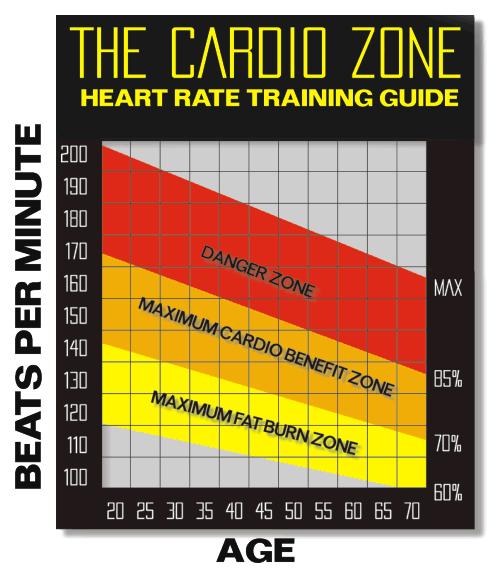
Should we adopt a standard method of describing Heart Rate Training Zones? My argument is that until we (I'm talking about everyone in the fitness Industry) all speak with consistent language, manufactures will continue to put stickers like this on fitness equipment. The Majority of people in your club will see this chart on an elliptical machine and remain confused by (if not down right afraid of) Heart Rate Training.
Danger Zone? Isn't that a song by Kenny Loggins?
Nothing will change until there is something to change to.
Where are you on this chart?
Does this chart provide anything even remotely helpful or beneficial?
In this post I mentioned that I was using a Blink Heart Rate monitor because I can't see the numbers any more. It's flashing light shows me when I'm below JRA ( T1 or aerobic threshold), between T1 and T2 (T2 is anaerobic threshold) or above T2. Very simple. I like simple when it comes to trying to communicate with my class.
ICI/PRO member Chuck Cali has a fun video he shot as a way for users to learn a very simple assessment of T1 and T2. Except he doesn't call them T1 and T2… Instead he talks about Blue, Yellow and Red. Very simple 🙂
Please watch this and consider if this would be something you could teach on the bike as an introduction to Heart Rate training.
Ask Amy about her biggest teaching challenge while on a working fitness vacation at a Caribbean resort and she will tell you it's accommodating all the different languages of the guests. Jamaica is very popular among Europeans and Asians, so in one class she may have students that speak German, Spanish, Russian and Japanese. Many know some English, but Amy has learned that sign language works the best because everyone understands it. She gets their attention, demonstrates what she wants and then leads them with nothing more than her smile and hand gestures.
I'm not saying we should adopt a form of sign language to communicate Heart Rate Training Zones. I'm not sure that would work… But the signage in your club or studio should simply and accurately show visually, exactly what you are speaking in your class.
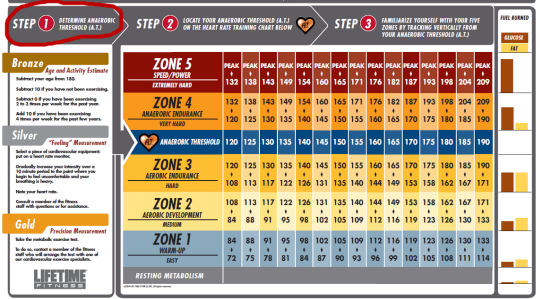
No health club is perfect, but I have to hand it to Life Time Fitness. They have done an exceptional job and educating all of their instructors on the concept of Threshold and the ever present Heart Rate Charts (in every studio) serve as visual reinforcement of the language we all use in class. You can download a pdf of the chart here.
Notice step one
I say exceptional job because it's very rare to find a student in my class that doesn't understand the concept of Threshold Heart Rate and in an average class 60% – 80% of the participants are wearing and using monitors. To put that in perspective, LTF has 90 clubs and in excess of 300,000 members that are being educated about the proper uses of Heart Rate Training .
Am I suggesting we adopt Life Time's chart? Not necessarily. We need a “generic” or “open source” version so everyone will be able to use it without cost or limitation.
How does your club compare?
Do your signage and fellow Instructors all speak the same language?
Are you resistant to establishing a standard? If so, then why?