The Yellow Jersey Bicycle Insurance company is promoting their service with this very cool infographic about the Yellow Jersey, worn by the leaders of the Tour de France. As they are a UK company, it's fitting that they are highlighting past British riders who have worn the Yellow Jersey. If you follow professional cycling you're aware of how utterly dominate Team Sky / British Cycling has been over the past two years. More excitement will follow for sure 🙂
I teach indoor cycling at multiple facilities in the Denver area but I spend most of my work week at Greenwood Athletic and Tennis Club. Greenwood is my “home club”. This is where I'm a personal trainer, teach indoor cycling, HIIT (High Intensity Interval Training) classes, CVI (Cardio Vascular Interval Training) classes, I've been a Master Swim Team coach, a Triathlon Team coach, I'm one of the Race Directors for the annual Tri-Our-Village Kids Triathlon and the Roadless Century Coach and Lead for the annual Roadless Ride fundraiser to benefit Brent's Place.
Greenwood is considered one of the best athletic clubs in the country. They do a lot of things VERY well. The facility is kept immaculately clean, they have the latest and greatest equipment and vast and diverse group exercise program with some of the best instructors in the Denver area. I could go on and on about what they do well, but there are plenty of facilities that are clean, big and have plenty of offerings, let's talk about something they do differently.
Greenwood is the only facility that I have every worked in that has, PAID, semi annual ALL STAFF meetings. There are some things that cannot be expressed in an e-mail or newsletter. There is something powerful and unifying about the ENTIRE staff gathering TOGETHER hearing the EXACT SAME message coming directly from the facility owner and general manger.
Our first All Staff meeting of 2016 took place last Thursday. The most exciting announcement, for me, was replacement of our Spinner Blade Ion indoor cycling bikes with the new Stages SC3 bike. This will take our, already stellar, indoor cycling program to a whole new level!!!!!!! I felt the most memorable segment of this meeting was when the video I've posted below was played. Watch, listen and know that your actions are powerful.
If you've followed indoorcycleinstructor.com for any length of time you know that I'm a huge fan of the 2T/3Z method of Heart Rate training which is the basis for Zoning. That simple Blue/Yellow/Red response from my Blink Heart Rate monitor is (to me) the perfect way to introduce zone based heart rate training into your class.
Here's some proof of it's success – OK it's a bit rough, but Diana presents a powerful truth that Zoning has worked for her in this video. Your students are in your class to lose body fat and Diana losing 100 pounds and finishing the Danskin Triathlon is a testament to the effectiveness of 2T/3Z Heart Rate training.
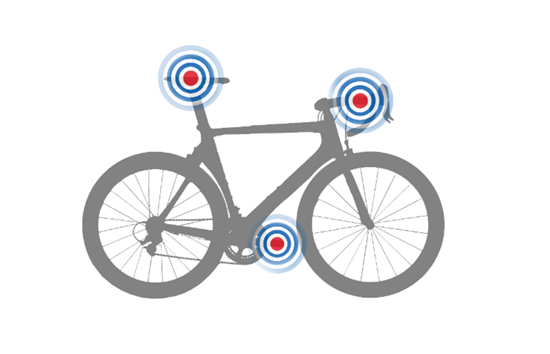
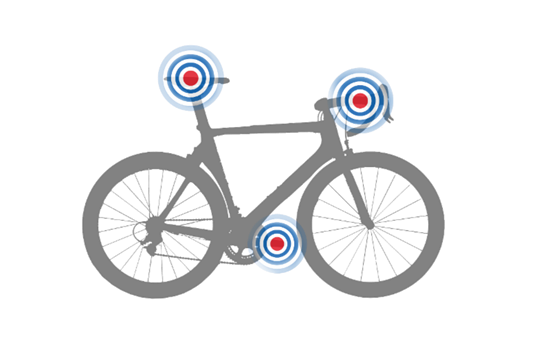
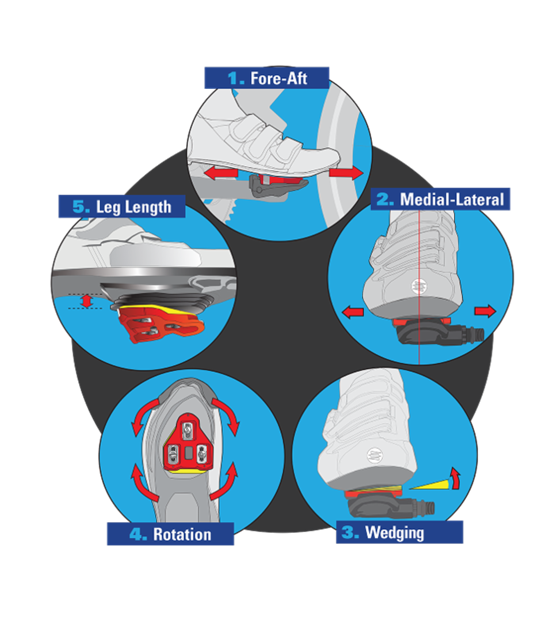
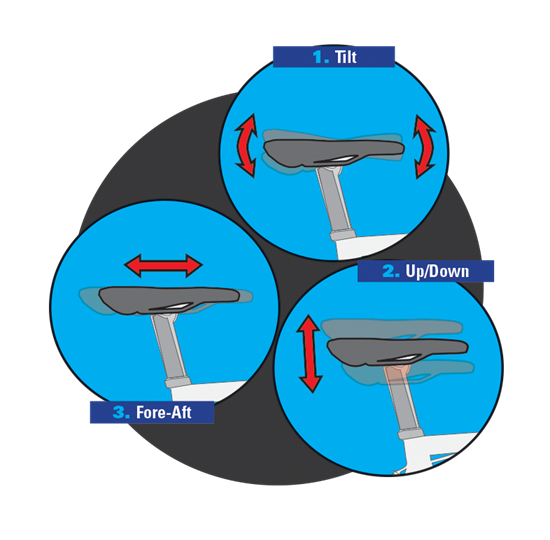
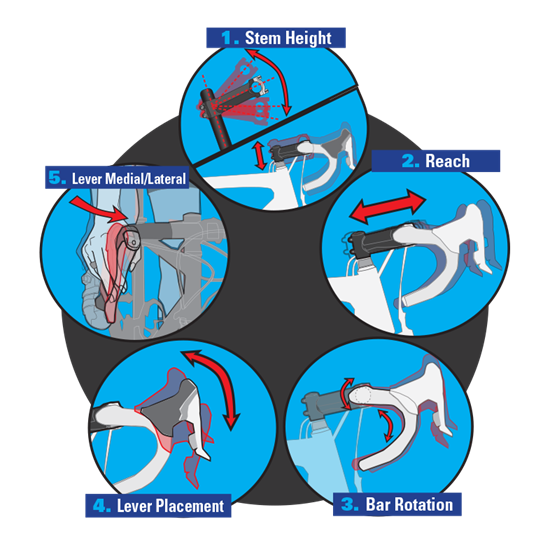
The guys at BikeFit.com do a great job using infographics to communicate the process of proper bicycle fit. Today they sent out these images and I wanted to share them with you. Each details the multiple points of adjustment that can be used to ensure a comfortable setup.
Having been through a three hour, professional fitting like what BikeFit.com offers – I have experienced how many of these adjustments are effected by others… i.e. saddle fore/aft affects height and reach to the bars, cleat position can require a change in saddle position, etc…
A comprehensive fitting is really important for someone who is riding thousands of miles a year and/or is super concerned about efficiency = getting the maximum amount of power to the road.
So how detailed should you be with a new participant? After setting up people for over 15 years, it's my view that you just need to get them close and feeling comfortable. You obviously don't have 3 hours and with the exception of the Keiser M3, the adjustments on Indoor Cycles are too coarse to really fine tune a person anyway.
Shannon Fable, Co-Founder and President of GroupEx PRO Group, has published this informative presentation directed at Instructors and studio owners/managers:
How to Keep Crowds into February
January is such a great time of year for Fitness Professionals, especially group fitness instructors. Studios are packed and there are tons of new faces! And, as a GFM, I’m sure you are searching for ways to keep the excitement alive well past the January rush. We thought you’d appreciate this webinar we recorded a while back right about now!
Click the video below for 3 quick tips to capitalize on the New Year’s influx. We hope you enjoy. This was part of a series we hosted so you will hear mention of the next topic. We will be sending you this one, as well, so stay tuned! Just a small way to say thank you for what you do … GroupEx PRO is dedicated to helping make managers' lives easier in 2017!
Talking after class with members, is an infinite source of feedback for me. Today was a great example.
My friend Georgia Green and her friend Mark were in class this morning. You met Georgia and learned about her and Mark's plans to ride 10,000 miles this summer in Podcast 342.
After class Georgia commented; “how do you (meaning me) ride with such a stable upper body?” I don't see many Instructors, or participants who can do that. My response was that after 20 years riding and racing bicycles, my legs tend to work pretty well together 🙂 Explaining more, I offered that excessive upper body movement is often the result of some muscular imbalance while pedaling = each leg's force is balanced by an equal, but opposite force from the other, throughout the pedal stroke.
While I appreciated her comment, on my way home it got me thinking:
Am I too solid/stable when I'm riding?
Should I move more? Perhaps even extenuate my movements, to communicate my effort using my body?
[wlm_private ‘PRO-Platinum|PRO-Monthly|PRO-Gratis|PRO-Seasonal|Platinum-trial|Monthly-trial|PRO-Military|30-Days-of-PRO|90 Day PRO|Stages-Instructor|Schwinn-Instructor|Instructor-Bonus|28 Day Challenge']Road cyclists have very little upper body movement while seated, even when they're producing crazy wattages. This video does a nice job demonstrating how stable these Pro's are when they ride. In the run up to the sprint finish they're probably going way over 30 MPH = a continuous 350 watts or more.
Switch now to this short video and you'll see where “if you don't do it outside, you don't do it inside” really doesn't apply.
Watch how Spinning® MI Mike Michaels moves side to side – a lot. I'll bet he doesn't do that on the road – it wastes too much energy. Here's another showing something similar, this time from Josh Taylor:
All that movement is show, right? Josh, as an experienced bicycle racer, wouldn't move like that in a race > the people he's riding with would think there's something wrong with him. I don't know about you, but watching Josh's movement has me wanting to move along with him. Which I guess is the point of this article; Just sitting there and pedaling smoothly may have you looking like a Pro out on the road, but you're riding inside.
How can you tell if you're moving?
Mike and Josh have an advantage over you and me > they have been filmed presenting multiple times. So they get to watch themselves and, seeing what they look like riding, they can visualise changes they can make to ride with additional… I think the word is flourish.
Have you ever filmed yourself? This could be another reason to rig up a simple stand for a cell phone and then watch how you move. Even if you don't go the video route, you might try adding or accentuating your upper body movement. Adding a little extra flourish just might give your class a reason to follow you.[/wlm_private]
I'm going to attempt to do this in my future classes. Are you willing to give it a try?