Quick question: what do you feel is missing with (or should be added to) Spotify or Deezer, that would make it the complete music delivery package we need as Instructors?
From where I'm sitting, having the option to include non-Spotify/Deezer tracks in playlists I share – and then have those tracks play for whoever I shared with.
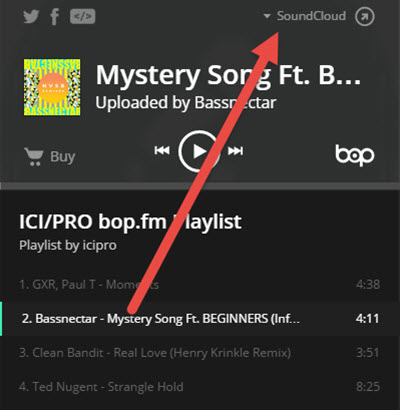
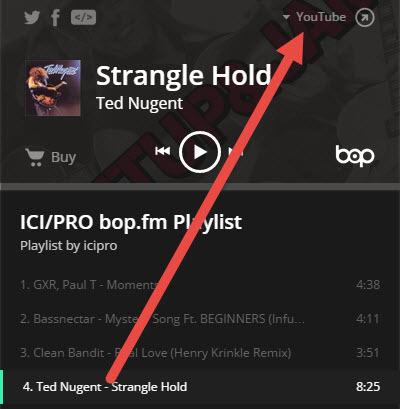
I'm not sure yet, just getting a feel for it – but bop.fm maybe a service we can use in the future. bop.fm connects to many of the popular music sites and their iPhone App allows you to assemble a playlist from multiple sources like; Spotify, Deezer, SoundCloud, YouTube, etc.. and then you can share the playlist with anyone. As long as you have a premium subscription, the bop.fm playlist will stream & play the songlist accuratly.
The trouble with local files > you can't share them
When I create a playlist with the purpose of sharing it, I'm either super careful not to include any of my local files – or – I make sure to include a download link for any tracks that aren't in Spotify/Deezer. But this is still really limiting because there are lots of awesome remixes and mashups that can really complete a playlist.
The trouble with SoundCloud > no option to download many of their tracks
You might search SoundCloud for a specific root track and find dozens of great quality remixes. Which is great except most don't offer any download option = you can only stream them. So you could build and stream a SoundCloud playlist as your class music, but there's no option to include any tracks from anywhere else.
So bop.fm maybe a solution?
Yes bop.fm will aggragate tracks from multiple sources. Which solves the initial problem of sharing a playlist with you. Unfortunately there isn't an “offline” option to download all of the tracks to your device – placing your and your class at the mercy of your Internet service. If you've got a great wireless signal you might give bop.fm a try. I don't, so I say bop.fm might be an option for us in the future if/when they include an offline mode in the future. Spotify's early iPhone App didn't at first, it was added later.
Here's a great deal for anyone who's been dragging their feet on subscribing to Spotify. Sign up now and get three months for $0.99 – this is for USA customers, you'll need to check to see if the offer is available in your country.
If you're concerned about learning the in's and out's of Spotify – we've got you covered here at ICI/PRO.
Beyond the access to millions of tracks – one of the main benefits of Spotify is how easy it is to share playlists between friends. As an ICI/PRO member you're considered a friend and we have over 60 fabulous playlists that you can download here.
Looking for that perfect track? We have 8 collaborative playlists where you can find song selections from other ICI/PRO members and you can add your own.
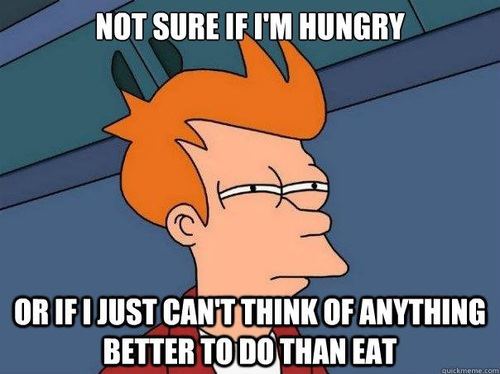
Have you heard about stomach hunger versus mouth hunger? Many nutritionists and dietitians talk about this. A client mentions eating Something Bad, and the practitioner asks, “Was it stomach hunger or mouth hunger?”
A variation on the question is, “Was it physical hunger or emotional hunger?”
Peak-performance motivator Anthony Robbins says, “If you ask bad questions, you get bad answers.” Asking a client whether she ate because of stomach or mouth hunger — or because of physical versus emotional hunger — is the classic Bad Question.
And it gets bad answers. Answers like “I don’t know” or “I’m not sure.” Sometimes the answer is another bad question: “How can I tell?” The client is trying to figure out if she was hungry for physical reasons or emotional ones.
Despite these rampant failures, the question persists. One book even uses the term “intestinal hunger.” Does anyone out there have any idea what that is? If I can’t understand it, what chance do my clients have?
Of course, if you’re not comfortable handling your participants’ food and eating issues, by all means refer to a nutritionist. This post is about awareness of what some of your participants may go through daily.
A Better Question
Here’s an idea that might be good for practitioners to adopt. I never use the term “hunger” for anything but physical hunger. Instead I ask, “Were you physically hungry, or did you just have an urge to eat?”
That question gets real answers and can uncover some important issues. People can tell the difference.
The urge to eat could have much behind it — emotions, stress, shifts in brain chemistry, shifts in hormones. Some clients might need coaching to explore the emotional component and retrain their responses not to involve food. Some may need to change their diets to change brain chem and/or hormones.
Real Hunger
Hunger is a specific, physical signal that the body needs food. I’ve explained in detail what hunger feels like to clients who don’t experience it.
Why don’t those clients experience hunger?
Some may not because, for years, they’ve been eating for reasons that have nothing to do with hunger:
– the clock says it’s mealtime
– everyone else is eating
– appetizing food is here now
– they ate too much at the last meal
– they’re stressed, depressed, anxious, or even happy.
Readers may conclude that the items in the last bullet show “emotional hunger,” but I’m suggesting that the word “hunger” causes the confusion. It’s more appropriate to use it only when physical hunger signals are present.
How Do I Know If I’m Hungry?
Clients who never feel hungry may be confused about how to determine hunger. If someone says, “I ate breakfast at 7 am, and now it’s 12:30, so I must be hungry,” that’s a thought process, not hunger. The best tactic is to help clients retrain their recognition of hunger through increased awareness of body signals.
It’s helpful to stay aware of misinterpreted signals. An obese client told me his hunger was “here” and placed his hand on his throat. Further questioning revealed that he actually had GERD (gastro-esophageal reflux disorder), which we alleviated in two ways. One was monitoring his work position after eating (he sometimes worked from home in bed). The other was taking an OTC remedy before the meal. (Don’t worry; I checked with his doctor.)
Clients who eat lots of sugar may not experience hunger. Despite research, I haven’t yet found a satisfactory explanation for that. Client symptoms, however, can typically be traced back to drops in glucose. If someone says, “I don’t get hungry, I get a headache,” that could be one sign of reactive hypoglycemia. Other examples exist.
So the absence of hunger could reflect lack of awareness, chronic overeating, or chronically high sugar consumption. When I uncover a solid explanation for the last, I’ll definitely let you know.
In the meantime, if you refer your participants to a nutritionist, please screen them and find one who doesn’t ask about mouth hunger.
(Indoor cycling instructors probably have their holiday eating under control, so this post is for your participants. I hope the information helps them.)
Quite a few years ago, I was on staff at a 10-day seminar on nutrition and eating behaviors. We lived at the ranch where it was held. Staff and participants alike followed the same mealtime rules.
Frankly, the seminar wasn’t particularly good. But we did one great exercise that helps me to this day.
The Standing Ovation
In the dining hall, we had to stand and announce that we were going back to the buffet to take seconds. At that point, everyone in the room gave us a standing ovation.
The reason behind this is simple. Some people tend to pile food on their plates when they go through the buffet line. It prevents the embarrassment of returning for more. The problem is, once the food is on the plate, it’s easy to keep eating, even when we don’t want it.
Giving yourself permission to get seconds eliminates the need to pile extra on the plate. Start with a small portion, and get more only if you really need and want it.
A Better Standing Ovation
The other part of the exercise was this: We had to stand and announce whenever we were throwing away food. Again, everyone in the room gave us a standing ovation.
I’m convinced this is one of the most valuable exercises anyone with food issues can try.
Most of us grew up learning that it’s a sin to throw away food. Didn’t you? Because of the starving children, right? Where were they starving when you learned it? We all heard different countries, different locations, but the sin was the same.
Kids immediately see through this nonsense and say, “So send it to them.” No one can convince kids that shoveling food that they don’t want or need into their mouths will help starving children anywhere. And yet this “teaching” persists and its negative lesson lingers into adulthood.
U.S. Food Production
Meanwhile, the U.S. produces 3950 calories worth of food for every man, woman and child (even infants) in the U.S., each and every day. 3950 calories is far more than most adult men need, and certainly more than women and children need.
So much of the food the U.S. produces is excess. There’s almost no way to prevent wasting of food.
Under circumstances like those, throwing away food isn’t a sin. It’s survival. And learning to be 100% okay with doing it is the smartest strategy.
Convincing My Clients To Get Rid Of Trouble Food
It isn’t easy to convince my clients of that. One client bought a giant tub of dates at Costco. Even though the date sugar kept triggering binges and her weight was creeping up, she kept eating them daily. When we talked about it, she said, “They’re almost gone.”
Perfect. Don’t put the dates in the garbage. Treat your body like a garbage can and put the dates in there. Yikes.
Another client had dinner with her parents at their home twice a week and couldn’t refuse the giant portions her mother served her. She had a problem with the sin of throwing away food. I wish she’d learn to use plastic containers for the purpose for which they’re intended.
Seminar Benefits You Can Use
After the seminar at the ranch — and all those standing ovations! — I can throw away any food. Now, I’m definitely NOT telling you to buy good food and throw it away for no reason.
But if a food — especially sugar — is making it difficult or impossible to stick with your eating plan, it needs to go. Not when it runs out, but now.
The impact of the sugar you can’t stay away from is huge. It goes beyond the “empty calories” most people talk about when discussing sugar. (Does that phrase bore you as much as it bores me?)
Toss That Sugar
Sugar increases appetite by inhibiting your satiety center. It changes your food preferences and makes you want more junk and fewer vegetables. It can make your eating feel out of control. As all of that happens, it affects your self-esteem, and not in a positive way.
And sugar will — as always — be everywhere this holiday season, along with holiday buffets.
Stop treating your body like a garbage can. Throw junk in the real garbage can, where it belongs. If you need to ruin the food first, do it. (Dishwashing liquid is handy for that!) Dump it and move on.
Your body deserves better. So does your brain, and your self-esteem. Can you hear the standing ovation?
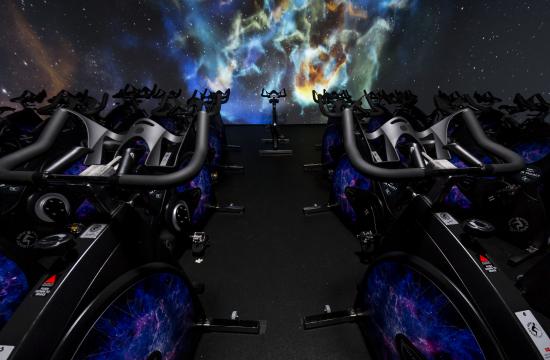
I just saw this announcement about a Immersive Fitness Studio that is opening at the 24 Hour Fitness in Santa Monica, CA. It included the picture at the top of this post – which I think was taken at a different location as the Indoor Cycles pictured are BodyBikes, not the NXT's cited in the article.
Les Mills is teaming up with 24 Hour Fitness to open the world’s first permanent Immersive Fitness studio in Los Angeles.
Located within the 24 Hour Fitness Super Sport club in Santa Monica at 2929 31st Street, the studio is the first permanent location globally and will open to the public today, Nov. 22.
The newly installed Spinner NXT Black Belt Bikes will prove their workhorse abilities as the immersive cycling experience is launched.
Les Mills will open additional Immersive Fitness studios in 2015 in partnership with other global fitness leaders including CMG Sports (France) and Pure Fitness (Hong Kong), with other locations to be announced in the coming weeks.
Immersive Fitness adds a rich visual layer to music and group exercise.
Cinema quality video content is projected onto the screen of a purpose-built studio, while an instructor cues exercise moves that synchronise perfectly with music and graphics.
Riders in a cycle class get the sensation of ascending steep glaciers, sprinting around digital velodromes or cruising into a peaceful sunset.
The immersive experience creates a heightened sense of anticipation and reward for participants that leads to increased motivation and energy.
This sounds like a fancy version of Team ICG's MyRide+ system. My question is why the Black Belt* version of the Spinner® NXTs and not the Blade Ion's? Why no power? I'll be digging into that more and if I can get some answers I'll let you know.
*This reminded me that I never shared my thoughts on the belt version of the NXT – not much to say really. I'm not hearing of any major Big Box or small boutique studio who's purchasing any non-power indoor cycle, except for a few Schwinn AC's. I also don't agree with their choice of a high tension flat belt, which I feel is inferior to the Gates toothed belt offered on the FreeMotion S11.9 and Schwinn AC.
As promised in this post, here's my interview with fitness equipment leasing expert Joe Schmitz from F.I.T. Leasing. During the interview Joe provides answers to many of the questions you might have if you're planning a new Indoor Cycling studio, or are considering an upgrade to any of the new Indoor Cycles with power; FreeMotion S11.9, Keiser M3i, Schwinn AC Performance or Star Trac Spinner® Blade Ion.
It was interesting to me that, depending on your financial situation & credit history, I might be possible to include some of the other component parts of your business (AV system, furniture, specialty technology, etc…) into your equipment lease.
Joe has provided some additional information that you can use for business planning and/or preparing to qualify for a lease.
Listen to our discussion below or contact us for more information on equipment leasing.
Here are a few questions about leasing we discuss during the interview:
When does leasing make sense for a new studio — or an existing studio looking to upgrade to new equipment?
When doesn’t it?
Should I lease my indoor cycles directly from the manufacturer?
What other costs can be included, besides new Indoor Cycles?
What is the approval process?
Is it more difficult to get approved for a lease vs. a bank or SBA loan?
What documentation will you need?
Is there anything you want to do, or prepare for, in advance of needing your lease funds?
How long is a typical lease?
What happens at the end of the lease?
Explain any tax benefits of leasing vs. conventional financing or paying cash.
You can use this contact form to submit your questions at any time.