John Manrique from Revolutions Cycling Studio in Jupiter, Florida joins me to explain how his riders have pedaled 200,000 miles. Along the way John and his wife Michelle have really forged a connection with their riders.
Since opening in December 2012, the folks at Revolutions Cycling Studio have been doing one thing: pedaling. A whole lot. As the only studio in Jupiter that exclusively offers indoor cycling (aka “spinning”) classes, Revolutions' founders Michelle and John Manrique estimate that the more than 11,000 individual rides completed over the last eighteen months will reach the 200,000 mile mark in May.
“We started Revolutions based on our shared passion for indoor cycling,” said Michelle, who along with husband John, moved to Jupiter in 2001. “Since there wasn't a ‘cycling only' place in town, we saw an opportunity to open a studio for people like us who like to ride hard and get a great workout in a fun, family environment.”
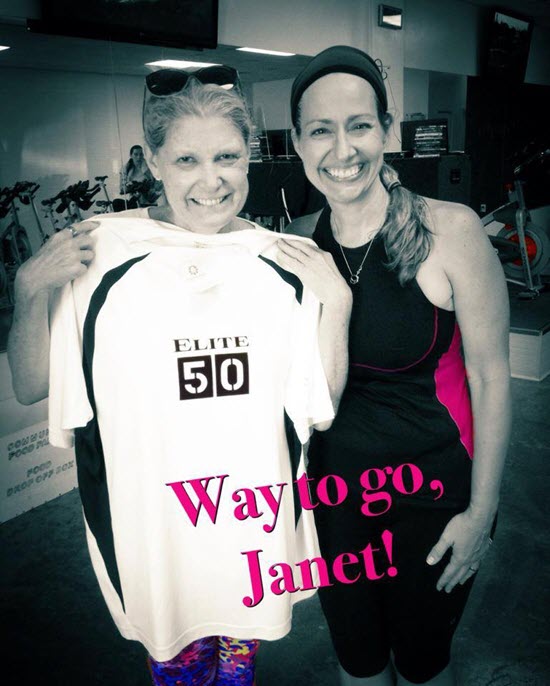
During our interview, John offers a number of great ideas you can implement to reward your riders – such as the special t-shirts shown above.
For those of you who aren't an “Excel Spreadsheet Geek” like John Manrique, there are simple options for collecting and disseminating rider data collected from these indoor cycles with power; Keiser M3i, FreeMotion S11.9, Schwinn AC and Spinner Blade Ions.
Performance IQ used in conjunction with Station/Bike Reservations and My Stats will connect riders with their data and send out an email at the conclusion of class automatically. Amy's an expert on how these systems intigrate and would love to show you a demo – feel free to call her 320-685-0183 or amy.macgowan@getliveedit.com
It seems like a logical thing for a studio to offer; a variety of Indoor Cycling class formats, targeted at a wide demographic of people:
Early AM classes that are full of purpose, for all those “A” types who get up before dawn.
Fun/party/social class formats for the mid-morning crowd.
Shortened (express) class for the lunch hour.
High-energy classes in the evening (maybe with a DJ) to attract the youngsters.
Combo/hybrid classes that feature cycling (cardio) and a strength/flexibility component.
Endurance Sports Training.
A beginner's class to recruit new participants who might be a little apprehensive to join your HIIT classes.
It's common to see many of these class formats offered – except the last one, a regularly scheduled beginner's class.
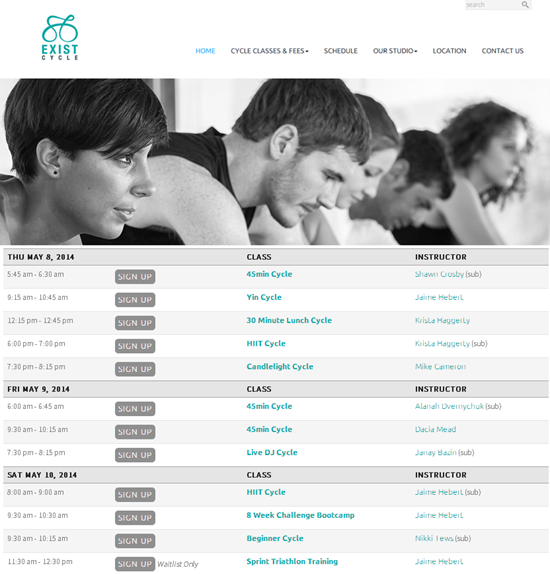
Exist Cycle in Sherwood Park Alberta CA offers them all – and it sounds like they're having great success!
Hi John,
We are finding that many people are intimidated by indoor cycling so the beginner class is a great way to introduce people to the cycling community. If people are new to cycling we always suggest our beginner class first but doesn't take long before they are riding in all our classes. Many clients love our 30 minute cycle and 30 minute HIIT class. It truly is a full body workout and 30 minutes of cardio.
We have had many success stories with a lot of returning riders and we are always excited to see new people in the studio each week. We are in to our 4th week of a 8 week wellness challenge with 20 clients. One of our instructors is a holistic nutritionist so the challenge includes 2 cycle classes/week, a boot camp class and then weekly meal plans. So far all our challengers are down in weight and inches and many have told us they are starting to feel stronger and healthier in just 3 short weeks.
Love reading your articles and visiting your website for a variety of great information!
Marketers have specific names for people, based on how quickly they purchase new products or embrace new technologies. The people who lined up, days in advance, to buy the first iPhones are described as innovators. Those of us who waited a few weeks for our new phone are early adopters. The few holdouts still using a rotary dial phone fall into the laggards category.
It maybe a “guy” thing, but I love new technology and feel I'm a bit of an innovator. I'm very comfortable experimenting with new software, especially if it includes a promise to improve my fitness or help me deliver a better class. For example; the second I saw Spotify I knew I needed to learn how it worked – both for myself, and then be able to help motivate the thousands of Instructors who visit here use it as well.
When it comes to Social Media, I hate to admit, I haven't been very innovative. Closer to a laggard. I've been privately wishing that FaceBook would fade away. You see, ICI/PRO has always been about others. My response to questions; “so, what do you do John?” has always been; “I have a platform to promote smart, talented and passionate people in our industry”.
So after multiple promptings to “get more active on FaceBook” and my realization that it isn't going away any time soon – I have finally decided to do just that… get more active on FaceBook and other platforms. Except I realized that I needed some help.
Enter Social Media expert, blogger and Indoor Cycling Instructor – Courtney Messier Lee 🙂
Courtney makes her living helping businesses develop their brands, online, using the various social media platforms. She has graciously offered to help me, starting with the creation of a FaceBook fan page.
Courtney joins me to discuss her plans to enhance my social profile and some of her ideas may help you as well.
You can learn more about Courtney and the services she offers, by following the (you guessed it) links to her profiles below.
UPDATE: Unfortunately we ran into contractual issues that prevent us from having this event this year. We'll keep trying.
ICI/PRO is partnering with ECA World Fitness to co-host a very special Cycling Studio Owner and Instructor education conference near San Francisco, CA over the weekend of November 7th – 9th, 2014.
We've chosen the beautiful campus of the College of San Mateo and their San Mateo Athletic Club as the event location.
How cool is this? I hadn't experienced an Indoor Cycling studio that offered reserved seats before. It had me feeling like a VIP when Amy and I visited CB Cyclebarn, Karen Casler's studio last month.
The website system she uses integrates her Mindbody account with the class rider data collected by Performance IQ. I thought you might like to see the string of conformation and followup emails the system creates automatically.
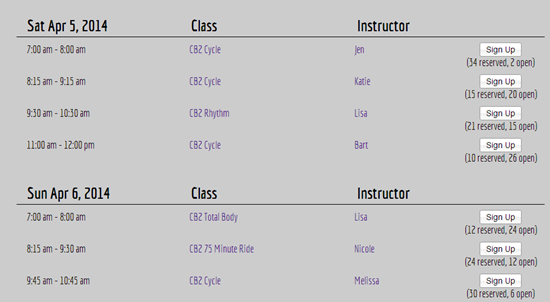
First let's reserve a spot in the class. I didn't think to take a screen shot at the time so I'm showing tomorrow's schedule.
Better hurry and sign up now for Jen's 7 am class! There's only 2 spots left.
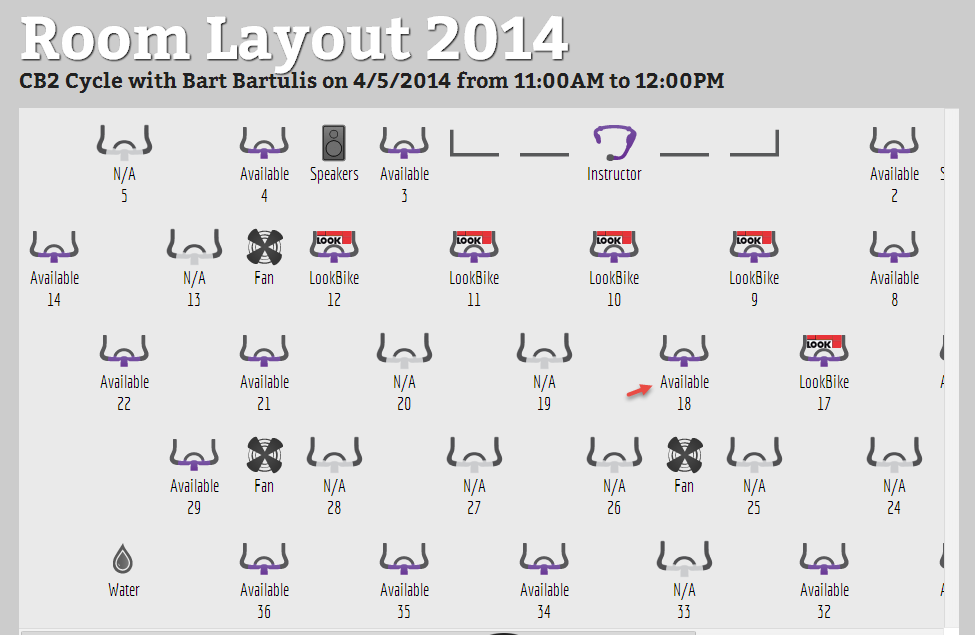
Next you select your bike – just like picking a seat on an airplane or at a concert. The image is for Bart's 11:00 am class. Note how you can pick a bike that has your type of pedals.
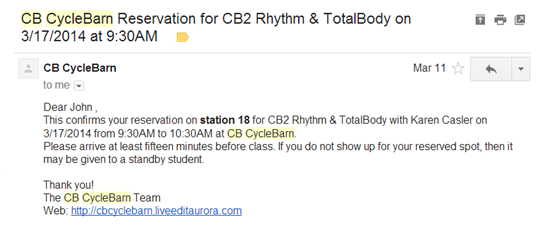
Once you've completed your purchase you receive a conformation email – all this happens automatically.
Having a confirmed seat, in a sold out class, is awesome.
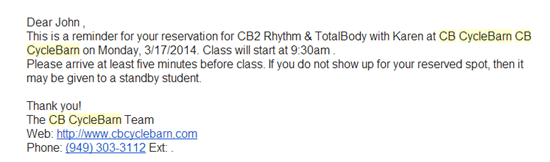
A friendly reminder is appreciated by scatter brains like me.
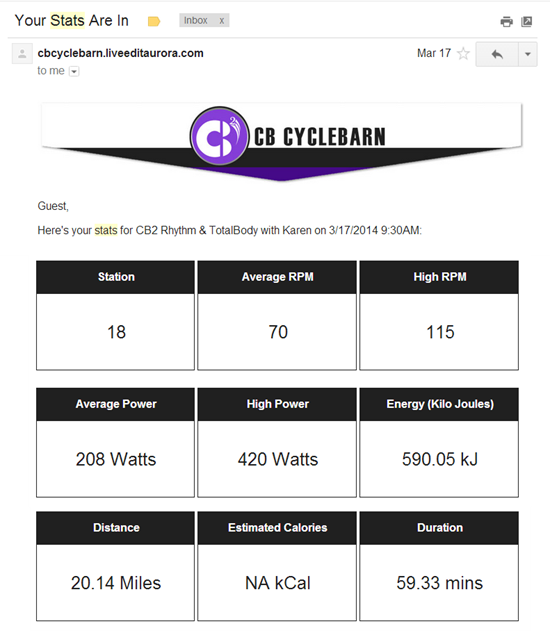
After the class I checked my email and saw all of my performance data. I wasn't wearing a heart rate strap in this class. If I had that data would show as well.
Receiving this information had me wanting to return to see if I could improve my average.
Amy and I were very impressed by this system and feel it will really get your participants excited about training with power on a consistent schedule! The website integration system is offered by LiveEdit and will work with these Indoor Cycles with power; FreeMotion S11.9, Spinner® Blade Ion and the Schwinn AC Performance.
Disclosure – Amy recently joined LiveEdit as a representative, specializing in helping new Indoor Cycling Studios. She would enjoy answering your questions. Amy.Macgowan@getliveedit.com or feel free to call her 320-685-0183
EPA: CO2 Emissions From Fitness Clubs Threaten Public Health and the Environment – New carbon tax will apply to health clubs and fitness studios. Science overwhelmingly shows greenhouse gas concentrations at unprecedented levels due to human physical activity
WASHINGTON 4/1/2014 — After a thorough examination of the scientific evidence and careful consideration of public comments, the U.S. Environmental Protection Agency (EPA) announced today that it will begin regulating greenhouse gas (GHGs) emissions from Health / Fitness Clubs and other strenuous fitness activities that cause humans to release CO2 at levels above normal, resting, breathing rates.
GHGs are the primary driver of climate change, which can lead to hotter, longer heat waves that threaten the health of the sick, poor, elderly and obese.
“When physically active Americans selfishly chose to participate in activities that cause them to exhale an excessive amount of a known pollutant, they threaten the health and welfare of not just other Americans, but inhabitants of the entire planet” said EPA Administrator Linda Q. Jackson. “Key scientists, government officials, concerned citizens and the United States Supreme Court have called for enduring, pragmatic solutions to reduce the physical activities that are causing climate change. This continues our work towards regulating anything that produce GHGs.”
EPA’s final findings respond to the 2007 U.S. Supreme Court decision that GHGs fit within the Clean Air Act definition of air pollutants. The findingsdo not in and of themselves impose any emission reduction requirements but rather allow EPA to finalize the GHG standards proposed earlier this year for the regulation of facilities classified as Area Sources of GHG, primarily carbon dioxide.
A recently released study shows that human physical activity above normal, resting, breathing rates contribute more than 13 percent of total U.S. GHG emissions. EPA’s proposed GHG standards for health and fitness clubs and other fitness activities would reduce GHG emissions by nearly 950 million metric tons each year.
EPA’s endangerment finding covers emissions of key activities shown to produce excessive carbon dioxide — that have been the subject of scrutiny and intense analysis for decades by scientists in the United States and around the world. They are; health club participation, indoor and outdoor cycling, running, swimming and all other forms of human activity at an intensity that increases the rate of breathing.
Scientific consensus shows that as a result of human physical activities, GHG concentrations in the atmosphere are at record high levels. New data shows that the Earth has been warming over the past 100 years, with the steepest increase in warming in recent decades as a direct result of the increase in what was previously thought to be a more healthful lifestyle. The evidence of human-induced climate change goes beyond observed increases in average surface temperatures; it includes melting ice in the Arctic, melting glaciers around the world, increasing ocean temperatures, rising sea levels, acidification of the oceans due to excess carbon dioxide, changing precipitation patterns, and changing patterns of ecosystems and wildlife.
President Obama and Administrator Jackson have publicly stated that they support a legislative solution to the problem of climate change and Congress’ efforts to pass comprehensive climate legislation. However, climate change is threatening public health and welfare, and it is critical that EPA fulfill its obligation to respond to the 2007 U.S. Supreme Court ruling that determined that greenhouse gases fit within the Clean Air Act definition of air pollutants.
EPA issued the proposed findings in April 2013 and held a 60-day public comment period. The agency received more than 380,000 comments, which were carefully reviewed and considered during the development of the final findings.