Image of Dr. Suzuki and her team from suzukilab.com/
Here's a creative exercise for you to try.
Imagine that tomorrow you begin marketing your Indoor Cycling classes differently… Instead of focussing on physical benefits of increased strength, endurance or weight management/loss, what would happen if your marketing was directed at cerebral benefits instead?
Do you feel you could possibly attract a new/unique group of participants? Maybe those people who aren't necessarily interested in physical improvements. Computer types (geeks) come to mind. They are rarely seen in your studio, unless they're there to fix your computer of course 🙂
But what if you were able to show the Geek Squad technician that your special classes could actually improve their troubleshooting, problem solving or coding skills… things he/she might really be interested in improving?
Or how about that advertising firm officing across the street? Do you think they would be interested in a brainstorming class where their entire team could spark some additional creativity?
There's a lot of scientific research that is proving the link between exercise and improvements in the brain in the form of enhanced memory and creativity. I posted a fascinating Ted Talk video presentation last month on the subject and the presenter is my guest for this episode – neuroscientist/group fitness instructor Dr. Wendy Suzuki.
Dr. Wendy A. Suzuki is a Professor of Neural Science and Psychology in the Center for Neural Science at New York University. She received her undergraduate degree in Physiology and Human Anatomy at the University of California, Berkeley in 1987, studying with Prof. Marion C. Diamond, a leader in the field of brain plasticity. She went on to earn her Ph.D. in Neuroscience from U.C. San Diego in 1993 and completed a post-doctoral fellowship at the National Institutes of Health before accepting her faculty position at New York University in 1998.
Listen to this episode below.
Near the end of the interview, Dr. Suzuki describes a clinical trial she running on the effects Indoor Cycling has on cognitive abilities. Participants are riding three time a week at Swerve Fitness in NYC and she says that their study results should be completed by the end of the year.
Here’s some information about sugar and appetite that most people don’t know. Of course, those of you on ICI/PRO may know it if you’ve read my posts.
Anyway, here’s the info.
Endorphins
Sugar triggers beta-endorphin, usually called endorphins. Endorphins inhibit the part of the brain that causes satiety — the feeling that we’ve had enough food and don’t need to eat more. That part of the brain is the VMH.
When we eat sugar, the VMH is blocked by the endorphins that sugar triggers. So we want more food at a given meal. Or we may want to eat again sooner than we normally would.
Endorphins can also change which foods we want, as mentioned in a previous post. They’ll probably make you want more endorphin-triggering foods — those would be sugars or fats.
Either way, sugar is likely to change your food landscape.
Priming
Endorphins from sugar trigger another brain chemical, dopamine — just enough to make us want to eat more sugar. This is probably the best reason not to follow the common advice to eat a little bit of sugar when you crave it. (Terrible advice!)
Some people are more susceptible to this ‘priming’ effect than others. If it affects you, you may find yourself wanting more sugar after you’ve eaten just a little bit.
Withdrawal
People joke about being chocoholics or sugar addicts, but people who are affected by it know it isn’t a joke. If you eat sugar often, you may find that you crave sugar when it’s not around — or when some time has passed since you’ve had any. That could be a sign of withdrawal.
If you’re also feeling a little (or a lot) cranky, it most likely is withdrawal. If so, you’ll probably crave sugar and eat more of it.
Bottom Line
Sugar can impact appetite dramatically. As covered in a previous post, it can also increase fat in our diets. Think of all the sugary foods — such as ice cream or chocolate cake — that contain a lot of fat, along with sugar. Those fats are typically not healthful ones, making a bad nutrition slam even worse.
By the way, alcohol can affect appetite in similar ways, and sometimes with even more impact than sugar. But that’s a different post.
This might be a perfect space for a 25 bike cycling studio – except the HVAC system was designed to supply air for a three person travel agency.
I'm learning that many small/boutique fitness studios are located in spaces designed as offices or small retailers. Businesses with a handful of sedentary people, sitting at a desk. The building's HVAC system isn't typically optimised for all the CO2 and moisture created by a room full of heavy breathing participants = poor air quality, especially at the end of class 🙁
Does this describe your studio? Should we be looking for solutions to improve your studio's air quality, while keeping energy costs to a minimum?
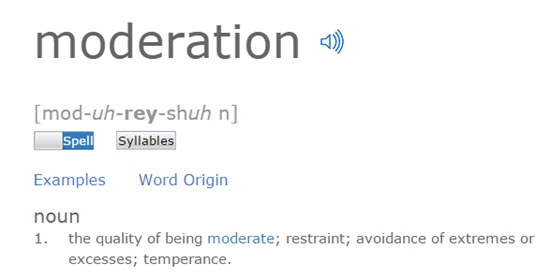
When it comes to food, no doubt you’ve heard, read, or even said something along these lines: Everything’s fine in moderation.
Many famous people have said that they’ve never been successful at achieving moderation.
Professionally, I never recommend moderation in sugar intake.
Instead, I favor this quotation by Saint Augustine: “To many, complete abstinence is easier than perfect moderation.”
Clinical experience has taught me that some people simply can’t achieve moderation around certain foods.
Sugar addiction is real. Encouraging a sugar addict to eat sugar “moderately” makes no sense. It makes as much sense to tell a recovering alcoholic to drink in moderation — or a smoker who’s just quit to smoke in moderation.
In fact, when you’re talking about addiction of any type, moderation makes no sense at all.
Many Of Us Should Abstain From Moderation
In cases of addiction, moderation may be an impossible goal. For some of my clients, a small amount of any addictive substance — alcohol, sugar, whatever — simply leads to more. In addiction literature, the phenomenon is known as “priming.”
When I’ve brought up priming and sugar, self-styled censors have chastened me online. Apparently, researchers have not yet tested such a thing on sugar.
My dissertation study, however, showed priming among women with binge eating disorder who were also sugar-sensitive. Sugar was a primary food trigger for their binges.
Yet lab research is often behind the curve — which seems exactly the opposite of the way things should be. Scientific research happens when a need, a problem, is perceived. It’s my strong hope that researchers will soon realize that we need to acknowledge and start testing priming and sugar.
The research delay isn’t surprising. I’ve been speaking and writing about sugar addiction for almost 25 years — and only now is it becoming mainstream thinking.
Better late than never, of course. A lack of abundant scientific study in the past didn’t make the notion false, though — just ahead of its time. Research existed back then but was limited. Much was done on animals, but not all. Chocolate studies, for example, were always conducted with human participants. But I digress.
The Moderation Myth Makes Clients Feel Crummy
The main reason I dislike the myth of moderation is it makes my sugar-sensitive clients feel as if something’s wrong with them. That bothers me.
When sugar addicts can’t eat certain foods in moderation, no one’s to blame. Certainly not the sugar addicts — it’s a brain chemistry thing.
Brain chem is largely genetic. You got what you got. I’m old enough to recall the public service announcements that used frying eggs to show us “This Is Your Brain On Drugs.”
‘Your Brain On Sugar’ isn’t your fault.
People now agree that sugar is addictive, yet the implications remain a mystery to some. Who cares who says what about moderation? Do what works for you.
If it’s easier for you to abstain completely than to try moderation … then fail … and then feel crummy about yourself, I strongly encourage you to abstain.
My coach, Jim Karanas, used to say that athletic performance triggers the ego. It brings forward conflict, discomfort, anxiety, self-defeating thoughts, and doubts about what’s possible and what’s not.
In athletics, you do what’s necessary. You have the above thoughts without reacting to them — and stay with the event. The athletic objective is to learn to be nonreactive to distractions, including pain.
Giving up sugar can also bring forward discomforts — withdrawal symptoms, cravings — plus the anxiety, doubts, and self-defeating thoughts that may go with them. Like the athletic distractions, none of them is permanent.
You do what’s necessary to eliminate them and stay with the plan.
One difference is that, in athletics, it helps not to derive an identity from your performance. That identity, my coach said, is just ego.
In contrast, I say, what’s good about going through the process of quitting sugar is the sense of identity you develop when you do it. Your identity shifts.
You become The Person Who Doesn’t Eat Sugar, and things change.
– You stop finding sugary foods tempting. They’re Not Food.
– You consciously stop putting junk into your healthy body.
– People stop trying to persuade you to eat what you’d rather avoid.
– People stop giving you gifts of tempting sugary treats.
It’s not that the foods don’t look or smell appetizing. But they don’t bother us because we view them as something we simply don’t eat.
They’re no longer who we are.
Brain Chemistry Puts a Space Around Sugar
Eckhart Tolle, who wrote The Power of Now, talks about putting a space around pain, thoughts and memories — especially negative ones — by staying present in the moment.
Basically, that’s becoming nonreactive.
Once addictive foods — like sugar — have been removed from your diet, the right foods you’ve added along the way can, and will, enhance dopamine and improve your focus.
Meanwhile, serotonin will put a space around what’s happening — and make you less reactive — by literally increasing the time between thought and action.
The non-reactivity holds true whether the trigger is external — seeing chocolate cake, smelling freshly baked cinnamon buns — or internal — having a taste that triggers the desire for lots more.
I talk to my clients about stability, which applies to both brain chemistry and glucose.
When both are stable and even, my clients are able to make decisions about food, instead of reacting to every treat.
They make decisions, instead of succumbing to junk they know won’t do them good, just because they can’t resist or think they have “decision-making fatigue.”
Once my clients are stable, I know they’re on the ‘Zen path’ — as described in my last post — to making clear decisions about food and sugar.
I just became aware of a new Indiegogo campaign for an innovative* method of pedaling a bicycle. Similar in functionality to a KrankCycle, the Caron Bicycle uses independent left/right crankarms that create 6 different pedalling movements.
They have their crankset installed on a conventional IC in this video. Watch and then tell me if you feel these added exercises would improve your class… or is it just a solution in search of a problem that doesn't really exist?
This animated video shows the various muscle activation from the different pedalling techniques.
*I'd be curious to know if Matrix has patents on the KrankCycle that would extend to a leg powered bicycle?
In case you haven't seen the KrankCycle in action:
Caron claims this on their campaign page:
Technology for CARON Bicycle is protected by patents worldwide, including US Pat. No. 7,544,139.
It might be cool to observe power output – especially during one legged work 🙂