I'm still getting asked (and see questions on Facebook) about integrating music MP3's from multiple sources (Soundcloud's the most popular) into a Spotify or Deezer playlist.
We'll use Spotify for this tutorial as Deezer is nearly identical and Spotify is more popular right now. I'm using a PC, but the solution is the same on a MAC if you're having this problem that goes something like this:
Hi John,
I downloaded a Free Music Friday track from Soundcloud (or one of Dennis Mellon's fabulous 3 song mixes) and want to include it in a Spotify playlist. I'm pretty sure I downloaded the track and it opened and played in iTunes – but I can't find it anywhere in Spotify.
Can you help me?
Frustrated Instructor 🙁
Hidden settings in iTunes and Spotify and your Internet Browser
We'll actually they're not hidden, just hard to find without knowing where to look. There are two places that will decide what local files (music that you have in iTunes) will be displayed in Spotify's Local File Library.
iTunes settings
When you download a MP3 from any website, it will typically end up in your Download Folder. I say typically because the default location on every browser (Chrome, FireFox, Safari – please don't use IE) is your computer's Download Folder. If your downloaded MP3s don't end up in your Download Folder you can change the location in the browser's settings. Leave a comment below if you need help.
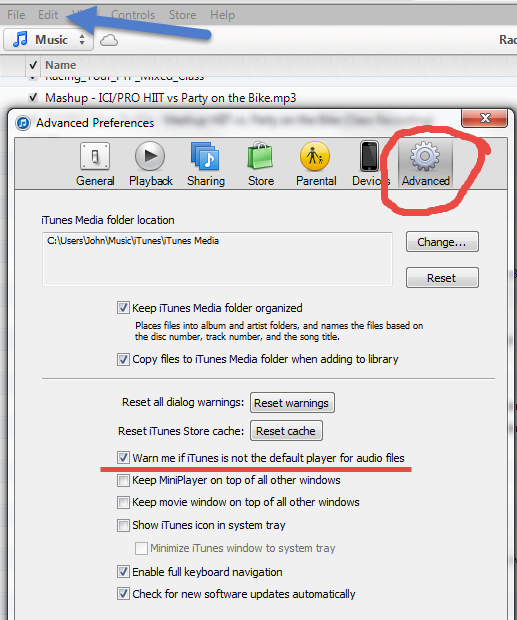
To get your new remix into iTunes you just need to click the file and it should open in iTunes. If it doesn't open iTunes and go to Edit > Preferences > Advanced and tic the box shown below and then close the Edit window. Click another MP3 in your Download Folder and you'll get a message, something like; iTunes is not the default music player… would you like it to be? You do. Select yes and that part's done.
Now just because a MP3 opens and plays in iTunes, doesn't mean it's actually in iTunes.
Go back to the Advanced settings in iTunes. Tic the two boxes shown below so when you open a track iTunes will make a copy and add it to your My iTunes Music Folder. That will solve 99% of the problems I hear 🙂
Spotify settings
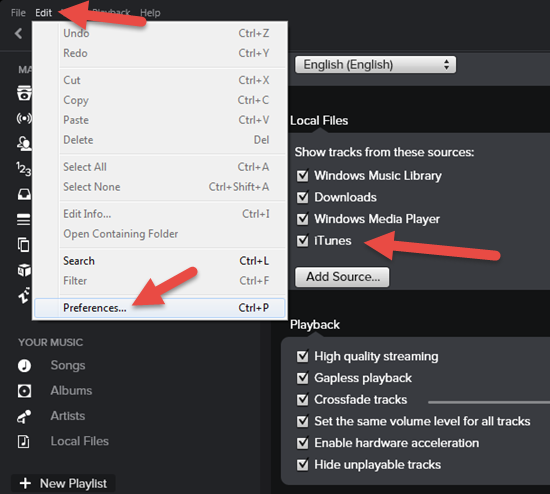
The defaults settings in Spotify should be set correctly. So once you've downloaded a track, clicked it and it opened in iTunes, it will show as a local file in Spotify. Here's where you check if it doesn't.
Yes I know Spotify is supposed to also include files from your Download Folder – I'm not sure it works for everyone. So Tic everything you see here.
Did this solve a big problem for you?Here's how you can reciprocate value with me and have access to dozens of similar tricks combined with over 1300 articles and 60+ class profiles.
Yoga can be a great addition to any endurance athlete’s training plan and overall health. It can improve your strength and balance, as well as give you a heightened sense of how your body moves. But like all aspects of fitness, it’s not without risks.
The Benefits of Yoga for Endurance Sports
Yoga helps develop strength through controlled movements and poses. In any sport, consistent movement is vital for efficiency and injury prevention. Consider running – the connection of your feet to the ground, where you toe-off, your body symmetry in dynamic movement, and your posture are all dependent on good core strength. Boat pose, downward facing dog, locust pose and plank are examples of poses that build strength and stability.
Yoga also develops balance. Cycling (cornering, descending, and out-of-the-saddle climbing), swimming (holding streamlined body alignment during rotation), and running (maintaining a limber, dynamic gait through technical cross-country courses) can all benefit from better balance. Tree pose, warrior, and side plank are good examples of poses that develop balance.
As you move through various poses, remember to breathe into the stretches and be mindful of how your body is feeling as you work through any discomfort. This will give you context in racing and training and help you hone in on imbalances. Simply slowing down your day and moving through a flow session with intent and focus can also be incredibly relaxing.
The Risks of Yoga for Endurance Athletes
If you are in the thick of training for a 100-mile century ride, an hour of strength-intensive vinyasa yoga at the end of the day may take away more than it provides. Even practicing yoga on your recovery day can be too much exercise. To continue yoga without adding fatigue during heavy training blocks, choose a beginner class, or opt for yin yoga, which is more regenerative.
Injury can be a concern in yoga as well. Athletes tend to be physically competitive in nature, which isn’t always ideal for deep stretching. To avoid going down with a yoga injury, try to err on the side of under-doing your poses. Remember, there’s no prize awarded at the end of class to the downward dog champion! Instruction quality is also important. An experienced instructor can help you avoid excessive soreness, a strained muscle, or joint injury.
It’s also a good idea to approach bikram (hot) yoga with caution. It’s a style of yoga enjoyed by many, and can help with heat adaptation for hot climate races. On the flip side though, it can also contribute to fatigue and dehydration. Additionally, the heat opens your joints and muscles for further range of motion, which may increase the risk of a strain or a tear.
Whether you are a yoga novice or a veteran returning after a break, adaptation is key. Yoga should be supplementary to your training, not deleterious. Be consistent and ease into it gradually over a span of three to four weeks. Learning new skills can benefit your main sport as well as overall long-term health and happiness. Be calm, consistent, and patient, and yoga will be a great supplement to your endurance training protocol.
By Lance Watson, LifeSport head coach, has trained a number of Ironman, Olympic and age-group Champions over the past 30 years. He enjoys coaching athletes of all levels. Contact Lance to tackle your first IRONMAN or to perform at a higher level. For more training tips, visit LifeSport Coaching on Facebook or on Twitter at #LifeSportCoach.
How cool would it be if your insurance company paid for indoor cycling classes?
A national policy of Prescriptive Exercise would be the holy grail* for small studio owners.
Imagine; A new client walks in with her doctor specified exercise regimen for you to “fill”, just like at a pharmacy. As an approved provider, you and your studio would provide the required exercise and then bill the clients insurance company… and not at your normal class rate – at a much higher rate in recognition of your fitness expertise.
A fantasy? Nope**, not if you're near The Wellness Institute in Winnipeg Canada. Doctors there are actually writing detailed prescriptions for exercise. How cool is that?
Doctors at a unique medical facility in Winnipeg are starting to write some unusual prescriptions.
“A lap a day keeps the doctor away” is one of the mottos at the Seven Oaks Wellness Institute (SOWI), a fitness facility attached to the Seven Oaks General Hospital on Leila Avenue, where doctors have started prescribing exercise instead of pills.
Dr. Kevin Saunders is one of the founders of the SOWI and the medical director. He said exercise is an effective treatment for all kinds of illnesses, including hypertension, Type 2 diabetes, high cholesterol and even some forms of cancer.
The facility offers clients a more holistic approach to fitness, helping people from all walks of life to understand what kinds of exercise they should be doing, and what they need to avoid if it puts their health in jeopardy.
You'll note that what Dr. Sanders is targeting with this program are Special Populations of people who would benefit from physical activity. I'm guessing you'd have a little trouble getting a prescription for a USAT Triathlon coach to get you ready for your next Ironman 🙂
What has me most excited here is the potential for prescriptive exercise for people suffering from Parkinson's Disease. It's been shown repeatedly that people of all ages with PD respond well to Indoor Cycling classes. Especially classes that are designed and taught by a Parkinson's Cycling Coach. Indoor Cycling studios already have the necessary tools to conduct this hugely beneficial classes. They're best held around 10:30 – 11:30 in the morning, which is normally a time without a scheduled class
I did some research and found an excellent article here at emedicine.medscape.com that explains in detail what Perscriptive Exercise is (different from physical rehab) and includes a number of areas where exercise is typically prescribed by a physiian.
Background
Exercise prescription commonly refers to the specific plan of fitness-related activities that are designed for a specified purpose, which is often developed by a fitness or rehabilitation specialist for the client or patient. Due to the specific and unique needs and interests of the client/patient, the goal of exercise prescription should be successful integration of exercise principles and behavioral techniques that motivates the participant to be compliant, thus achieving their goals.[1, 2, 3, 4, 5, 6, 7]
Components of exercise prescription
An exercise prescription generally includes the following specific recommendations:
Type of exercise or activity (eg, walking, swimming, cycling)
Specific workloads (eg, watts, walking speed)
Duration and frequency of the activity or exercise session
Intensity guidelines — Target heart rate (THR) range and estimated rate of perceived exertion (RPE)
Precautions regarding certain orthopedic (or other) concerns or related comments
Note that a properly structured, Power based Indoor Cycling class would easily include all of the stated components.
Consider this simple prescription:
Type of exercise or activity – Indoor Cycling class.
Specific workloads – Below, @ and Above riders observed 4 minute Best Effort PTP Watts or FTP if known
Duration and frequency of the activity or exercise session – 3 x 60 min classes weekly
Intensity guidelines — each 60 class to include: 5 x 5 min intervals @ PTP, 3 x 1 min intervals Above PTP, that remainder of class Below PTP and Above VT1 (staying aerobic) + adequate recovery after each @/Above interval.
Precautions – None
What you'd have is essentially an endurance training program, written by an MD.
Taking this further. If you were to incorporate the rider's performance data capture, from a Display Training system like Performance IQ or Spivi, your doctor could review your progress = make informed recommendations for future exercise prescriptions. Wouldn't that be awesome?
If you can offer any additional information about prescriptive exercise, I'd love to hear from you!
*Yes, I'm aware that many insurance programs offer a discount/rebate for club dues – if you attend a speciaf number of days a month. This is very different.
** I don't know the specifics of Canada's reimbursement system, but I'm looking into it. I have asked for a representative join me on the Podcast to discuss all of this.
I love discovering smart, talented people who are passionate about Indoor Cycling and Lena Hershey is someone I feel you should get to know. Lena is a brand new (she started in May) Spinning® Instructor at the Carlisle Family YMCA in Carlisle, PA.
Lena's journey to become a Spinning Instructor began with a pretty large life event – moving from her native Russia to the United States three years ago. While you listen keep in mind that English is her second language 🙂
She describes what happens next at her blog LeanLena.com
My name is Lena. This blog is mostly about my way to my personal transformation — from the body I have been abusing and neglecting for the most of my life, to the body I always wanted to have — fit, strong and beautiful.
I am not there yet, but you can see the progress
I write about my exercise program/routines and my meals, share healthy recipes, health tips, etc. etc.
I have started this journey on an ordinary day in February 2013. I was in the car with my husband and two step-kids, driving home from somewhere when I said: “I will go and work out at the YMCA every day for a month starting today”. Just like that — out of the blue. I can’t even remember why I said that or what prompted that decision. I just said that and once I did, I had to do it. So I did.
Once I was done with one month, I just couldn’t stop. I did adjust my exercise program by now and I am not working out every single day, but I am doing so much more for myself thanks to that decision in February of 2013.
Results — I’ve lost almost 20 pounds (9 kg) and counting, I am 2 sizes down in clothes, and I feel lighter, better, healthier and happier than ever.
In part two we identified how the talkers act the way they do because of; cluelessness, a lack of respect for you and your class or they're challenging your position as the leader.
Much of this could also apply to the texters/bring their own music/do their own thing people.
I defined the three possible reasons WHY people act disrespectfully as:
They don't know they are acting disrespectfully…
They don't care they are acting disrespectfully…
They're disrespecting you on purpose…
Because you've made it here to part three, I'm guessing you'd like to know my ideas on how to solve these problems. But first, a few words of caution.
My recommendations below will be difficult for many Instructors, especially for those of you with a short amount of teaching experience. They require you to be the Leader your class expects you to be – not just one of their friends who happens to be on the bike in the front.*
I realise that this will be difficult for many Instructors who would prefer everyone just get along… but they won't > that's why they need you!
These suggestions may conflict with your natural instincts to protect the feelings of others. Attempting to implement these solutions may make you feel uncomfortable. I've heard it expressed dozens of time; I really wish I could get these people to stop disrupting my class… but I don't want to offend anyone 🙁
That's why I broke this up into a series and spent so much time on explaining WHY people are acting the way they do. My hope is that through this process you would already be coming up with these solutions yourself, or at least understand that at times being the leader is hard and not always pleasant.
Your class participants and manager/owner are expecting you to be the leader of your class.
So ICI/PRO Members let's end these Talker problems today!
First – Set your microphone volume level correctly
I can't tell you how many classes I've been in, where I wanted to run up and turn the Instructors mic level up… way up. Your voice must be the most dominant sound in the room!” IDEA recommends a mic level 10 decibels over the music. Your amplified voice should be clearly heard and easily understood, over the music.
Many new Instructors (and some not so new) are not comfortable hearing themselves through an amplified sound system, so they keep their mic level low. Do whatever you need to correct this – today! If you're a manager/owner please offer to audit sound levels for your Instructors > many rooms end up with a cone of silence, shielding the Instructor from accurately hearing their voice/music ballance – ultimately what the class is hearing.
Get help to properly set your voice/music levels.
Your class needs & wants to hear your big strong, confident voice > weak, quiet voices are very easy to talk over and this alone may solve many of your problems.
Second – don't talk over the lyrics
If two people are talking at the same time, which one is the leader?
Neither
You are diminishing who you are as a fitness professional and what you're trying to communicate, by competing with the voices of Bono, Pit Bull, Nicki Manaj, Ellie Goulding or whoever else you're playing. Talking over them forces your riders to have to choose between listening to you or their favorite singer. You'll lose with some and they'll potentially tune you out. Others, who can't understand what you are saying, just might decide to start a conversation that they can hear – with the person next to them.
Third – keep your cues short and actionable
Ever been at a party where you were stuck talking with “that person” who never seems to run out of words? What do you do? When I'm in that situation, I'll listen respectfully for a few moments and then I'm looking around for someone to rescue me.
I'm convinced that Instructors lose control of their classes for the same reason. I've seen it happen. She/he drones on and on to the point where riders just shut them out. Too much talking = you lose people. Once they've lost interest in what you have to say, it's natural to turn and engage with the person next to them. That is until there's a “SQUIRREL” moment that catches their attention.
Are you with me so far?
Excelent. Suggest trying these in order and you'll soon be teaching to the quiet, focused class you dream of having. …
#4 Solving – They don't know they are acting disrespectfully…
This one should cut out 60% or more of the talking > if you do it consistently in every class. You must firmly and clearly explaining that conversations are not allowed after the initial warmup.
Say it with me with a bib smile: We run our studio like a movie theater. Now that our class has started, talking and other distractions should stop. Please, no further conversations until after class has ended.
PERIOD… END OF SENTENCE!
I know this sounds really simple and it is. Your class isn't (and can't be) a democracy where everyone gets a voice. It should be a dictatorship with only one voice – YOURS!
If you don't set clear expectations, how can you expect people to behave properly? You can't. If you have a talker problem (and I listened to a recording your class) I'll bet you don't say anything, or at best you mumble something unintelligible that no one listens to.
If after your warm up you still have talkers, I want you to clearly tell them how it makes you feel. Remember, this group of talkers just doesn't realize the negative affect their talking has on you and the class. I've personally found this to very effective. A man, talking about his feelings? I better listen.
Turn the music way down (almost off) and say along with me: Can I get your help here? Pause long enough to get the attention of the talkers. Look directly at the talkers and say; It's really hard for me to teach this class when when I'm competing with the two of you talking. Can you understand how this can be difficult for me?
The temptation is to address the whole class (there's that fear of offending someone) rather than communicate directly toward the talkers. Is that fair to the rest of the class? No. Demonstrate your leadership here by confidently addressing the actual people who are causing the problem.
For the next two (#5 and #6) you'll need the full support of your owner or manager because both of these could get ugly**. Which means you should have already discussed this problem with them and they agreed that the issue needs to be corrected.
#5 Solving – They don't care they are acting disrespectfully…
Members who feel entitled and don't care might not respect you, but they will care if you shame them (just a little) in front of other members. I used this method a few weeks ago at a class I subbed. The aftermath was overheard by another member who's email to me is part of this post; It’s a good thing I don’t teach in New Jersey .
After making specific requests for people to stay quiet and focus on the ride, I turned down the music – which makes my voice seem even louder – and I pointed directly at the people located around the two talkers. I asked them; are you all OK with those two talking? This resulted in a bunch of frowning faces vigorously shaking side-to-side. NO! Then sitting up, with both hands extended, palms forward, I made a meek, squinty face and said; I'm sorry, but they don't want you talking during class. And then got right back to my cuing as if nothing ever happened.
Both women looked at each other with stunned looks on their faces and we enjoyed complete silence for the rest of class. I do hope the regular Instructor will carry this policy forward > so I don't have to repeat this exercise again.
Why does this work, when making general statements to the whole class doesn't? The first is probably obvious; no one likes being shamed in front of their peers. These rich members might not respect you, but they do care about the opinions of those riding around them.
The second reason this works is that you are supporting all the non-talkers who are too polite to say something. Don't be surprised if you are thanked multiple times after you give them the chance to show their disgust for the Chatty Cathys who are disrupting your class.
#6 Solving – They're disrespecting you on purpose…
When nothing else works, then you're left with two choices and neither is easy:
Confront them directly and they stay
Confront them directly, they leave and never come back
You and your manager need to be OK with either result.
You've probably figure out that I have a very low tolerance for nonsense or disruptions in my classes. As a result my participants are all very well behaved 🙂 I've learned that people who are challenging your authority need to be confronted quickly and directly. The longer you tolerate their negative behavior, the harder it will ultimately be to address this successfully.
In my entire career, I've only had to ask two people to leave the room – they were together and it wasn't even my class. If you can believe it, this couple had removed their seatposts in the middle of a class I was attending. There were two loud BANGs as the aluminum posts hit the floor, scaring everyone. I saw that the Instructor had frozen in place, unable to comprehend what had happened. I hopped off and in a very loud voice I said: YOU BOTH NEED TO LEAVE NOW! And I stood there in front of them until they did. As you can imagine, there were a few angry phone calls to our GM. Because my GFDH was very understanding after talking with the Instructor, she backed me up and nothing became of it.
If I remember right, another two I asked on separate occasions not to come back. None of these confrontations were pleasant and part of me is sad that it got to the point where I would need to exclude someone from my classes.
In both instances I had decided during the class I would confront the person privately as soon as possible after the class.
Start with a question
Do you realise how disruptive it is when you; talk/criticise me/do your own thing/etc…?You've established the specific behavior you don't want in your class. My experience is they will get defensive at this point > be ready for “I've been a member here for 20 years!” but don't let it deflect where you're going.
You are welcome in this class, but not if you continue to; talk/criticise me/do your own thing/etc… If you come again and continue to; talk/criticise me/do your own thing/etc… I will ask you to leave immediately.
Is that clear? To confirm what you are expecting. And then quickly turn and walk away. You don't want to get into a debate here. Just set your clear boundary and leave.
Then I would document the exchange in an email to your GFDH/owner ASAP – so they aren't blindsided by an angry phone call. I would ask the GFDH/owner to contact the member and reinforce the requirements for her/his attending your class in the future.
My experience is that you'll never see the person in your class again. If they do (and behave) it's all good.
What if they return and continue to disrupt your class? You've done everything you can. Now it's time for your owner/manager to step in – so no I wouldn't publicly confront them… unless you feel it would be appropriate.
I truly hope this will help and I'd love to hear what happens in your quest for a quiet & focused class!
*I'm not suggesting you aren't supposed to be friendly with your class. Just as parents need to be Parents to their children and not their children's friend – Instructors need to be Leaders in the studio.
**There are some who dismiss what I'm writing here as overly dramatic and hyperbolic. They obviously have never had a regularly scheduled class, at a Big Box club, in an affluent part of town.
ICI/PRO member Joey, a Cycling Fusion Master Instructor and routine contributor to The Weekly Ride on ICI/PRO, delivers a ride. THIS IS THE COMBINED FILE THAT INCLUDES THE MUSIC AND THE VOICE. IT IS NOT AVAILABLE ON ITUNES.
This ride is from Joey!! – “This ride is designed as a decreasing cadence endurance ride with three repeats. The goal is to work through the various levels from primarily cardio work (cadences 90+) through muscular endurance work (cadences 70-89) and finish up with strength work (cadences 69 or less) to produce complete fatigue in the rider's legs by starting with the slow twitch fibers and progressing through the fast twitch fibers for total exhaustion.” Joey




 Yoga can be a great addition to any endurance athlete’s training plan and overall health. It can improve your strength and balance, as well as give you a heightened sense of how your body moves. But like all aspects of fitness, it’s not without risks.








 ICI/PRO member Joey, a Cycling Fusion Master Instructor and routine contributor to The Weekly Ride on ICI/PRO, delivers a ride. THIS IS THE COMBINED FILE THAT INCLUDES THE MUSIC AND THE VOICE. IT IS NOT AVAILABLE ON ITUNES.