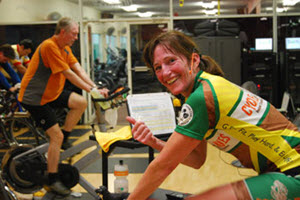
FREE ICI/PRO PODCAST: What an exciting day, this is our second ride recording. ICI/PRO member Zack, a Cycling Fusion Master Instructor and routine contributor to The Weekly Ride, delivers a ride.
“I am very excited to be releasing an audio version with my ride this week. You get to really feel how i intended the song to be felt then. Notice the shorter than usual notes this week to really make you listen to the delivery. As always my rides can suit all riders and ill be sure to highlight that verbally. So listen up and enjoy!” Zack
The Cycle Moles camps are designed as 8-week Training Camps that are a performance enhancing, progressive training program. They are geared toward cyclists, but part of the beauty of the programs is that you do not have to be a competitive cyclist to reap the benefits. The training is periodized and designed to progress the riders through their development. This is the next best thing to having a personal coach.
The program has two levels: Level 1: Appropriate for those who have a base level of aerobic fitness. You’ll learn secrets that will change the way you ride to make you more efficient and powerful both indoors and outside. Level 1 training sessions are 60 minutes and include a coached ride plus stretching.
Level 2: for the seasoned cyclist, triathlete, endurance event enthusiast or individual with a strong aerobic base who wants to improve cycling performance. We heat up the intensity of the rides throughout the camp so that you’ll end with a much stronger level of fitness and improvements in your pedal stroke and power. Level 2 training sessions are 90 minutes and include a 75 minute coached ride plus 15 minutes for the Core 100 and stretching.
Below is the Foundation Ride information that Robin Speaks about in the episode. Take your time and look at this, it is amazing information. The jpeg files below are linked to the full PDF files.
ICI/PRO member Joey, a Cycling Fusion Master Instructor and routine contributor to The Weekly Ride on ICI/PRO, delivers a ride.
What an exciting day, this is our first ride recording. We will certainly get better at the audio, but you should still find this enjoyable. Take a few moments to listen to my ride. The instructions for the audio files are below.
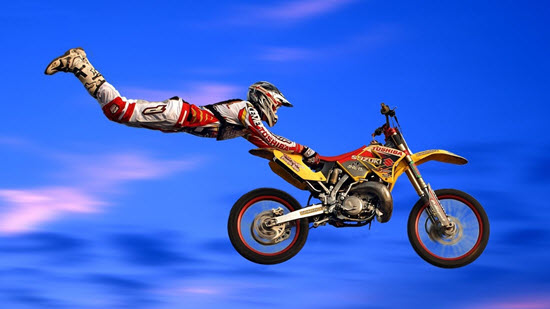
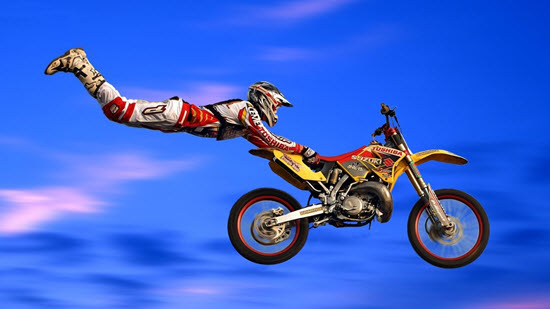
No stunt is too dangerous for extreme motocross competitions.
What caused the SoulCycle phenomenon? Why are their riders so passionate, loyal and willing to spend $34 dollars a class, when clubs and studios had been offering Indoor Cycling classes for 10 or more years – long before SoulCycle's launch in 2007? The research done (and reported here) by future studio owner Callie Bowling finds Cycling Studios that are offering class formats similar SoulCycle's appear to be doing well, but studio startups following traditional / cycling specific formats are struggling. Sadly many have already closed. Why?
One plausible explanation is that for a long time now, Indoor Cycling has been too focused on the negatives, “don't do this [contraindicated] … and don't do that [contraindicated]” while at the same time asserting rules and restrictions on the sport, [if you don't do it outside…]. Now I get that the intent here has been to try and ensure our rider's safety, butcould all of these rules/limitations/contraindications be causing unintended consequences?
My theory
So let me throw out a possible theory for you to consider. NOTE: my intent here at ICI/PRO is never to tell you what to think… you're too smart for that. Rather, my hope is that you thoughtfully consider what's written and come to your own conclusions.
Is it possible that people are turning to SoulCycle classes, for reasons similar to the rise in popularity of Extreme Sports?
Growing up in the late 60's and 70's there were no “Extreme Sports” – although I should probably be dead based on how much danger I was exposed to daily. That is, I enjoyed a lot of freedom as a kid – if you're of a similar age, I'll bet this was the same for you. We spent summer days in the suburbs pretty much unsupervised. Neither my mom, summer sitter, or my neighborhood friend's moms, knew where we were most of the day. We did pretty much whatever we wanted and created our own play. We got everyone together for pickup games of all types daily. Yes we got in trouble on occasion. Yes we got hurt a few times, doing dumb things like falling out of trees we shouldn't have climbed, crashing our mini-bikes without wearing a helmet, etc. We survived. Sure we had youth sports (little league baseball and football) but there was very little parental involvement. I rode my bike to practices/games and, with the exception of my grandmother who seemed to attend every game, my parents were rarely involved in my play while I was growing up.
Everything was different for my two daughters and kids across America, growing up in the 1990's. Amy and I parented like every other parent our age. We knew where our kids were pretty much every minute of the day. “Play time” was often initiated, structured and supervised by us. Why? Because we wanted to ensure our kids safety, based on concerns that I now see were really overblown.
Organised youth sports (soccer and later softball) started at age 5. Games and practices were religiously attended by both parents. I coached both my girls until they were teenagers. As a youth sports coach, I had first hand knowledge (very intense phone calls and on-field conversations) of how incredibly involved and controlling some parents were in their daughters lives.
Thankfully, Amy and I recognised the negative impact our actions were/or could have on our girls and we backed way off. For many who didn't, all of that parental supervision and control didn't end well. Multiple friends of my daughters quit sports completely, having been burnt out by excessive amounts of structured practice. These kids just wanted to play and have fun. But their parents never gave them the chance.
What should have been enjoyable, playtime activities with friends, became joyless, purposeful, objective driven work. And a lot of kids grew to hated it.
The problem isn't limited to moms and dads. Schools, for a multitude of reasons*, have imposed restrictions and limitations on “play time” during recess to the point where it's hard to believe you actually could have fun. Don't believe me? Try teaching your five year old to follow all these playground rules I found for an elementary school in California. After reading through the very detailed list of playground rules, I'm thinking I would give up and just instruct my child to sit quietly on his hands 🙁 Here's how the list of rules begins:
Playground Rules
Play Structure
Play with SAFETY in mind at all times. Students are always to walk in the playground equipment area. Those running will be removed from the area. No tag games are allowed in the playground area.
Swings: * Students sit on swings facing the field area
* Students can swing to a count of 50
(1 swing consists of a forward and backward motion)
* Students wait behind the green pole to take turns on the swing
* Students should never be allowed to jump over the swing seats, twist swings, or
stand on swings
* Students must swing independently. No pushing from a friend!
Enter Extreme Sports
It no secrete that youth have a tendency to rebel against authority. Sociologists have figured out that many young adults are acting out their rebellion at the parental and societal intrusion on their play, by participating in Extreme Sports. Now, instead of climbing trees, doing an oly-under while pushing your friend on a swing and occasionally sneaking out at night as kids, we have people jumping off buildings and doing flips with motocross bikes 🙂
I did some research and I found a book that you can read at this link; The Sociology of Sports: An Introduction. The author makes a compelling argument > Extreme Sports are in fact a response to the excessive structure imposed on children's play.
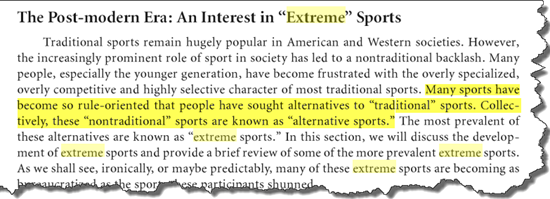
Excerpt from The Sociology of Sports: An Introduction – page 53
Many sports have become so rule-oriented that people have sought alternatives to “traditional” sports.
So, are people flocking to SoulCycle because it's the alternative to rule intensive Indoor Cycling programs? I believe in part they are. After taking a few SoulCycle classes last fall, I wrote a series of reviews that you can find here, here and here > opens in new tabs. I came away thinking that part of the appeal of SoulCycle is that the class is very challenging physically – and I don't mean just cardiovascularly…
Is there purpose to all of these extraneous movements?
Critics of SoulCycle (and similar) classes point to how non-cycling specific movements; jumps, push ups/rhythm presses, “tap-backs”, figure eights, etc… have no proven training value and/or diminish the potential training value of riding an Indoor Cycle… like an Outdoor Cyclist would. For those reasons, along with perceptions the some of these movements may be potentially dangerous, we’re told we should not include these movements in our classes as they’re “Contraindicated”.
Based on what I saw at SoulCycle (and other similar classes I’ve taken) my feeling is that critics are completely missing the point. IMO these movements are a critical part to the appeal of these classes. It is a thing of beauty, watching a room full of people exactly on the beat and rising and falling in unison. I’ve heard this described as “tribal” behaviour, similar to fans doing the ‘wave’ at a sporting event. It’s a very powerful way to connect a group of people together. And at the same time, these jumps are very challenging to perform correctly — which I feel is another reason for the success of SoulCycle that I explained in this post.
In case you're wondering, what started my thought process here was a provocative post from CB Cycle Barn's Owner Karen Casler. She made a statement, by way of the below image, in this post at the Indoor Cycling Instructors Facebook group. You might be interested in reading the 100+ comments, including mine near the end where this theory first popped into my head.
Are you an independent thinker when it comes to conducting a fun, effective, entertaining and motivating Indoor Cycling class? If so please consider joining us here as an ICI/PRO memberwhereeveryone is welcome — no matter where, our how, you choose to teach!
*Yes, I agree that there are a lot of legal liability issues that drive institutional decisions. It's just that I've talked to too many school administrators, who's personal interest in “protecting the children” seemed more important than whether or not the kids will actually have any fun.
Social Media has grown to become the primary method of marketing for Indoor Cycling Studios. Which makes sense. Many of your prospective customers are active on Facebook, Twitter and Instagram – and you can't beat the cost. All it takes is posting a few pretty pictures or clever sayings and SHAZAM! you get a bunch more loyal customers… right?
OK, it's really not that easy. I talk with studio owners every week who feel completely lost, with no clear strategy about how they should be using Social Media.
One common question I get is; “how can I know if my efforts at attracting, engaging and then converting followers are actually working?”
Instructor Cassie Piasecki is what I would describe as a Social Media Expert. She's responsible for all of the social promotions for Grit Cycle – a year old studio in Costa Mesa. CA that's crushing it. Part of their success, I'm guessing, comes from Cassie's obsession with everything social.
You can check out and then steal many of Cassie's ideas by following her blog | Facebook | Grit's Facebook That picture of Cassie is a fabulous idea all by itself – from Cassie's Instructor profile. Notice how it communicates some of her personality and personal interests? Check out all the other Grit Instructor profiles here.
I was excited to record this episode of the podcast with Cassie and share it with you.
[wlm_private ‘PRO-Platinum|PRO-Monthly|PRO-Gratis|PRO-Seasonal|Platinum-trial|Monthly-trial|PRO-Military|Schwinn-Instructor|PRO-Visitor|PRO-Studio|28 Day Challenge'] Enjoy!
Are these interviews helpful to you? Please let me know what else you'd like to learn by posting a comment below[/wlm_private]
I coach a four month long winter training camp that offers 14 indoor cycles and 6 bicycle trainers. This allows participants to bring their own bikes, mount them on the trainers and ride alongside the stationary bikes. Everyone gets a fantastic experience with this mix. But there are a few things to know about mixing trainers and spinners.
Why offer Road Bike Trainers? Having bike trainers as part of your program will expand your market, increase your class capacity with a small budget, and give new interest and challenge for instructors and riders alike.
There are three important things to consider if you are mixing spinners and trainers in the same room: Why BYOBike, Location/Set-Up/Noise, and Cueing for Instruction. 1.) Why BYOBike?
Why would someone want to bring their own bike in the first place? For a number of reasons, using your bike on a trainer is a more realistic experience.
It’s About Fit.
The fit is just better on a “real” bike. Owners of bikes have the seat/handle bar location adjusted, a saddle that they are accustomed to, and crank positions that fit their body. If not, this is a great opportunity to help your riders with a proper bike fit.
Vital to fit is that the spread of the pedals on your own bike is the right width. I find that on some brands of spinners, the pedals are set much wider apart than you’d find on a road bike. This can cause knee pain. We tested the Kaiser M3 bikes at my Club and several riders (me included) experienced knee pain. While I like many features on the Keiser M3, I discovered that the pedals are set 1” wider than the Lemond Revmaster. This can be a make or break in comfort and dissuaded us from purchasing the bikes.
Practice with Changing Gears
While it is not quite like riding outside, riding your own bike on a trainer does give you practice in shifting gears and learning your own gear ratios related to work effort. We’ve had many riders who bring in a new bike and want to try it out to “learn the bike” before taking it outside.
It’s a Harder Ride
On your own bike, there is no help from a weighted flywheel. If you are not pedaling on a bike, the wheel stops going around. That means every pedal stroke counts a little bit more. It is 100% your own effort.
Spinning bikes are a “fixed gear” with a weighted fly wheel that retains energy which means you are getting assistance with every pedal stroke from the momentum of the flywheel, especially at high RPM.
Trainers are 20% the Price
Bicycle trainers are about $350 compared to a spinning bike at $1800 (of course, prices vary wildly for both of these options). If you want to add more bikes to a room, you could add 5 trainers for the price of one Spinning® bike.
I use Kurt Kinetic Fluid trainers because they are fairly indestructible and give a very smooth, quiet ride. All you need is the trainer, a mat, and the front wheel cup. When you mount a bike to a trainer, the rear wheel has now been lifted off the floor by several inches. To avoid feeling like you are riding “downhill” (since the front wheel is lower than the back), you need to raise the front wheel. Most brands of trainers come with a front wheel support. I like the supports that offer a variety of tire sizes and heights — sometimes you may want to even raise the front tire higher than the rear if you are going to focus on a hill climbing workout. This will help to put the rider’s body in a more realistic climbing position.
In a pinch, if I don’t have a front wheel support, I’ll use a riser from a step aerobics bench. They are about the right height to level the bike.
Who you Attract
You want your program to meet the needs of a variety of participants. With trainers, you will attract riders who may otherwise never consider a “spinning” class. The cyclists who want to go through the trouble of bringing their own bikes to a class are usually the ones who are avid outdoor riders. This will expand your market — with a low cost – to a whole new group of cycling enthusiasts. Of course it will be up to you, as an instructor, to make it worth their while. And your spinning participants may see the bikes on trainers and develop the interest to take up biking outdoors. This makes your members much more likely to continue with bike related fitness programs.
2.) Location, Set-up, and Noise
OK, let’s say you are going for the mix of indoor cycles and trainers in you class. What can you expect?
Location
Where, oh where, do you put the BYOBers? Near the entry door.
With years of experimentation on where to physically put them in the room, I have found that it is simplest to group them nearest to the entry door. This makes it easier for navigating the bikes in and out of the room. Plus you want all the trainers in one area. Close proximity makes it easier to give specific cues to the trainers vs. the others. I can look at the group on trainers, give the cue, and know they are staying on track with the rest of the group.
Dirt
Bikes can be dirty. We require that the riders bring clean bikes and clean shoes to class. Plus we always have them wipe down their mats after class. This helps everything stay clean. If you can set up a bike cleaning station outside of your facility, you will win the hearts and admiration of cyclists.
Set-Up
We provide the trainer, on a mat, with a front wheel cup. A bike on a trainer takes up about 30% more length than the foot print of a spinning bike. I usually set the trainer off the back of a typical bike mat with the front wheel cup at the front of the mat. This way the sweat from the rider still falls on the mat.
As an instructor, you need to know how to attach the bike to the trainer. There are several steps to be aware of. I usually let the rider set up their own bike, but if they haven’t done it before, you’ll need to give them help. We always have a floor tire pump on hand because tires should be filled to the correct pressure to have the best ride on a trainer.
1. Rear Skewer
Most trainers have some sort of screw on cup that attaches to the rear wheel skewer on the bike. Some bikes have skewers that will not fit in these attachment points. It is a good idea to have loaner skewers on hand (Kurt Kinetic Trainers come with a skewer that will fit the trainer) and you can swap it out for the rider. It is simple to do, but you should be confident in what you are doing. If you have any questions about how to swap out a skewer, go to your local bike shop and have them show you how before you do it on someone else’s bike. Chances are that your rider will know how to do this.
2. Jiggle Test
Once the bike is mounted to the trainer and before you add the tension to the rear wheel, make sure the bike is stable. I simply grab the frame and give it a jiggle. If the bike seems a little wiggly, increase the tension on the axel mount. If the bike is stable, you are good to go.
3. Skid Test
After adding tension with the resistance roller to the rear wheel, grab the wheel and give it a tug to spin the wheel. Does it skid on the resistance roller? If it does, then apply more resistance to the rear tire. Tug it again. When there is no skidding or squealing, you are ready.
Before class starts, it is a good idea as an instructor to give each bike the jiggle and skid test.
Noise
Yes, bikes on trainers are louder than the stationary bikes. That sound, the revving of the bike tires on the trainers, gives added “feel and fuel” for everyone as you increase/decrease speeds through your workout. If you aren’t used to wearing a microphone when you teach, you may want to start.
The noise level of the trainer will depend on two things: the trainer model and the tread on the bike wheel. Some models of trainers are simply noisier. That is why I like the fluid trainers — they tend to be quieter.
More tread (and wider tire) = more friction = more noise. A smooth tire will be much quieter than a knobby one. If you notice a rider with a noisy tire, suggest for the purposes of the class that they switch out their tire to a narrow smooth one. This will also reduce the wear and tear on their regular tire.
I'll follow up next week with how I actually teach one of my BYOB (Bring your Own Bike) Indoor Cycling Classes.
John's note: We're excited to have Coach Robin (AKA CycleMole) on the ICI/PRO Team and I can't wait for her to share her story about where the name CycleMole came from and I'm super interested in learning exactly what it takes to ride around the world on a bicycle!
Robin Robertson
Creator of Cycle Moles: Indoor Cycling for Outdoor Adventure
USAC Level 2 Coach, ACE Personal Trainer www.cyclemoles.com www.powertopedal.com

 FREE ICI/PRO PODCAST: What an exciting day, this is our second ride recording. ICI/PRO member Zack, a Cycling Fusion Master Instructor and routine contributor to The Weekly Ride, delivers a ride.