Coach Gino gets an assist from a professional statistician.
Let’s Try This Another Way
After testing 14 different bikes, with 6 of them also being repeat tested at least twice, I was pretty disappointed to see the data I reported in our last blog. This was never meant to be just an academic exercise. This had pure practical motivation. I wanted to be able to do real and reasonable competition in class. I wanted to encourage more tantalizing trash talk among my most competitive riders. I wanted to let some of my “little old ladies” throw it down against some of the guys who think bigger is better. I needed the bikes to be on an even scale to do this in good conscience, and handicapping them against a reputable objectively measured power meter seemed like a no-brainer to do just that.
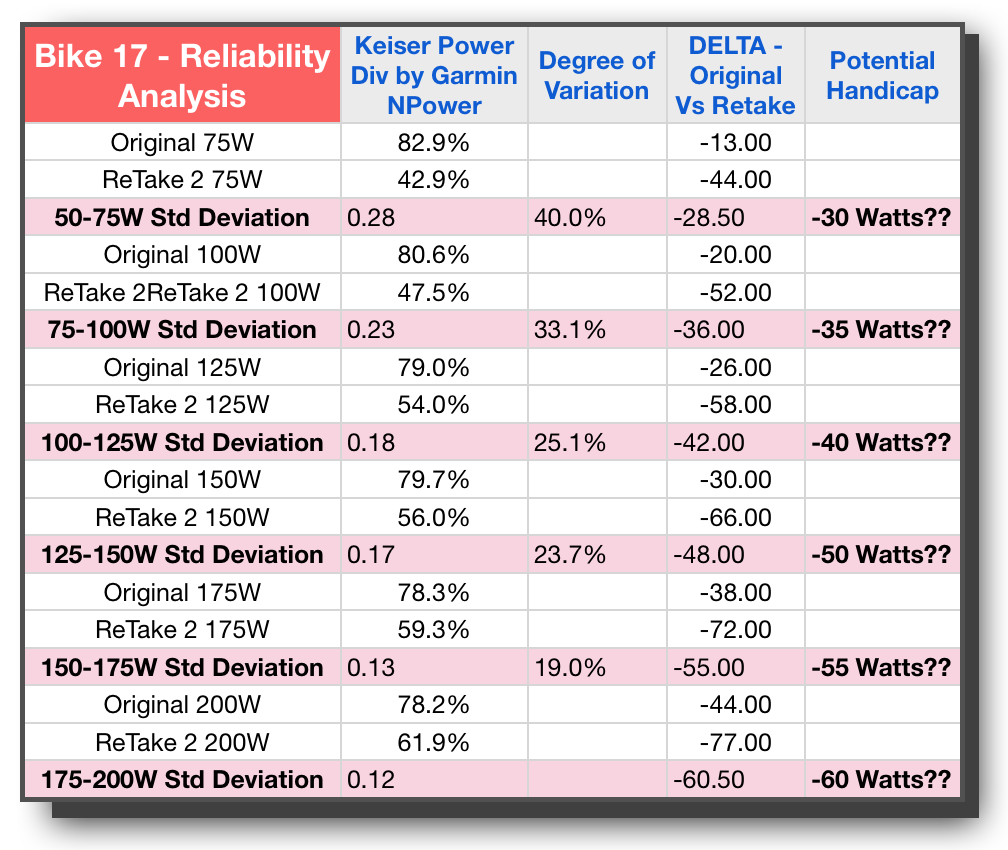
But alas, the numbers from my work up to this point lead me to a conclusion I simply had not anticipated; that each bike within itself may vary day to day with regards to what power it will display given the same force being applied. This was an assumption that myself and many other “defenders of calculated power” have held on to for these past 4 years or so – that it doesn't really matter if the power is accurate compared to what would be measured with a real power meter, as long as that power was consistent. In other words, we could know if our training was making us better or not by pre and post testing on the same bike. It would simply generate a relative value so we could know if we improved a lot, a little or not at all. Each year at Winter Training we would assign bikes so that we could be assured of this “fact”. This was indeed the fundamental assumption that prompted the entire notion that a handicap could indeed be created, if we had a objective way to get at power simultaneous to seeing the bike's power display.
Unfortunately, as you could see from the numbers reported the last time, they varied so much within the same bike, from one testing episode to the next (even despite painfully recreating the same circumstances of a consistent rider, environment, time of day, method of execution and all the like), that this assumption was not true for at least 50% of the bikes. Undaunted by this surprisingly sad turn of events, I started to ask around for an available statistician that might be interested in this research. I wanted a more experienced extra set of eyes and less personally invested perspective so that they could let me know if I am doing something wrong. Was I measuring the wrong way, perhaps working with false assumptions, not controlling enough variables, etc. I didn’t want to give up just yet — I had already invested too much time and energy.
3 More Bikes Tested, 3 Times Each
One of my regulars referred me to Sarah who is both a cyclist and teaches statistics at a nearby university. We met a couple of times to discuss what I had done so far, and she spent some time and thought on the issue, and created a new protocol. We would focus on just 3 bikes, took them out of commission so no one else would ride them, made sure she conducted/directed me as I rode/tested each bike. These trials would be done on three different days, in random order as generated from a random table of numbers. This video takes us through one of those three sessions.
In the next blog post, we will discuss the results of these 9 trials.
* n'at a “general extender”[2][3] (http://en.wikipedia.org/wiki/Pittsburgh_English)
For those of you not well versed in the language of “Pittsburghese”, we use the phrase “n’at” for a variety of reasons, but in this case it means “along with some other stuff”. Consider this a “side-bar” to the story I’ve been building in this Evidence Based Cycling blog. John Macgowan wrote an article on incorporating the “grade of a climb” into your Indoor Cycling classes, and it seemed like a great topic to write a follow up for.
Power, Speed & Grade of the Hill
While writing the first book on Training with Power for the Indoor Cycling environment, it became imperative to create a system that was both practical and easy to teach from Indoors, but that could also be directly applicable outdoors. After all, the mission of Cycling Fusion™ from day 1 has been to bring these two worlds together, and the validation of how our training translates while riding on 2 wheels continues to be a Start Trek level “Prime Directive”.
To that end, my crew and I followed the same approach I have been describing each week through this blog. . So, I purchased an outdoor power meter (the iBike was the cheapest that had about a 5% tolerance for accuracy — plenty for our application. Getting 100% accuracy is absolutely necessary indoors, since we won’t have the same power gauges outside anyway, and we just need to know that we are improving it, not that we are at 200 or 300 or 225 or some other arbitrary power number.
When I would ride outside, I would compare the wattage I was seeing indoors with wattage figures while riding outdoors. This led to a variety of research undertakings with myself and my study participants. This work on Power truly marked the beginning of Evidence Based Cycling, I just had not put a name and more structure to it at that time.
1 Watt per Pound
One of the key principles presented in the book is the notion that if we want to ride outside, or more specifically, if we want to be able to climb typical hills that cyclists normally climb outside, we need to be able to achieve a minimum of about 1 Watt per pound of weight you are carrying up the mountain (rider wt + bike wt).
Through existing math equations, we were able to create a chart that showed how many Watts/lb would be required on hills with specific grades, given specific speeds. It turns out that under 1 Watt/lb there are few hills that can be ridden at a speed of 5 MPH or greater. Below 5 MPH it becomes increasingly hard to hold the bike upright. One can just about walk at 4mph, and that’s not “speed walking”.
Willing Guinea Pigs… er Volunteers
I was lucky enough to have a bunch of regular members that embraced the whole EBC approach to training and learning, and they were more than willing to help with the research. We first wanted to know if the chart and our math seemed to bear itself out in the real world. We used different people, at different riding and fitness levels to climb various hills with differing grades with our power meter, and we found that the numbers seemed to jive. While the testing of our own clients and fellow coaches/instructors would have been enough for us to build our training with, in writing a book for “the masses” we were compelled to go a bit further.
We wanted to establish some early credibility with both the book and our own research, so we commissioned a University Study to validate the formula and the chart in a different state with different riders, and with a Power Tap that would directly measure power instead of our inexpensive model that only calculated it.
Independent Validation
Carl Foster, Ph.D., FACSM; is the director of the Performance Lab at the University of Wisconsin. His team independently validated the chart that our 1 Watt/Lb principle is based upon, and thus we have a solid foundation for using this as a good target Power goal for the average rider. Here are the final excerpts from their published paper:
Results: Predicted PO and measured PO (within the range of 140-400W) were highly related (r=0.989), with an essentially zero value for intercept (Figure).
Conclusions: Without correction for wind, altitude or the effect of additional riders, the relationship between predicted and measured PO during cycling was very strong, supporting the value of published climb equations.
Comparison of Predicted and Measured Power Output During Uphill Cycling
Carl Foster, Ph.D., FACSM; Jacob Cohen, Gene Nacey University of Wisconsin-La Crosse and Cycling Fusions.
Comparison of Predicted and Measured Power Output During Uphill Cycling Carl Foster, Ph.D., FACSM; Jacob Cohen, Gene Nacey University of Wisconsin-La Crosse and Cycling Fusions.
Implications for Indoor Cycling Instructors
Given that there are no real hills and real grades in an indoor cycling room, one must artificially create the feeling by adding resistance. With the spate of power indoor cycles there are now on the market, using the Speed & Power Chart, and specifically 1 Watts/Lb as a target, and the concept of Watts/Lb as a training parameter can provide a ton of useful options for cueing climbs or even entire classes.
SoulCycle doesn't offer Indoor Cycling “classes” so much as they offer Indoor Cycling “productions” where the participants (if they choose) are part of the show. Not just as “extras” playing bit parts, but critically important actors and actresses in each SoulCycle performance.
During these 45 minute scripted fitness events, the Instructor's role is split between; Performer, Cheerleader, Coach and lastly as the Director – directing the participants in their parts of the production.
If you missed any of my earlier articles about SoulCycle, you'll find them all here.
Any great musical or theatrical production begins with building anticipation in the audience. The SoulCycle location we visited has what can best be described as a waiting area. A room with multiple benches that's midway between the hall with the lockers and the primary entrance to the studio.
After I got dressed in a very nice locker room, I met Amy in the waiting area. The previous class was just ending and a stream of sweaty, smiling faces flowed out and past us, on their way to shower and change. (Yes they have showers) We chatted with a couple of women regulars (I never miss this class for anything) one told us, while waiting for an indication it was time to go into the studio. My typical experience has been when one class leaves, the next files in right behind. Not here. You could feel and hear the excitement of the 30 or so of us waiting, when a man wearing a SoulCycle shirt walked out of the studio with a handful of rags. He didn't say anything and didn't appear to need to. The group knew it was time for us to go in.
As I described in part #1, SoulCycle understands that details matter. Between classes they have a crew (it looked like three people) go in and clean everything before the next class. Every bike appeared spotless and functioned properly. Each had a clean towel across the handlebars and two clean hand weights in the little holders under the seat.
When we walked in it was obvious that the studio is a very special place. They had the lights were very low, primarily lit by the faux candles on the four corners of the Instructor platform. What was a noisy/chatty group became much quieter as everyone filed in and found their reserved bike, got set up, and climbed aboard. With 60 people in that small space and so much activity going on, I didn't see when Instructor Heather P (Peggs) walked in – but it was obvious once she cued up her music and turned on her mic.
Among friends
Amy and I were two of the three new folks in that class. Heather seemed to know most everyone else in the room, greeting what seemed like dozens by name as she bounced around the room before the start. She must have reviewed her attendance list because she walked over and welcomed us both by first name.
Heather explained that this was her third class of the day and that two of her favorites would be up front demonstrating, while she conducted the entire class off the bike. The cleaning/setup crew had already prepared for this. Before we walked in there were two bikes on the Instructor platform – in my second class there was only one.
Heather P
Intros
In both classes the Instructors introduced themselves and explained a little bit about the ride to come. I was surprised how both Heather and Lindsay B (who taught the second class I took) offered modifications; the need to keep enough resistance on the wheel and suggestions for taking it easy if today wasn't your day. Lindsay made the point several times; “turn it down until you can't feel anything… then add back a half turn. We never ride in here without resistance“.
Note about form. I can't remember when I saw so many people who looked so good on their bikes. And no it wasn't that they are all young females. Nice flat backs, relaxed upper bodies, very smooth pedalling techniques and I didn't see any of the wild, out-of-control crazy stuff I expected to see. Yes there is a lot of 110+ RPM in these classes – and it looked very controlled.
My idea, and it's only based on observing two classes, is that there's a lot of peer pressure between riders to look good on the bike. They know they're part of the “show” and do their best to look the part.
If you ride in a group outdoors, you've probably experienced the same peer pressure to look good – that's why many men shave their legs 🙂
I've taken this class before
Both classes I rode started exactly on time and followed the same basic profile. I wasn't keeping track of time so I don't have any specific segment lengths. Actually I didn't watch the time on purpose. I wanted to know; how long did the class feel? It felt like it zipped by very quickly. Amy felt it was short – she normally teaches 60 minute classes.
The class profile was something like this:
Standing warm up, with cues to add load over ~ 10 minutes
Transition to a climb with a lot of push ups and jumps
Lather, rinse, repeat
Weight segment
Inspiration/reflection time
Big finish
Stretch and transition
Key Detail: These Instructors know their music exactly and teach to it very effectively. Both exhibited Group Fitness backgrounds, giving us helpful 8 count – countdowns, that always ended right with the phrasing of the music.
I was very impressed by both Heather's and Lindsay's professionalism in the way they conducted their classes. NOTE: with the one exception that Lindsay used music (hip hop) that had a lot of profanity in it and swore herself on occasion. It's not for me, but the guy with the gauges and sleeves riding next to me said he never misses her class. Throughout class they both discussed and encouraged proper form. During the weight segments we were instructed to add a bunch of load and sit up straight and tall. It was also suggested that we stop pedalling. Most slowly rolled their legs during this part.
Is there purpose to all of these extraneous movements?
Critics of SoulCycle (and similar) classes point to how non-cycling specific movements; jumps, push ups/rhythm presses, “tap-backs”, figure eights, etc… have no proven training value and/or diminish the potential training value of riding an Indoor Cycle… like an Outdoor Cyclist would. For those reasons, along with perceptions the some of these movements may be potentially dangerous, we're told we should not include these movements in our classes as they're “Contraindicated”.
Based on what I saw at SoulCycle (and other similar classes I've taken) my feeling is that critics are completely missing the point. IMO these movements are a critical part to the appeal of these classes. It is a thing of beauty, watching a room full of people exactly on the beat and rising and falling in unison. I've heard this described as “tribal” behaviour, similar to fans doing the ‘wave' at a sporting event. It's a very powerful way to connect a group of people together. And at the same time, these jumps are very challenging to perform correctly – which I feel is another reason for the success of SoulCycle that I explained in this post.
Soultime
I found this element of each class interesting. After the weight segment, both Heather and Lindsay turned down the lights and described overcoming a challenge in their personal lives. Playing some trance like music, Heather explained how this week marked the five year anniversary of her sobriety and how appreciative she was of the support she'd received from SoulCycle and all of her regulars.
Lindsay did something a little different. She invited a man to ride her Instructor bike. Then described how she had lost her voice for 10 days and couldn't teach. She then put her arm around the man and explaining how he was the doctor who helped cure her vocal paralysis.
Both short speeches ended with loud applause.
This then segued into a time where we were all asked to reflect on some personal challenge of our own. We rode in near total darkness for a few minutes with just the music. From here the intensity built in a way to communicate how we could overcome whatever it was – leading into a final big effort to finish the class.
Closing time
Each class includes a three minute stretch/cooldown. How do I know it was three minutes? They both said so in their closing. With everything else tightly scripted, I'm guessing the class ended exactly on time. Here's where these Instructors diverged a little; after each did hamstring and lower back stretches while on the bike, Heather did most of her stretches off the bike. Lindsay did all of her's on the bike.
After we were told their upcoming class times and locations (there are 6 SoulCycles around the LA area and they both teach at multiple locations) we were thanked and encouraged to leave quickly. This may explain what didn't happen. I've been in classes like these where the “groupies” flock to the Instructors after class. I observed both pretty much alone after the immediate end of class. This gave me and Amy a chance to say hello to Heather and tell her that we were visiting instructors. She said she appreciated us being there and asked if we would be attending other classes while we were in town.
Overall impression of SoulCycle
In case I haven't effectively communicated it here, Amy and I were very impressed by our experiences at SoulCycle. I participated in two classes, led by true professional Indoor Cycling Instructors who understand what their participants want from a class and they both delivered it.
With the exception of the horrible music (I hate Hip Hop) Lindsay played in the beginning of her class (she did win me over during her weight segment as she went around cuing proper form to multiple individuals), I didn't see anything that wasn't near perfect in the delivery of this experience.
Final note: I appreciate the 20 or so emails and Facebook PM's I received about part #1 – my preference would be that you leave your remarks as comments to this post. But if you're concerned about publicly expressing your views, your email or PM is still appreciated.
That would be your FTP looking back at you… catch him if you can.
Now that I'm an official Stages Indoor Cycling Master Educator, I figured I needed to create an Audio Profile so you can hear how I teach one of my Power classes. My profile is “Racing Your FTP”.
The goal is very simple; beat your FTP or “Threshold Check” numbers on every set. The ride will consist of two warm up songs, a “Threshold Check”, and three efforts of around 12, 18 and 9 minutes with a 1 minute recoveries after each interval.
I love mixing my class music and I've provide you with the MP3 below. I have also included an actual recording of me coaching this complete class. I suggest riding to this class by yourself, to experience exactly how I present this profile and you'll have a better idea of where & what I'm cuing during the class.
[wlm_private ‘PRO-Platinum|PRO-Monthly|PRO-Gratis|PRO-Seasonal|Platinum-trial|Monthly-trial|PRO-Military|30-Days-of-PRO|90 Day PRO|Stages-Instructor|Schwinn-Instructor|Instructor-Bonus|28 Day Challenge']
Enjoy and please let me know how it works for you as a comment below.
Myth: Rider Setup / Bike Fit should be done before class.
Common sense says that the best time to help someone with their bike setup would be before class. After all, this new student has just walked in and they have 45 – 60 minutes in the saddle ahead of them.
So pre-class would be the best time, right?
Well… no, it probably isn't. And when you think about it for a few minutes, I'll bet you'll agree.
I got this myth from our local bike fit guru Chris Balser, who's actually known as The Bike Fit Guru.
4. Saddle Height is not static. To demonstrate, bend forward and try to touch the floor. Do it again. Try repeating the exercise when it is cold, hot, at the end of a hard ride, before an easy ride, etc. It will never be identical because our activities and climate are always changing. Remember this when prescribed the “magic number”.
The point I think Chris is making here is that there are a bunch of external factors that can influence setting a rider's saddle height properly… the most important being the temperature.
Living here in the “Frozen North” we face the issue of “shrinkage” when we're cold – no, not that shrinkage silly 🙂 I'm talking about how your muscles and connective tend to shorten/tighten when they are cold. One of the worst feelings imaginable is how your back tenses up after climbing into a car, when it's been cooling all day in a 10° parking lot. You're forced bolt upright, with your back muscles near spasm and you can't bend forward to save to save your soul. Thank heavens for heated seats!
The opposite occurs when we are warm. We relax. Our muscles loosen and can extent completely. Is this beginning to make sense to you?
It's only after a thorough warm-up can a leg (or legs) comfortably extend. And proper saddle height can only be set with full extension.
So wouldn't it make more sense to check/adjust participants at the end of class?
When I rode with the top level cycling team here in Minneapolis, it wasn't uncommon for one to the club leaders to ride by and offer; “You need to raise your saddle 2 millimeters”. So I would. Except I can remember thinking the next morning when I went off on a training ride; “that can't be right… my seat is too high”, as I would feel the pulling in the back of my knee with each revolution. But then it would go away, or I forgot about it. Either way, once I was warm and could fully extend, my saddle height was exactly where it belonged.
Outdoor riding tip in cool/cold weather: If you leave home and don't feel slightly chilled for the first mile or two (or a slight pull in the back of your knee), you're wearing too many clothes – or your saddle's too low… or both.
But what about a new person to class?
I say get them close, but don't forget about them at the end of class. You could discuss this during your into/warm-up and then remind everyone during the transition/cool-down that you will be available post class to assess everyone's warm position.
I'm guessing you'll get more than a few takers – because I can guarantee that they've never heard this before.
By Team ICG® Master Trainer Jim Karanas and ICG® Marketing & Product Director Gary Warren
Forward Motion Video was first produced for, and used in, Indoor Cycling classes in the form of DVDs. DVDs paved the way for production companies like Virtual Active to bring Hollywood-level filming to the fitness industry.
We would never detract from the contribution these DVDs and their producers made to the indoor-cycling industry. Going forward, however, there’s a point of contention that we consider critical: continuing to use DVD as the medium for providing forward motion video.
In response to Jim’s last post, “Video Done Right”, Gino Nacey, one of the pioneers of Forward Motion Video, offered his “1% disagreement” and commented, “as long as the DVD is played on a big screen, I don’t really see why we should knock it — if all a site can afford is a projector, screen and some DVDs then if the video is well done, they should have a great experience.” We appreciate Gino’s feedback.
DVDs are seen by some in the industry as a good option for clubs, a way to provide a quality visual experience in an indoor cycling class. ICG® believes that, at this time, DVDs will do more to inhibit the development of both indoor-cycling programs that offer video and the instructors who teach with it.
DVD is being superseded as technology progresses. Despite DVD’s low initial purchase cost for club owners, is it really forward-thinking and fit-for-purpose with respect to the skills instructors need to develop to enhance their classes with video, as they do with music? We believe DVD limitations are one reason more instructors don’t teach with forward motion video.
What can an instructor truly do with a DVD? The instructor can’t alter the programming or investigate the synergies that exist between music and video. The profile is unchangeable. DVD length can’t be altered to fit the music. That limits the music that can be used with the DVD. The instructor can’t swap out portions of the DVDs, which makes it impossible to alter the profiles to create endless class variations.
DVDs lack the essential tools the instructor needs, such as selecting and changing footage at any given point in a profile, repeating parts of a video, skipping parts of a video, or switching to panoramic footage for water breaks or to shift the experience. Even more importantly, DVDs don’t permit the instructor to keep the footage running to match the music track length, or vice versa. Any of the above can be done — with one touch — with a system like Myride®+.
DVD offers the same ride time and again, and the ability to use different music is limited.
The use of DVDs for virtual classes may seem to make sense initially, particularly if the voiceover coaching and the music are good. Again, the number of different rides is limited because DVD footage is fixed and can’t be reprogrammed. Also, quality of filming comes into play because Standard Definition on a large screen looks unrealistic.
But it’s more than that. Virtual classes have to be highly advanced in coaching, graphics, filming techniques, post-production techniques, and exhibit extremely compelling locations because they now do what instructors do — lead the class. We also have to push the limits of technology to enable consoles to provide “virtual class” schedules, where console and projector turn on and off at selected times to enable the club owner to offer classes without an instructor present.
It takes a platform of technology that can continue to grow to make the experience (and the buyer’s investment) stronger over the years without fading. Sustainability is key, and DVDs can’t make the cut.
Are DVDs passable? For the retail market, yes. But for sustainable commercial operations where the consumer is savvier and more demanding as competition rises, perhaps not.
Finally, our tree-hugging moment. DVDs are not green and create an enormous amount of waste product that is eliminated with the use of advanced digital technology. CDs and DVDs don’t decompose. Their composition is too complex to make large-scale recycling possible, unlike aluminum, glass or paper. So old CDs and DVDs must be shipped to a special center for recycling.
Then there’s packaging. 85% of under-24s believe that downloading music can help save the planet by reducing the packaging, waste, and carbon emissions involved in producing and transporting CDs and DVDs to shops.
Here’s what video in indoor cycling needs:
1. Improved content-delivery tools for video that offer increased programming features, designed to enable instructors to utilize this new asset fully and owners to embrace the ROI they can get from video done right.
2. Increased availability of high-quality video through network delivery that will enable us to bring new video to our customers as easily as we bring new songs.
3. Improved filming and post-production techniques to enhance immersion and raise the member experience and the demand for video.
4. A shift away from a retail product that’s not green and that experts say won’t be around much longer.
We believe Myride®+ fulfills these needs, except item 2, which it will in the immediate future.
As always with new technology, there’s a higher initial cost — in this case, for the digital media console and the HD projector. But let’s not confuse initial cost with “total cost of ownership” (TCO). The cost of a DVD media system may be low, but it wastes money if it’s not sustainable and/or doesn’t fully meet the market’s needs. As demand increases and more companies play a role in development, digital video costs will decrease. Continuing to advocate DVDs, which give the club owner a cheaper option without a complete understanding of its limitations, will hinder forward progress.
The end result seems inevitable, and DVD may delay the transition but won’t prevent it.
ICG® respects Gino and his organizations for all they’ve done to pave the way. But ICG® can’t recommend adherence to an outdated form of presenting video to the Indoor Cycling industry.