
by John | Feb 17, 2015 | Best Practices, Big Box Instructor, Class Work-Sets, Display Training, Instructor Training, KEEPING IT FUN, Master Instructor Blog
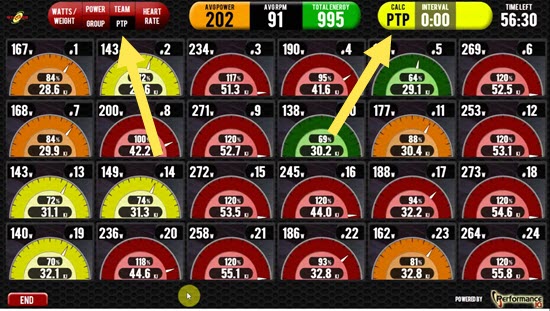
As a training tool – running a PTP test/assessment is invaluable!
We had some excellent questions from Studio Owners this past weekend during our Full Psycle/PRO PIQ workshop. Paul Harmeling addressed these two related questions during the Q&A – I wanted to offer my thoughts on it here:
When, or how often, should we be using using the PTP (Personal Threshold Power) mode screen?
What exactly should we have our riders doing, during the PTP (Calc) test/assessment?
First, for those currently not using a Display System in your studio, let me explain what we're talking about. NOTE: I'll focus on Performance IQ because I know it much better – all of this has similar application with Spivi.
On a related note, I learned a little known trick that could potentially save a new studio enough money to pay for PIQ or Spivi – contact me if you're interested in learning more.
The PTP (Personal Threshold Power) mode screen in PIQ offers a quick (just three minutes) and simple tool to give your riders an approximate understanding of their maximum sustainable power wattage. Then through the wonders of technology, PIQ creates 5 power zones and displays them as different colors. The system calculates PTP as 90% of the highest sustainable power each rider can sustain for the length of the three minute test.
Is PTP as accurate as a 20 Threshold assessment? It doesn't matter to ~98.5% of your riders. What is important is that PTP answers the question that I've heard over and over the past 3 years I've been teaching with power: how hard should I be working… when you ask me to work hard?
So on to the questions:
When, or how often, should we be using using the PTP (Personal Threshold Power) mode screen?
Paul and I are in agreement here – we both feel you should be including PTP in most, if not all classes. There are of course exceptions. You may have a teams challenge scheduled or focus on a class that's directed toward handicapping everyone based on watts/pound.
What exactly should we have our riders doing, during the PTP (Calc) test/assessment?
Here's where Paul and I diverge in our thinking. I see this as a time for a focused effort in the saddle with a consistent cadence, where Paul was saying (and he demonstrated during the Master Class) that he's open to varying position and/or cadence. So who's right? I feel we both are 🙂
You see we each teach very different classes. Mine are typically focused efforts in the saddle = how I would run my PTP tests. Paul's classes are much more frenetic, with frequent changes = that's how he conducts his PTP segments.
Here's mine:
Running a PTP test isn't any different from the Best Effort intervals we suggest you use in a power class that doesn't have a Display Training system. Here's one I included in a recent Performance Cycle class.
Track #2 — the first PTP track is important. We’ll use this average wattage for each of the four PTP efforts to follow. Everyone seemed to enjoy Billy Idol — Rebel Yell — 1999 — Remaster — maybe suffered a bit as well. At 4:47 there’s plenty of time to explore PTP.
We use the Stage button to reset the averages at the beginning of what I describe as; Your Best Sustainable Effort. It’s normal for riders to miss-judge where they should be, so I’ll often have everyone make needed adjustments and hit the Stage button again to reset the averages.
My experience is that everyone will benefit from from a few mini (30-60 secs) PTP efforts to figure out where you should be. On any of the magnetic bikes I like to have find a reasonably challenging climb at around 65 RPM and then have riders accelerate to over 80RPM and observe what it feels like (RPE) and the wattage.
Two or three of these short intervals should give your peeps a watts window they can shoot for during the actual 3 minute PTP test.
I ask everyone to stand and walk, without touching the resistance, for a minute recovery.
To start the PTP test, I'll cue up a track like 83RPM Billy Idol — Rebel Yell and cue finding the cadence. Ten seconds to get everyone there and I will click Calc PTP. Encourage everyone to do whatever it takes to complete the assessment and let the technology work it's magic, figuring everyone's training zones.
Make sense?
by Joan Kent | Feb 16, 2015 | Best Practices, Engage Your Students, Health and Wellness, Master Instructor Blog
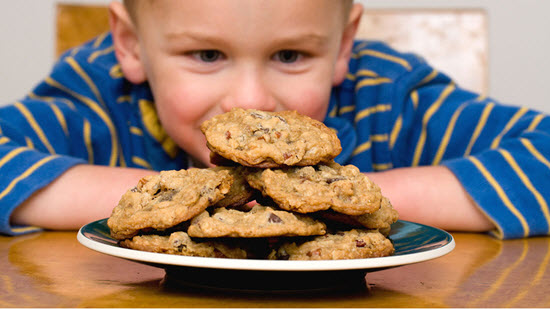
As a nutritionist who coaches many clients with sugar addiction, I find myself talking about willpower frequently and thinking about it a lot.
I used to take a hard line against willpower — or rather, against people’s view of it. On behalf of my clients, I resented those who smirked when the clients reacted to sugary temptations with vulnerability and conflict. “You don’t have to eat it,” they would smirk. I’m not a fan of smirking.
Time and again, I remind my clients of how misguided that smirking view of willpower is.
Would we tell a smoker who’s trying to quit to carry a pack of cigarettes in her purse, and place a pack in the car, in the office and in every room of the house, just to prove she has willpower?
Would we tell someone who’s trying to stop drinking to get a job in a bar or hang out with his drinking buddies while they party, just to prove he has willpower?
So why do we expect someone going for weight loss to sit in a room full of brownies and jellybeans and not take a bite?
If your goal is to lose weight, the only thing you have to do is lose weight. You don’t have to show you’re a tower of strength. Keep tempting foods out of the house so they don’t challenge your willpower.
The tower-of-strength willpower view is misguided at best. It typically comes from people who don’t understand sugar addiction or why someone may have trouble resisting sugar that’s readily available.
But have you noticed a shift lately in the attitude toward willpower?
I remember motivating slogans. Things like, “Willpower is a muscle. The more you use it, the stronger it gets.” Things like, “Where there’s a will, there’s a won’t.”
The slogans seem inspiring — but they can make someone feel like a failure for not exerting willpower in certain situations.
Willpower 2015[wlm_private ‘PRO-Platinum|PRO-Monthly|PRO-Gratis|PRO-Seasonal|Platinum-trial|Monthly-trial|PRO-Military|30-Days-of-PRO|90 Day PRO|Stages-Instructor|Schwinn-Instructor|Instructor-Bonus|28 Day Challenge']
The new view of willpower is that it’s finite, and actually in short supply. It’s now considered a conscious state that’s strong early in the day but diminishes as the day wears on. Apparently, it’s not a muscle that strengthens with use. It runs out because of something called Decision-Making Fatigue.
The more decisions we have to make over the course of the day — choosing between a donut or egg whites for breakfast, skipping a muffin at the morning meeting, avoiding dessert at lunch, ignoring the tray of cookies in the snack room at 3:30 p.m. — the more difficult it becomes to say “no” when we get home at night.
So is willpower a lifestyle habit that can be developed and strengthened? Or is it a limited resource that has to be meted out and saved for the moments it really counts?
And I wonder whether the limited-willpower viewpoint reflects rising obesity rates. Is it an attempt to explain them?
I’ll boldly go where no one seems to be going. Could this new Law of Diminishing Daily Willpower have anything to do with the fact that sugar is everywhere, and in everything?
Because sugar is everywhere, it’s an external trigger, making us want the goodies we see or smell. Cinnabon, anyone?
Because sugar’s hidden in everything, it’s an internal trigger, changing brain chemistry and priming us to eat more.
If sugar didn’t run our food industry, maybe we’d have stuck with the old view of willpower. It was around for a long time. I recall hearing those “inspiring” sayings before the obesity epidemic.
Maybe sugar is the reason for diminishing willpower — and the change in viewpoint about it.
Maybe. But I still say you don’t have to prove you’re a tower of willpower to get your nutrition goals. Set things up so you can win and just get them.[/wlm_private]
by John | Feb 12, 2015 | Best Practices, Latest News, Master Instructor Blog, Your Fitness Business
I had an awesome phone call from the Better Business Bureau (BBB) today. The nice man told me that because of our sterling (we've never had a complaint) reputation, the BBB had upgraded our company's rating to A+… their highest rating 🙂
Like many other business, our actual name (Deep Breath In, LLC) is different from how we are known publicly – indoorcycleinstructor.com and ICI/PRO. The only place you'd see our name is on your credit card statement – which has to be listed as Deep Breath In, LLC vs. ICI/PRO. This has, at times, created some confusion; “honey, what's this charge on our credit card from Deep Breath In, LLC?”
Of course that wasn't the only reason why he called – the BBB offers a special “Accreditation” (which would remove the “This Business is not BBB Accredited” notification) for an annual fee of $490.00. I thanked him for recognising that we take very good care of our ICI/PRO members, but I would pass on the additional expense.
You can see our company's A+ rating here.
Is your business BBB Accredited? I don't know for sure, but I'll bet that it's more important for higher ticket products or services. I am curious to know if you feel it's worth the $500.00 a year cost.
by John | Feb 7, 2015 | Big Box Instructor, Engage Your Students, KEEPING IT FUN, Master Instructor Blog, Music

Yep, I'm teaching another class where we're using weights!
I'm pretty excited. I'm subbing a Cycle Sculpt class tomorrow! Cycle Sculpt is a branded class format at Life Time Fitness, designed to attract the crowd who would be interested in a SoulCycle like class. This won't be my first time teaching this format – a little over a year ago I had the privilege and wrote about my experience here.
This class format has been evolving. Instead of using weights/bands while on the bikes, now we split the class up into two groups; half ride while the other half completes Boot Camp style circuit training on the floor.
It's like herding cats
Yesterday I discussed with Kadi (it's her class) how she conducted the class. She explained that it can get a little chaotic with so many people moving around the room – she typically has ~50 people. “Give each group a simple objective that they can complete on their own” was her advice, along with doing my best to keep everyone smoothly moving and focused.
As a side note I will be interested to see how many people I recognise. My previous experience was that most of the participants were completely unknown = they don't come to regular cycling classes.
I'm all about self-directed work. So I created the simple profile below and I'm (pretty)confident everyone will be able to follow it successfully 🙂
[wlm_private ‘PRO-Platinum|PRO-Monthly|PRO-Gratis|PRO-Seasonal|Platinum-trial|Monthly-trial|PRO-Military|30-Days-of-PRO|90 Day PRO|Stages-Instructor|Schwinn-Instructor|Instructor-Bonus|28 Day Challenge']
Here's my Spotify Playlist John's 2/8 Cycle Sculpt Playlist
John's 2/8 Cycle Sculpt Class
Klingande — Punga Warmup
Flo Rida — Good Feeling – Bingo Players Remix Openers
I'm doing a pretty normal warm up with a series of accelerations during the second track.
A.R. Rahman — Bobbleheads Life Time calls these a Reset = not a real recovery, but a reduced effort ridden to a short fun track.
Avicii — Heart Upon My Sleeve 3:30 Best Effort (this class will still incorporate Power/Watts) that starts one minute into the song. Here's where everyone can observe their PTP.
Jens Buchert — Crypton Recover and discover Base Watts – the wattage that has you working just above “Chatty” (early part of Zone 3 HR using a 5 Zone system).
Each track that follows is about five minutes long. The “On” (riding) group will directed to complete these distances each time they're on the bike:
- Men ride 1.5 miles (at 20 mph this should take about 4:30)
- Women ride 1 mile
- Then complete the segment at “Base Watts” If you get Chatty that means you're not working as hard as you've been assigned.
Ellie Goulding — Salt Skin – Alex Metric Remix While they're riding, the “Off” group will be performing the following with an offer to modify if necessary:
- 15 Squat Presses with dumbbells
- 15 Pushups
- 15 V-Ups
- Repeat until time's up
Paul van Dyk feat. Starkillers Everyone switches
Bastille — Pompeii – Audien Remix First Group – 2nd set
- 8 Lunge each side with dumbbells
- 15 Bicep Arm Curls
- 15 Triceps Kickback
- 20 Bicycles each side
- Repeat until time's up
Hilary Duff — Reach Out – Remix Everyone switches
Blue Stahli — Kill Me Every Time First group, 3rd set
- 10 Jump Squats
- 10 Reverse Flys
- 1 minute plank
- Repeat
Living Colour — Cult Of Personality Everyone switches
Sunday On Weed — You Can't Hide (Cet Merlin Mix) – Cet Merlin Mix Big Finish – repeat Best Effort or something else, depending on how they look 🙂
I'll let you know how it goes!
[/wlm_private]
by John | Jan 21, 2015 | Best Practices, Engage Your Students, Instructor Training, Learn Leadership Skills, Master Instructor Blog

You need to have read part one of this series where I laid out two scenarios and asked the question;
Why do Breathless Betty and Chatty Cathy not behave the same way that you and Susan did at WSSC?
It's my worldly perspective that the major difference between those two situations boils down to respect. You and Susan show your respect for Josh Taylor by behaving correctly – riding in silence. Breathless Betty and Chatty Cathy aren't showing the instructor in scenario #1 any respect > make sense?
But why?
So if in one instance people are disrespecting you and the other's in your class by talking, but in a different situation they wouldn't, the obvious question to ask is WHY? Why do people act disrespectfully? The whole concept of why people do what they do is fascinating to me. Back in 2011 I introduced you to the concept of Start with WHY and that it's important to understand why you are doing what you do… and why some of your participants do what they do.
I see three possible reasons why:
- They don't know they are acting disrespectfully…
- They don't care they are acting disrespectfully…
- They're disrespecting you on purpose…
I'm making the assumption that your goal is a quiet, focused class – where you're the only one doing the talking. If it's a yard-sale (neither quiet or focused) – with others talking (besides you), I feel it's super important to truly understand why (what's the real reason), before you can effectively address the problem.
Was there ever a time when you made an assumption about the motivations behind a person's actions, only to be horribly embarrassed when you discovered you had it completely wrong?
We don't want that to happen, so lets explore these three potential reasons a participant in your class would disrespect you. Then we'll know the right ways to address the issues.
OMG! I had no idea 🙁
In my little story about your participation in Josh Taylor's class, your friend Susan acts embarrassed when she realizes that attempting to start a conversation with you was completely inappropriate.
Most people care and wouldn't purposefully act disrespectfully toward you. So we can assume that the reason why the are talking… is because they don't understand that they shouldn't. Unfortunately there are a lot of Instructors who don't have control of their class. I've ridden in many classes where the Instructor has either given up, or are too afraid to do anything.
So there's a good chance that your talkers have experienced other classes where they felt free to talk, so they feel perfectly free to chat away in yours. This group will apologize to you, after you apply the solution you'll find in part three.
I'm special!
I teach at an “Athletic” (most expensive) level Life Time Fitness in an affluent suburb of Minneapolis. A trip through the parking lot will confirm that my typical participants are very well to do. It's common for me to reassuringly pet the dash of my humble Mazda3, as I park between $100k S Class Mercedes, 6 and 7 series BMW's, Lexus', Audi's, Land Rovers and Escalades on Thursday mornings.
Some people of “means” can act – how should I say it? – a bit entitled. I'm sure you've met a few people like this. They (if you ask them) feel that because they are spending a lot of money to be a member, they expect to be able to do pretty much whatever they damn well please. When you make general comments about riding quietly, these folks don't think it applies to them > does that sound familiar to you?
My experience is that these are the people who get mad if you confront them directly > “how dare you!” They are also the group who will pull rank and complain to management, if you don't correct them properly.
I'm the leader here, not you!
A few years ago I wrote this post; Two Places Where Democracies Don’t Work.
The concept of a democracy; social groups where everyone works together, contributes equally and respects the needs of others sounds good… but rarely works out well in the real world. I can’t think of better places to demonstrate this than in your class or on an outdoor group ride. Both these collections of people require a leader… or chaos ensues.
There are members who will purposefully challenge your authority as the leader of your class.
You may have experienced this at some point in your teaching career. Maybe it was some participant in the back row holding court with those sitting around him. The effect is disrupting to your class and it may have irritated, if not angered you.
I view a large part of this as simple disrespect, but sometimes it’s not. It may be helpful to look at it a different way; the disruptive student may be trying to assert themselves as leader of your class.
At the time I got some grief on Facebook about that post. So before you dismiss the possibility (“this never happens John!”) that there are members who are trying to take control away from you, I'd like you to think back and see if anything like this has ever happened to you…
- That gal who talks endlessly with whoever is riding near her – while she looks straight at you? She maybe testing you, waiting for your response.
- That guy who's in the front row defiantly doing his own thing? No question about it. You might catch him watching in the mirror to see if anyone will follow his movements, instead of yours.
- That jerk who's always late. He strolls in and takes his sweet time getting set up front & center. He's trying to take control of your class by distracting everyone. The “LOOK AT ME!” narcissists of the world live to try and tear down others in authority.
- “I hate this song!” Ever had some A**hole who complains or criticises you publicly? There are insecure people in the world who are intent on pulling you down, thinking it will elevate them in the eyes of others.
Your class isn't a democracy. Only you can be the sole leader in your class… if you don't protect your role as the leader, someone else could try to take it from you.
Now I hopefully have you thinking about the specific problem in your class.
Here's part three where I offer my strategies and methods for addressing/correcting each instance of when people act disrespectfully (talk) in your class.
by John | Jan 21, 2015 | Latest News, Master Instructor Blog, Training With Power, Zone based Heart Rate Training
Hey [wlm_firstname] how hard should I be working to; get faster, lose weight, build endurance, ect…
Answering that is the age old dilemma many of us face when questioned by our riders. We try to be helpful by offering subjective descriptions of what both thresholds should feel like. We give breathing cues, run special FTP classes and/or include Best Effort intervals into our class. They're all designed to help our participants discover (for themselves) their threshold hearts rates and/or threshold wattages. We can get close… but at the end of the day they're still subjective measurements = not always as accurate as we would like.
Breathing gas exchange monitors can scientifically measure the two thresholds. Systems like those from New Leaf and Korr can objectively measure the changes in our breathing levels of O2 and CO2. They work well, but are very expensive to own (you can no longer purchase a New Leaf cart, now that they were purchased by Life Time Fitness) and individual metabolic testing can run to $200.00 or more. The actual tests are rather unpleasant, requiring you to wear a very uncomfortable mask – trust me on this > I've had over a dozen tests and would dread doing another.
The only other option was blood lactate testing during a graded exercise test at a university or sports performance center. Here they prick your finger every two or three minutes, while you work to failure during the assessment. I haven't done one of these personally, but it sounds equally unpleasant.
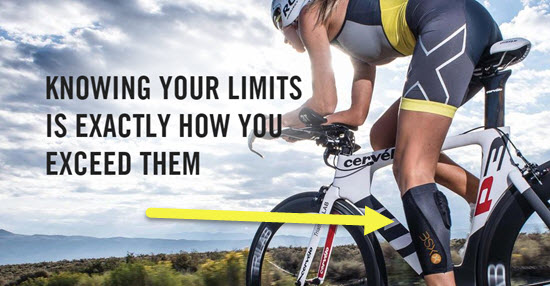
Enter the new BSXinsight – a wearable device that optically measures your O2 levels = this could be exactly what all of us training athletes were looking for. Pictured above, the BSXinsight is positioned on your calf using a compression sleeve. It wirelessly communicates with a smart phone and the data is displayed by (you guessed it) their special app.
Don't just listen to your body, look inside it.
Data and gear are only as good as their ability to improve your riding. Now you can access the most powerful training metric in endurance sports, making every mile more effective and putting every piece of technology you already use into valuable perspective.
BSXinsight uses revolutionary technology that allows you to see inside your muscle, measuring your lactate threshold and generating personalized training zones. Stop trying to “feel” whether you’re pushing too hard or leaving too much in the tank and let the science of your body speak to you.
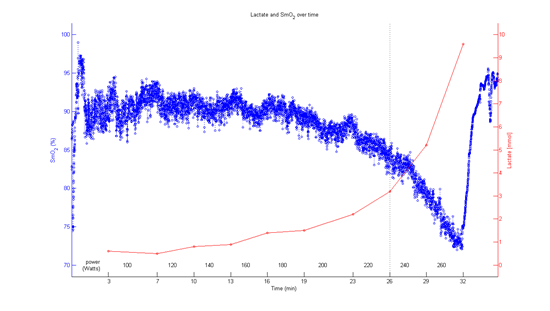
Clearly identifying LT2 threshold
I just finished a fascinating conversation with one of the principals of the company. They have offered to send me a demo BSXinsight to experiment with. When I'm done I'll be sending it to Dennis Mellon for his feedback. Once we are done accurately learning our own LT and overlaying it with our Heart Rates and wattages, we will record an episode with the company spokesperson so we can share what we've learned with all of you.
Stay tuned 🙂
