Cyrus, who's the Dungeon Master Personal Trainer that leads my Mon/Wed/Fri “Man Camp” boot camp, played this track last week. I found ithugely motivating and thought it would work very well as an inspirational song that leads into that final, BIG FINISH track you end your class with.
You can go the distance You can run the mile You can walk straight through hell with a smile
You can be the hero You can get the gold Breaking all the records they thought never could be broke
Yeah, do it for your people Do it for your pride How are you ever gonna know if you never even try?
Do it for your country Do it for your name ‘Cause there's gonna be a day…
When you're standing in the hall of fame (yeah) And the world's gonna know your name (yeah) ‘Cause you burn with the brightest flame (yeah) And the world's gonna know your name (yeah) And you'll be on the walls of the hall of fame
Be a champion, be a champion, be a champion, be a champion On the walls of the hall of fame
If you want to be really clever, you might want to use an instrumental remix of Hall of Fame as your transition/cooldown. Download the remix here
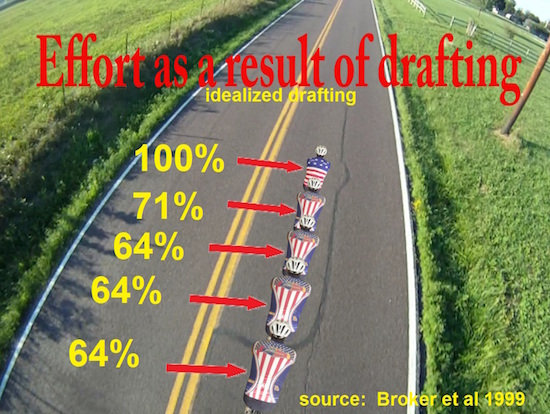
Last Saturday my outdoor cycling group had their last organized ride of the season. It was a beautiful day in Denver, no wind and the temperature ranged from 50-70 degrees. This group has a wide range of abilities, there are men and women, young and old, husbands and wives, parents and children, $700 and $7000 bikes. As a group we ride well together we often split apart on hills, but the faster riders wait at the top so we can continue the ride together, no one is ever dropped. Though our routes are often different we always end up at the Starbucks in downtown Golden, Colorado, for a latte break. This day the ride had a bit of different feel to it. With it being the last ride of the year I think everyone wanted to test their hard fought fitness and every tiny bump in the road to every longer climb was an all out race to the top, man was it fun! The faster riders knew that at the top of every hill they would have time to recover as they waited for the slower riders to catch up. This recovery time just added to the intensity of each and every climb. Needless to say, by the time we made it to Starbucks in Golden some of us were already “cooked” and we still had 20 more miles to go. As we ride out of Golden there is a long stretch of about 8 miles of fairly flat roads with no “Stop” signs or traffic lights. We usually don't race every hill, like earlier in the ride, but we ALWAYS race this section. As we slowly rolled out of Starbucks we merged with two other groups and got caught at the last traffic light before the long 8 mile stretch. It was so cool to see about 40 riders all waiting for this light, everyone enjoying this beautiful day and knowing the “race” was about to begin. When that light turned green “it was ON”! Unfortunately I was not in front when the light changed and I could see the leaders start pulling away, but I thought “no problem, I can close that gap.” Well, I'm sorry to say that after a few “overflown sinks” I was never able to “close that gap”.

While I was out there “filling up my sink” for 8 miles and never getting closer than 50 yards to the lead group I thought that this would be a great indoor cycling set. The goal of my “Close the Gap” set is to ride below threshold wattage for a 2-3 minutes then spend 1-2 minutes bringing the average wattage back up to or “on the wheel” of the riders threshold wattage and repeat. When I coach this set I like to keep the timer running so it becomes increasingly harder to elevate the average wattage the further into the set the riders go. This teaches the riders the importance of pacing, if the average wattage drops too low it will take harder and/or longer efforts to bring it back up, as there is a limited amount of time anyone can maintain an above threshold effort the rider may never be able to bring the average wattage back up to threshold levels. Similar to the way I was never able to catch or “close the gap” to the leading group last Saturday.
3 song harmonically mixed track, to download Right Click > Save As / Save Target As to download. Open in iTunes and then you'll see this in your Spotify Local File folder.
Knowing that many of my members are strong at cadences of 60 to 80, but struggle to consistently turn pedals above 80, I've been encouraging (i.e. forcing ) 🙂 them, and myself, to pedal more quickly. We're all getting better by coming out of the saddle to bring our leg speeds back up any time they drop below the designated number! This is the #3 song in the very start of class, bringing us from 87 rpm's with the #1 song: https://www.indoorcycleinstructor.com/icipro-instructor-training/music/free-music-friday-103/, to 97 rpm's with the #2 song: https://www.indoorcycleinstructor.com/?s=free+music+friday and now 102 rpms, the completion taking about 11:30 minutes.
This is a funky combo of Peter Gabriel and John Cougar Mellencamp from djschmolli on SoundCloud. Here's your free download:
I collect stuff; articles, observations, suggestions and random ideas that I feel could make for an interesting post or interview. Not everything is worthy of the time needed to research and craft into an article – but I feel are still worthy of sharing. Here are the latest:
Why So Many Women Are Crying at the Gym?
Great question and this article in Time Magazine explains a bit more of why many women love SoulCycle classes:
For a generation of stressed-out working women, exercise is as much about emotional release as it is physical training.
You could go to therapy — or you could hit the gym. Women are getting teary in SoulCycle, and misty-eyed at Pure Barre. They are letting out wails in yoga and rubbing the shoulder of the weepy woman next to them at CrossFit. “I think people have started to notice that their clients are just showing up to class and just unloading, and so they’re tailoring their classes to create space for this,” says Hayes, who is a pilates instructor by day. “When I take private clients I end up feeling like a therapist for them.”
These fitness instructors aren’t trained in that, of course. But they’ve probably been there.
It’s not an accident that just as you’re starting to relax, coming down from the adrenaline, you’re blasted with a throaty ballad. Those playlists are meticulously constructed. “I’ve been teaching for almost 20 years, so I’ve basically seen it all: crying, laughing, throwing up, overheating,” says Stacey Griffith, a Soul Cycle instructor. “There are moments in the class that are directly programmed for that reason — but it’s not like we’re trying to get people to cry. We’re giving them the space to step outside of themselves.”
Great example of how mixing in key can create energy
I was reading this article in the WSJ ANATOMY OF A SONG How the Kinks Roughed Up Their Sound If you're an old Kinks fan you'll enjoy learning how they created their special sound in the days before digital music – poking holes in the speakers with a knitting needle.
Near the end of the article Ray Davies, the song’s composer and band’s lead singer, makes a reference to key changes in the song The Kinks — You Really Got Me and the effect they had:
Once teens saw us and heard our metallic sound, the excitement built and the single took off after its release the following week. Part of what the audience was responding to was the song’s key shift from G to A. The more natural and melodic place for the song to go was from G to C or D. But I wanted it to go to A, which was quite revolutionary then. There’s something about that full step up that feels like acceleration and raises the excitement level. The progression actually made me shudder when I originally came up with it.
Turn up the volume, and listen to with your eyes closed – do you hear what he's describing? Are there time in your class where a similar change could be valuable?
http://youtu.be/S7ffgqjcH40
Will women be wearing corsets in your class soon?
I hope not. It seems that fitness expert Kim Kardashian has started a trend called “waist training” using an old fashion corset and many of her followers are lacing up these devices of torture and giving it a try:
However, “own photos” seem to be a big part of waist training. And so I decide to wear the corset to spinning class and possibly take an own photo afterward. Apparently, this is what Kim Kardashian does: She waist-trains at the gym, then she takes an “own photo.” I don’t really like spinning that much, but I go to this particular class because it’s very leisurely. For example, we keep spinning to “California Love,” which is kind of slow. Every song is the pace of a stroll in the French countryside.
Before I go to the gym, I put my corset on under a gigantic shirt. It’s slightly easier to put on today. Perhaps I am training my waist? I can even walk to the gym without getting too winded.
Unfortunately, actually spinning is a bit harder. I am only one minute into “California Love” when I start feeling very out of breath. I unbutton the first snaps of my corset. Then the spinning instructor puts on “Bang Bang” by Jessie J. She has never done something like this before, and I am quite displeased. What an energetic song. It’s almost entirely screaming. My corset can’t stand the stress. I start unsnapping more buttons under my huge shirt, even though everyone in spin class is looking at me, wondering what I am doing under the shirt. I throw the corset near my bike. I do not take an own photo. I decide to take a couple of days off from waist-training.
I'd love to hear if/when one shows up in your class 🙂
As many of you know I was recently selected as a Master Educator by Stages Indoor Cycling. Last Saturday I led my first workshop at Cherry Creek Athletic Club in Denver and it was an honor to share the basics of power training with this group of 20 fitness professionals.
I believe FreeMotion S Series bikes (built by the Team at Stages Cycling) are currently the best in the industry. The ability to accurately and directly measure the rider's output is so leading-edge that professional cycling’s Team Sky uses the same power meter technology on their outdoor bikes. Paired with the power console, instructors have all the metrics necessary to lead an exciting power-based indoor cycling class. That being said, we at Stages Indoor Cycling strongly believe that the first step for any instructor to understand and properly “cue-municate” data, requires a thorough grasp of “anchoring” time to effort. The simplest way to do this is to provide consistency with how one describes rate of perceived exertion (RPE).
At Stages we use a RPE scale of 1-10 with 5 being lactate threshold. Lactate threshold is the exercise intensity at which lactate begins to accumulate in the blood stream. If an above threshold intensity is maintained the rider will eventually fatigue and working muscles will fail. When explaining RPE to riders I like to compare the body to a kitchen sink. The working muscles are the sink, the ability of the body to clear or filter waste products, like lactate, is the drain and the intensity or waste products are the amount of water flowing out of the faucet.
When exercising at a RPE of less than 2, water is dripping out of the faucet. The drain can easily keep up with this extremely low flow of water. This low flow would be best associated with:
Zone 1
Active Recovery
Less than 55% of Functional Threshold Power (FTP)
Less than 68% of Functional Threshold Heart Rate (FTHR)
Efforts at this RPE can be held almost indefinitely
Can talk in full sentences, comfortable, light, very easy, recovery, soft pedal
When exercise intensity is increased to a RPE of 2-3, flow increases to a trickle, but the drain can easily match the low flow of water. There is still no accumulation of H2O in the sink. This trickle of water would correspond with:
Zone 2
Endurance Training
56-75% of FTP
69-83% of FTHR
Efforts at this RPE can be maintained for long periods of time
Conversational effort, “social ride”, breathing is slightly elevated, starting to sweat or glisten, this is where you train your muscles to burn fat for fuel
As intensity increases to a RPE of 3-4, water flow increases to a steady stream but the drain can still keep pace with the flow and there still isn’t any accumulation of liquid in the sink. This steady stream of water would most closely correlate with:
Zone 3
Tempo Training
76-90% of FTP
84-94% of FTHR
Efforts at this RPE can be maintained for 60 minutes to 3 hours
Can talk in broken sentences but would rather focus on the work at hand, marathon pace
At a RPE of 4-5 the flow increases and the drain can match the flow but water is on the verge of collecting in the bottom of the sink. The flow and draining capacity are at equilibrium and would most closely parallel with:
Zone 4
Lactate Threshold
91-105% of FTP
95-105% of FTHR
Effort can be maintained for 8-30 minutes
Heavy breathing starts, but not breathless, uncomfortable and challenged, start to feel a little “burn”, maintainable but must stay focused, 10k race pace
At a RPE of 6-7 the surge of water is increased to a point where it begins to accumulate in the sink and if it is not reduced the sink will overflow in 3-8 minutes, depending on the size of the sink. The more trained the rider the bigger the sink. This surge would associate with:
Zone 5
VO2 Max
106-120% of FTP
Greater than 106% of FTHR
Effort can be maintained for only 3-8 minutes
Deep, labored breathing, very uncomfortable, very challenged, above the “Red Line”, rapid breathing as your body tries to vent accumulating waste
At a RPE of 7-8 the gush of water is so great that the sink will overflow in 30 seconds to 3 minutes. This flood of water would most closely resemble:
Zone 6
Anaerobic Capacity
121-151% of FTP
Due to the lag time of the heart HR is not a metric that should be used
Muscles fail in 30 seconds – 3 minutes
Gasping for air, Unable to work harder, very very uncomfortable, burning mostly carbs for fuel.
At a RPE of 9-10 the torrent of water will overflow the sink in less than 30 seconds. This flood is most like:
Zone 7
Neuromuscular Power
Maximum Effort
Muscles will run out of gas in less than 30 seconds, at the end the engine just shuts off
It’s important to explain that when working below threshold or when the drain can keep up with the water flow, RPE remains constant, but when working above threshold or when the drain CAN NOT keep up with the flow, RPE’s are dynamic. If output is held constant, above threshold, a 6 turns into a 7, a 7 turns into an 8, an 8 into a 9 and eventually the muscles fail or the sink overflows and recovery is needed.
As fitness improves the body will build a better “plumbing system” or larger drain and remove waste products more quickly. Also, the brain will build a better lactate buffering system or a larger sink, therefore being able to withstand more and more waste products without reaching muscle failure or “overflowing the sink”.
The 3 song profile I created for this week is titled “Call the Plumber!” The 1st goal of this set is to slowly and steadily increase the riders RPE every 2 minutes until they reach their MAX intensity or the water reaches the very top of the sink. The 2nd goal is to overflow the sink by performing three 20 second maximum efforts with just 10 seconds recovery after each. Try to explain how each RPE should feel as your riders “fill their sink”, then at the end let them make a big mess by working so hard the their sink overflows all over the kitchen floor.
3 song harmonically mixed track to download Right Click > Save As / Save Target As to download on PC or Download Linked File As on Mac. Open in iTunes and then you'll see this in your Spotify Local File folder.
3 song harmonically mixed track AND video Right Click > Save As / Save Target As to download on PC or Download Linked File As on Mac. Open in iTunes and then you'll see this in your Spotify Local File folder.
With some delay (and my apologies), here is the second flat road installment of the three builds I've been using to a final leg speed of 104 rpm's (third and final song next week!) as the intro in my latest class. Here is the first road that starts class at a leg speed of 87: https://www.indoorcycleinstructor.com/icipro-instructor-training/music/free-music-friday-103/
This second road brings leg speed up to 97. I coach to also add a bit of load to bring up the challenge and watts.
This tune is an interesting mix of the Bee Gees and AC/DC…
Enjoy and next week will bring us to leg speeds of 104 and a great mash up.