As a nutritionist, I hear many clients say they want to lose weight — to look better, have more energy, improve their health. But losing weight can also help you increase your power on the bike.
Ratios intrinsically provide two ways to improve the ratio — by manipulating either variable. The results of improving both variables can be dramatic.
As covered in a previous post, efficiency — the ratio of work output to expended energy — can improve with increased work output or decreased energy expenditure (or both).
In the same way, your power-to-weight ratio on the bike (measured in watts per kg) can improve with increased power or decreased body weight, or both.
Power is itself another ratio, of work to time. If work increases or time decreases, the result is greater power. ICI/PRO is currently covering this topic in depth.
So that provides 3 variables in the power-to-weight ratio: increase your strength (work), increase your speed, or decrease your body weight (or all of them).
Why Lose Weight?
Even if you’re not overweight, weight loss may improve your power-to-weight ratio. It need not — and shouldn’t — involve a strict “diet” that leaves you hungry most of the day.
It does involve careful monitoring of your numbers — how many calories you burn (using your power meter or, preferably, a wearable calorie counter 24 hours a day), and your calorie intake.
The goal is to eat fewer calories per day than you burn, but not by much, just 150 to 300 calories. If that feels too restrictive, drop the deficit to 100 calories. The result would be a slow decrease in weight that you can stop or reverse at any time.
These days, the general recommendation for weight loss is rapid loss. (Is that to match up with HIIT and the shorter-and-harder approach to fitness, I wonder?) Rapid weight loss is said to keep the “loser’s” motivation high.
Yet gradual weight loss — while also training for power — has the advantage of maintaining fat-free mass (FFM) so you won’t lose strength, an important variable in the power ratio.
Holding On To FFM
Weight loss often decreases muscle mass, especially rapid loss. But in the long-running (13-plus years) weight-loss program for which I was both the nutritionist and a training coach, we typically saw steady or increased FFM while the participants lost weight at a slow, sustainable rate.
That helped them maintain strength and power so they could do the training, which was frequently high-intensity. The intense training, of course, was designed to increase strength and power.
Maintaining FFM also prevented participants from having to drop calorie intake more and more (and more) for continued weight loss.
Don’t Bonk
Make sure you don't restrict calories on the ride itself. Whether you’re riding outdoors or doing tough power training in the studio, under-fueling before or during the ride could cause you to bonk.
Even without bonking, you may still feel week and have difficulty working up to your capacity — the power you’re trying to improve. Fuel as usual while riding.
Keep the calorie restriction small. Cut back a little more on days that you’re not training hard, or at least save the restriction for after the ride. If your power ride is late in the day, early A.M. calorie cutbacks may work. Just keep your pre-ride meal about the same as usual, and eat or drink whatever you need on the bike.
Be strict about post-training refueling (covered in a previous post) so you can train well the next day.
Technique and Efficiency
In all of this, don’t forget that better technique on the bike will help you waste less energy by reducing the energy needed for pedaling, reducing energy lost as body heat, and retaining more energy for your next pedal stroke. Your functional strength, a power variable, will increase.
Combining good technique, all the power training tips you’re currently getting here on ICI/PRO, and gradual weight loss will help you dramatically increase your power-to-weight ratio on the bike.
What would it be like to be losing both your vision and hearing?
Can you even imagine how challenging it would be teach?
I just had to know more about Instructor Rebecca Alexander and then share her very inspiring story with you. Rebecca currently teaches at Equinox in New York City and has taught in the past at New York Sports Club, New York Health and Racquet and SoulCycle.
Rebecca has written the book Not Fade Awayabout her challenges with Usher Syndrome III, a disease that is slowly robbing her of both sight and hearing.
It was a delight for me to interview Rebecca – please enjoy our last podcast of 2014!
After listening to Rebecca's story, I encourage your to purchase and read her book using the link below. You can learn more at her websitewww.rebalexander.com
Also, if your family tithes annually like ours, and you're looking for a place to make a last minute donation, please join Amy and me in contributing to Rebecca's Usher III Initiative. Donation information is here.
I don't know about you, but the holidays for me are spent rushing around, trying to get everything done… which can result in a few activities getting pushed off until the next day 🙁
The word I like to use is “frenetic” to describe the feeling. It's when I still feel that I have a bit of control over my life and schedule vs. that feeling of CRAZY when I've exceed it!
There are times when I want to introduce a feeling of frenetic activity into my classes; a long, downhill attack is a good example. The best way I know is to use a track that communicates that feeling > like this remix of the track Lonely People from Orla Gartland. No Spotify link available.
I plan to use it at the end of a 70ish RPM PTP climb. The increase of both tempo (87RPM) and the frenetic energy hits immediately. This should have everyone accelerating without me having to say much of anything.
Looking at the sound track profile below you'll see that there are two ~ 1 minute sections that you can use to cue some awesome surges!
If you aren't seeing a free download link you can get it here. Right Click > Save As.
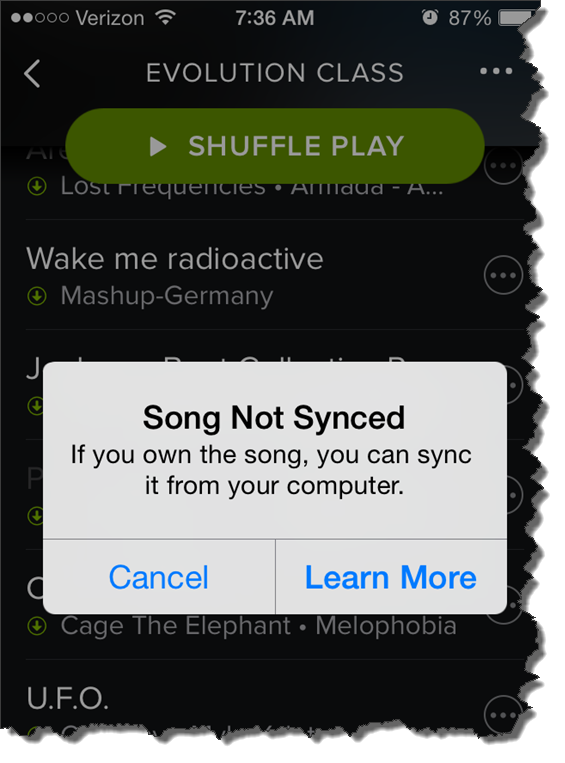
This morning at about 5:30, as is my normal routine, I check to see that my playlist is ready for my 6:00 AM class. The frustrating notice above appeared when I clicked one of the local tracks in my playlist.
I've seen this before
Amy has been having this same problem with her iPhone 6. Best we can tell, this started after she updated to the latest version iOS 8.1.2. Playlists that have worked perfectly in the past now have local tracks that won't play.
But not all local tracks are MIA – which is very confusing to me. For some I figured out that Spotify was substituting one of their tracks. Others work just fine. When I checked the folder location on my computer and compared working tracks vs. nonworking tracks – I can't find any difference. Unfortunately many of the remixes Amy and I like to use aren't available to use with Spotify = we're SOL.
So far I don't have a solution
We tried everything we could think of on Amy's iPhone; rebooted the phone, checked for a Spotify update, copied all the tracks into another playlist, toggled the Available Offline off and on multiple times… nothing has worked.
Some riders are present to train and give 100% every class. Many, however, are present simply to be…present.
Through The Customer’s Eyes
When was the last time you really looked at the Indoor Cycling experience you offer through the eyes of your customer?
The riders who consistently attend your classes relate to you. But … have you taken the time to consider how a first time rider relates to you and your teaching style. Have you taken the time to
walk in a first time riders’ shoes or ride in their saddle. If you have had new riders in your class who chose to not come back, have you asked yourself…
Am I current and relevant to today’s customer?
Keeping up with our customers’ evolving WHY means accepting the radically different concept that an increasing number of riders don’t care about the workout. It means embracing riders who are more concerned with recovery from daily stress than recovery from working effort. It means delivering a fun, safe, and effective class to riders who train for LIFE alongside riders who TRAIN for the road or for a specific event. It means making them feel safe the moment they walk through the door.
Have you ever considered that the rider on the end in the 3rd row may be…
Overwhelmed by numbers, spreadsheets, and thinking in general
Or … Suffering from an eating disorder and low self esteem
Have you ever considered that the rider in the back row, 2nd bike in may be…
Training for the Special Olympics…grateful for a 2nd chance at life
A parent whose child recently tried to commit suicide
A rider whose spouse committed suicide
An ex college athlete whose body feels older than his years…
who rides for the non impact cardio, weight loss, and because he can escape
A verbally abused housewife who quietly arrives late and leaves early every class…
not wanting to be recognized and grateful to be alone for almost an hour
A recovering addict who rides to get high…and to stay sober
A military wife who misses her deployed husband
A depressed teenager who doesn’t seem to “fit in” anywhere.
A mother battling post partum depression
A parent of a Marine that never came home
A 50 year old father with 100lbs to loose before walking his daughter down the aisle
Or … A veteran who feels lost and unappreciated.
Have you ever considered that the rider directly in front of you …worries about losing their job?
Each one of these riders is real and has a name.
Each one of these riders wants to escape, to check out, and to get lost in the music.
Accept … Don’t Judge WHY
Welcome every rider free of judgment and celebrate that they have a WHY that is different.
Accept that a rider may not want to push outside of their comfort zone. That’s OK!
It doesn’t mean they are “lolly-gagging,” “wasting an hour,” or “need to leave if they aren’t going to make an effort” because they aren’t working as HARD as you are asking them. That’s not WHY they are there. For them, it was HARD WORK, just getting there.
For these riders, the CardioTherapy benefits of Indoor Cycling outweigh any interval or strength training benefit. These riders and countless others stepped out of their comfort zone simply by walking through the door. If we, as instructors are current and relevant to their WHY … these riders have a better chance of returning. Make them feel SAFE and FUN follows. If we are doing our job correctly, EFFECTIVE falls into place and riders see results … mind, body, & spirit.
Accepting and understanding that every rider is not in your class to TRAIN like an athlete is the first step to delivering the ultimate Indoor Cycling experience, to every rider in the room, every time … regardless of their WHY.
The word “technique” intrigues some and makes others yawn. But there’s much to be said for technique. It’s the foundation for all athletic performance features.
Technique involves improved skills. In the broadest, most general terms, that means eliminating unnecessary movement; making movements in the correct directions; applying the necessary power, but no more than that; using the right muscles for the activity; and using optimal speed if time isn’t a factor.
Okay, that’s a dry list. Still, the benefits of good technique — and the consequences of bad — affect training and performance. The last thing I’m going to do is describe cycling technique; vastly superior riders have done that in too many venues. (Check out the excellent videos here on ICI-PRO.) Instead, I’d like to list some benefits of good technique.
Efficiency
The main benefit of good technique is efficiency. Efficiency is the ratio of work output to expended energy. If work output increases OR energy expenditure decreases, efficiency has improved. Efficiency and technique are closely related because principles of efficiency are so similar to principles of technique.
Many activities have an optimal rate. Rates above and below that cost more energy. The mechanism behind that is stored muscle elasticity, which requires the shortest time between muscle relaxation and contraction to prevent the loss of energy as heat.
Good technique reduces the energy required for the pedal stroke, reduces energy lost as body heat, and retains more mechanical energy for the next pedal stroke. Strength goes up — functional-type strength.
Practice reinforces cycling technique, so it improves efficiency.
Consistent velocity
Consistent velocity also affects technique. Unintentionally accelerating or decelerating due to poor technique wastes energy. Obviously, holding a single cadence throughout a cycling class isn’t usually part of the workout plan.
But staying consistent during a song or segment — an important technical skill — can increase efficiency. Beatmatch is an excellent teaching tool for helping students develop consistency.
What else affects efficiency?
Efficiency may involve factors other than technique. For example, it may depend on the contractile properties of the muscle: slow-twitch is more efficient than fast-twitch. It may depend on training, which can increase strength and endurance by increasing muscle efficiency. Big-gear training, for example, can improve efficiency in fast-twitch fibers.
Other benefits of good technique
Doing something with correct technique feels good, probably because the body is being used the right way.
Correct technique makes the student look good. In my master’s thesis, I compared the principles of technique and efficiency to principles of movement aesthetics. It turns out that what makes a movement correct and efficient is also what makes it beautiful.
So technique leads to efficiency, and that wastes less energy. The less we waste, the more energy is left for the demanding parts of the class when it really counts. And the better we look and feel cycling.
You’d like your students to look and feel good while taking your class, complete it successfully, and want to come back for more, right?
Jim Karanas always said, “Endurance athletes don’t mind expending energy, but they never want to waste it.”