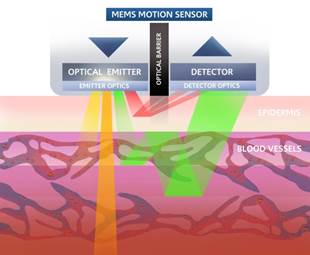
The Scosche armband heart rate strap uses optical sensors to “see” the pulses of blood flow in the blood vessels in your arm. Groundbreaking technology and pretty cool stuff if you ask me. Anything to get rid of those monitor chest straps will be an improvement. I feel this will result in a greater number of people training more effectively. You can read an earlier post where I describe the Scosche as possibly the best heart rate monitor strap option for participants in our classes that include any of the new Indoor Cycles with power consoles – except the Keiser M3 or M3i.
The new Apple iWatch uses the same optical sensor technology and it will be interesting to see how the two match up.
Jon Ham is a fitness consultant to Scosche and has written a detailed comparison between what he sees as the differences between the Scosche and the iWatch. You can read it here. [Understand that Jon's comments about the iWatch are based on information provided by Apple – the iWatch isn't available for purchase yet.]
As a side note, I've been trading emails with a former Schwinn Master Trainer who's involved in the iWatch project and (fingers crossed) I hope to interview him about the fitness applications of the iWatch once it's released.
The part I found most interesting in Jon's article was the part about data collection
Is the Apple Watch Designed to be a Continuous Heart Rate Monitor for intense exercise?
The way I saw it, In Tim Cook’s presentation, the Apple Watch was shown to be an excellent Activity/Life monitor, where movement, lifestyle, and general health were emphasized, and not heart rate training. I could be wrong, but I think Apple knows heart rate is not going to be super accurate during exercise with the Apple Watch, therefore they built the Watch around making a great interface for activity monitoring – IE: how often you stand up throughout the day, pedometer information, etc. This will surely play out to be a thorn in the side of FitBit and other activity monitors, but I don’t think it poses a threat to serious heart rate training athletes.
Data Centralization
I think Apple knows their job is to centralize the data collected from accurate sensors, not to necessarily create the sensor itself – except for activity monitoring. For example, Health Kit will allow all connected apps to push data that has been collected from different sensors directly into Apple’s Health App. I don’t see Apple getting into the Blood Pressure monitor or blood glucose monitor business any time soon, but apps that monitor blood pressure and blood glucose can push their data to Apple Health. I DO like the way the Apple Health App will centralize that information into one health app, along with other health related metrics. It makes sense to have all that data in one centralized location. The bottom line is that you should be able to use other heart rate sensors to do your workout and gather accurate data, you won’t be confined to only using the Apple Watch to collect accurate heart rate data.
Time will tell if Jon is accurate about this and if so, there's a chance we'll want to be wearing both an iWatch and a Scosche armband when we exercise.
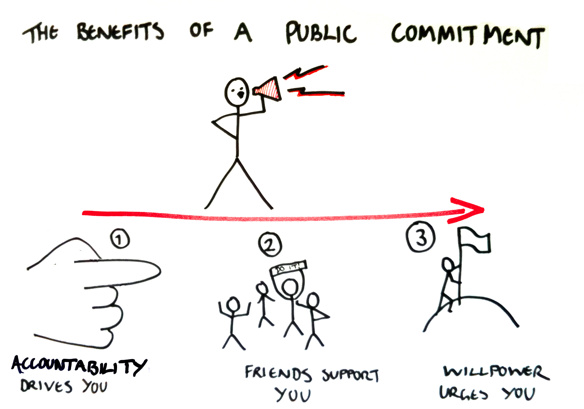
Found this great graphic at http://cooperandkid.com
We published the first 7 challenges yesterday and thought it would be fun to share my thoughts about each as daily posts.
By the way, you can still join the ICI/PRO 28 day Challenge – click here to request admission to our Facebook Group.
Challenge #1
We all have areas where we know we could improve. Today's challenge is to publicly commit to one tangible improvement at least for the next 27 days of the challenge (e.g.: start your class on time, spend more time helping new students, not be in a hurry to leave, build in more warm-up into your profile, etc..)
I'll often begin my class with this statement:
I walked in here believing all of you are capable of successfully completing everything I throw at you… it will be up to each of you, to prove me wrong.
This challenge is based on the same perception in your capabilities as an Instructor – actually all of the the challenges start from our belief that you can successfully complete all of the challenges. That's not to say that they're easy. Many will be truly challenging, but Lena and I feel you're up to all 28 of them.
We all have areas where we know we could improve. You don't need anyone to tell you; you need to get to class on time, or be better prepared. You already know your own flaws and weaknesses. But for some reason we don't choose to correct them; we're perpetually late, wing the class because we forgot to prepare, etc…
It becomes our little secret;I know. I know. I'm late to my class again.
Maybe no one will notice – they will and they do 🙁
I'll try to do better next week – but you don't…
Keeping your secret is easy, you just don't tell anyone. But something very important happens when you disclose your behavioral flaw to others – you might feel the need to correct it, because there's a chance the person you told may ask you again.
That's the purpose of the public statement. When said aloud; “I will not be late to class this month” you are giving the person/people you say it to permission to hold you accountable. Most of your class doesn't have trouble getting there on time – and they, in turn, believe you are just as capable as they are… now it's up to you to prove them wrong.
I'm a huge believer in the concept of including a “Best Effort” in every class I teach. “Best Effort” as in; what is your sustainable power over 3-4 minutes? The reason is simple – I want every participant, in every class I teach, to have an understanding of their estimated threshold wattage. Why? Because when I teach with power (always) I feel knowing where you should be is super important. It makes my cuing much more understandable to even the first-timer. I can then ask for efforts Below/@/Above threshold and there's no confusion.
And I'm not the only one doing this. In his upcoming Audio Class Profile, Master Educator Dennis Mellon uses these “Best Efforts” for exactly the same reason 🙂
But my regulars would get a bit bored if I did the same class every week, so I mix up how we do these… Climbing, Fast Flats and occasionally we'll even do them out of the saddle! Regardless of the cadence or position, these are very popular (OK, sometimes I get a few groans) with my class. Throw one in at around the 20 mark, and then as the “Big Finish” at the end of class – except during round two your expectations are for even a BIGGER “Best Effort” as a close.
A fun “Best Effort” takes the right music and I'm providing a few remixes from Instructor/DJ Peter Gonzalez, better known as Peter G, that should work nicely for you to add in to your next playlist.
65 RPM “Best Effort” track – at 4:37 you'll start with the first spoken lyric and ride for 4 minutes.
The music wars are starting to heat up between Apple/iTunes and Spotify. Last week Apple added (without your permission) the new album Songs of Innocence to every iTunes account in the world. Some people weren't happy with either the free music… or the part about Apple adding it without telling anyone what they were doing. So Apple has created a free tool to remove all of the tracks if you don't want them.
From a marketing perspective this was very cool. In one day something like half a billion iTunes users had the songs in their possession, making this the largest ever album launch in history.
Except this has effectively locked this album out from Spotify and Deezer, neither of which have access to these tracks. One article said Apple paid U2 $100 million > I don't know about you, but I'd grant Apple an exclusive for that amount of zeros.
But you can add them to a Spotify or Deezer playlist 🙂
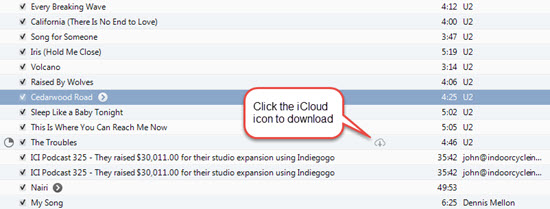
In iTunes go to your Library and if you search by date added you'll see the list of tracks from Songs of Innocence, but they'll be light grey because they aren't actually downloaded. What you are seeing are just links to the Apple iCloud. You'll need to click the little cloud icon next to each track to download it to your computer.
In Spotify or Deezer you'll see all your new U2 tracks listed in the Local Files section.
Display tracking of each rider's performance during an Indoor Cycling class is proving to be very motivating for the riders and profitable for the studio owners because those participants keep coming back.
Customer retention is hugely important to keeping your classes full. I hear over and over; “once you've shown me my performance, up on a screen and then on that email I get after class, I'm hooked. Why would I ever go back to that Big Box club, who doesn't show me anything?”
Jennifer Ashbrook is the owner of Inner Drive Cycling | Fitness Studio in Newtown Square, PA. Jennifer's studio features FreeMotion S11.9 indoor cycles that provide the performance data that drives the Spivi Display Training system she purchased to differentiate her studio, from other competing fitness clubs in her area.
Jennifer created this short video to help her prospective customers understand Spivi and how it adds to the “WOW” factor of her classes.
You can learn more about Jennifer and her studio by listening to our interview.
I forgot to talk about … It's common for guests to contact me, post interview, with a point or two that they felt should have been included, but weren't. Jennifer emailed me to add:
Hi John,
I just wanted to thank you for the chance to talk with you about Spivi this morning — I really enjoyed it! A couple of things I think maybe I should clarify about Spivi that I forgot to mention — when I explained how Spivi “normalizes” or handicaps riders, I indicated that they are normalized based on power output — and that’s a major part of the equation for bikes with power — but the system also takes into account cadence; it factors all of that together and “ranks” riders based on “Spivi Points” — which (as I understand it) factors in riders age, weight, gender, FTP (if know and power data is available), and cadence — perhaps other factors… The system can also pick up heart rate from ANT+ heart rate straps.
You probably know how I came up with the title of this article. Several years ago, a popular book advocated chocolate consumption based on various factors, some of them unique to women. Hormone changes during PMS, menopause and stress were given as examples. Trust the body and give in to your cravings, the author told us! Indulging is better than depriving ourselves. Fat and carbs like bread and chocolate are the body’s natural feel-goods. (Yes, it really says that.)
Where are the anti-gluten, anti-processed food champions when we need them?
The good thing about the book was the extensive bibliography. I researched, read and cited a few of the references in my dissertation. Still, the author’s conclusions are flawed. For instance, she says cravings reflect the body’s needs. It’s a common theory, but it’s just not the case with processed, addictive foods.
So I hope you haven’t been recommending chocolate for your students, even if it’s PMS time!
Why talk about this not-so-new book? Because cocoa is news. No doubt you’ve read about, heard about, and talked about the benefits of cocoa, particularly dark, unsweetened, 70% cacao. They’re everywhere lately: the antioxidant benefits due to the specific flavonoids in cocoa, called polyphenols.
A quick summary of the benefits includes decreases in all of these: blood pressure, insulin resistance, excess clotting, diabetes risk factors, and the risk of cancer, stroke, and coronary heart disease.
In addition, cocoa promotes increased HDL (good) cholesterol and improvements in vascular health and gut bacteria, which thrive on the polyphenols. Cocoa can prevent oxidation of LDL, which contributes to arterial disease when unchecked. It even seems to inhibit fluid secretion in the small intestine, so research may soon show it to be effective in treating diarrhea.
Other health benefits are reduced fatigue and improved mood, both due to cocoa’s natural theobromine (similar to caffeine). Another mood-elevating chemical in cocoa is phenylethylamine, sometimes likened to the feeling of being in love.
What I won’t do — send me your hate mail now — is what the book’s author did, namely recommend chocolate. Even 70% dark chocolate.
Why not? The drawbacks of sugar are too great. In fact, sugar can singlehandedly reverse almost every one of the benefits of cocoa listed above.
But there’s not much sugar in 70% chocolate, you say.
I specialize in sugar addiction, so I look at sugar’s consequences differently. Recently, at someone else’s seminar, a participant offered her opinion that “sugar is bad in large quantities.” You’ll never hear me argue with that! Yet sugar can be bad even in small quantities because of its sneaky effects.
One sneaky effect of sugar is to increase appetite. Another sneaky effect is to change food preferences. Both of these are due to endorphins, which are often overlooked when people talk about health or food.
And what then? Your students may eat an “innocent” amount of chocolate and find themselves wanting more food in general AND more endorphin-triggering foods — such as sugar of all types.
This is how the quantity of sugar can go way up when students eat chocolate for its “health” benefits. Health becomes the excuse for eating sugar. And that’s why I won’t recommend it (no matter who does).
But I will — and do — strongly recommend cocoa. Dark, unsweetened, 70% cacao will let you reap the benefits of cocoa without the drawbacks of sugar. Please tell your students.