As I was bouncing between Indoor Cycling sessions at IDEA, I kept Shazam qued up on my iPhone. It came in handy for when I heard something fun… and there was a lot of great music at the conference!
During Nothing But the HIITS! (a Schwinn Cycling presentation from MI Tatiana Kolovou) she played Juno Reactor — Pistolero – Astrix Remix which I thought would make for an awesome long 7:16 climb @ 70 RPM. It includes a fabulous intro that you just know will lead to something challenging.
Here are the workshop notes for Nothing But the HIITS! you can download if you didn't get the chance to attend IDEA.
The same version is available as a free download 🙂
A Playlist of offline video could make for a cool class 🙂
The word out is that YouTube is planning to launch a streaming service, similar to Spotify and Deezer, for music videos. The premium version would be advertisment free which would be very cool.
I realise that in the past we (and others) have pointed out that playing YouTube videos in a commercial setting (your class) is against YouTube's terms and conditions that prohibit displaying their videos in a club, bar or studio. iTunes, Spotify, Deezer and every other music service has nearly the exact T's&C's – no commercial use. Many of us are using these services to deliver our class music and your club or studio should be paying ASCAP and/or BMI for a commercial use license. My view* is that that license should cover your playing of music videos, just as it does for the audio versions of the songs. Or maybe there's a different license required for videos? If this becomes real I'll dig in and find out more.
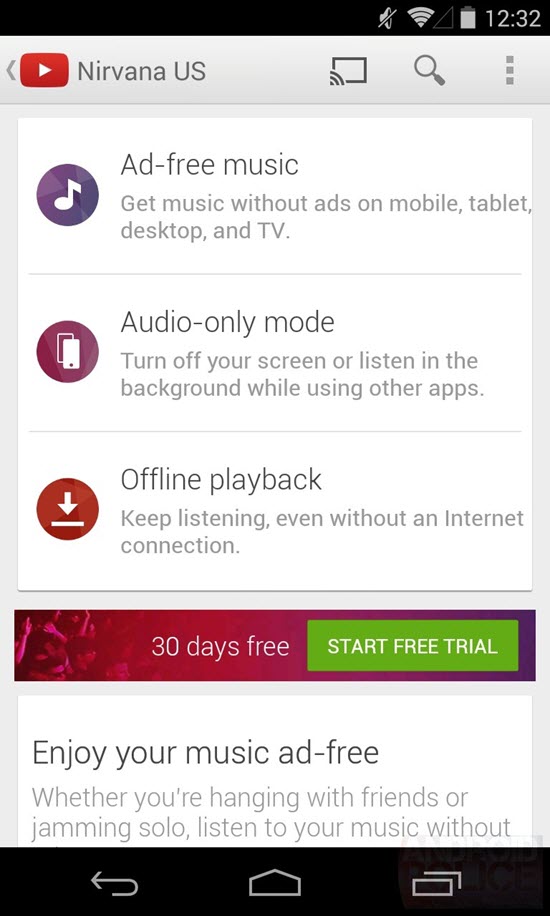
Here's the basic rundown – YouTube is set to launch a service called YouTube Music Key, and Google is set to rebrand Google Play Music All Access to Google Play Music Key.
Specifically, it looks like YouTube Music Key will offer ad-free music, audio-only playback (for background or screen-off listening), and offline playback…
Of course, one of Music Key's major value propositions is that users will have access not just to official discographies, but to concert footage, covers, and remixes. Play Music already houses remixes and covers, but YouTube as a platform is significantly more open and workable for derivative content – the platform is much easier to add content to, and user discoverability is substantially different from Play Music. YouTube Music Key also promises to make suggestions for what to watch/listen to based on the other things you watch/listen to on YouTube.
Of course all of this is speculation / rumors – except that screenshot looks pretty legit > so we'll have to wait and see if/when it launches. Also if this will be available as an iPad app, or will it just be for android?
While we continue to wait for Deezer to make it here in the USA (which was promised for sometime in 2014) the potential that there could be an advert free, music video service that would play off a portable device means there's lots to look forward to 🙂
Does showing a playlist of music videos sound exciting to you?
*I'm not an attorney, so proceed at your own risk. If you have questions or concerns, seek competent legal representation.
There are times when exercise can be painful*, especially when you're coaching or participating in, a HIIT or Tabata® training class. You know that. You might also be aware that the more you expose yourself to high intensity training, the feelings of pain / discomfort you experience diminish over time. Said another way; over time, you may develop a tolerance for the pain that accompanies HIIT or Tabata® type training. You knew that too… and now there's actual research that suggests regular exercise can reduce a person's sensitivity to most any type of physical pain.
I learned at IDEA that Tabata® is an actual brand name. Out of respect for them I've included the ®. I hope to have more about the new Tabata® Cycling certification they'll be offering in the near future.
Regular exercise may alter how a person experiences pain, according to a new study. The longer we continue to work out, the new findings suggest, the greater our tolerance for discomfort can grow.
For some time, scientists have known that strenuous exercise briefly and acutely dulls pain. As muscles begin to ache during a prolonged workout, scientists have found, the body typically releases natural opiates, such as endorphins, and other substances that can slightly dampen the discomfort. This effect, which scientists refer to as exercise-induced hypoalgesia, usually begins during the workout and lingers for perhaps 20 or 30 minutes afterward.
But whether exercise alters the body’s response to pain over the long term and, more pressing for most of us, whether such changes will develop if people engage in moderate, less draining workouts, have been unclear.
So for the new study, which was published this month in Medicine & Science in Sports & Exercise, researchers at the University of New South Wales and Neuroscience Research Australia, both in Sydney, recruited 12 young and healthy but inactive adults who expressed interest in exercising, and another 12 who were similar in age and activity levels but preferred not to exercise. They then brought all of them into the lab to determine how they reacted to pain.
Click the link if you'd like to read the entire article – here's the important conclusion…
The study’s implications are considerable, Mr. Jones says. Most obviously, he said, the results remind us that the longer we stick with an exercise program, the less physically discomfiting it will feel, even if we increase our efforts, as did the cyclists here. The brain begins to accept that we are tougher than it had thought, and it allows us to continue longer although the pain itself has not lessened.
So how can this help you as an Instructor or coach?
While at the IDEA fitness conference this week, I took the Tabata® Cycle workshop presented by Team ICG Master Trainer Mike Michels. During Mike's lecture he really emphasized how difficult it is to perform the series of 8, 20 second all-out intervals properly. So difficult in fact that Mike said none of us would be successful initially. But if we performed them regularly, over time we will improve. Beyond an increase in fitness we'll experience, some of that improvement will come from an increase in tolerance for the pain that's a part of HIIT.
I left the class thinking… I should start communicating – your incentive for working hard today, will come in the form of a less painful workout tomorrow. Then, when your tomorrow comes, take advantage of it 🙂
*Of course I'm talking about the pain felt when pushing yourself to your maximal effort, not localized pain that's indicative of poor form, improper bike set up or joint strain/injury 🙁
Here's a special treat for you. With me and Amy in LA at the IDEA fitness conference, Master Trainer Dennis Mellon (new title for Dennis – more about his advancement in a week or so) has provided a three track mash-up for you to add to your next class playlist + a high quality recording of him teaching the actual class.
Start by listening to how Dennis cues this 9:54 minute three song mash-up, recorded during an actual class – download it here.
Here's the three song mash-up you can download to add to iTunes. Right click here > save as…
Dennis and I would love to know if these longer music segments are of value to you. Please leave your review below.
Two articles, about two different Indoor Cycling Studios, came across my desk today! The fun part for me was how they both featured ICI/PRO members who've hung out their shingle and pursued their dreams of a fitness business!
And Rev Up also takes advantage of technology to help people keep up with their workouts and fitness goals. Each bike has a mechanical device that calculates the amount of work a person does while exercising.
“One of the challenges has been, typically in spinning, is that people get on there for 45 minutes to an hour, and they get all hot and sweaty, and they guess how many calories they might have burned; they don’t really know,” Beane says. “With our system, they have a very accurate (record), as well as a way to track how many calories did you burn, how many watts did you produce. … Since that data all goes into your account, you can track over time, ‘How well am I doing? How am I progressing?’”
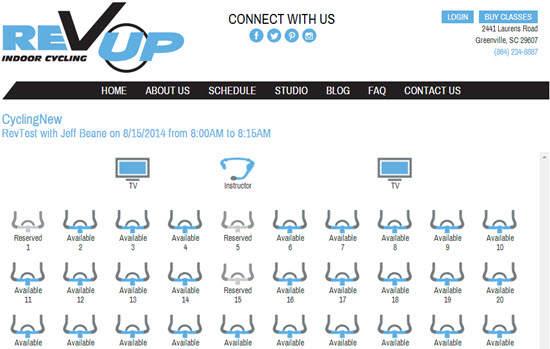
A screen shot of Jeff's online reservation page, from his great looking LiveEdit, website is above. By registering for a specific bike, the Performance IQ system knows who's – who in the class and then displays and records the rider's performance data in their user's account.
Jeff's studio is still very new. He'll probably appreciate learning how a bike reservation system has solved some problems at CBCycle Barn, from owner Karen Casler…
How CB CycleBarn Indoor Cycling Studio Used a Bike Reservation System to Cure ‘It's MY Bike Syndrome'
What are your customers saying about your site and the Stations app? (Live Edit's name for their reservation system)
Customers love booking their bikes! It has a trickle down effect of both customer and studio benefits. The Stations app allows me to give the customer what I feel is the most powerful customer service tool there is. The Stations app lets the customer know exactly what to expect!
Aside from knowing what to expect, another bonus is that by booking a bike online, customers are immediately escalated to VIP status. I like to use the analogy of flying American Airlines vs. Southwest Airlines. People are territorial about their space in any GroupX class. Before the Stations app, any territiorial Bike Vultures arrived early and hovered anxiously, waiting to stake claim to “their” bike.
Territory anxiety is now a thing of the past–but that’s something I expected when we added the Stations app. What I didn’t expect was that the Stations app would relax everyone! Some of the greatest feedback I’ve received is from the riders who had simply put up with the Bike Vultures because it’s been that way since the beginning of GroupX time. It never occurred to anyone (myself included) to complain about the “It’s MY Bike Syndrome” riders.
The very day the Stations app launched, the tension that we didn’t even previously acknowledge was instantly gone. Customers shared with me that they had felt so uncomfortable waiting for a class to start because of riders inflicted with IMBS. They had stories of being pushed, accidently hit with gym bags, and shoved aside in the stampede to stake claim to a bike. But that’s not all. Riders from the class before the IMBS stampede had also been made to feel uncomfortable. Their amazing hour of cardiotherapy zen was abruptly disrupted by hovering Bike Vultures before the first rider could wipe down the bike and gather their belongings.
VIP status … Check.
Bike Vulture Extinct … Check.
Performance IQ Compatibility … Check.
Knowing Exactly What To Expect … Check.
As a studio owner, how can it possibly get any better ?
How bout … Parking Lot Congestion Relieved … Check.
One of the most common issues for any dedicated indoor cycling studio is the parking lot crossover between classes. Because it is no longer necessary to arrive early to secure bike real estate (and trust me some people arrive as much as 30+ minutes early,) riders now show up 5 minutes or less before class starts. This allows the first class to make their exit and gives a lil’ breathing room for those coming in for the next class.
Priceless.
And there is one more box to check…
Competitive Advantage … Check.
At the moment, none of the big box gyms around our studio offer a Stations app reservation system. Using the Stations app makes reserving your class and showing up for class easy.
It’s dinnertime, and I’m flying home to San Francisco from a Houston business trip. The flight attendant is bringing around the service cart and I’m about to order … milk. I never drink milk, so why now?
Let’s go back to how the day started. Fortunately, I had ordered eggs and oatmeal from room service. (This was a number of years ago, before we all became gluten-phobic.) Breakfast showed up at 7:00; so far so good.
I was in Houston in January for a meeting called by Sherry. The meeting started at 10:00 a.m. and was scheduled to last till 1:00. My return flight was at 2:30 p.m.
Sherry had promised us food. I should have been suspicious, because Sherry and I once had dinner at an airport, and hers was a plate of white-flour pasta and a plate of white rice. The only foods at the meeting were donuts, Danish pastries, M&Ms, Halloween-size candy bars, soft drinks and coffee. No refreshments for me, thank you.
At 1:00, a few of us got into Sherry’s car so she could drive us to the airport. Six hours without food had left me hungry, and I planned to get food at the airport. Unfortunately, unexpected traffic due to an event in town slowed us to a crawl. It was not going to be possible to get food before my flight. Maybe a pack of raw almonds? Almost every airport newsstand sells those.
Well, time was so short I had to run to the gate. When I finally stepped on the plane, they closed the door literally the instant I was on board. And then.
The flight couldn’t take off for an hour due to some problem or other. (Believe me, I had stopped caring.) Even when we were cleared to go, we couldn’t take off because the plane now had to be de-iced. We sat on the tarmac for 2 more hours.
So our 2:30 flight departed at 5:30. There was no meal service — it was an afternoon flight. A 2½-hour flight. After a 7:00 a.m. breakfast and nothing else, all I could think about was food.
Finally, the beverage cart appeared. I had already decided what to order. You might think I’d grab whatever I could get, but as I watched people consume Pepsi, ginger ale and apple juice, I knew that spelled nothing but trouble for a carb-sensitive like me.
The answer lay in finding food.
Food on a beverage cart. Are you thinking peanuts? So was I. But they had pretzels. White flour would have been worse than nothing. So my plan — at this point, was it Plan B or Plan C? Maybe D; it was a long day — was milk. Milk isn’t a beverage; it’s food. Usually, I don’t drink it, but this wasn’t usual.
Got milk? They had it — 2%, the only kind they serve on airlines. I had done the calculations (plenty of time to do arithmetic on the tarmac), and 2% was actually the perfect answer. It came as close to a 40-30-30 meal as I could get on the fly, although it was light on protein and a bit heavy on fat. Even though I don’t go around pushing 40-30-30 meals (remember The Zone?) on my clients, I do know that the effect of those percentages is stabilizing.
The key word is Stabilizing, and that’s the take-away here. In this case, stability refers to both blood sugar (glucose) and brain chem. In a semi-emergency like this, it’s tempting to use the situation as an excuse to grab anything edible, even things we should avoid.
But milk was a wiser choice, and in 20 minutes I felt a lot better.
Lately, I’ve been finding it necessary to go with Plan B often — so the best idea is always to have one. When it comes to food, a solid Plan B is absolutely vital. Carry envelopes of protein powder or packs of raw nuts with you, rather than fruit. Think stability. After all, we’re talking about your brain first, as well as the rest of you.




 and hovered anxiously, waiting to stake claim to “their” bike.