I love the simplicity of the Zoning Heart Rate program. Three zones (Easy-Blue/Moderate-Yellow/Hard-Red) that are created using two thresholds; T1 Aerobic Threshold & T2 Anaerobic Threshold – AKA: AT or LT. Simple to communicate and easy for anyone to understand – perfect IMO for our Indoor Cycling classes.
We've discussed Zoning multiple times here at ICI/PRO. Here are some links where you can learn more about Zoning and how this three zone system is recommended by ACE – the American Council on Exercise as their preferred Heart Rate Training program for our “Club Athletes”. We've also got some excellent class profiles that follow the Zoning format.
Tia Kilpatrick is a Zoning Specialist who works closely with Sally Edwards. You can virtually meet her in the video below where she leads her Falling in Love with the Golden Zone class at the past Heart Zones conference held in conjunction with Cycling Fusion.
Tia has an upcoming ebook; 44 ZONING Rides for the Indoor Cycling Enthusiast. We'll let you know when it's available.
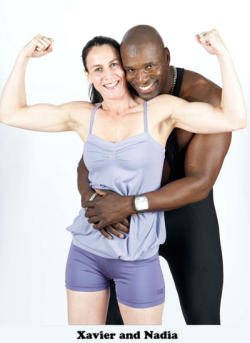
Running a successful fitness studio takes a lot of passion, experience and hard work. The husband and wife team of Xavier and Nadia McClinton who run Body By X Skill Development & Training Center in Marin County California sound like they have all three covered… and more!
Together they have developed a unique fitness offering that combines strength training, along with Indoor cycling and includes the MyRide+ virtual ride video system. Body By X's experiences with MyRide+ were covered in more detail in this case study we published back in February.
Listen to my interview with Xavier and Nadia to get an understanding of how they are able to succeed by creating a real sense of community at their studio and a simple idea you can use to retain members who (for whatever reason) decide not to show up.
You can subscribe to our free Podcast in iTunes by clicking here.
Minimal required maintenance – the belt doesn't stretch and you never need to lube it.
Should last forever
Did I mention that it's very quiet?
Weaknesses
More expensive than a chain drive
It may require the pedal crankarms be spaced further apart = wider “Q-factor”
That's all I can think of.
Disclaimer and perspective: I have taught on the FreeMotion S11.9 for the past year at two Life Time Fitness clubs. I train at home on a S11.0 (the home trainer) that was given to me for evaluation purposes.
My only real complaint with the original chain drive FreeMotion S11 series Indoor Cycles has been the amount of chain noise coming from the drive system. That noise, multiplied by 50 or more cycles in a class (or just one in a basement) can be very distracting/unsettling/frenetic and it requires much more volume of both you and your music.
If you've every experienced how calm/relaxed a class with belt driven cycles is, you'll understand exactly what I'm talking about.
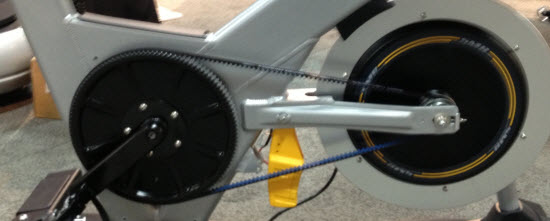
Where does this additional noise comes from? It's from the chain wrapping around very small front sprocket used to rotate the flywheel at a much higher RPM than on a friction IC.
Big drive gear x small driven gear = very fast flywheel RPM
All Indoor Cycles use some form of weighted flywheel to mimic the momentum of riding a bicycle. Cycles with magnetic (Eddy Current) resistance (FreeMotion S11.x, Keiser M3 & Schwinn AC) all use an aluminum (or combination aluminum/steel) flywheel. All steel alone won't work when you're using Eddy Currents to create resistance.
Aluminum is lighter than steel = less mass = less rotating momentum. Also the design of the combination flywheels has the “steel” portion closer to the hub, resulting in less mass around the perimeter of the flywheel. The flywheel needs to rotate quite fast to create enough of these “Eddy Current's” to make the requested resistance, which is good because this additional speed makes up for the aluminum's lack of mass. The gear ratio (big crankshaft gear x small flywheel gear) needed to achieve this flywheel speed = additional chain noise.
By using a belt, instead of a chain, FreeMotion has eliminated the noise problem… but all belts are not the same…
There are a number of popular Indoor Cycles using a belt drive system; Keiser M3, Livestrong/Tomahawk and the LeMond RevMaster. All of these cycles all use a Kevlar belt – perfect for most people, except for the cyclists in your class. For them, these Kevlar belts feel very foreign. They don't “feel” like a bicycle because chains create a vibration as it rolls across the sprockets and that vibration is missing from a super smooth Kevlar belt.
I'm sure that Gates did a bunch of research and testing when they developed the Carbon Drive system as a replacement for bicycle chains. Their success (I'm presuming here) would be dependent on creating a replacement for a chain that eliminated all the negatives; maintenance, wear, weight, grease and noise – while retaining the familiar feel of riding a bicycle. The “teeth” of the carbon belt, as it rolls across the pulleys, create a similar vibration to a chain = the “feel” of a bicycle, W/O any of the negatives of a chain.
Recovery is one of those interesting words that can be used to describe two completely opposite things. We're often discussing recovery as a well deserved period of rest, like some easy pedaling after after a hard effort or simply a fun day that follows a week of focused training.
But recovery can also be hard work 🙁
Like recovering from a near disaster from when your trusty Dell computer abruptly reaches the end of it's life. So instead of being really productive this weekend, I had the privilege of spending way too much time downloading 300 gig's of files, installing all the programs and drivers I use + uninstall all the BS programs (all very annoying) they stuff into a new computer and adjusting the myriad of computer settings that I've become accustom to dependent on. I must have clicked à agree” thirty or more times, never once reading what I was agreeing to. I hope it wasn't anything important.
My plan to launch the the next Ultimate Instructor Class Profile Contest has been pushed off a week – until 9/22.
But don't let that stop you from getting started. The Grand Prize winner will be vacationing somewhere warm this winter… and they'll need a passport to get there.
Also we have been working on a redesign of this website that incorporates many of the ideas and requests many of you expressed in our recent survey.
Coach Gino gets an assist from a professional statistician.
Let’s Try This Another Way
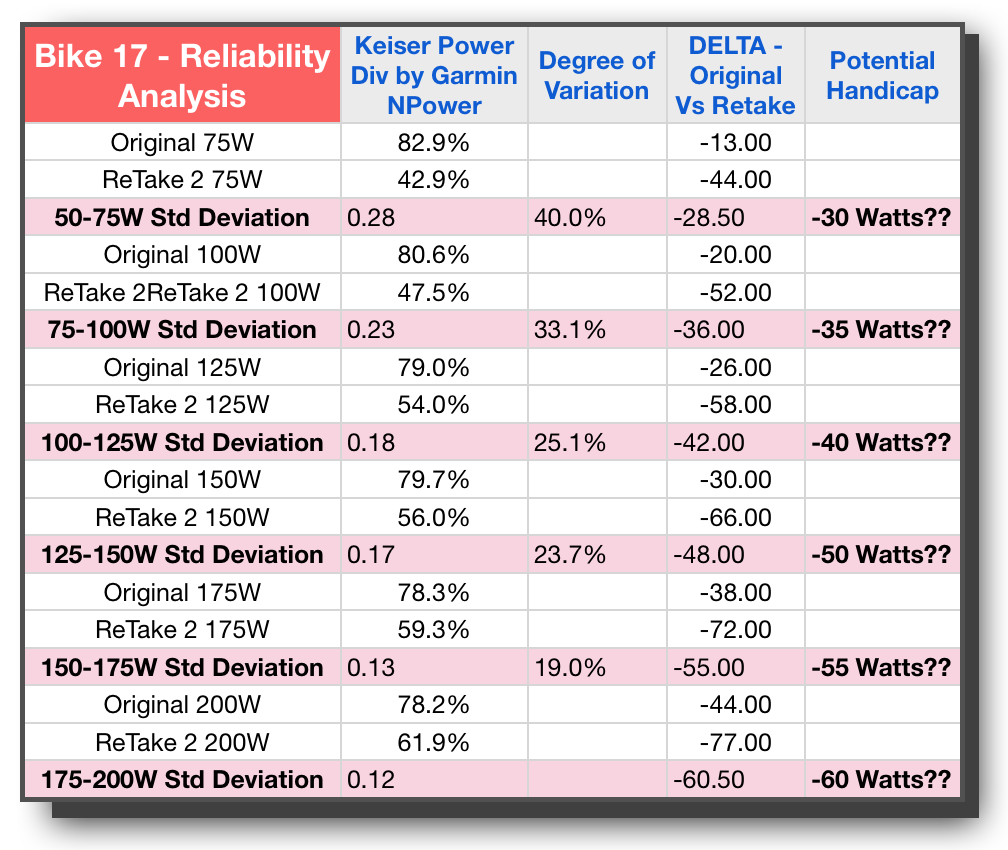
After testing 14 different bikes, with 6 of them also being repeat tested at least twice, I was pretty disappointed to see the data I reported in our last blog. This was never meant to be just an academic exercise. This had pure practical motivation. I wanted to be able to do real and reasonable competition in class. I wanted to encourage more tantalizing trash talk among my most competitive riders. I wanted to let some of my “little old ladies” throw it down against some of the guys who think bigger is better. I needed the bikes to be on an even scale to do this in good conscience, and handicapping them against a reputable objectively measured power meter seemed like a no-brainer to do just that.
But alas, the numbers from my work up to this point lead me to a conclusion I simply had not anticipated; that each bike within itself may vary day to day with regards to what power it will display given the same force being applied. This was an assumption that myself and many other “defenders of calculated power” have held on to for these past 4 years or so – that it doesn't really matter if the power is accurate compared to what would be measured with a real power meter, as long as that power was consistent. In other words, we could know if our training was making us better or not by pre and post testing on the same bike. It would simply generate a relative value so we could know if we improved a lot, a little or not at all. Each year at Winter Training we would assign bikes so that we could be assured of this “fact”. This was indeed the fundamental assumption that prompted the entire notion that a handicap could indeed be created, if we had a objective way to get at power simultaneous to seeing the bike's power display.
Unfortunately, as you could see from the numbers reported the last time, they varied so much within the same bike, from one testing episode to the next (even despite painfully recreating the same circumstances of a consistent rider, environment, time of day, method of execution and all the like), that this assumption was not true for at least 50% of the bikes. Undaunted by this surprisingly sad turn of events, I started to ask around for an available statistician that might be interested in this research. I wanted a more experienced extra set of eyes and less personally invested perspective so that they could let me know if I am doing something wrong. Was I measuring the wrong way, perhaps working with false assumptions, not controlling enough variables, etc. I didn’t want to give up just yet — I had already invested too much time and energy.
3 More Bikes Tested, 3 Times Each
One of my regulars referred me to Sarah who is both a cyclist and teaches statistics at a nearby university. We met a couple of times to discuss what I had done so far, and she spent some time and thought on the issue, and created a new protocol. We would focus on just 3 bikes, took them out of commission so no one else would ride them, made sure she conducted/directed me as I rode/tested each bike. These trials would be done on three different days, in random order as generated from a random table of numbers. This video takes us through one of those three sessions.
In the next blog post, we will discuss the results of these 9 trials.
It's National Eagle Day here in the USA and I thought I should share an experience I had with the bald eagle one morning before class. I actually had this post sitting as a draft from a few weeks ago. As often happens, I got distracted and never finished it. Learning that today is our day to celebrate these majestic birds has me back at the keyboard.
A great metaphor flew over me this morning!
And when I say flew over me this morning, I mean flew right over me! This bald eagle flew directly over my head, and swooped down on one of the many fat rabbits we have around here, quickly dispatching it.
I was walking into the club this morning (it was a Saturday and I was subbing for my partner who doesn't like to wake up in the morning), thinking through my profile when I heard (and felt) this loud swoosh before seeing this massive bird dive in on his breakfast. If you haven't seen one of these strong, majestic birds up close and personal you are missing a great treat. They stand nearly 3 feet tall and with a wingspan of over 6 feet, the sudden presence directly over my head was quite startling and I'll admit a bit frightening.
Side note: this particular Lifetime Fitness sits on the edge of a large swamp/wetlands and only a few blocks from a major shopping mall. Seeing a bald eagle isn't all that surprising around here. It was always very common to see these beautiful birds perched in trees as you drive through northern Minnesota. Now it seems that wildlife of a every sort is moving back to the suburbs to reclaim their place in what was once farms and prairies.
But this beautiful bird had a problem. Despite their reputed incredible eyesight, she (?) (how do you tell the difference?) appeared to have completely overreached, miss judging it's weight and wasn't strong enough to carry away her breakfast. With a firm grasp on her rabbit, she leaped off the ground with wings powerfully flapping. But try as she might, she was only able to get three or four feet off the ground before stalling, dropping the rabbit before she herself crashed back to earth. I watched from about 20 feet away as she circled repeatedly, each time swooping over my head, attempting to grasp the rabbit and fly off. Each time with the same results… and then I realized she had a plan.
With every attempt to carry off the rabbit, she moved it 10 or 15 feet. It became obvious that she wasn't going to sit and consume her catch right there in the middle of a parking lot, but rather her plan was to move it to a stand of trees, which were across the road from the club – across four busy lanes of traffic, I should add.
It was a climbing day, per our class schedule and my plan was to show Epic Beartooth Pass. As I was getting dressed for class, I realized what a fantastic metaphor I just observed. So during the warm-up I told the story of what I had just witnessed. I talked about how impressed I was with the Eagle. How I watched her develop a plan – improvising a strategy, so as not to lose what she was fighting to accomplish.
I asked the class; do you have the confidence to overreach today on this climb?
I mean really overreach… to the point where you're forced to resort to Plan B?
A common strategy out long climbs as to alternate between seated and standing. As you ride along you'll add an extra gear or two, which has the effect of forcing you out of the saddle. Then you remove those gears and returned to the seat. Because we're riding Freemotion cycles with power, I'm able to coach everyone how they find their two, individual, climbing gears. After we're warmed up I have everyone work through a five-minute effort at or very near threshold HR. this gives us a baseline power average to work with. Maintaining a steady 80-ish cadence, seated efforts are just below this wattage number and the standing number just above. There's no break in this climb. The effort is continuous. Over and over we alternate position – adding for standing, remove slightly and back to the saddle.
After class I hurried out to see if the eagle had been successful. It wasn't difficult to figure out where she was. A swarm of angry blackbirds were taking turns diving at her, as she sat perched in the tree looking down at her catch. I walked over and this is where I had the chance to take her picture. Complete confidence 🙂