
by John | Sep 13, 2019 | Instructor Training, Master Instructor Blog, Your Fitness Business

This morning I read how Soul Cycle has been banning fitness instructors (from competing studios) who try to attend their class.
About 10 days after hitting a SoulCycle class on a recent day off, Barry’s Bootcamp owner Joey Gonzalez got a phone call. It was a lawyer for the mega-popular cycling brand issuing a message: don’t come back.
“He essentially said we have a policy at SoulCycle where instructors at other group fitness studios are not allowed to take class,” Gonzalez says. “He seemed half embarrassed.” We reached out to SoulCycle’s public relations team for comment on the policy but did not hear back.
Gonzalez took to Facebook with the news, and his post went viral. (At time of this writing, it had 158 comments and 14 shares.) Other popular fitness instructors, like Natalie Uhling, Darryl Gaines, and Lindsey Clayton weighed in to say the same thing had happened to them. Flywheel instructors jumped in to invite trainers from other studios to come take their classes (“#team”), and tons of people weighed in to rail against the lack of “soul” the policy stood for.
Then I dug in to this story a bit more. The article references this post from rateyourburn.com addressing the same issue. They begin with listing a few reasons why it maybe OK to limit the access of Instructors from competing fitness clubs. I see it as incomplete… in fact, I feel they are missing the real concerns of Soul Cycle completely.
IS IT OKAY FOR FITNESS STUDIOS TO BAN INSTRUCTORS WHO WORK FOR THE COMPETITION?
Why do studios ban instructors employed by competitors?
-
Trade secrets. We suppose the primary reason studios do this is to prevent competitors from coming in and spying on their ways of business, copying them or stealing their methods.
-
Exclusivity. Perhaps some studios want to create a country club bubble, where only approved members are allowed within their establishment.
-
To ward off studio-bombing. On rare occasions, people do show up just to cause trouble. In our opinion, bad behavior is the only justifiable reason to ban a paying client.
Limiting access to your “Tribe”
Paul Harmeling from Full Psycle Studio really opened my eyes about what makes Soul Cycle so successful – how good they are at cultivating a “team” or “tribe” of passionate people who are united by their participation in class. This sense of community isn't just between the customers and Soul Cycle or the Instructor. There are a lot of relationships, both personal and professional, being made between the riders.
You've probably seen this at your club. It's no secret that common interests and activities build trust between people. That trust can lead to relationships that extend beyond the club. Over the years my family and I have chosen to do business with people we've gotten to know at our club;
- Claudia is Amy and my financial planner – she's also been a longtime regular in our classes.
- Amy first met Craig at the club. He later hired her and we've been friends of Craig and his wife Julie for 15 years.
- Morry (another regular) arranged for daughter Abby's interview, which resulted in her current job.
- Richard is an Instructor at our club. He's also a C level employee at a company where younger daughter Carly would like to have a summer internship…
I can easily understand why Soul Cycle (or your club for that mater) would want to limit access to their Tribe of passionate, fitness minded people who have the financial wherewithal to pay for premium classes.
Wouldn't these same people be prospective customers for any fitness business – especially a competitor located near by?
Soul Cycle's “Tribe” is really their brand, the “special sauce” that makes them unique and profitable. Using attorneys to protect a brand from competitors isn't really any different from how Mad Dogg Athletic will do the same thing to protect the Spinning® brand from improper use.
I don't know anymore than what's been written, but I would venture this guess; Soul Cycle was concerned that Mr. Gonzalez was recruiting customers for his boot camp business. Neither of the articles, nor the Facebook post, explains how Soul Cycle's attorney would know Gonzalez was an Instructor… unless someone (maybe a class participant?) informed management.
What would you do in this situation?
Originally posted 2014-05-05 09:15:44.

by Joey Stabile | Sep 11, 2019 | Audio PROfiles, Best Practices, Class Work-Sets, Creativity Indoor Classes, Instructor Training, KEEPING IT FUN, Master Instructor Blog, PRO/Playlists, Training With Power
Welcome to the The Weekly Ride by Cycling Fusion
Welcome to our new era of The Weekly Ride, you get:
- Full Ride PDF
- Apple Music Playlist
- Spotify Playlist
- File to Download the Ride directly into My Fitness DJ (Yes, no Programming)
- The Ride will be available for purchase in the iClass Builder Store (No Programming)
- A Podcast of the ride being delivered by a master instructor.
(more…)
Originally posted 2018-12-18 21:31:33.
by John | Sep 9, 2019 | Instructor Training
The TRX Suspension Trainer and Indoor Cycling look like they were meant for each other. Check out this video from Instructor – Personal Trainer Pam Leno where she demonstrates the Cycling/Strength fusion class she calls: Buff, Bike & Balance!
Here is a link to learn more about the TRX
If this is interesting to you you may want to listen to Amy's interview on Group Fitness Talk Radio with Fraser Quelch from Fitness Anywhere. Episode #4 – Group Exercise with the TRX Suspension Trainer
Save
Originally posted 2017-10-09 09:00:01.
by John | Sep 7, 2019 | Free Podcasts
The Indoor Cycle Instructor Podcast is now available in the itunes Podcast Directory!
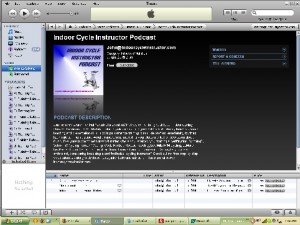
You can subscribe by clicking the orange chicklet below.
 Subscribe in a reader
New to Podcasting? What's with this Subscribing thing?
Once you subscribe, iTunes will check each day to see if I have posted a new Podcast. If I have, iTunes will automatically download it so it's ready for you to play or transfer to your iPod. It's easy.
Originally posted 2008-08-05 20:45:07.
by John | Sep 7, 2019 | Spotify

What Rocket Scientist at Spotify thought this would be a good idea?
What the @#$%^& was Spotify thinking by removing the total playlist time in the latest update? The number of followers has zero value to me when I'm building a playlist.
Last week my Spotify displayed this message offering to update, which I regrettably did.

Don't upgrade Spotify if you want to keep your playlist timer.
Now I have no clue about the total length of the playlist. Chris Hawthorne and I are trying to find a work-around, but for now I suggest using the little X in the right hand corner of the update notice if you haven't updated yet.
Originally posted 2013-03-17 09:35:00.
by Jim Karanas | Sep 5, 2019 | Master Instructor Blog
 By Team ICG® Master Trainer Jim Karanas
Cycling performance is all about oxygen. Muscle cells need oxygen to burn fuel and produce the energy necessary to power the muscle contractions that move us. This is known as cellular respiration.
All indoor-cycling instructors have received rudimentary training around proper breathing on the bicycle, but it’s rarely the focus of a class. Think about it. Can you create and lead a class profile that focuses just on breathing exercises and make it compelling for 45-60 minutes?
OK, you’re thinking, “Why would I want to?” But evidence indicates that we can improve breathing capacity with “inspiratory” muscle training and improve both performance and comfort. In “Endurance training of respiratory muscles improves cycling performance in fit young cyclists” by Holm et al (2004), riders rode a simulated 40-kilometer race on a computerized exercise bike after weeks of inspiratory training. Neither control group improved, but the experimental group rode 4.7 percent faster.
The trained riders found breathing hard more comfortable. The respiratory muscles didn't tire, so they filled and emptied their lungs more often with less fatigue. The fact that the athletes could breathe harder with no change in effort is an important finding because many people stop exercising due to severe shortness of breath.
Have you ever wondered what creates the need to breathe?
Of course, we breathe because we need O2. But the urge to breathe is triggered by a high concentration of CO2 in the blood, not a lack of oxygen. When we hyperventilate, we’re trying to dispel that CO2 and balance the pH of our blood. Inspiratory muscle training improves not only breathing capacity but also tolerance for CO2.
So where do you start? Some of the following techniques may help.
1. Integrate nasal breathing in your on-the-bike training.
Start with a short, low-intensity section of a ride. See how it feels to breathe only through your nose. Your anxiety may rise a bit with the sensation of not getting enough air. Carbon dioxide receptors adjust to this in time, however, and the urgency disappears.
2. Develop a regular practice of conscious breathing.
Develop a closer relationship with your breath. Don’t think about your breath more or try to control it. Just become aware of it. As you warm up on the bicycle, at what moment do you first become aware of your breath? Be more fully in the experience of breathing — really feel the sensation of your breath moving in and out of your body.
3. Learn diaphragmatic breathing.
As you concentrate on deep breathing, you push your diaphragm down and the abdominals out. If you’re doing it correctly, your abs will expand more than your chest. I’m amazed when I hear an indoor cycling instructor still telling students to “hold their abdominals firm” to support the forward flexed body position on a bicycle. (Support for forward flexion comes from the posterior core muscles, but that will be another post.)
4. Synchronize your breathing with your pedaling.
Try to synchronize your respiratory rhythm with your pedal cadence. Start by focusing on pedaling. Once you establish your cadence, organize your breathing with the turning of the pedals. Inhale and exhale for the same number of pedal strokes. This gives you a focal point while you’re cycling and keeps your breathing calm and regular, which moves more oxygen.
5. Change your rhythm.
Once you’ve established your inhale/exhale pattern and coordinated it with your pedal stroke, change it. This idea has been expounded by numerous sources, most notably Ian Jackson in his book BreathPlay. I’ve used BreathPlay techniques for a long time and find them helpful. To strengthen the inspiratory muscles, you must do things that cause you discomfort.
The central BreathPlay skill is “upside-down breathing.” It involves pushing the air out and letting it in, instead of sucking it in and letting it out. The change is simple but profound. First, settle into a cadence. Then explore pulling your belly back for a three-count out-breath and relaxing it for a two-count, passive in-breath. Emphasize the three/two pattern. Next, fit the breathing pattern to your pedal stroke: three turns on the exhale and two turns on the inhale.
The 3/2 count is an easy way to start learning odd-count upside-down breathing patterns. Once you feel comfortable with the out/in 3/2 count, practice until you have the same level of comfort with a 5/2 count, a 2/1 count, a 4/1 count, a 4/3 count, and a 6/3 count. Whether you're out on the road or (in the studio), you'll need to be able to change breathing gears to accommodate changing work rates, and this repertoire of breathing patterns will give you a breathing gearbox. – Ian Jackson
Long-held patterns of breathing may actually have separated us from some of the natural strength, calmness, and energy we have within us. Changing them could reconnect us with those. Is anything more fundamental in our moment-to-moment experience, consciousness and awareness than our breath?
Originally posted 2012-05-14 08:50:35.
