by John | Jun 9, 2018 | Correcting Form, Instructor Training, Master Instructor Blog
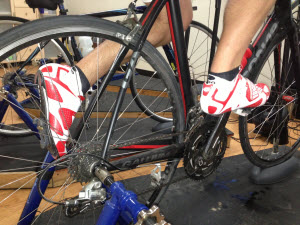
During a class I attending yesterday, the Instructor had everyone doing one-legged pedaling drills… one legged as in pedaling with one foot un-clipped and held out to the side or rested on the frame.
That's wrong/contraindicated… isn't it?
My initial reaction was to do what I normally do in this situation, I would just ignore his cue. Unfortunately I was setup in the dead center of the room and I quickly saw that I would be the one rider (of about thirty) NOT riding with just one leg. So I popped my left foot out and joined everyone else.
OK, so what's wrong with this? Was my first thought, as I began focusing on smoothing out my pedal stroke. This feels like what I remember from riding my old Schwinn Paramount road bike, on a trainer, back in the 90's
Looking around the room, I didn't see anyone riding with any difficulty or appear to be off balance or unsafe. All I saw were cyclists doing exactly what they're supposed to be doing during one-legged drills; trying to make up for the missing leg's influence at the “dead spots” in the pedal rotation – which is the purpose of the exercise. This wasn't a class of cyclists, but rather the typical diverse group of club athletes we all see each week.
So why is one-legged cycling viewed as contraindicated in our classes?
I did a few Google searches for “one-legged indoor cycling class” and found a number of articles, from knowledgeable people, recommending against removing (un-clipping) one foot while pedaling here, here, and here. That last link is from pdf from Spinning called Keep if Safe and includes this:
PEDAl STROKE
Do not pedal backwards or with one foot out of the toe cage or cleat. Pedaling with one leg is an advanced drill that elite cyclists practice on trainers–not fixed-gear bikes like the Spinner bike. On a Spinner bike, these drills have absolutely no benefit, since muscles work the same and burn equal numbers of calories pedaling forward and backward.
While I completely agree that pedaling backwards is dumb/goofy, pedaling with one leg is a very commonly recommended technique, for cyclists of any level.
Another Google search returns dozens of articles and videos advocating for this exercise. None of them issue any caution that this is an exercise reserved for a professional, on the contrary. It's the new cyclist who needs to learn to pedal properly and efficiently.
Here's none other than Joe Friel describing his recommended pedaling drills:
Let’s get rid of the energy wasters in this Base period. Drills will help you to pedal better. Following are the common ones I use with the athletes I coach. They may be mixed together in a single workout or each may be done by itself as a workout.
* Isolated leg training (ILT) drill. This is the quintessential pedaling drill, the one you should do a lot in the early weeks of Base. It’s done on an indoor trainer. Unclip one foot and rest it on a chair next to the bike so you are left to pedal with only one leg. With the bike in a low (easy) gear turn the crank at a comfortable cadence. The first thing you’ll notice is that getting through the top of the stroke, the 12-o’clock position, is difficult. Focus on smoothing this top transition. At first you may only last a few seconds before the hip flexors fatigue. When that happens switch to the other leg. When it fatigues clip both feet in and pedal for a few minutes applying what you have learned in the single-leg pedaling. Repeat the drill several times throughout the workout.
While I'm the first to raise my hand and say; “just because Joe Friel says something, it doesn't automatically mean that it's applicable to our classes“, I'm using him as an example of the clear conflict between what's recommended for indoor cycling vs. outdoor cyclists. Mr. Friel says this is the quintessential peddling drill (representing the most perfect or typical example of a quality) and yet others are saying this will hurt your participants – or is completely useless.
So where's the concern coming from?
Clearly there's a fundamental difference between a bicycle on a trainer and an Indoor Cycle. The bicycle has a freewheel that prevents the monument of the drive-train from pedaling you = you have control to easily stop the rotation. Indoor Cycles (with the exception of the CycleOPs) are fixed gear. The perceived (rightly) danger comes from the heavy, weighted flywheel spinning out of control and potentially carrying the loose pedal into the free leg of the rider.
So why didn't that appear to be a problem yesterday?
We were riding indoor cycles with magnetic resistance. I perceive this has two design differences that mitigate the safety issues that exist, as compared to Indoor Cycles that use friction resistance. If you've had the chance to ride (or your club has updated to) the Schwinn AC, Keiser M3 or Freemotion S11 you'll probably recognise the following;
- My perception (and I've ridden everything) is that magnetic cycles have less rotational flywheel inertia than friction. By design, the weighting of the flywheel of friction cycles is around the perimeter, which creates a greater amount of inertia = harder to control or stop. Magnetic cycles have either a smaller flywheel (M3) or in the case of the AC and S11, the outer diameter is aluminum. In all three there's a feeling of less of the flywheel's influence / control of your pedals.
- The amount of resistance created by the magnets increases with RPM = you don't see run-away pedals, even starting with a very low level of resistance.
Is this right for your class?
If you're teaching on a magnetic cycle, you'll have to decide for yourself if you want to add Single/Isolated leg training drills into your class. I wouldn't consider this if you are on friction resistance cycle.
Start by experimenting alone by yourself. Spend some time practicing with one foot detached. How does if feel to you? Could you safely introduce this into your class? Maybe as part of the warmup? How would you cue this?
I'm going to begin on Thursday. My initial thoughts are to offer it, with a modification to stay clipped in of course. I'll find a fun track around 70ish RPM, have everyone dial on a nice flat road feel – just below their base wattage and let everyone experience what it feels like.
I'll let you know the classes reaction 🙂
NOTE: If you're teaching on the FreeMotion S11.9 cycles, the power readings will be disrupted with either foot un-clipped. You'll want to explain to your class that the power is measured off the left crank. Removing the left foot and using just your right, results in near zero wattage displayed. Peddling with just the left foot appears to confuse the computer and I was seeing what looked like double the wattage. Both the Schwinn AC and Keiser M3 will display correctly.
by Joan Kent | Jun 8, 2018 | Engage Your Students, Health and Wellness, Strength Training

Frequently, I recommend protein powder to supplement dietary protein, but my clients aren't always sure exactly what to do once they have it. That’s the topic of this post.
Why Protein Is Important
Protein has numerous functions in the body, starting with the obvious one that it can be converted to glucose for energy.
Because I’ve covered protein in previous posts, I’ll keep this part brief. Protein is used to form hormones, enzymes, blood, body tissue, hemoglobin, antibodies, transport proteins, and much more.
As protein enters the small intestine, it triggers CCK, a powerful satiety hormone. CCK curbs carb cravings significantly. People who don’t get adequate protein often have strong sugar cravings.
Protein provides the amino acid precursors for brain chemicals that have many functions. Those amino acids can, for example, raise dopamine and norepinephrine for alertness and improved mood. Eating sufficient protein can reduce the need for caffeine — which triggers the same brain chemicals. But while caffeine depletes those chemicals, protein increases their production.
Another example is tryptophan, used by the brain to make serotonin. Serotonin enhances satiety and mood.
And protein provides several B vitamins that act as catalysts in forming all three of the brain chemicals above.
Why Protein Powder?
I’m not suggesting that you give up real foods and use protein powder instead. But protein powder is convenient. It’s light and portable and needs no refrigeration. Here are some suggestions for specific situations.[wlm_private ‘PRO-Platinum|PRO-Monthly|PRO-Gratis|PRO-Seasonal|Platinum-trial|Monthly-trial|PRO-Military|30-Days-of-PRO|90 Day PRO|Stages-Instructor|Schwinn-Instructor|Instructor-Bonus|28 Day Challenge']
Vegetarians / Vegans
Powdered protein is great for those who don’t want to eat meat. For vegans, who don’t eat any animal products, vegetable protein powder might be the best way to get high-quality protein in the diet.
Please recall that non-animal sources of ‘protein’ often aren’t. Nuts are not protein; they’re unsaturated fat. Beans, rice and quinoa are definitely carbs.
Vegans often experience sugar cravings. Vegetable protein powder could be a top method for vegans to stop cravings long-term.
Post-Training Fuel
As detailed in a previous post, refueling within 30 minutes is ideal. The best post-training meal is a combination of carb and protein in about a 3-to-1 ratio (the original research used 2 to 1).
Powdered protein will keep in a gym locker and mix with water as part of a solid post-workout “meal.” Just add good starch. Potatoes are excellent after workouts; other starches work, too.
Travel
Travel is an obvious time for the convenience of protein powder. A couple of years ago, I attended a 5-day seminar in a remote area. We were told it would feature only vegetarian cuisine. I brought 15 envelopes of raw vegetable protein powder and mixed one with water at the start of each meal. With my protein needs taken care of, I could enjoy the meal with no problem.
Conquering Sugar Addiction
For reasons explained above, having protein throughout the day can help you end sugar addiction by changing brain chemistry and preventing sugar cravings. Many brands of protein powder are out there, so find one with no junk — especially no sugar.
Don’t make the same mistake as a client of mine who had a serious sugar addiction. Instead of buying plain, unsweetened powder and mixing it with water (per my instructions), she bought French Vanilla and mixed it with orange juice. “The protein drinks are delicious!” she told me, but her sugar cravings got worse.
“Delicious” is usually a telltale sugar sign. Unsweetened protein — whey, pea, vegetable, soy, other — plus water won’t be delicious but will be helpful.
On the Go
Away from the office and a snack room, it might be difficult to find protein if you can’t stop for a meal. Depending on the hours you’ll be in the field, protein powder may help. Carbs are easy; we can find salads and other carbs almost anywhere.
Plan B
As suggested in a previous post, leave an envelope or two of protein powder in your car for emergencies. Take care of the protein and the rest of the meal will fall in place.
So skip granola bars, “energy” bars, chocolate-hazelnut spread, electrolyte drinks. The main benefit of protein powder is it’s a true protein source when ordinary foods aren’t available.
[/wlm_private]
by John | Jun 6, 2018 | Instructor Training, Latest News

And there's plenty of time to learn how to “Fly”.
I got a question about a one week working fitness vacation.
Hi John,
I appreciate what you are trying to do with the contest but why would I want to work on vacation? How is that a real incentive?
That's a great question and it caused me give it some thought before responding.
Amy and I have heard “why would you want to work on vacation?” a lot over the past 15 years from friends and other Instructors. Depending on who's asking we tend to give two different answers:
If it's a friend who's asking (so we can be more truthful) we tell them that we could never afford to go on a similar trip if we had to pay what all the other guests at the resort were paying. These are the finest locations in the Caribbean and most All-Inclusive resorts cost $3,000 – $6,000 a week + airfare = completely out of our reach financially.
If it's a club member (most can afford to travel anywhere and do, frequently) we typically say something to the effect of; “I'm going to work out anyway… so why not save the money?”
But even though both are accurate; we really can't afford to travel at this level and we normally work out most days we're there, there's another reason Amy and I prefer to be that week's fitness professional… it makes us special 🙂
As Instructors we are used to being special. At the club, out for dinner or at the grocery store people recognize us as someone who's different from everyone else. You have no idea how many times I've heard; “Oh honey, come here… I need to introduce you to my Aerobics Instructor, Amy.
Amy tells a very funny story about running into a club member at a resort in Jamaica. A clothing optional resort. “Oh my gosh it's Amy from Life Time and I'm completely naked!” ” Honey it's Amy from the club… come and meet her!”
We also tend to be more easily connected with the other guests and more importantly the staff. We both love the Jamaican people and they tend to more open to us when they see that we are working while we are there, even if it's only for an hour or two each day.

Amy and I have meet some really interesting people, from all over the world, solely because we were the Instructors that week. Many resorts have a scheduled Power Walk each morning and you typically have the same 4-6 people each day. So you chat with them as you walk the beach or golf course – getting connected if only for the week.
They see you later that evening at dinner; “Oh Honey, meet Amy… she's my Instructor this week.”

by Jay Duplessie | Jun 4, 2018 | Jay Duplessie, Motivation

Steve had always the typical over achiever. Great student, even better athlete, and everything seemed to come so easy. By the time he finished college, he had already accomplished so much, yet things had just begun.
Landing a high paying marketing job right out of college, he set his sights on one day becoming head of his own firm. And that “someday” came sooner than later. By the time he was thirty he owned a very successful agency with forty of the brightest employees in the industry. Things were perfect.
Just before his thirty-fifth birthday, he married his long time sweetheart and they set their sights on a family. Life was incredible.
By the time he reached forty, all his successes and goals had accumulated to a point that he started finding himself searching for new ones, new challenges. At the same time though, he realized that the hussle and bussle of daily life in the Marketing industry was starting to wear him down. So he and his wife Christy decided to purchase a second home in Breckenridge, a place where they could get away and forget all the responsibilities of the business, and the drain of city life. In no time at all, the second home became a place of comfort and tranquility. With the love of his wife and children, life felt complete.
One day while sitting on the deck of their new mountain home, Steve and Christy noticed a clearing in the brush at the end of their property. Together they walked over to it and found that this was a trail that most likely led to the base of the foothill. No telling exactly how far down, but the trail looked steep. The brush had started to grow back, but there was no doubt that this was a trail that used to get a lot of use.
Early the next morning, Steve drove down to the bottom of the hill where he had seen a make shift parking lot. Someone had parked on the grass enough times that it had left a dried out section of land. He pulled into the area and got out of his car. Sure enough, just as he suspected, an opening, just like the one in his back yard. He walked back to the car, threw on some hiking shoes, grabbed a bottle of water, checked the time, and began his assent.
Forty minutes into the climb, Steve realized he did not have the stamina he once did as a college level athlete. He sat down for a quick drink and to catch his breath. While sitting there, the achiever in him made a promise. He promised that he would master this climb, and beat his time, even if by seconds, each time he hiked the trail. Back on his feet, he started again and twenty-eight minutes later he reached the top. He looked at his watch and saw that his first initial climb took seventy two minutes, a time he knew he would and could beat.
Christy came out onto the porch and asked where he had been. He told her about his new hobby and the challenge he made to himself. She saw that same determination in his eyes that he had when he opened his firm. She admired this in him and always found his dedicaton to a goal, any goal, very attractive. She kissed him and went back inside. Steve grabbed a pocketknife out of the junk drawer and walked to the top of the path. There on a large oak tree, he carved the number 72.
Over the next four years, every time Steve and Christy visited the home, Steve would make his climb. And almost every time he did, he would beat the previous time, even if by a few seconds. And when he would get it down a whole minute, he would carve a new number. Currently it was at 49.
One fourth of July weekend, Steve and Christy invited all their friends from the city, all of their family, and the neighbors they had met in Breckenridge. It was to be a day to remember.
Early that morning, Steve set out to do his climb. Christy left at the same time to pick up a few things for the party. As Steve pulled off the side of the road to park in his spot, she drove past, waved, and gave him a honk. He smiled and waved back. He looked up at the sky and saw the clouds coming in. He prayed that they would pass before the party, and then turned towards his trail. Today, he would beat 49 minutes, he knew it. He set his timer and took off like a sprinter.
Thirty-five minutes into it, he knew he was making great time and would beat last weeks time with ease, but he didn’t let up. He pushed himself and his leg muscles burned. He came around a small switchback that he had so many time before. This was a section he needed to be careful at because there was a twenty-foot drop. Almost thru it, a huge bang erupted right next to him and before he could catch himself, he was falling towards the bottom. The lightening bolt didn’t hit him directly, but it might as well have because what came next was just as horrible.
When Steve opened his eyes he wasn’t sure how long he had been out. He quickly remembered the fall and thought to himself how lucky he was that he did not get hit directly by the strike. He didn’t feel any pain, so he thought he must be okay. Then he tried to move and nothing happened. His legs were not only non responsive, they were paralyzed. He could move his arms just enough to look at his watch. It had been 87 minutes since he started his climb. He laid his hand back down and started to weep. Not only did he loose the ability to walk, he had failed to beat his old time.
On her way back to the house, Christy drove by Steve’s car. She knew he would be waiting for him at the top and she would have to drive him back down to get his car. She had done this so many times before, but this time he would have to wait until she got the ice cream into the freezer.
When she walked into the house, she headed straight to the refrigerator. She hollered thru the house “Did you beat it? Did you break 49 minutes?” But there was no answer. She walked upstairs thinking he was in the shower, but he wasn’t. She ran outside, but he wasn’t there. She ran inside to the phone to call the neighbor, but he wasn’t there either.
This Fourth of July would still be a party, but it would be a search party. Three hours later Steve was airlifted away broken, battered, and paralyzed. Life wasn’t so good.
Over the next twelve months, Steve spent a lot of time in rehab, little time at the office, and the remainder of it in Breckenridge. He would sit on the deck, remembering the day he and Christy found the path and how perfect life was. Back when he had everything, and now he had nothing, or so he thought. He wished he had never seen that path.
After the first year, he was able to drive himself. A handicap van, complete with ramp and hand controls had been built for him and now he could come and go as he pleased, but he didn’t go, he didn’t go anywhere. Instead, he sat on that porch staring at the path, and everyday the brush got thicker and thicker. Eventually no one would even know that a trail existed, and no one else would have to go thru what he had experienced.
One year, three months, and twelve days after the accident, he woke with a different feeling. Instead of feeling like the victim on this day, he felt like the person angry at the victim. He felt angry that he had let this self-pity go on as long as it did.
All day long he heard an inner voice yelling to quit complaining and to stop sitting around, to get his life back, find a new goal, start over. The voices became so loud that he started to wonder if he was going crazy. He couldn’t sit still, and he couldn’t focus on anything.
Christy had been gone all morning with the kids doing some errands, and so he decided to get out of the house for a while. Maybe that would calm the voices. Not knowing exactly where he was headed, he got into his van and started to drive. When he reached the bottom of the hill, he knew why today was different and where he needed to be. There, on the right hand side of the road, was the place he used to park. He had not been there since the accident. Every time they drove to the house, he would look away. But today it stared him right in the face. He pulled over to the side of the road and onto the spot. Just like the trail, the grass here had started to return. Almost as if it was telling him, “we won, you lost.” He put the vehicle in park and sat. At first he thought this was all he needed to do. That what he was meant to do today was face the location. But before he could think, he was out of the van, sitting in his wheelchair. He rolled to the foot of the trail, moved the branches aside, and stared up the hill.
For no reason he could explain, he started to feel like the old Steve again. His chest came forward, the frown went away, and he no longer felt like a victim. Now he felt like someone with a huge opportunity. He looked at his watch, checked the time, and dove out of his wheel chair. On his hands and knees, he dragged himself into the brush and up the trail.
On her way home from running errands, Christy started her drive up the hill to the house. For whatever reason, she failed to see Steve’s van on the side of the road. Maybe it was because over the last year, the trees had grown in, or maybe it was because in her wildest dreams she had never expected to see Steve’s van there again. But nonetheless, she drove right by it without a single glance. When she got home, Steve was not there. A smile came over her face as she realized he finally got out of the house on his own and maybe he was feeling better today.
Two hours later, Steve had made it a third of the way up. He lay there taking a break, hands bloody, knees torn up, and tears running down his face. One might look upon this situation as a time of frustration and defeat, but it was just the opposite. The thoughts running thru his mind were those of gratefulness and passion, strength and victory! He was not only doing it, he was doing it alone without the help of others or his wheel chair. He felt free again and more alive than ever. If he had any negative thoughts, there was only one. He was so angry at himself that it had taken so long to step up and regain the fire he knew he always had for adversity and challenge.
Christy began to worry when she could not get him on his cell phone. Where had he gone, and why wasn’t he answering? She waited another thirty minutes before calling her neighbor. She came over and sat with Christy and together they thought about where he might be.
Four hours and twenty-three minutes later, Steve found himself more than two thirds of the way up. Right at the place that he had fallen over a year ago, he found himself right back where it had all began. Anger started to creep up inside of him, but he caught himself and realized that being angry did no good. Being angry was what took away the last fifteen months of his life. It wasn’t being physically paralyzed, it was being emotionally paralyzed that stole away those months.
So there, in the middle of it all, he promised to never be angry again. He looked down at his beaten up legs, and the blood on his hands, and told himself that if he was ever to be the man he used to be, it had to start now. He looked up towards the top and with a smile bigger than he had ever worn before, he pushed forward up the hill.
Christy could not wait any longer. She and her neighbor agreed that it was time to call the authorities. So she picked up the phone and called the police. She gave a description of her husband and his vehicle. The woman on the phone explained that it was too early for a missing persons report, but that an officer would drive thru the neighborhood and let her know. Christy hung up the phone, not feeling much better. She sat on the porch and waited for news. She looked over at the trail, covered with brush, and cursed it. That damn trail took her husband away from her. She wished they had never found it in the first place. No longer able to think about it, she went back inside and waited for news.
Forty five minutes after the call, a squad car drove towards Steve and Christies home. As he was making his way up the hill, he noticed something. Off on the side of the road, he spotted Steve’s vehicle. He pulled off to the side and got out of his car. There, at the base of the hill, was the wheelchair Steve left behind. Not sure what to think, the officer walked towards it and then up into the trail about 50 feet. He saw nothing. He then called Steve’s name, but heard nothing. In his mind, there was no way Steve was here, and something must have happened. He walked back to his car and continued to drive up the hill to meet Christy and tell her what he had found. Someone must have picked him up.
Ten minutes later, the doorbell rang. Christy walked to the front door and opened it. Her worste fears were staring her in the face. The officer asked if he could come in, and she said of course. He told her that he had been driving thru the area with no luck. But then, on his way here, he spotted Steve’s vehicle. It was empty and the wheel chair was left behind. As the officer explained this, clearly thinking that Steve had been abducted or picked up by a friend, Christy face and mood changed. She was no longer afraid and she was no longer worried. Instead, as the officer continued to speak and ask questions, she pushed him aside and ran thru the door. She bolted to the only place she knew to find him. The closer she got to the trail, the surer she was. She ran to the entrance and moved the branches aside. There, laying on the ground, was Steve. This wasn’t the Steve she first met, and it wasn’t the Steve she’d been with after the accident, this was a whole new Steve. A Steve with a new appreciation of life and the gifts he still had. He looked up at her, covered in dirt, sweat, and blood, and he winked. There were streaks down the side of his face from the tears. He said “one second honey” and turned away, and there, she saw what it was he needed to do before he could tell her where he had been. Far down, at the base of that oak tree, he was doing what he always did after climbing the trail. In big script he had carved into the base “Five hours, one minute…..BEST TIME EVER!!”
Remember, it’s not about how fast you do it, it’s about the Journey……..it’s about the Climb!!”