“Hey John – If it's raining tomorrow will you have an indoor ride for us?”
The question came to me from a member while I was in Amy's class last Saturday. The Sunday following was the annual “Ironman” ride which is typically nasty weather and the forecast was for lots of rain and wind.
If you are transitioning to riding outdoors, there's a good chance one or more of your scheduled rides will be rained out. Instead of sitting, watching the rain, why not hold an impromptu class for all of your outdoor friends?
But what would you do?
It's the question I asked Master Instructor Tom Scotto in our latest PRO Podcast.
Long climbs have you bumping up against your power ceiling.
I prefer to limit the mathematical computations many Instructors typically ask of their classes. For example you'd never hear me say;
“now I want everyone at 85% of their FTP” or… “this next interval is 30 seconds in Zone 5B which is 103 to 106% of your LT/AT heart rate followed by 2 minutes in Zone 3 = 90%-93%”… everybody got that? Then let's GO!!!
I'll admit that part of this is due to my phobia of math. It's also because I recognise that there are a wide diversity of personalities riding in front of me. Sure, I've got a few engineers who could probably spit out the square root of their FTP between pedal strokes if you asked, but it's my impression that the majority of folks in your class would prefer that you leave the math for times when they have a calculator handy 🙂
Just this past Sunday I had two women in my Performance Cycle class cheer when I mentioned that I wouldn't be requiring any percentage figuring that morning.
But we still need to communicate intensities, right? That's where establishing Floors and Ceilings comes in. They're simple concepts everyone will understand – we all know what's below a floor or when we're up against a ceiling!
Master Instructor Dennis Mellon using this same Floors and Ceilings concept in his classes, except a little differently. We discuss how we each use them to (hopefully) communicate effectively, in this ICI/PRO Podcast episode.
[wlm_private ‘PRO-Platinum|PRO-Monthly|PRO-Gratis|PRO-Seasonal|Platinum-trial|Monthly-trial|PRO-Military|30-Days-of-PRO|90 Day PRO|Stages-Instructor|Schwinn-Instructor|Instructor-Bonus|28 Day Challenge']
Please let us know your questions.
You can read more about using VT1 Aerobic Threshold and VT2 Anaerobic Threshold to create easy to understand Floors and Ceilings here.
Do Indoor Cycling Classes really need to be 45-60 minutes – to provide the health and fitness benefits expected by our participants?
Asked another way: If your studio offered classes that were shorter (say 30 minutes), while still just as effective as 3/4 or a full hour, could an “express class” attract people who feel time strapped?
Of course anytime you use the words “just as effective” smart Instructors are going to ask; “show me the research”!
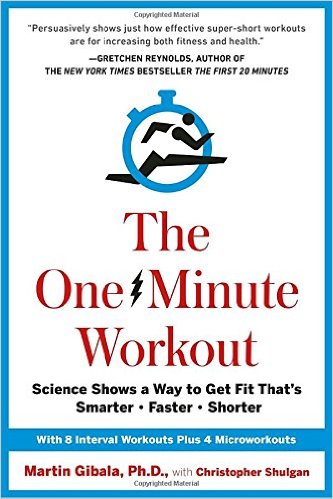
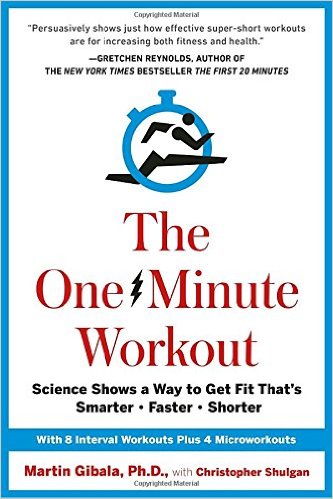
Martin Gibala, Ph.D. is my guest, for this episode of the Podcast. Dr. Gibala has done the research (and I'm quoting from the back cover of his new book – The One Minute Workout) “As the world's foremost expert in high-intensity interval training, Martin Gibala has pioneered the study of new and remarkably time-efficient type of workout, making available the benefits of exercise in a fraction of the time.
Listen to our conversation in the Podcast below to learn more about the science of HIIT and how you could use this information to improve your classes and attract more participants.
Here's a short video featuring Martin Gibala, Ph. D.
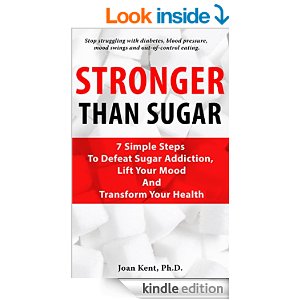
2/3/2015 UPDATE: ICI/PRO contributor Joan Kenk Ph.D. has published a new book on Sugar Addiction! So to celebrate her success I thought it would be helpful to republish her interview from 2011 – it was previously only for ICI/PRO members.
The first thirty seconds of the podcast will have you convinced she is the expert on the addictive qualities of sugar – and what to do about it.
As I was preparing this interview I went back and counted… Dr. Joan Kent is the 20th different Master Instructor that I've had the privilege of interviewing for the Indoor Cycle Instructor Podcast!
Dr. Kent is a Master Instructor with The Indoor Cycling Group of North America and she holds a Doctorate in psychoactive nutrition; the study of how foods effect brain chemistry along with a Masters in Exercise Physiology.
We got off of our intended track when I described an eating problem that I have and Joan helps me with a possible solution, one that maybe of interest to someone in you class.
Joan's suggested solution to my problem of yielding to sugar cravings after dinner was to take a spoonful of Super B Complex Vitamins. I'll let you know how it works 🙂
For years I had been patiently waiting for the facilities I instruct in to upgrade their bikes to use power. When these upgrades finally started to happen I was surprised by the different wattage readings I would see, not only, from different brands of bikes but by bikes built by the same manufacturer. I had always assumed a watt is a watt the same way a MPH is MPH or an RPM is an RPM. At first this was VERY disappointing, I have a very technical teaching style and I was hoping to have all my class participants perform a Functional Threshold Power (FTP) Test every 6-8 weeks, calculate their personal power zones and coach each and every class to those zones. Unfortunately, if every bike in the studio reads wattage, even a little bit, differently I would need to adjust my teaching style.
[wlm_private ‘PRO-Platinum|PRO-Monthly|PRO-Gratis|PRO-Seasonal|Platinum-trial|Monthly-trial|PRO-Military|30-Days-of-PRO|90 Day PRO|Stages-Instructor|Schwinn-Instructor|Instructor-Bonus|28 Day Challenge']
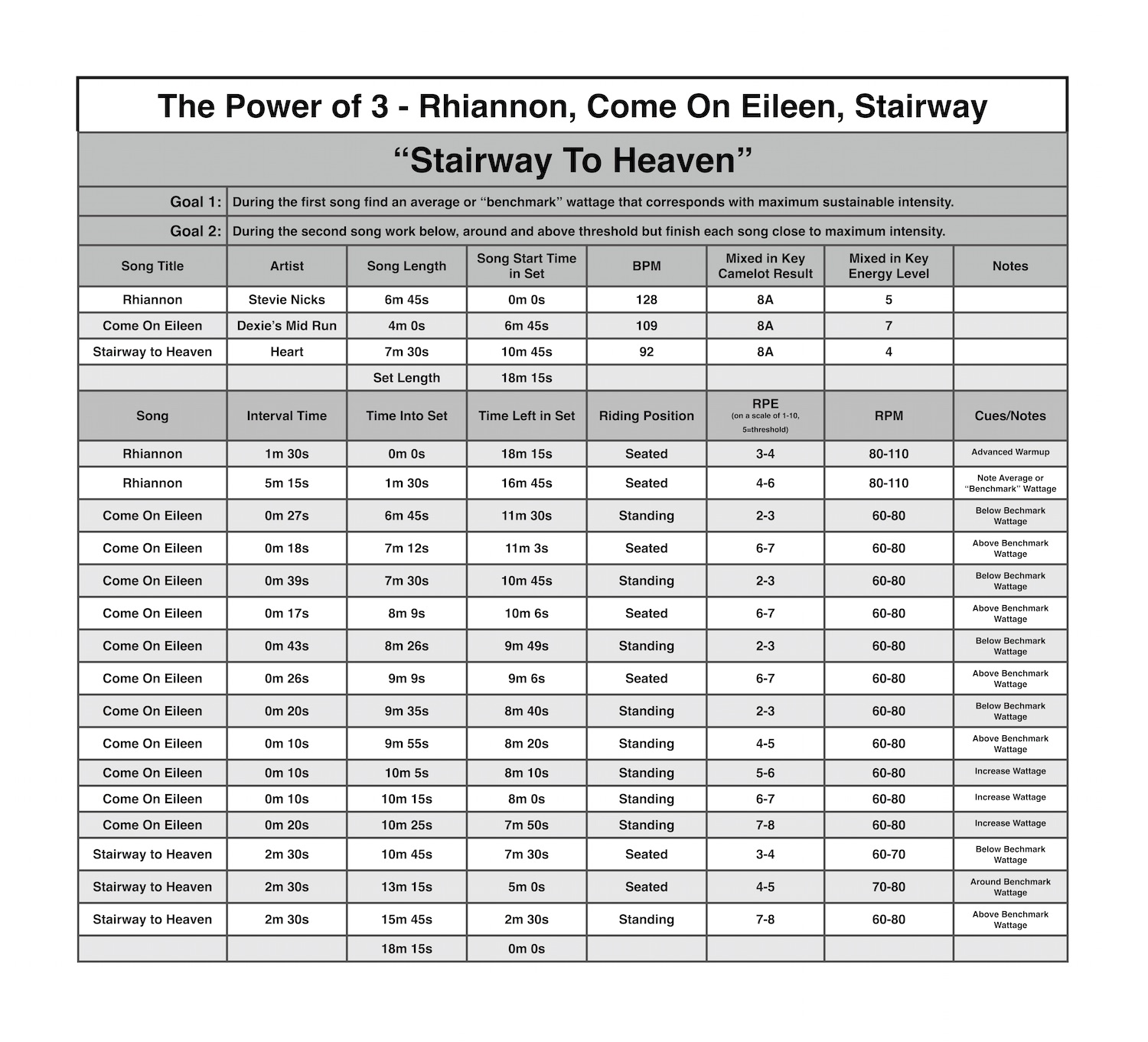
I needed to figure out a way to use this new technology, even with it's faults, effectively to give my participants the best workout possible. I decided that the FTP test was still going to be an integral part of my programming and I would still perform this test every 6-8 weeks. I asked my class participants to find 2-3 bikes that they believe are similar in wattage readings and ride those bikes as often as possible. Small differences are ok, large ones make zone training impossible. I also needed a technique to “dial in” new riders, those who never performed the FTP and others who may be forced to ride an unfamiliar bike. I decided to start every class with a proper warm followed by a mini threshold test that I call a “Threshold Check”. This “Threshold Check” can last anywhere between 4-6 minutes and I ask class participants to ride at their maximum sustainable intensity or wattage for the duration of this short test. If the bikes are equipped with a console that will show average wattage I ask for the class to find their average wattage for this “Check”. If the bikes do not have a way of reading average wattage I ask the class to be aware of their wattage throughout the “Check” and choose a wattage that they believe is closest to their maximum sustainable wattage. If I'm teaching on a bike that is not equipped with a power meter I still perform this “threshold check” and i do my best to “anchor” effort with threshold RPE. I also like to “anchor” effort and RPE during the FTP . Most FTP tests last 20 minutes, so 10 minutes into a FTP effort I'll explain that the feelings participants are experiencing, slight breathlessness. burning sensation in the legs and the need to stay extremely focused or wattage will drop is how a threshold effort “feels” and I ask them to associate this feeling with whatever RPE number is used as threshold in the facility I'm teaching in.
Now that each participant has a threshold wattage or RPE to work with I break my profiles down into 3 zones: Above Threshold, Around Threshold and Below Threshold. Efforts that are Above Threshold (greater than 106% of threshold) can last up to 8 minutes, efforts around threshold (90-105% of threshold) can last up to 30 minutes and below threshold efforts (less than 90% of threshold) can last up to 3 hours.
Check out the recorded classes below to hear how I use this “Threshold Check” in a class setting.
3 song harmonically mixed track, to download Right Click > Save As / Save Target As to download. Open in iTunes and then you'll see this in your Spotify Local File folder.
Here's a great deal for anyone who's been dragging their feet on subscribing to Spotify. Sign up now and get three months for $0.99 – this is for USA customers, you'll need to check to see if the offer is available in your country.
If you're concerned about learning the in's and out's of Spotify – we've got you covered here at ICI/PRO.
Beyond the access to millions of tracks – one of the main benefits of Spotify is how easy it is to share playlists between friends. As an ICI/PRO member you're considered a friend and we have over 60 fabulous playlists that you can download here.
Looking for that perfect track? We have 8 collaborative playlists where you can find song selections from other ICI/PRO members and you can add your own.