by Christine Hawthorne | Aug 12, 2017 | Instructor Training, KEEPING IT FUN, Music
Your classes will love this climbing song from Indie Rocker Coleman Hell. You can ride seated or standing at around 60 rpm. (bpm 120) and I promise you the tune will be stuck in your head for the rest of the day! I first heard it when I was taking a Pound class and I had to hit up the instructor after class to find out what this cool song was all about. If you like this one, you might also want to check out Devotion and Fireproof. And don't forget to save this one for your upcoming Halloween ride!
2 Heads by Coleman Hell iTunes link (60 rpm)

by Karen Casler | Aug 9, 2017 | Instructor Tech Help, Instructor Training, KEEPING IT FUN, Mental Toughness, Your Fitness Business

Congratulations! You have decided to take the leap and open an Indoor Cycling studio…you're not alone.
Dedicated Indoor Cycling studios are growing in popularity and numbers. Owning an Indoor Cycling studio is FUN and like any other new small business adventure, not without obstacles.
Let’s assume that you've done all your research, found the perfect location, pulled permits, hired an architect, created a logo, chosen your bikes, learned new software, stayed true to your vision and spend 3X your budget. You are fully prepared to greet the new generation of Indoor Cyclists armed with state of the art equipment, and a team of instructors eager to show it all off.
Are you really ready?
Do you have what it takes to navigate “old school” customer service firedrills like a clogged toilet with a smile, as well as modern day stereo/microphone issues, also with a smile?
Are you prepared for the technology based firedrills of tomorrow that accompany power measurement, real time leader-boards, data tracking, and wireless internet? Indoor Cycling Technology(ICT) issues are common in a brand new studio. It's not a matter of if they are going to pop up. It's a matter of when.
My name is Karen and I am the self proclaimed spokesperson for Keeping It FUN Indoor Cycling. I'm excited to share my Keeping It FUN approach to ICT firefighting while never losing sight of the customer and of course, always having FUN.
1. View every issue as a challenge … never a problem.
Each issue that crosses your path is nothing more than a “First World Problem,” for which you are grateful. and therefore, not a real problem at all. challenge is an opportunity for you to learn and grow. You have the power, as a studio owner, to turn any negative into a positive by how you choose to fight the fire. You also have the ability to turn a frustrated, perhaps angry customer into a lifetime customer.
2. Never let them see you sweat in a world of sweat…
In the event of a fire, customers are more likely to remember how you handled the situation and how you made them feel rather than the problem itself. View every customer complaint as an opportunity to EARN a rider's business. Upset customers need to be listened to and often become your most loyal clients.
3. In the event of a customer complaint, stick with…
Keeping It FUN's 10 Commandments Of Customer Care…
- Apologize
- Say “Thank You” for bringing up the concern
- Ask the customer to explain the issue in their own words
- Listen to the customer through their eyes
- Empathize…”I completely understand why you feel this way.”
- Acknowledge the concern (big or small) as a legitimate concern
- Explain how the issue will be resolved/handled
- Assume full responsibility for the issue
- Apologize (again) with sincerity
- Thank the customer (again)
4. Recognize that the power may be in the palm of someone else's hand…
Be prepared for ICT issues, software glitches, and unsolved mysteries that you have no control over. Accept the fact that you are at the mercy of someone else's schedule.
5. Document, document, document…
When something breaks…document it every time.
6. Treat your ICT PowerPartners as part of your team…because they are…
It is what it is. ICT issues are likely to require third party involvement. In order to find the quickest resolution, you must be allies with your ICT PowerPartners. Provide the team with as much detailed information as possible regarding your issue. Be prepared to help them troubleshoot and provide them with well documented information. Show them respect and gratitude.
7. Adopt the Keeping it FUN Worry Scale of 1-10
Starting with 10 rate all real or hypothetical issues/problems on a scale of 1-10.
Below is an example:
10. Catastrophic loss of multiple family members
9. Loss of a child
8. Loss of spouse/family member
7. A life altering accident
6. Fill In
5. Your
4. Own
3. Blanks
2. ICT Firedrills
1. Which lululemon Pace Setter skirt will I wear, today?
The Keeping It FUN Worry Scale is fool proof and guaranteed to help you catch any ICT curveball that gets thrown your way!
I had the honor and privilege of working for, training under, and calling friend Mad Dogg Master Instructor_____________. In 2002, she taught me the power of words.
SB, from my heart to yours,
Thank you for sometimes telling me I had to do it your
way and supporting when I wanted to do things my way.
But, most of all, Thank You for teaching me to choose the
Word “resistance” over tension. Because of you, I may
Cue a Steep hill something like this…
“I invite you to let all your tension go.
Tension, weighs us down, holds us back, and makes it harder to breathe.
Resistance, both in life and on this hill makes us stronger. Close your eyes.
Relax your shoulders. Heart center forward and climb. Without changing
cadence, add reistance that makes you push back and fight harder.”
Today, 12 years later and 1500 miles away, her voice is heard in the words I choose when I teach. It’s a powerful lesson that extends beyond Indoor Cycling. The words we choose are more powerful than any ICT malfunction.
There will always be resistance, but you don’t have to have tension. Your customer’s response mirrors your response. If you smile and have FUN going over new studio speed bumps, they will too.
You Got This…
One pedal stroke at a time!!!
Originally posted 2014-09-04 08:45:11.
by John | Aug 6, 2017 | Featured Instructor, Instructor Training, KEEPING IT FUN, Master Instructor Blog, Your Fitness Business
Hi, my name is Kathy Helmuth and I am excited to share a wonderful new program called Parkinson’s Indoor Cycling.
UPDATE September 25, 2014:
We are now offering an ACE approved Parkinson’s Cycling Coach training program. To learn if you qualify click here.
As group cycling instructors, we try to educate and encourage success in our indoor group cycling classes. We see those moments of achievement and we are excited for the participants who have reached their goals. In the Parkinson’s Cycling Coach classes, those moments of achievement are multiplied by 10.
Parkinson’s Disease can rob a person of smell, facial expression, movement, and flexibility.
Imagine this…. A person with Parkinson’s Disease comes into your indoor cycling class using a cane or a walker. He or she registers for the program, completes the necessary paperwork, and goes through the initial testing. You notice that this individual shows very little expression on their face.
After riding a few classes being coached at the proper intensity and cadence, that individual no longer needs a cane or walker. That person is walking with an improved gait and has better balance and flexibility. They have a smile and some expression back on their face!
Or imagine this…. a person diagnosed with Parkinson’s Disease not being able to smell the aroma of chocolate chip cookies baking in the oven. After a few Parkinson’s Cycling classes, that individual can now able to smell and taste those delicious cookies.
I have really enjoyed the opportunity to help these Parkinson’s individuals feel better and move through their daily activities with greater ease.
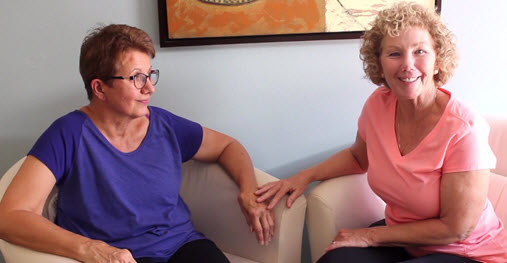
“Feeling normal” is the way one of our riders describes why she loves this program. In my interview with Sharon in the video above, she says that the pedaling class makes her “feel normal….like everyone else”.
I hope this helps ignite the compassion you have for helping others. Seven to ten million people have been diagnosed with Parkinson’s Disease around the world.
If we could provide you with the training you needed, would you be willing join us as a Parkinson's Cycling Coach?
We'll be offering a coaching certification in early October.
Click here to subscribe to our notification list.
Originally posted 2014-09-15 08:08:51.
by Christine Hawthorne | Aug 5, 2017 | Instructor Training, KEEPING IT FUN, Music
Here's an fun and educational drill to try with your riders and three killer songs to kick it up a notch! It's important that your riders get a feel for what different rpm's feel like and that they have some time to play with the resistance at each rpm, especially if you are using bikes with no readout. Here's a drill that I use often in my classes: We ride three consecutive songs and each song has a different bpm/rpm. This time, it was 80, 90 and 100. You could also begin with 100 and go down-whatever works for you and your current profile. Each of these are in the saddle efforts, but feel free to give your riders time in between each song to stand and stretch their legs out if they feel like they need it. Here are three songs to get you started with this drill, but any songs that fit the rpm range would do, so change it up when you can!
Raise Hell by Dorothy iTunes Link (80 RPM))
Too Loud by Icon For Hire iTunes link (90 RPM)
Worth It by Fifth Harmony, Kid Ink iTunes link (100 RPM)
by Christine Hawthorne | Jul 28, 2017 | Instructor Training, KEEPING IT FUN, Music
Here's a simple yet effective 4-minute drill you can use in your class today. Sprints, surges, accelerations: whatever you like to call them-you're going to be doing four of them. This song is perfect for 30 second work efforts followed by 30 seconds of recovery. It's the newest single from the rock band X-Ambassadors (also try Unsteady, Renegades and Jungle) and it's going to rock your next profile!
*TIP* Save this one for your Halloween themed playlist!
The Devil You Know by X Ambassadors iTunes link
by Joan Kent | Jul 19, 2017 | Big Box Instructor, Instructor Training, KEEPING IT FUN, Master Instructor Blog, Strength Training

If you’ve done stomps in your cycling workouts, you may think I’m crazy when I say this, but I’ve always liked them. They’re extremely tough but appeal to that twisted part of me that enjoys hard training. (I know: you’ve got that part, too.)
If you haven’t done stomps, they’re designed to increase power in the saddle. I believe Chris Carmichael is generally given credit for the training, but his guidelines differ from the ones I know. The Carmichael method involves 15- to 20-second stomp intervals. Here's Chris' description at www.active.com
In Performance Max, the program created by Jim Karanas, we used 60-second intervals with a 60-second rest, and followed the format below.
A solid warm-up is essential, since stomps are difficult and can stress the knees and the lower back. Roll the legs for several minutes. Begin an alternating pattern of 2:00 of seated high cadence (110-120 rpm); 1:00 of 80-rpm standing runs; 1:00 seated with resistance at 80 rpm; 1:00 of recovery at 90 rpm. Go through the pattern several times, as your group requires. Change the order, if desired.
A stomp interval is 60 seconds; the recovery interval is 60 seconds. Allow 22 minutes for 10 stomps: a set of 5, a short break, another set. The break I used was 3 minutes total: one minute of the usual recovery after stomp #5, then 2 more minutes (sit out one stomp cycle). It’s enough, but you could go longer. Resistance during stomps is high to very high and drops during recovery. Recovery cadence is individual, but I suggest 90 to 100 rpm.
– Stomp at 80 rpm. Fatigue will tend to slow the legs, so it helps A LOT to have an 80-rpm song to beat-match. We almost always came back to Hallogallo by Neu! because it’s a pretty precise 80 rpm. The fact that it’s 10 minutes long helps sustain the energy of the training. Play it twice or change music for the second set.
– Keep the body centerline on the bike. During the stomp, don’t move side to side, as you would in climbing. Keep hands in position 1.
– Rules for a beautiful, circular pedal stroke don’t apply during stomps. Exaggerate the down-stroke and smash against the resistance, without moving the body side to side. I cue it as “punching the pedals.”
– Heart rate isn’t the point. However, there are no HR limits on this exercise, and HR can spike quite high if the rider is seriously stomping without modifying the resistance. (Intervals under 60 seconds may yield lower heart rates.)
Avoid longer stomps. One instructor used 90-second stomps, but that means easier stomping, so what’s the point? A full-out, 60-second stomp will start to bring on failure at the 50-second mark, so 90 seconds requires reduced intensity. That makes it … something, just not a stomp.
Avoid “mushy” cueing. The instructor of the 90-second stomps would cue the stomp with, “Okay, you guys, do another stomp now.” There’s NO WAY that will elicit a stomp from your riders. It will get you something, but absolutely not a stomp.
One time, the above instructor’s cue was so mushy, I actually missed the start of the interval. That simply never happened when Jim Karanas cued stomps.
So I recommend Jim’s cueing. It starts about 5-6 seconds before the stomp interval. In a firm voice, say, “And load the bike … AND … STOMP!” The slight pauses and the delivery are intended to let the word “stomp” hit the first second of the interval. Cue time during the interval — say, at 30 seconds and again with 10 to go.
If there’s a way to use some feature on the resistance knob to mark the resistance used on the last stomp, it makes things much easier than trying to re-determine resistance for each interval. Cue that reminder for your riders.
Resistance can be ferocious during stomps. Every time I do them — about 8 trainings per year in the PMax calendar — I notice that, despite growing leg fatigue as the intervals proceed, I can still raise the resistance for each stomp. Don’t ask me to explain that, but it’s too consistent to be a fluke. It even happens when I do stomp training on my own. As a result, I started cueing the riders to keep increasing the resistance so they’d get the added strength benefit.
If you use high-intensity intervals in your classes, this training could fit right in with your approach. Because the emphasis is on strength and resistance, stomps may offer variety, say, a change from speed intervals. If you try stomps, please let me know how they work for your classes.
Originally posted 2014-09-23 08:17:39.
