by John | May 2, 2015 | Engage Your Students, Health and Wellness, Instructor Tips and Tricks, Instructor Training, KEEPING IT FUN, New Instructor 101
Glamour Magazine recently published an article The 6 Secrets to Burning Major Calories in Spin[sic] Class written by Faith Cummings. Four of the points raised are solid. One is iffy and another is IMO boarding on BS.
Their suggestions; Don't stop moving, Make sure you have enough resistance, Push yourself and Prep your body before class (that last one is my favorite and I'll expand on the idea below) are all solid and sound advice.
These other two, not so much:
Turn up the heat.
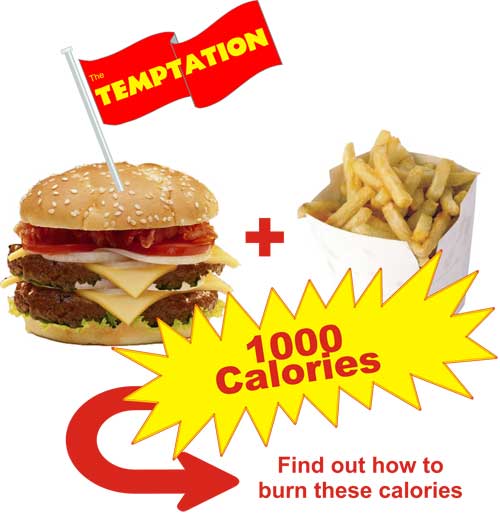
We're going to sweat while we workout anyway, so why not turn the temperature up a bit and really get it going? “Riding in a heated room torches calories,” says The Sweat Shoppe co-owner Mimi Benz. “You can burn up to 1,000 calories in 55 minutes.”
While technically accurate (yes your body expends additional calories staying cool… actually more than staying warm) what's missing is how our body's ability to create work decreases, as our core temperature increases. So if you can't work as hard because you're overheating, I find it hard to believe that a hot room has a positive effect on calories burned. I'll respond to the 1000 calories in 55 minutes BS below.
Remove the bounce.
“Bouncing stresses our joints and actually takes away from the calorie burn,” says Flywheel cofounder and creative director Ruth Zukerman. “When riding out of the saddle, hovering closer to the saddle relies on the use of your muscles more, resulting in more calories burned.”
I've love to see an actual study showing this – it's actually the first time I've ever heard it. My perception is bouncing out of the saddle is the result of improper pedaling technique – so technically she could be right > better technique could result in more muscle recruitment = more work accomplished / calories burned… or it could go the other way > better technique = more efficient, which could result in less work/calories expended. Either way I have a hard time believing that hovering will contribute to you being swimsuit ready anytime sooner.
My six secrets to Burning Major Calories in Indoor Cycling class.
[wlm_private ‘PRO-Platinum|PRO-Monthly|PRO-Gratis|PRO-Seasonal|Platinum-trial|Monthly-trial|PRO-Military|30-Days-of-PRO|90 Day PRO|Stages-Instructor|Schwinn-Instructor|Instructor-Bonus|28 Day Challenge']
#1 Dump the assumptions, they're unhelpful and potentailly destructive
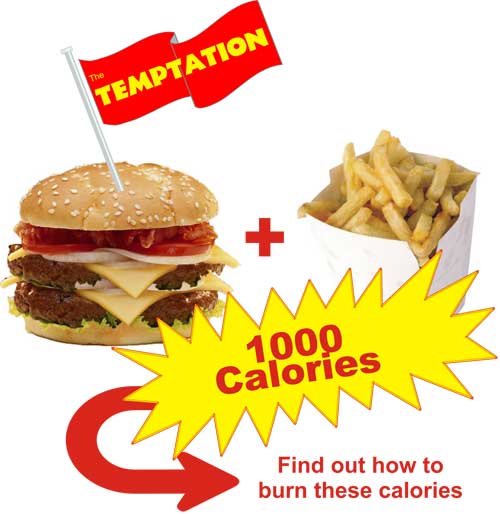
No, Ms. Benz, the typical participant in one of your Indoor Cycling classes CAN NOT BURN 1,000 calories in 55 minutes. Yes there may be a few in your classes who can. But unless you're looking at a room full of very fit 200lb men in every class, burning even half that amount (500 calories) will be a huge result for most participants.
Knowingly setting unrealistic expectations (BURN up to 1,000 Calories!) for riders in a class is unethical and is sleazy marketing of the worst type.
So what happens when a rider thinks they will burn 1,000 calories (no one hears the “up to” part) in a 55 minute class? Lots of things and none of them good:
- They'll feel free to eat more post-class as a reward. This post describes what's called hedonic snacks which are those little treats we use to reward ourselves for a job well done. “I just burned 1,000 calories!” “Say, doesn't the blueberry muffin look like the perfect reward?” Congratulating folks for expending way more calories than they really did, sets up a destructive cycle of behavior that results in weight gain, not weight loss.
- They won't work as hard in class, so their actual caloric expenditure will be even less than it could be. “I'll be happy with just 600 calories today, so I'll take it easy and chat with my new friend riding next to me.”
- They're set up for failure. Consider a studio equipped with Indoor Cycles with power indication. The studio's marketing materials tell riders they can burn 700/800/1,000 calories a class. At the end of the 60 minute ride the customer hits the avg/end button and sees; ‘Total Calories = 287'. How do you think they'll feel? “What happened to 1,000 calories?” “I must be a failure” “I'm never coming back here” 🙁
- OR – consider a studio without power who tells their customers; today we burned 700/800/1,000 calories! And then one day they ride a competitor's Indoor Cycle with power and learn the truth. Whoever lied to them will have lost a customer…

Image from http://www.wired.com/2012/08/fitness-trackers/
#2 Find some technology
I'm not talking about a wearable fitness tracker or heart rate monitor that offers estimated calories – they've been shown to display wildly optimistic calorie counts > Instead find a club or studio where you can ride an Indoor Cycle with Power/Watts indication – so you can observe a real measurement of how much work you're actually doing in class.

Indoor cycle power meters
At the risk of losing you here, there's a Law of Physics that can be applied to exercise and calorie expenditure. In layman's terms, the law; Conservation of Energy says you can't get more energy out of a machine… than what you put into it. Makes sense, right?
The power meter on an Indoor Cycle will record the the amount of energy your body expends turning the pedals x the amount of time you're working. Through some fancy math, any brand's power meter will display a reasonably accurate estimate of the amount of energy that went into powering your ride, expressed as Kilocalories (kcal), kilojoules (kJ) or both.
There are still a number of unknowns with these estimates of calories expended. The cycle doesn't know your gender, body weight or fitness level. My understanding is that the estimates used by manufacturers are based on a reasonably fit, 160 lb male.
Don't let these minor variables trip you up. The most important benefit of riding an Indoor Cycle with power/watts is how you can see today what you burned during the total class. Your next ride you'll have the chance to work a little harder and then you'll get to see your actual success!

#3 Stick with water
Nothing drives me crazier than seeing a participant, who I know is in class for weight management, with two bottles of energy drinks on her/his bike. 12 ounces of Gatorade has about 80 calories > the typical water bottle holds 20/24 = 160 calories for one and 340 calories for two bottles or more. So there's the potential to replace every calorie you've burned, and then some.
Depending on the time of your class, participants and instructors should be consuming a small meal of ~200 calories, that consists of a blend of carbs/fats and proteins. My favorite is a slice of whole wheat peanut butter toast.
Side note: Dr. Joan Kent, who's our resident nutritionist here at ICI/PRO, has been battling the addictive properties of sugar for years. She's written extensively about how you don't need sugar before, during or after exercise of any form. Endurance Nutrition Coach Ben Greenfield offers his own similar suggestions here.
Don't be left at the start
#4 Get there early… and get after it
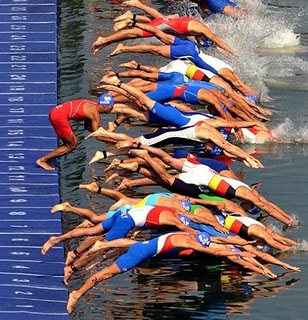
Fitness can be expensive and if you're anything like me – you hate to waste your hard earned dollars. So with popular boutique studios charging $30 or more per class, what's the secret to ensuring you get your money's worth + maximizing your calorie burn? Don't waste your pre-class time! Instead of sitting there, slowly pedaling and chatting with your neighbor, take yourself through a purposeful, self directed warm up. The objective is to be warm and aerobic by the time class begins.
Find a comfortable pedal cadence around 80-90 RPM and quickly add resistance until you're feeling productive. Wait until you feel the workload get easier (as you warm up you'll feel stronger) and add another gear. Ride there for a few minutes and then recover until you can breath easily. That's your cue to start the process again. This isn't anything crazy. Unless this is your first class, you know what you can (and need) to do to raise your body temp and elevate your heart rate to the point where you'd rather breath, than talk. I call this working above the Chatty Zone – that's the training zone you want to stay above to burn the greatest number of calories.
Again your goal is to be warm and ready to work the moment the music starts. You'll be burning major calories, while your neighbor is still organizing her towel.

Shut up
People who chat constantly during class burn 50% fewer calories than those who don't. OK, I made that statistic up out of thin air. As far as I know it's actually closer to 80% for the simple fact that burning calories requires a lot of Oxygen (O2) and talking can only occur when you don't need the O2 in the air you're breathing for anything else.
Just how much O2? The chemical conversion of the stored fuel in your body (fats & sugars) to usable muscular energy is around 3 to 1. So to burn 1 pound of body fat, you need to consume (breath in) 3 pounds of O2. Think about that for a moment. Oxygen is a gas that's only ~14% of the air you breath. O2 doesn't really appear to weigh anything and yet you need huge amounts of it absorbed into your bloodstream, to support the chemical reactions that turn stored body fat into energy.
Anything you do, that limits your ability to breath, will reduce the amount of calories you can burn. Choosing to talk during a workout subconsciously tells your body not to work hard = you might have had fun catching up with your friend, but you just wasted 60 minutes of calorie burning time – plus you probably irritated those riding around you 🙁
Here's a fun fact: do you know how those burned calories leave your body? Through your mouth! Fats and Sugars that have been “burned” (a more accurate description would be oxidized) are long chain carbon molecules that are broken up – one carbon atom combines with two oxygen atoms, to form CO2 carbon dioxide. So that toast you had for breakfast this morning leaves your body, a little bit at a time, with each exhale.
Stay down
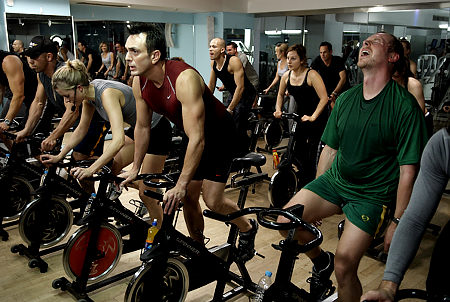
I call it, “bailing out” – the act of sitting up, to recover completely after an interval. If your objective is to burn the maximum # of calories, then you need to work at your highest sustainable level for as much of the class as possible. Killing yourself in a short burst, only to back way off has a negative affect on your total work accomplished during the class. Instead, to expend a larger amount of calories, try working not so hard > but for a longer period of time. Physical endurance will come over time, so stick with it. Stay down in the riding position for as long as possible, while managing your workload to you can complete each interval segment. If you need another reason to stay down… consider that everyone watching you bail out, is secretly chuckling at your lack of stamina 🙁
Come consistently
A focus on “burning calories” kind of misses the point. The objective is to reduce stored body fat, right? Just as you can't effectively train for a marathon, by randomly running across the street – reaching your weight loss and/or fitness goals requires a lot more than riding in a cycling class where you burning major calories. Weight loss will only come to those who attend fitness classes consistently.
If you're a little weak in self-discipline, I suggest finding a friend with a similar schedule and fitness objectives. Plan to meet together at a few specific classes, so someone will miss you if you're not there.[/wlm_private]
I'll often tell new riders:
The most important class you'll ever take… will be the next one.
Then I'll ask:
Will you be there?

by John | Apr 12, 2015 | Best Practices, Instructor Training, KEEPING IT FUN, New Instructor 101

I received more responses to the frustration originally expressed by new Instructor Irene in this post; Hey Team > How Would You Answer This Question?
What I find to be the single biggest challenge as a new instructor is music- music flow, and knowing what drills or activities to do to what music.
I feel at such a loss though when it comes to setting up a class…. And feel as though I let hours of time evaporate listening to music but not knowing how to incorporate it effectively into what I am doing….
Instructor and ICI/PRO contributor Krista Leopold – AKA GroupFitPower over at Pedal-On.com – offers this:
Hey John!
I don't know if it is too late, but I thought I'd throw in my couple of cents on this one.
Starting out, the music was overwhelming for me too. I thought I had a great library of music and so many ideas, but when I finally switched from being the rider to the instructor, suddenly I felt like I didn't know what I was doing! That's when I started tagging my music. I use a program called MediaMonkey, but there are a million ways this can be done – playlists, excel spreadsheets, notebooks. Start jotting down the songs you hear that when you hear them you think, “that would be a great song for…” I have lists of warm ups, cool downs, heavy climbs, fast flats, different emotions, song tempos and everything in between. Then, when I know what I want to do in class, I have a go-to list of songs to pick from. However, know that having a nice long list takes a while to come together, so you'll need to be patient as you develop your ear and the songs start trickling in. In the meantime, I encourage you to play other people's music and teach other people's profiles. You might be surprised how a song you don't think you like is actually amazing for what the creator chose to use it for in the profile. You can find great profiles here on ICI/PRO, or over at pedal-on. You can find lists like the one I described over at Spotify. The links are posted in a Pedal-On thread here: http://www.pedal-on.com/showthread.php?12446-Pedal-On-Collaborative-Spotify-Playlists. Don't be afraid to play songs chosen by other people. This is the single best way to find more music. It will open up genres to you, expose you to new artists and truly give you more music and ideas than you can possibly use! Good luck!
Hope all is well with you, John!
Krista
Endurance Coach and Stages Indoor Cycling Master Instructor Dennis Mellon adds:
John, let me know if this is what you are looking for.
Class Flow:
I believe the best way to insure class flow is with good class preparation. I also feel that class profile should come before music. A great profile can carry mediocre music but a great music cannot carry a mediocre profile. I would suggest putting together a class profile that supports your club’s training or class schedule program with a proper warm up, drills, sets with appropriate work to rest ratios, cool down and stretch, then add music that you feel works best with each segment. I think most instructors put too much emphasis on finding the perfect song for each and every segment of class. I only focus on the actual music for 2-3 songs per class then I use it to control the energy and/or motivate during the tougher segments of class.
I have posted a number of “The Power of 3” song sets on the ICI/PRO website that include music, set profiles, video and recordings of me teaching these sets during an actual class, these may help you “find the flow” you are looking for.
These are great suggestions Krista and Dennis > I'd like to add…
Irene, there was a time when most, if not all, of us have had difficulty with (to use your words) music- music flow, and knowing what drills or activities to do to what music. After 17+ years, and thousands of classes, this has become second nature. I'm thinking I should add your question to the list of things I struggled with as a new Instructor and have now forgotten, it was so long ago.
Wow… I just found the world's first 5% flat road.
Indoor Cycling has IMO too many “rules” that I feel constrain new Instructors and create frustrations similar to what you've expressed. Take for example the “rule” that; “X” cadence = “Y” terrain – i.e. 60RPM is a Climb, 90RPM is a Flat, etc… Rubbish. Yesterday I was riding outdoors. Looking down at my Garmin bike computer on a long, seated, threshold intensity climb, I saw that my cadence was hovering around 90RPM. Wait, that's completely wrong… isn't it? I am climbing a hill with a 5% grade, shouldn't I be peddling slower?
My point is that there are songs that, independent of their BPM, communicate something you can follow. By “follow” I mean responding in a way that feels natural to you – what could also be described as improvising. Hearing those “cues” contained in a particular piece of music, and then acting on them, is something you might need to learn. And for most people that requires, 1] practice and 2] developing the confidence to go whatever the music leads you.
Yesterday I shared a 40 minute mashup as the Free Friday music. Twenty three different tracks, of all different BPM's and intensities, professionally joined together that I feel would make a great practice session for you to practice your improvisational skills.

by John | Apr 9, 2015 | Big Box Instructor, Instructor Tips and Tricks, Instructor Training, KEEPING IT FUN, Music, New Instructor 101

Here's more responses to Irene's question about music in part one of Hey Team > How Would You Answer This Question?
ICI/PRO contributor and future studio owner Callie Bowling Kelly responded with…
Hey John!
Here's my reply:
This is a fantastic question! If I may pull from my background in Psychology to get to the root of what may be occurring… this sounds like a case of Blockage to me. Blockage from trusting your unique genius to come through and guide you. You know what made you fall in love with indoor cycling, if you didn't you never would have gotten certified to teach in the first place, right!? Get back in touch with what it was that you loved most about cycle classes, and then re-create that passion in your own class.
There is no right or wrong way to set up a class… honestly! The industry is evolving so much that all sorts of studios and instructors are coming up with their own way and re-inventing the wheel so fast my head is spinning (pun intended). I give you complete permission to do whatever it is that feels fun and challenging to YOU and then implement that in your classroom, as long as it's safe of course!
I know all too well the pressure of being up in the front of the room, positioning yourself as a leader, and feeling like you have to perform. It is human nature to want acceptance. We crave it. But, wanting acceptance too badly can literally shut you down artistically, because you second guess every decision you make. We think: how is this going to be received, are they going to like my music, is my class hard enough, what if they think I don't know what I'm doing? All of those thoughts are counterproductive to getting up there and having a great time and inviting your class participants to do the same.
Here's a tip of mine on music and choreography for the ride: I pick EPIC music that has a beat and makes me want to move! For the choreography… I like to work intervals, so in my classes we go hard during the chorus and bridge and recover during the verses. It makes the workout follow the energy of the music which creates pure exercise magic in the class!
Hope that helps John!
Callie
You'll find Callie's fun and informative articles and interviews here.
Lena Hershey is a Spinning® Instructor & Fitness Blogger @ leanlena.com. She offer these practical tips that I feel are perfect for a new Instructor.
Hi John.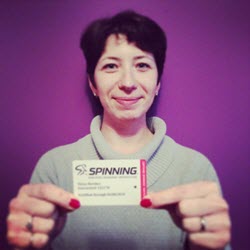
Thank you for including me into this.
Here's what works for me:
1. Profile first – think “terrain”. Where are your wheels taking you after warm up? Hills? Fast flats? Off the road and through the mud? Lay it out on paper – draw! That really helps me visualize and make the class profile realistic and my cues to class “spot on” not just pure technical.
2. Put your profile onto music. Beware of the lyrics – just as it can be incredibly inspiring, it can ruin a perfectly wonderful intent. Listen carefully to the lyrics of the songs and make sure not just the musical but verbal message matches the purpose you're putting this piece in your class for. Too overwhelming? Go instrumental! Sometimes a non-verbal message of the music can be more powerful than verbal.
3. Ride it. There is nothing wrong in practicing your rides before teaching them – especially when you're new to teaching. It is not a sign of weakness and seasoned instructors do it, too. Get in that room, turn up the music and teach yourself that class you created. Make sure the music flows nicely piece to piece, and practice cueing your ride.
4. If you can't ride it, listen to your class playlist with your drawing in front of you and think of or say what you're going to say in class.
I know how daunting it can be to start putting your class profiles together. Some of them will be worse than others. You will fail before you succeed. Just remember that you're the only one who will notice the “failure” as you're the only one who knows what the plan is. If something doesn't go according to your plan in class, just move on. Your class will follow your lead, so smile and believe in yourself and your profile. Your pack will follow you!
Best regards,
Lena Hershey.
Lena and I partnered on the 28 Day Instructor Challenge > what turned out to be a very fun exercise in self development for Instructors, over the course of a month. You can look back the challenge in this series of posts.
The Senior Group Fitness Instructor here Amy, dashed off these thoughts will sitting at the airport.
My quick and dirty response would be:
Categorize music with a beats per minute app on your computer. Climbs = 60 to 80 bpm, Flats = 80 to 100. This helps you ‘hear' the music and what it works best for. Start a playlist called ‘Climbs' and ‘Flats' and add to that playlist as you listen through music….just collect a bunch in each category. This gives you a couple master lists to work from to create classes.
Download ‘Shazam' on your phone. When you're out and about and hear a tune you like, you can ‘Shazam' it and determine the bpm later.
I would highly recommend a Spotify Premium account (approx. $10 a month). That way, you're not paying for individual tunes, but have a huge library and can maintain your lists there.
I label my profiles/playlists primarily by date. I have a small spiral notebook where I write (by hand) the playlist title, each tune, the bpm and time length. I keep this notebook in my gym bag and use it for every class. That way, there's no surprises.
I hope this helps!
Amy
As a long time ICI/PRO contributor, Amy has shared her 20+ years of fitness experience, knowledge of music and fitness related beauty tips for female Instructors.
So, what did we miss?

by John | Mar 20, 2014 | Best Practices, Big Box Instructor, KEEPING IT FUN, New Instructor 101, Teaching Intro Classes
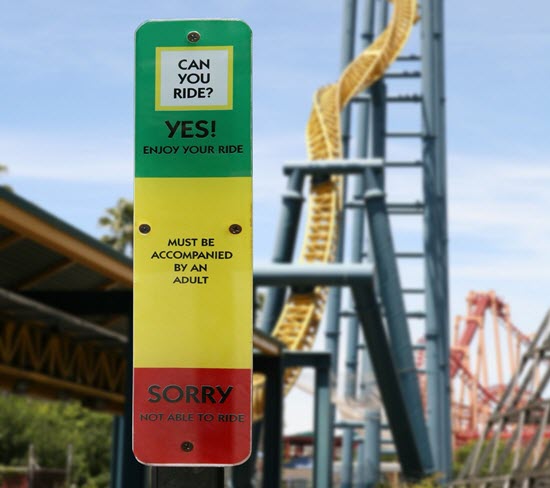
Theme Parks solved this problem 100 years ago.
When I get the same question, from two ICI/PRO members, a week apart, it means I should probably write a post about the subject.
First the questions:
Hi John –
I hope you are doing well and have the prospect of defrosting in the near future! A question came up at one of the places where I teach about minimum age for spinning. Back when I was certified, I understood that 16 was the earliest age based on growth plates, etc. Has there been any change in thinking? Can you point me to the most current research? The owner has been hounded by a member who wants his 12 year old to spin with him. I encouraged the owner to send an email to all the members spelling out the club's policy regarding kids and spinning (a tactic employed by the lovely studio owner from California who you interviewed on a recent podcast!). Having the research will give him the ammunition he needs.
Thanks, John. I appreciate any leads you can give me!
—————————————————————————–
Hello,
The YMCA I teach at wants to let children join the spin class. Is there an age limit or height recommendations that you can suggest? I have been on line before when some children came to spin with their parent. I found one source that said 4'10 but I need something to show my supervisor.
Thank you so much.
Here's how I initially responded
Hi Alice – I actually talked to Dennis Keiser about your question this morning during the early AM workouts here at IHRSA in San Diego. He doesn't have any specific research he could point to, but the engineer in him made these points – which I'm paraphrasing as I didn't record our conversation.
- Most children are not just small adults. Although manufactures build Indoor Cycles to accommodate a wide range of adult heights, you can't compare a 5′ 12 year old with a 5′ 30 year old.
- The crank arm length (typically 170mm) maybe too long for many young children. This forces the rider's knees to move through too large a range of motion.
- The flywheels on IC bikes (and especially friction resistance cycles) have too much mass for children's underdeveloped leg muscles to control at low or no load pedaling.
That said, there are always exceptions to every rule – so making a blanket: no one under 16 rule is bound to have someone complaining when their 6′ 180lb 15 year old son is told they can't ride.
Not sure if this helps but it's what I have.
John
I'm thinking I may want to amend this a bit – truth is I was really squeezed for time when I responded to Alice.
Effective communication is a tricky thing and I totally failed to follow my own advice here. I know better than to give into the temptation to quickly educate – it's almost always the wrong initial response.
Instead I should have responded with questions, to better understand the issue.
I could (and should) have asked in response…
- What's your goal or intent here?
- Are you trying to protect kids from injury?
- Do you dislike having kids in your class?
- Are you trying to identify the nominal age where kids are mature enough to participate in a class?
- Is this to create an easily understood standard for participation? You must be this tall to ride.
- Are you trying to encourage more kids to get involved in our sport?
My view is that any response to these questions is legitimate. For example; one of the clubs where I teach is an Adults Only Life Time Fitness. The minimum age is 16 – period.
Your club may allow younger kids on the fitness floor, but wish to set a height/age limit for group classes. The reasons why can vary. You may be concerned about safety or a lack of maturity – it makes perfect sense not wanting a pack of 13 year old boys disrupting your class.
On the flip side, don't we want kids active and enjoying fitness? If a member wants to bring their 12 year old son or daughter to a class, shouldn't we try to find a way to accommodate them? Despite two fitness Instructor parents, neither of my daughters are very active. Abby and Carly work & play hard at their jobs and school, but they have almost zero interest in a structured fitness activity. I'd love to find a way to get them involved at our club.
If I had asked a few of those questions, I might have responded differently. My guess is that these Instructors don't want to have to be the “Bad Guy” = be the one who has to say “no, I'm sorry but little Billy can't ride with you.” There's an easy solution for this.
Appeal to a higher authority
We're in a service industry and it's hard to have to tell a customer; “no sir, your 10 year old daughter can't take this class with you.” As an Instructor it puts you in a very uncomfortable place, and often has you debating with the parent to no good end. There's a simple solution that theme parks figured out years ago. Create a very clear GO/NO-GO line and display it prominently. The MUST BE THIS TALL TO RIDE sign becomes the authority you can point to. I know it can make you seem like an un-thinking robot, but having something solid to point at can really reduce conflicts.
So how high do I set the bar?
The Spinning.com website has some good information you could follow.
Each Official Spinning Facility has its own policy on age requirements. Also, consider the following information in your decision —
Size: Proper bike fit is very important for injury prevention. Participants need to be big enough to get their proper seat height and fore/aft adjustments. Spinner® bikes usually fit people who are at least 4′ 11″. However, this is not an exact minimum height. Leg and torso length determine if the fit is appropriate.
Age/Maturity: Children need to be mature and responsible enough to follow the safety rules. It can sometimes be tempting for kids to pedal as fast as they can, and that can be unsafe. Because the Spinner® bike is a fixed gear bike, the weight of the flywheel can turn the pedals at a very high speed with a lot of momentum if there's not enough resistance.
They also offer a PDF you can download.
I really like the sign pictured at the top of the post, with it's three zones 🙂 Would it make sense to create something similar you could post at your club? Maybe with these three zones?
Can I ride?
- Red: Sorry, you need to be 4'11” or an adult to ride.
- Yellow: Under 13 (you decide) needs to ride with a parent in the front row – so you can keep an eye on them.
- Green: Let's Ride!