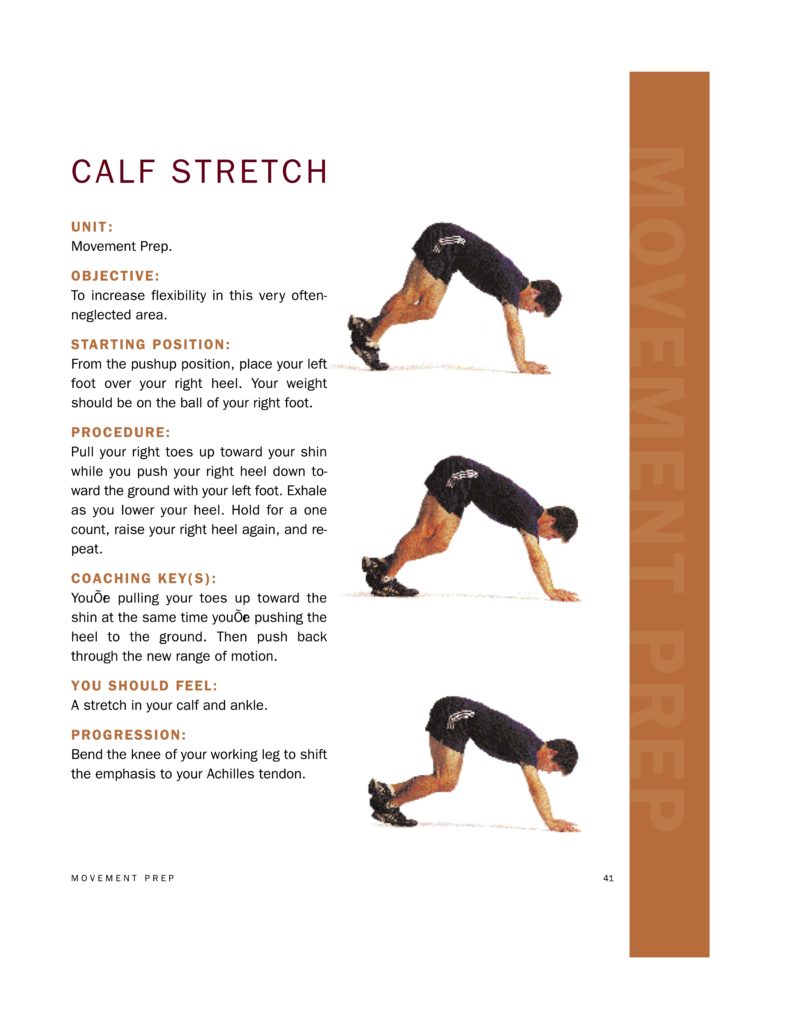
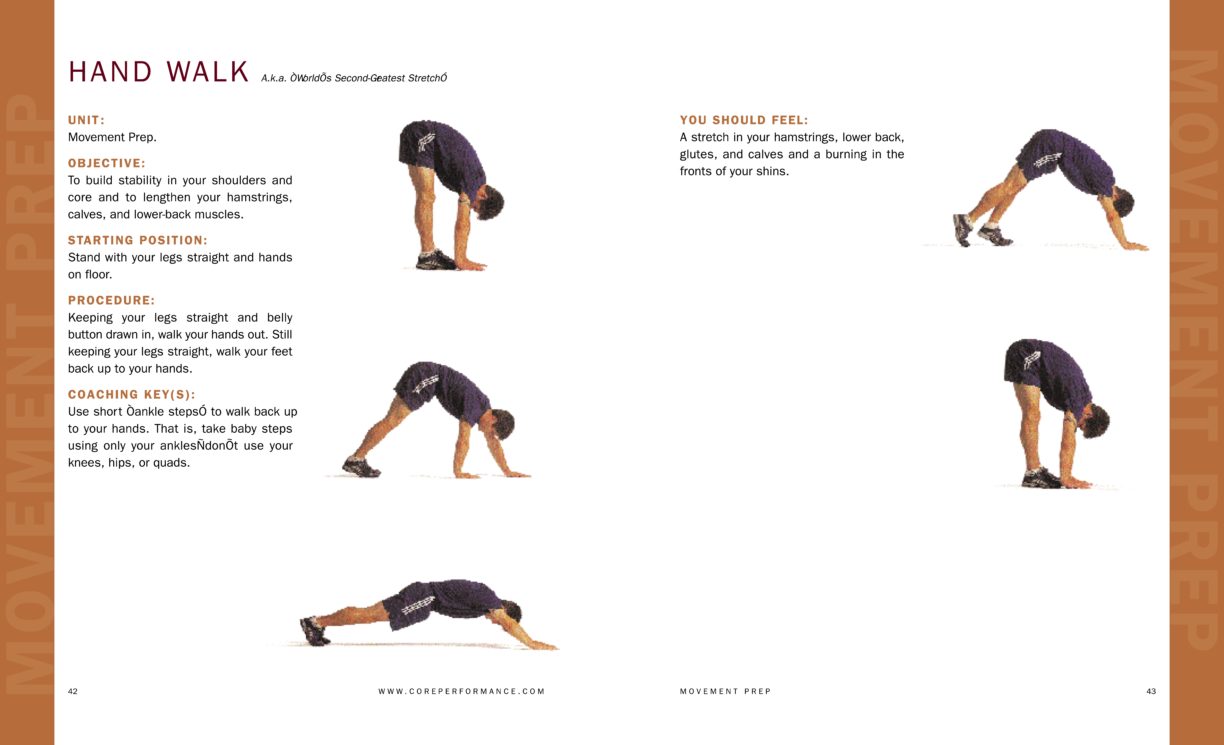
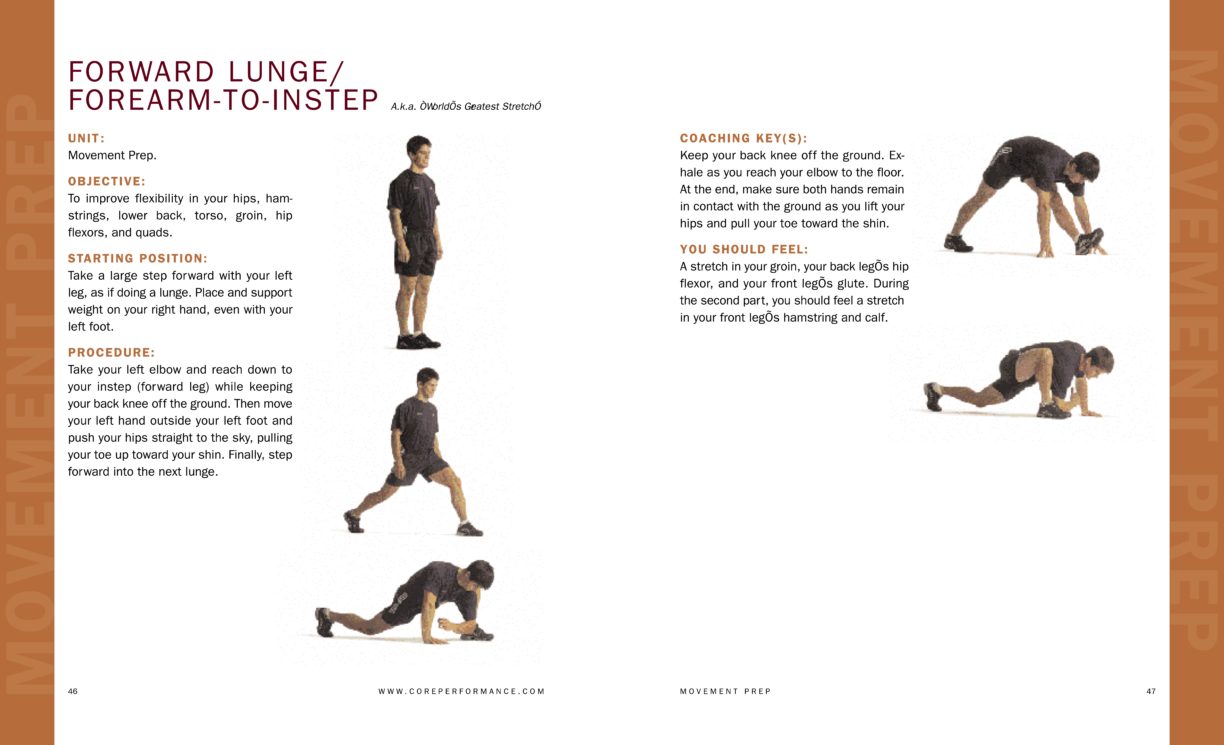
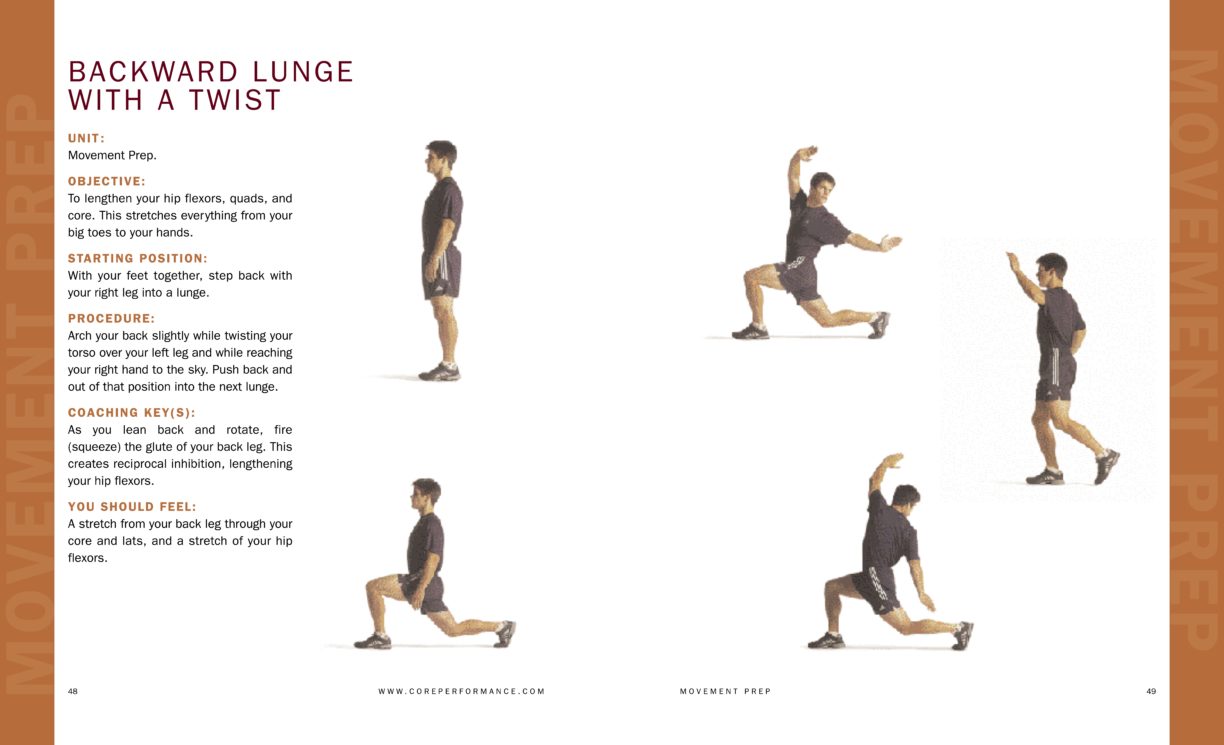
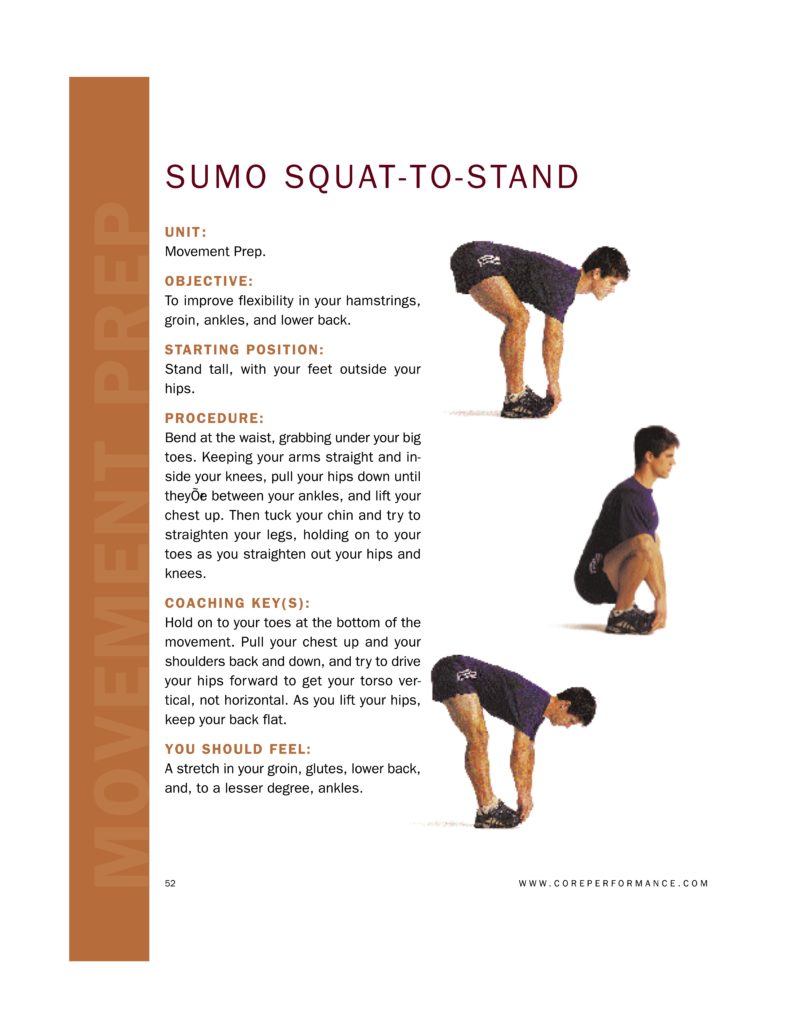
Many of my riders know that I'm also a Personal Trainer, so I often get asked questions about all aspects of fitness. Warm-Up is a subject that comes up again and again. I've been using the Movement Prep Warm-up featured below for nearly 15 years.
Cycle training is an exclusively linear exercise and I believe it's important to activate the lateral movers as well as muscle groups that are not emphasized while riding. Keeping all muscle groups active will assist in continued powerful pain-free riding.
These exercises, videos and .pdfs come from the book Core Performance by Mark Verstegen & Pete Williams which should be part of any fitness professional's library.
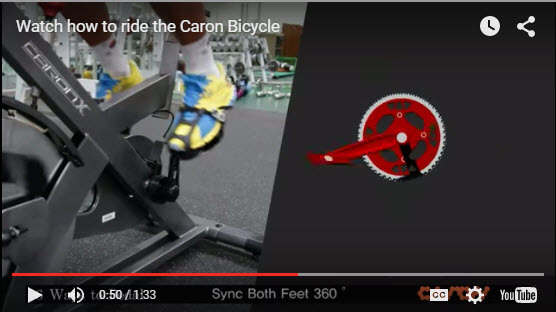
I just became aware of a new Indiegogo campaign for an innovative* method of pedaling a bicycle. Similar in functionality to a KrankCycle, the Caron Bicycle uses independent left/right crankarms that create 6 different pedalling movements.
They have their crankset installed on a conventional IC in this video. Watch and then tell me if you feel these added exercises would improve your class… or is it just a solution in search of a problem that doesn't really exist?
This animated video shows the various muscle activation from the different pedalling techniques.
*I'd be curious to know if Matrix has patents on the KrankCycle that would extend to a leg powered bicycle?
In case you haven't seen the KrankCycle in action:
Caron claims this on their campaign page:
Technology for CARON Bicycle is protected by patents worldwide, including US Pat. No. 7,544,139.
It might be cool to observe power output – especially during one legged work 🙂
Liquid B complex is the only Nutrition Magic I know. It can stop a sugar craving within a few minutes. But every so often, people will tell me they tried it and it didn’t work. How could that be?
Careful questioning revealed a few common reasons that prevent B complex from working effectively. Here’s what I’ve discovered.
Not Using Liquid B Complex
The liquid formulation seems to speed up the effect so we can feel it within a few minutes. Tablets take longer and might be good for regular supplementation, but a “craving emergency” is better dealt with by using liquid B.
If you already take a daily B-complex tablet, you can safely add liquid B on a day that you get a craving. On the other hand, if you’ve used liquid B for a craving before taking your usual dose of B, there’s no reason to take the tablet that day.
A one-day “overload” of B vitamins won’t be harmful, but it’s best to avoid it on a regular basis. (If you have any questions about this, please check with your doctor.)
Taking B12 Instead of B Complex
For reasons I’ve never been able to understand, people misinterpret “B complex” as “B12.” It’s possible that this dates back to the once-upon-a-time practice of getting B12 injections for energy.
Whatever the reason, B12 is only part of the complete complex — and not even the most important B vitamin in trampling cravings. Yet this misinterpretation has happened so often, I now clarify immediately whenever I recommend B complex to a client.
So again, use LIQUID B COMPLEX. Not tablets, not B12, not any other individual B vitamin.
Not Eating Any Protein
When this mistake is made, it’s usually by folks who haven’t worked with me as clients. All of my clients know I stress the importance of protein.
Protein is a key element in the craving-killing plan. B vitamins work as catalysts to help form specific brain chemicals. Those chemicals can end cravings (and also prevent them) when they’re at optimal levels. But the brain chemicals are made from amino acids — which we learned in 7th—grade biology as “the building blocks of protein.”
We can’t make the necessary brain chemicals without protein.
Junking Out On Sugar First
If you’ve eaten half a bag of cookies, please don’t expect B vitamins to stop you from eating the other half. The neurochemical changes that the cookies have set in motion are powerful — and even more powerful for some people than for others.
For reasons beyond the scope of this post, those brain changes will probably make you want the rest of the cookies.
Suffice it to say there’s simply no way that a teaspoon of liquid B complex can override the strong effects of whatever sugar you may have just eaten. The most helpful idea is to use B vitamins to stop your craving so you don’t eat the cookies in the first place.
I’ll throw in a side note. If you find it too easy to reach for cookies because you’re home and they’re conveniently located in your kitchen cabinet, please do yourself a huge favor: Don’t keep cookies in your kitchen. Throw away the ones you have. Don’t buy more.
It Works If You Work It
Liquid B complex is still the only nutrition magic I know. It’s effective; it’s quick. But it’s not a stand-alone miracle. It’s best used as part of a sincere attempt to reduce dietary sugar.
Please stay aware that B vitamins are a short-term solution for stopping sugar cravings. Getting rid of cravings permanently requires changes in diet.
And, yes, changing diet can virtually eliminate cravings. Think of the freedom that could mean for your students.
As a nutritionist, I hear many clients say they want to lose weight — to look better, have more energy, improve their health. But losing weight can also help you increase your power on the bike.
Ratios intrinsically provide two ways to improve the ratio — by manipulating either variable. The results of improving both variables can be dramatic.
As covered in a previous post, efficiency — the ratio of work output to expended energy — can improve with increased work output or decreased energy expenditure (or both).
In the same way, your power-to-weight ratio on the bike (measured in watts per kg) can improve with increased power or decreased body weight, or both.
Power is itself another ratio, of work to time. If work increases or time decreases, the result is greater power. ICI/PRO is currently covering this topic in depth.
So that provides 3 variables in the power-to-weight ratio: increase your strength (work), increase your speed, or decrease your body weight (or all of them).
Why Lose Weight?
Even if you’re not overweight, weight loss may improve your power-to-weight ratio. It need not — and shouldn’t — involve a strict “diet” that leaves you hungry most of the day.
It does involve careful monitoring of your numbers — how many calories you burn (using your power meter or, preferably, a wearable calorie counter 24 hours a day), and your calorie intake.
The goal is to eat fewer calories per day than you burn, but not by much, just 150 to 300 calories. If that feels too restrictive, drop the deficit to 100 calories. The result would be a slow decrease in weight that you can stop or reverse at any time.
These days, the general recommendation for weight loss is rapid loss. (Is that to match up with HIIT and the shorter-and-harder approach to fitness, I wonder?) Rapid weight loss is said to keep the “loser’s” motivation high.
Yet gradual weight loss — while also training for power — has the advantage of maintaining fat-free mass (FFM) so you won’t lose strength, an important variable in the power ratio.
Holding On To FFM
Weight loss often decreases muscle mass, especially rapid loss. But in the long-running (13-plus years) weight-loss program for which I was both the nutritionist and a training coach, we typically saw steady or increased FFM while the participants lost weight at a slow, sustainable rate.
That helped them maintain strength and power so they could do the training, which was frequently high-intensity. The intense training, of course, was designed to increase strength and power.
Maintaining FFM also prevented participants from having to drop calorie intake more and more (and more) for continued weight loss.
Don’t Bonk
Make sure you don't restrict calories on the ride itself. Whether you’re riding outdoors or doing tough power training in the studio, under-fueling before or during the ride could cause you to bonk.
Even without bonking, you may still feel week and have difficulty working up to your capacity — the power you’re trying to improve. Fuel as usual while riding.
Keep the calorie restriction small. Cut back a little more on days that you’re not training hard, or at least save the restriction for after the ride. If your power ride is late in the day, early A.M. calorie cutbacks may work. Just keep your pre-ride meal about the same as usual, and eat or drink whatever you need on the bike.
Be strict about post-training refueling (covered in a previous post) so you can train well the next day.
Technique and Efficiency
In all of this, don’t forget that better technique on the bike will help you waste less energy by reducing the energy needed for pedaling, reducing energy lost as body heat, and retaining more energy for your next pedal stroke. Your functional strength, a power variable, will increase.
Combining good technique, all the power training tips you’re currently getting here on ICI/PRO, and gradual weight loss will help you dramatically increase your power-to-weight ratio on the bike.
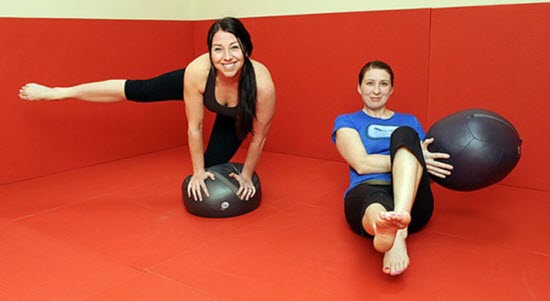
If you've ever had an idea for a new, fitness related product or service? Dream about building a company around your new widget and then selling your company to a larger company? If that sounds like you, you'll want to listen to this interview with fitness entrepreneur Sara Shears. Sara invented the Ugi ball to help her personal training clients train more frequently. After years of effort, she was able to sell her company Ugifit to Mad Dogg Athletics.
Rather than trying to explain Ugi to you – watch this short video to see it in action.
http://youtu.be/GxkBlo44XPA
Listen to Sara explain some of here entrepreneurial journey below.
I met with Sara at WSSC and took one of her 30 minute classes. It kicked my ass and the whole time I was suffering through Sara's class, I kept thinking how Ugi could be the perfect strength and balance compliment to a small boutique's cycling class.
Interested in training to teach Ugi classes? Here's the link to their website where you can find a certification training near you – or how to host a training at your club or studio. I'd love to know what you think about Ugi…
[plulz_social_like width=”350″ send=”false” font=”arial” action=”like” layout=”standard” faces=”false” ]
By Team ICG® Master Trainer Joan Kent
Lance Armstrong’s strength and conditioning coach, Peter Park, developed a series of core strengthening exercises that he calls Foundation. The focus is on the posterior chain of muscles, such as the glutes, hamstrings and lower back.
Peter Park describes this as “redefining the core” because the emphasis is shifted from the abs to the larger muscles in the back of the body. Because it was developed in this way — and with a world-class cyclist in mind — it’s no surprise that it gets indoor cycling students sitting better on their bikes. The improvement in my students has been remarkable. Their posture is completely different as they cycle.
I learned about this strengthening program from Jim Karanas, who had bought Peter Park’s book but hadn’t yet had time to go through it. I read the book and started doing the exercises. Some of the changes were noticeable right away.
The most fortunate part of this for me occurred in a somewhat unfortunate way. Only weeks after beginning this program, I crashed my bike and broke my pelvis in three places. My doctor told me not to do any type of “crunch” or abdominal exercise. Needless to say, I wasn’t looking forward to skipping my core training and watching my strength in that area deteriorate over the twelve weeks he said it would take to heal.
But I could do these Foundation exercises because they didn’t stress the abs. They kept my core strong throughout the healing — and possibly even shortened the healing time. I was OK in just over five weeks. I continue to do the exercises five to seven times a week and genuinely enjoy the first exercise, the Founder, in particular.
The book is called Foundation by Dr. Eric Goodman and Peter Park. The beginner’s routine consists of five exercises on pages 86 to 107. The entire sequence is short and can be run through two or three times in a row. The book also includes photos and descriptions of a moderate routine and an advanced one. The Founder exercise itself is short enough to fit at the beginning or the end of an indoor cycling class.
Here are the videos of the Founder sequence, taught by Eric Goodman.
I hope the Founder and the other exercises in the routines are helpful for you and your students. If you try them, please let us know how they worked for you.










 [plulz_social_like width=”350″ send=”false” font=”arial” action=”like” layout=”standard” faces=”false” ]