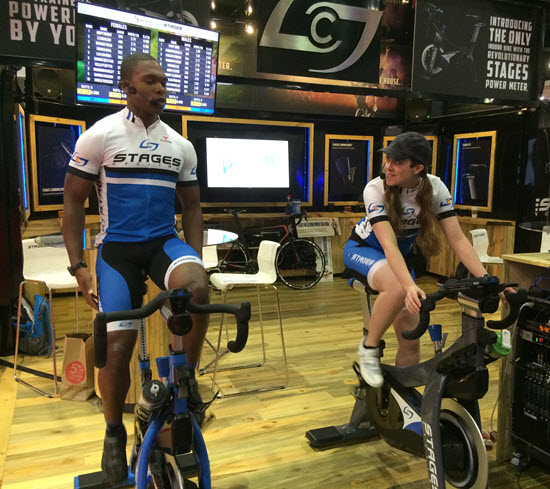
Stages Master Educators Dunte Hector and Cameron Chinatti leading the morning ride at IHRSA
IHRSA 2015 was the first public appearance of the Stages Cycling SC3 Indoor Cycle. This was a total surprise to me and I have no idea how Stages Master Educator Dennis Mellon was able to keep his mouth shut for so long. We talk weekly and it must have been killing him not to be able to tell me about their latest project 🙂
Going forward, I feel it's important to disclosure that Stages Cycling sponsored (paid) my and Amy's travel to, and lodging in, Los Angeles to take part in the launch of their new Stages SC3 at IHRSA 2015.
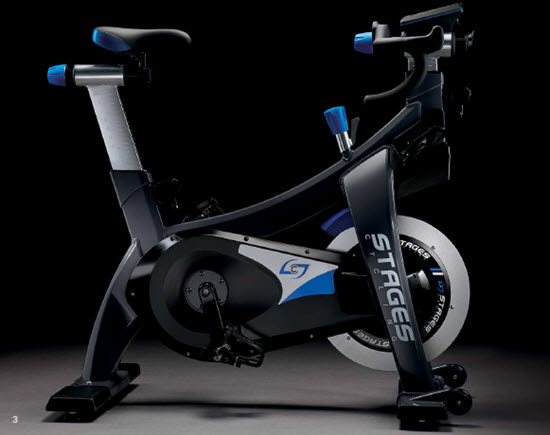
If parts of the Stage SC3 look familiar, there's a good reason. The engineers who designed this Indoor Cycle have a long and storied history of product development with indoor cycles and power consoles. It was explained to me that the design criteria for the SC3 was; take all of the engineering team's collective experience and build the ultimate, commercial Indoor Cycle. Did they succeed? Let's find out…
The Basics
Frame – Aluminum… and lots of it. This is a very solid/substantial IC > perfect for studios with big, powerful riders – or – those offering unconventional classes with a lot of movement.
Drive – CarbonGlydeâ„¢ drive system. Yes, this is the same Gates belt as other manufacturers are using, but there are fundamental differences with the other components of the drive train, that give the SC3 a very different feel. Because they don't run the belt under tension (there's a tiny bit of slack you can feel as you move the pedals back and forth) the SC3 is noticeably quieter than the Schwinn AC and it's tensioned Gates belt. It also retains a slight, chain-like vibration, but doesn't buzz like the AC. Stages is so confident in their drive system that they offer a 10 year warranty on the CarbonGlydeâ„¢ belt. Correction: Stairmaster's engineer Travis Vaughan alerted me to my error describing the Schwinn AC's Gates belt as “tensioned” – which it's not. I didn't intend to infer that they used a tensioner like what's used with Poly “V” belts. Instead I should have described the differences as; the AC runs it's belt taut (zero slack) vs. the SC3 which, when properly tensioned, has a very small amount of slack.
Resistance – Magnetic > surrounding an aluminum flywheel. Screw style adjustment and includes the new Stages SprintShiftâ„¢ three position lever . More on that below.
Handlebars – Road Bike Style Drop Bars – there's a reason that handlebars on road bikes haven't changed over the last 100 years > these fit us (humans) the best. Please don't ask me; “butwhere is position #3 John?” It's standing, with your hands surrounding the brake hoods, exactly where your hands belong when you're out of the saddle 🙂 It's here where you have the most leverage to power through a steep climb and it eliminates the temptation to “over reach” while seated.
Saddle – nice. Not too narrow… and not to wide/fat. Forgive me for saying it this way, it's very close to (might be exactly the same as) the saddle on the Schwinn AC > we have one on the back of our Trek Tandem. Amy loves this saddle and it's been comfortable for her for thousands of miles. Trust me on this one… I'd have heard all about an uncomfortable saddle.
The Power Meter
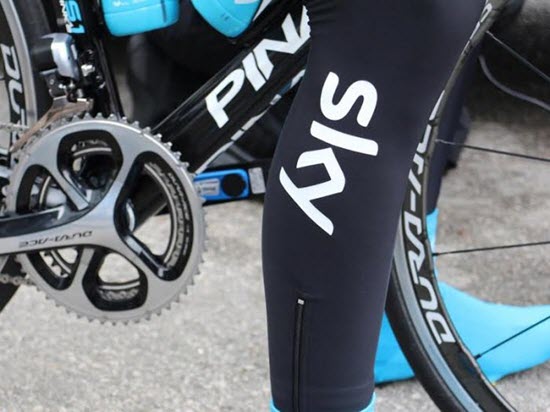
Good enough for TDF winning Team Sky Professional Racing Team
The heart of an Indoor Cycle that features power measurement is, of course, the power meter. The new SC3 is using the same technology used by Team Sky – winners of two Tour de France bicycle races and they're going to continue to use these power meters in 2015.
I could devote an entire article on just this topic and will have more as part of the ride portion of this review. In the interest of time I'll give you the important bits:
2,000 hours of battery life using two AA's – yes the display console is self-charging.
Same hardware, design, and accuracy found in the Stage Power® meter, which is used by professional cyclists’ and used in the world’s most famous cycling races, including the Tour de France.
ANT+â„¢ and Bluetooth – so it will connect with your iPhone or Android without any adapters.
Supposedly accurate to +/- 2.5%. I say “supposedly” because I have no way to verify their claims – but I bet Team Sky does 🙂
Display Console
It's important to separate the power meter, from the display console. Although most studios will choose to purchase their new SC3's with the new Stages EcoSCRNâ„¢ console, you don't have to. The Stages power meter will work with any Bluetooth or Ant+ device, like an iPhone or Garmin. You could also choose to wirelessly connect the Stages power meter directly to Display Training systems from Performance IQ or Spivi.
Here's a short video showing it in action during one of the 60 sec challenges.
The EcoSCRNâ„¢ console is self-powered = no batteries to replace ever… that's the Eco part 🙂
No exposed wires > I was told they've very neatly packaged the cable that connects the flywheel generator to the console = a long life of raising the handlebars up and down.
Constant backlight if you choose 🙂
Stage button to record intervals > there's also a nice feature that your averages remain displayed for 5 seconds after you end a stage.
Stages SprintShiftâ„¢ is a three position “shifter”, that provides course adjustments quickly. I want to describe it as a sort of cruise control, where you flick your finger and instantly resume your previous speed/resistance level.
Think of doing a repeating series of intervals. We cue everyone to add load, ride the segment and then recover. Now repeat it again. With SprintShift you can set your initial load with the lever full right. Move it left for recovery and then return back to the exact resistance instantly, by moving the lever all the way to the right.
There's some interesting physics at work here. If you use the SprintShift at lower resistance levels, the amount of change between each level remains relative & realistic. But start with a big gear and the changes are incrementally larger.
There are multiple ways you could incorporate this in your class and we'll find more over time. I'll describe a relay race we did in the ride part of the review where it was very helpful > we won! I'm sure Cameron and Co. will have some fun suggestions for using SprintShift when I interview her in the next few weeks.
If you've ever fought over a stubborn screw type seatpost of handlebar adjuster, you'll enjoy these new FitLoc cam style adjusters. Watch the video and you will see how quick and easy they are to operate. Also, they've kept the weight of the bars low, so it takes very little strength to raise them, using only one hand.
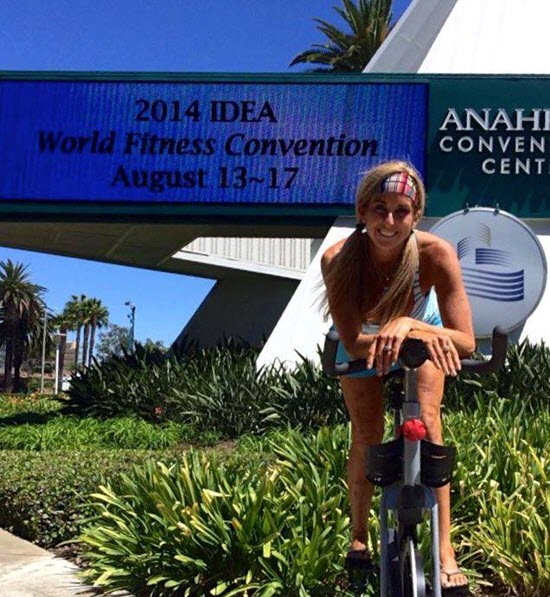
I'm super excited to participate at IHRSA 2015 next week – this is the largest fitness equipment/programing and services show in the USA. Our industry is continuously changing and many manufacturers launch their latest and greatest at this huge event.
Amy is joining me again this year and we'd love to meet you! We get into LA Tuesday 3/10 morning and will be there until noon friday.
Here's the IHRSA promotional video – highlights from last year. I need to comment that Callie Bowling (a past guest on the podcast) picked out Amy and me registering last year @ 0:26 – recognising us both before she'd ever met us in person 🙂
First, who I'm excited to meet at IHRSA
I've know him “virtually” for years, but at long last I'll get to meet David McQuillen of Sufferfest video fame. He is traveling from his home in Sufferlandria (which is on the opposite side of the globe) and will be there – booth #2554.
Cameron Chinati, Laurel Mylon and of course Dennis Mellon from Stages Indoor Cycling – they were notably absent last year – booth #2735
Both of the Display Training companies; Shay Amir with Spivi and Tae Yoo from Performance IQ.
Candice Mason is the Director of Commercial Sales for Mad Dogg Athletics. I've had the pleasure to talk with her by phone and I'm keen to learn what studio owner resources they'll be offering at the show – booth #1135
My friends from Keiser; Darrin Pelkey and hopefully Dennis Keiser. Amy and I had a great conversation with Dennis last year and I'm very interested to get his insights on the state IC technology.
And now what I'm looking forward to seeing
Star Trac / Spinning® is displaying their new “Fusion Drive” belt drive option for the NXT and Blade Indoor Cycles. I'm hoping design engineer Justin Kleber will be there to give me all of the technical details.
I'm hoping that Les Mills will be displaying their new IMMERSIVE FITNESS video presentation system. I've heard nothing but, this is totally awesome, from anyone who's been to their Santa Monica 24 Hour Fitness club.
MINDBODY is launching MINDBODY for Box, which they say offers workout and performance tracking. I've got no idea if this is targeted at their boutique studio customers, or (as the name implies) it's only for Big Box studios… but then that's why I'm going.
Wearable Technology like the Pulse ON watch that can read heart rate optically, without a chest strap.
And there are always surprises.
I'm not sure why, but ICG isn't showing as an exhibitor this year – although they may be part of the Matrix display. And Schwinn/Stairmaster isn't listed as a vendor either… UPDATE: Thanks to an email from Merrill Richmond I now understand that Schwinn is exhibiting along with the other brands owned by Core Health & Fitness, LLC – booth 1135. Merrill is now the Vice President of Marketing for Indoor Cycling brands Schwinn and Star Trac.
Stay tuned – I'll be live blogging during the event. If you have anything you like me to look at for you, please let me know.
“Hello… My name is Karen and I stepped out of the box last year. I am also the self proclaimed spokesperson for KEEPING IT FUNâ„¢ Indoor Cycling. I’m committed to helping other indoor cycling instructors who aren't afraid to approach indoor cycling differently.”
I wrote it a little over a year ago.
I wrote it after making the commitment to add variety into my own studio's Indoor Cycling program.
I wrote it because in order for me to continue to transform lives through Indoor Cycling I recognized that my program needed to evolve.
If you are an Indoor Cycling studio owner/manager the brutal truth is… maintaining the integrity of the road may be the demise of your studio/program.
Soon after I opened my studio in November of 2012, I realized this NOT SO FUN fact.
So, I took an honest inventory of what our studio offers, what our customer wants, and what future projections were for the Indoor Cycling industry. I listened to our customers. I observed what classes they gravitated to and away from. I asked them what they found FUN.
I took into account my personal evolution as a GroupEx instructor, my observations of the Indoor Cycling industry, as well as input from other instructors and studio owners. And then … I charted my Indoor Cycling course and set sail by following my heart. I stayed true to my WHY. I honored both my vision and our Mission Statement of creating the ultimate Indoor Cycling customer experience. I added variety to our schedule.
In addition to traditional Indoor Cycling classes, our studio also offers
CB2 Rhythm
CB2 TotalBody
CB2 Performance IQ
CB2 Rhythm & TotalBody and
CB2 Revelation Revolution Christian Indoor Cycling … all of which we did not offer when we opened. It wasn't easy … but we did it … and it was worth it!
Is offering variety the key to success for future Indoor Cycling studios? ABSOLUTELY NOT
The key is recognizing that the Indoor Cycling industry is evolving and will continue to evolve.
Only you can figure out where you and your studio/program fit in. I suggest you start by revisiting your WHY.
Make decisions that maintain the integrity of your brand mission (which I hope you have) and honor your brand vision (which I also hope you have). Talk to your customers and look at it through their eyes. Look at it through the eyes of customers that ARE NOT customers. Talk to your peers. Ask for help.
Regardless of the path you choose… BELIEVE in it and be ALL IN
Words of Wisdom From An Outdoor & Indoor Cyclist “People need to realize clients have different goals, something your team is exceptionally respectful of. Those who say dance has no room in spin* need to check why they are in the business in my opinion. I love cycling, fitness and helping people improve and grow. I know that may violate an ideal that orbits the bottom line comes first mindset, but it is how I feel. If you want to have limited appeal to a small clientele offer nothing but high powered, intimidating classes that serve Tour de France, Ironman Kona specialists, otherwise open your mind and look at he every day folks that are interested in mixing it up and developing fitness via different methodologies.
I'm admittedly novice in your world and likely idealistic to a fault, but I have trouble dealing with folks that are close minded, dismissive and risk averse. Try things live and learn!” Phil
* “spin” has not been identified as Spin® to maintain the integrity of the customer's own words.
Click below to see (clearly amateur) video of Phil riding in a CB2 class taught for the purpose of media photos. The testimonial after class is unplanned and a beautiful testament to different being a good thing. How do you feel about Phil's testimonial?
As a training tool – running a PTP test/assessment is invaluable!
We had some excellent questions from Studio Owners this past weekend during our Full Psycle/PRO PIQ workshop. Paul Harmeling addressed these two related questions during the Q&A – I wanted to offer my thoughts on it here:
When, or how often, should we be using using the PTP (Personal Threshold Power) mode screen?
What exactly should we have our riders doing, during the PTP (Calc) test/assessment?
First, for those currently not using a Display System in your studio, let me explain what we're talking about. NOTE: I'll focus on Performance IQ because I know it much better – all of this has similar application with Spivi.
On a related note, I learned a little known trick that could potentially save a new studio enough money to pay for PIQ or Spivi – contact me if you're interested in learning more.
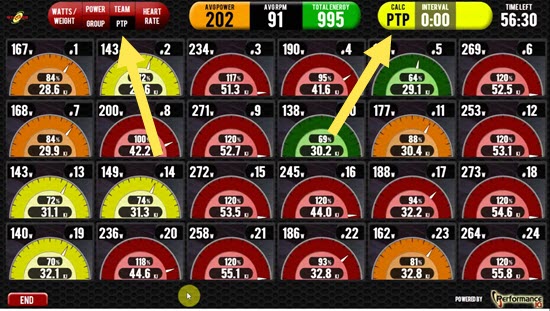
The PTP (Personal Threshold Power) mode screen in PIQ offers a quick (just three minutes) and simple tool to give your riders an approximate understanding of their maximum sustainable power wattage. Then through the wonders of technology, PIQ creates 5 power zones and displays them as different colors. The system calculates PTP as 90% of the highest sustainable power each rider can sustain for the length of the three minute test.
Is PTP as accurate as a 20 Threshold assessment? It doesn't matter to ~98.5% of your riders. What is important is that PTP answers the question that I've heard over and over the past 3 years I've been teaching with power: how hard should I be working… when you ask me to work hard?
So on to the questions:
When, or how often, should we be using using the PTP (Personal Threshold Power) mode screen?
Paul and I are in agreement here – we both feel you should be including PTP in most, if not all classes. There are of course exceptions. You may have a teams challenge scheduled or focus on a class that's directed toward handicapping everyone based on watts/pound.
What exactly should we have our riders doing, during the PTP (Calc) test/assessment?
Here's where Paul and I diverge in our thinking. I see this as a time for a focused effort in the saddle with a consistent cadence, where Paul was saying (and he demonstrated during the Master Class) that he's open to varying position and/or cadence. So who's right? I feel we both are 🙂
You see we each teach very different classes. Mine are typically focused efforts in the saddle = how I would run my PTP tests. Paul's classes are much more frenetic, with frequent changes = that's how he conducts his PTP segments.
Here's mine:
Running a PTP test isn't any different from the Best Effort intervals we suggest you use in a power class that doesn't have a Display Training system. Here's one I included in a recent Performance Cycle class.
Track #2 — the first PTP track is important. We’ll use this average wattage for each of the four PTP efforts to follow. Everyone seemed to enjoy Billy Idol — Rebel Yell — 1999 — Remaster — maybe suffered a bit as well. At 4:47 there’s plenty of time to explore PTP.
We use the Stage button to reset the averages at the beginning of what I describe as; Your Best Sustainable Effort. It’s normal for riders to miss-judge where they should be, so I’ll often have everyone make needed adjustments and hit the Stage button again to reset the averages.
My experience is that everyone will benefit from from a few mini (30-60 secs) PTP efforts to figure out where you should be. On any of the magnetic bikes I like to have find a reasonably challenging climb at around 65 RPM and then have riders accelerate to over 80RPM and observe what it feels like (RPE) and the wattage.
Two or three of these short intervals should give your peeps a watts window they can shoot for during the actual 3 minute PTP test.
I ask everyone to stand and walk, without touching the resistance, for a minute recovery.
To start the PTP test, I'll cue up a track like 83RPM Billy Idol — Rebel Yell and cue finding the cadence. Ten seconds to get everyone there and I will click Calc PTP. Encourage everyone to do whatever it takes to complete the assessment and let the technology work it's magic, figuring everyone's training zones.
I'm super excited to announce that ICI/PRO is teaming up with the owners of Full Psycle Indoor Cycling; Paul Harmeling & Shelly Scott. We are hosting our first Full Psycle/PRO Performance IQ Training on February 14th at the Full Psycle Studio in the Lincoln Park area of Chicago, IL.
1/20 update: There's just two open seats remaining.
I've taken over a dozen classes that incorporate PIQ Display Training – at studios across the country. In only one did I feel like the Instructor really understood how to effectively integrated PIQ into the class. That class was Paul Harmeling's and you now have the chance to learn from the person I see as the expert in teaching Display Training Indoor Cycling classes!
Can't make this workshop? If you would like to receive notifications of future events join this email list.
Listen to this short interview with Paul, where we discuss the details of the training we're providing February 14th.
This 6 hour, comprehensive training workshop will include two complete master classes. They'll be taught by Paul Harmeling & Shelly Scott – co-owners of Full Psycle.
To complement the Master Classes, we will be offering the following:
Understanding the basics of PIQ – presented by Tae Yoo
Troubleshooting and Best Practices
Training With Power for Indoor Cycling Classes – presented by Me John Macgowan 🙂
Maximising the functionality of Performance IQ and effectively class presentation using:
Power Screen/Race Mode
Heart Rate Training Screen
PTP (Personal Threshold Power) Screen
Watts/Lb – Weighted/Leveling/Handicapping Mode
Teams Screen
Building Entertaining Display Training Class Profiles
Creating Speciality Classes with PIQ
Get people excited about Display Training with Social Media
Using PIQ data to bring consistency to your Indoor Cycles
We are limiting attendance so we can include multiple opportunities for participants to demonstrate what they've learned. Instructors will need to conduct teach-backs throughout the workshop.
Tae Yoo is taking us all out for dinner Saturday night as the end of a great day of PIQ!