As a training tool – running a PTP test/assessment is invaluable!
We had some excellent questions from Studio Owners this past weekend during our Full Psycle/PRO PIQ workshop. Paul Harmeling addressed these two related questions during the Q&A – I wanted to offer my thoughts on it here:
When, or how often, should we be using using the PTP (Personal Threshold Power) mode screen?
What exactly should we have our riders doing, during the PTP (Calc) test/assessment?
First, for those currently not using a Display System in your studio, let me explain what we're talking about. NOTE: I'll focus on Performance IQ because I know it much better – all of this has similar application with Spivi.
On a related note, I learned a little known trick that could potentially save a new studio enough money to pay for PIQ or Spivi – contact me if you're interested in learning more.
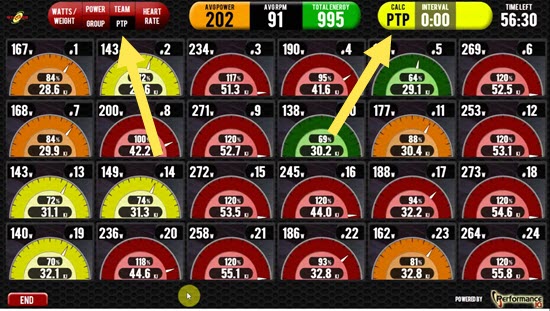
The PTP (Personal Threshold Power) mode screen in PIQ offers a quick (just three minutes) and simple tool to give your riders an approximate understanding of their maximum sustainable power wattage. Then through the wonders of technology, PIQ creates 5 power zones and displays them as different colors. The system calculates PTP as 90% of the highest sustainable power each rider can sustain for the length of the three minute test.
Is PTP as accurate as a 20 Threshold assessment? It doesn't matter to ~98.5% of your riders. What is important is that PTP answers the question that I've heard over and over the past 3 years I've been teaching with power: how hard should I be working… when you ask me to work hard?
So on to the questions:
When, or how often, should we be using using the PTP (Personal Threshold Power) mode screen?
Paul and I are in agreement here – we both feel you should be including PTP in most, if not all classes. There are of course exceptions. You may have a teams challenge scheduled or focus on a class that's directed toward handicapping everyone based on watts/pound.
What exactly should we have our riders doing, during the PTP (Calc) test/assessment?
Here's where Paul and I diverge in our thinking. I see this as a time for a focused effort in the saddle with a consistent cadence, where Paul was saying (and he demonstrated during the Master Class) that he's open to varying position and/or cadence. So who's right? I feel we both are 🙂
You see we each teach very different classes. Mine are typically focused efforts in the saddle = how I would run my PTP tests. Paul's classes are much more frenetic, with frequent changes = that's how he conducts his PTP segments.
Here's mine:
Running a PTP test isn't any different from the Best Effort intervals we suggest you use in a power class that doesn't have a Display Training system. Here's one I included in a recent Performance Cycle class.
Track #2 — the first PTP track is important. We’ll use this average wattage for each of the four PTP efforts to follow. Everyone seemed to enjoy Billy Idol — Rebel Yell — 1999 — Remaster — maybe suffered a bit as well. At 4:47 there’s plenty of time to explore PTP.
We use the Stage button to reset the averages at the beginning of what I describe as; Your Best Sustainable Effort. It’s normal for riders to miss-judge where they should be, so I’ll often have everyone make needed adjustments and hit the Stage button again to reset the averages.
My experience is that everyone will benefit from from a few mini (30-60 secs) PTP efforts to figure out where you should be. On any of the magnetic bikes I like to have find a reasonably challenging climb at around 65 RPM and then have riders accelerate to over 80RPM and observe what it feels like (RPE) and the wattage.
Two or three of these short intervals should give your peeps a watts window they can shoot for during the actual 3 minute PTP test.
I ask everyone to stand and walk, without touching the resistance, for a minute recovery.
To start the PTP test, I'll cue up a track like 83RPM Billy Idol — Rebel Yell and cue finding the cadence. Ten seconds to get everyone there and I will click Calc PTP. Encourage everyone to do whatever it takes to complete the assessment and let the technology work it's magic, figuring everyone's training zones.
I'm super excited to announce that ICI/PRO is teaming up with the owners of Full Psycle Indoor Cycling; Paul Harmeling & Shelly Scott. We are hosting our first Full Psycle/PRO Performance IQ Training on February 14th at the Full Psycle Studio in the Lincoln Park area of Chicago, IL.
1/20 update: There's just two open seats remaining.
I've taken over a dozen classes that incorporate PIQ Display Training – at studios across the country. In only one did I feel like the Instructor really understood how to effectively integrated PIQ into the class. That class was Paul Harmeling's and you now have the chance to learn from the person I see as the expert in teaching Display Training Indoor Cycling classes!
Can't make this workshop? If you would like to receive notifications of future events join this email list.
Listen to this short interview with Paul, where we discuss the details of the training we're providing February 14th.
This 6 hour, comprehensive training workshop will include two complete master classes. They'll be taught by Paul Harmeling & Shelly Scott – co-owners of Full Psycle.
To complement the Master Classes, we will be offering the following:
Understanding the basics of PIQ – presented by Tae Yoo
Troubleshooting and Best Practices
Training With Power for Indoor Cycling Classes – presented by Me John Macgowan 🙂
Maximising the functionality of Performance IQ and effectively class presentation using:
Power Screen/Race Mode
Heart Rate Training Screen
PTP (Personal Threshold Power) Screen
Watts/Lb – Weighted/Leveling/Handicapping Mode
Teams Screen
Building Entertaining Display Training Class Profiles
Creating Speciality Classes with PIQ
Get people excited about Display Training with Social Media
Using PIQ data to bring consistency to your Indoor Cycles
We are limiting attendance so we can include multiple opportunities for participants to demonstrate what they've learned. Instructors will need to conduct teach-backs throughout the workshop.
Tae Yoo is taking us all out for dinner Saturday night as the end of a great day of PIQ!
Hey – I just got an email explaining that Spivi has added a FTP (Functional Threshold Power) Test to their display training system. I can't begin to tell you how beneficial these short threshold/best efforts are for engaging participants in your power based classes. That's why I describe these as a Best Practice for anyone teaching with power.
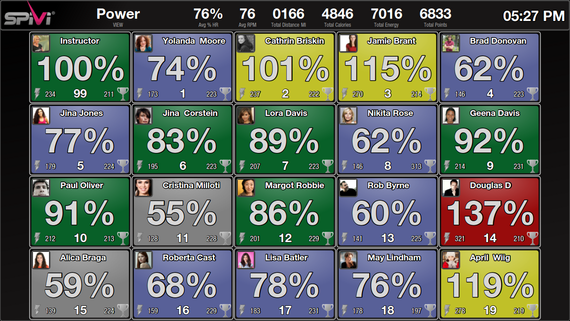
Like PIQ, Spivi offers the option for riders to manually add their FTP / PTP wattage into a user profile. Another option is to enable the Fitness Test option where you can select an 8 or 20 minute FTP test that will record each riders average watts for the period and then add either 90% (8 minute) or 95% (20 minute) of it to their user profile.
To start the FTP tests wizard, press the left analog stick once, just like if it was a button. Now select the requested test from the menu and press the “Start” button to start.
Don't forget to Instruct the group how to ride and what to do during the test. The FTP test lasts as long as the progress bar on the bottom right side of the screens appears.
Did you know that all of the Indoor Cycles that use magnetic resistance (FreeMotion S11.9, Keiser M3i and Schwinn AC) have a built in feature that will help your riders get stronger, create more power and burn more calories if you recognise and cue to it properly?
The feature I'm talking about doesn't have a label to identify it or a button to push to turn it on or off. It's not found in any manual that I'm aware of and there's a good chance it wasn't even mentioned in your training. That doesn't mean it doesn't exist – it's just poorly understood… which is where I come in 🙂
The feature I'm referring to is how cycles with magnetic resistance get progressively harder to pedal as cadence increases.
Now if you're reading this and are thinking; everyone already knows this John. I am going to challenge you and say most don't. I've taken a lot of classes recently on Schwinn AC's, taught by multiple Instructors. In each class the studio was using PIQ to track rider stats and the Instructor explained that they were committed to helping everyone work hard and burn the maximum amount of calories. But none of them took advantage of this unique feature.
This feature, by the way, doesn't exist on Indoor Cycles that uses a friction pad to create resistance.
I described a short experiment I ran in this post, comparing the new Spinner® Blade Ion (friction) with the bike I teach on regularly, the FreeMotion S11.9 (magnetic). I was pretty excited with the results as it confirmed what I had perceived after our club switched from Spinner® NXT's to FreeMotion S11.9's.
You can try a similar experiment on your own.
Riding by yourself, find a seated cadence of ~ 70 rpm and add resistance until you would feel comfortable coming out of the saddle and standing – a medium grade hill.
Stay seated and accelerate your cadence up to 100 + RPM and beyond if possible.
One of two things will happen, depending on which type of resistance is used on your bike.
On a Friction Resistance bike you'll typically feel that the amount of force need to turn the pedals becomes easier, with less and less force required as your RPM increases. Depending where you started from, you'll probably feel the flywheel taking over and begin to feel it run away on you as you get over 100 RPM.
A magnet bike will feel very different. The resistance gets harder and harder, the faster you turn the cranks. If you started with an honest hill there's a good chance you'll quickly reach the point where you simply can't go any faster, because you can't produce the rapidly increasing amount of power needed.
So how do I use and cue this feature if I have it available?
When you want to motivate your class to work hard it's actually very simple > always add/increase cadence to existing resistance.
Here's an example of how I cue this for a typical 3-4 minute “Best Effort” PTP (Personal Threshold Power) interval I include in every class. I include these to give everyone a working PTP for that day, on that specific bike – which helps to negate issues around variances between bikes.
NOTE: This is very effective when you are using the PTP feature on PIQ. From the PIQ manual page 16:
Personal Threshold Power (PTP) Mode In the PTP mode, riders are asked to spend 3 minutes riding as hard as they can to find their “critical power” level. 90% of the Average Power generated during the 3 minute PTP test is used as the PTP number. For example, if a rider rides for 3 minutes at an average of 100 Watts, their PTP would be 90 Watts. At the end of the 3 minute test, a purple PTP number will be displayed for 10 seconds. Using this PTP number, riders will be able to perform zone training based on each individual’s sustainable power level.
For this PTP segment I'll choose a song with a strong 85-95 RPM cadence, with the intent of having everyone at or near the track's RPM during the effort. I used this 88 RPM remix of; “Ain't no rest for the wicked” from Cage the Elephant last week
During the song's intro I'll ask everyone to go to ~70 RPM and add load until they're feeling they could stand.
At the right point in the song (where there's enough time till the end) I'll cue everyone to accelerate to the song's actual tempo 85-95RPM.
Cue thumb over stage button in three… two… stage button and/or click CALC PTP in PIQ to start recording the effort.
After the first minute I'll suggest making any small changes in load to make sure they can sustain the chosen cadence until the end.
I've found through experimentation and rider feedback (I've been doing this in every class I teach for ~ 2 years) that this is the easiest and most effective method I've found to ensure everyone works their hardest during these timed and recorded efforts = a more accurate PTP that I'll use to guide efforts during the rest of the class. I don't have PIQ where I teach – I just ask everyone to remember their PTP average watts once we get to the end.
Please give this a try and let me know your experiences.
Display tracking of each rider's performance during an Indoor Cycling class is proving to be very motivating for the riders and profitable for the studio owners because those participants keep coming back.
Customer retention is hugely important to keeping your classes full. I hear over and over; “once you've shown me my performance, up on a screen and then on that email I get after class, I'm hooked. Why would I ever go back to that Big Box club, who doesn't show me anything?”
Jennifer Ashbrook is the owner of Inner Drive Cycling | Fitness Studio in Newtown Square, PA. Jennifer's studio features FreeMotion S11.9 indoor cycles that provide the performance data that drives the Spivi Display Training system she purchased to differentiate her studio, from other competing fitness clubs in her area.
Jennifer created this short video to help her prospective customers understand Spivi and how it adds to the “WOW” factor of her classes.
You can learn more about Jennifer and her studio by listening to our interview.
I forgot to talk about … It's common for guests to contact me, post interview, with a point or two that they felt should have been included, but weren't. Jennifer emailed me to add:
Hi John,
I just wanted to thank you for the chance to talk with you about Spivi this morning — I really enjoyed it! A couple of things I think maybe I should clarify about Spivi that I forgot to mention — when I explained how Spivi “normalizes” or handicaps riders, I indicated that they are normalized based on power output — and that’s a major part of the equation for bikes with power — but the system also takes into account cadence; it factors all of that together and “ranks” riders based on “Spivi Points” — which (as I understand it) factors in riders age, weight, gender, FTP (if know and power data is available), and cadence — perhaps other factors… The system can also pick up heart rate from ANT+ heart rate straps.



 To start the FTP tests wizard, press the left analog stick once, just like if it was a button. Now select the requested test from the menu and press the “Start” button to start.