
by John | Jun 9, 2018 | Correcting Form, Instructor Training, Master Instructor Blog
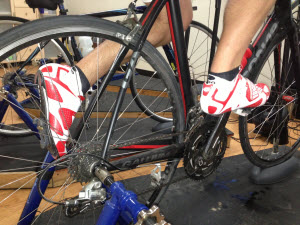
During a class I attending yesterday, the Instructor had everyone doing one-legged pedaling drills… one legged as in pedaling with one foot un-clipped and held out to the side or rested on the frame.
That's wrong/contraindicated… isn't it?
My initial reaction was to do what I normally do in this situation, I would just ignore his cue. Unfortunately I was setup in the dead center of the room and I quickly saw that I would be the one rider (of about thirty) NOT riding with just one leg. So I popped my left foot out and joined everyone else.
OK, so what's wrong with this? Was my first thought, as I began focusing on smoothing out my pedal stroke. This feels like what I remember from riding my old Schwinn Paramount road bike, on a trainer, back in the 90's
Looking around the room, I didn't see anyone riding with any difficulty or appear to be off balance or unsafe. All I saw were cyclists doing exactly what they're supposed to be doing during one-legged drills; trying to make up for the missing leg's influence at the “dead spots” in the pedal rotation – which is the purpose of the exercise. This wasn't a class of cyclists, but rather the typical diverse group of club athletes we all see each week.
So why is one-legged cycling viewed as contraindicated in our classes?
I did a few Google searches for “one-legged indoor cycling class” and found a number of articles, from knowledgeable people, recommending against removing (un-clipping) one foot while pedaling here, here, and here. That last link is from pdf from Spinning called Keep if Safe and includes this:
PEDAl STROKE
Do not pedal backwards or with one foot out of the toe cage or cleat. Pedaling with one leg is an advanced drill that elite cyclists practice on trainers–not fixed-gear bikes like the Spinner bike. On a Spinner bike, these drills have absolutely no benefit, since muscles work the same and burn equal numbers of calories pedaling forward and backward.
While I completely agree that pedaling backwards is dumb/goofy, pedaling with one leg is a very commonly recommended technique, for cyclists of any level.
Another Google search returns dozens of articles and videos advocating for this exercise. None of them issue any caution that this is an exercise reserved for a professional, on the contrary. It's the new cyclist who needs to learn to pedal properly and efficiently.
Here's none other than Joe Friel describing his recommended pedaling drills:
Let’s get rid of the energy wasters in this Base period. Drills will help you to pedal better. Following are the common ones I use with the athletes I coach. They may be mixed together in a single workout or each may be done by itself as a workout.
* Isolated leg training (ILT) drill. This is the quintessential pedaling drill, the one you should do a lot in the early weeks of Base. It’s done on an indoor trainer. Unclip one foot and rest it on a chair next to the bike so you are left to pedal with only one leg. With the bike in a low (easy) gear turn the crank at a comfortable cadence. The first thing you’ll notice is that getting through the top of the stroke, the 12-o’clock position, is difficult. Focus on smoothing this top transition. At first you may only last a few seconds before the hip flexors fatigue. When that happens switch to the other leg. When it fatigues clip both feet in and pedal for a few minutes applying what you have learned in the single-leg pedaling. Repeat the drill several times throughout the workout.
While I'm the first to raise my hand and say; “just because Joe Friel says something, it doesn't automatically mean that it's applicable to our classes“, I'm using him as an example of the clear conflict between what's recommended for indoor cycling vs. outdoor cyclists. Mr. Friel says this is the quintessential peddling drill (representing the most perfect or typical example of a quality) and yet others are saying this will hurt your participants – or is completely useless.
So where's the concern coming from?
Clearly there's a fundamental difference between a bicycle on a trainer and an Indoor Cycle. The bicycle has a freewheel that prevents the monument of the drive-train from pedaling you = you have control to easily stop the rotation. Indoor Cycles (with the exception of the CycleOPs) are fixed gear. The perceived (rightly) danger comes from the heavy, weighted flywheel spinning out of control and potentially carrying the loose pedal into the free leg of the rider.
So why didn't that appear to be a problem yesterday?
We were riding indoor cycles with magnetic resistance. I perceive this has two design differences that mitigate the safety issues that exist, as compared to Indoor Cycles that use friction resistance. If you've had the chance to ride (or your club has updated to) the Schwinn AC, Keiser M3 or Freemotion S11 you'll probably recognise the following;
- My perception (and I've ridden everything) is that magnetic cycles have less rotational flywheel inertia than friction. By design, the weighting of the flywheel of friction cycles is around the perimeter, which creates a greater amount of inertia = harder to control or stop. Magnetic cycles have either a smaller flywheel (M3) or in the case of the AC and S11, the outer diameter is aluminum. In all three there's a feeling of less of the flywheel's influence / control of your pedals.
- The amount of resistance created by the magnets increases with RPM = you don't see run-away pedals, even starting with a very low level of resistance.
Is this right for your class?
If you're teaching on a magnetic cycle, you'll have to decide for yourself if you want to add Single/Isolated leg training drills into your class. I wouldn't consider this if you are on friction resistance cycle.
Start by experimenting alone by yourself. Spend some time practicing with one foot detached. How does if feel to you? Could you safely introduce this into your class? Maybe as part of the warmup? How would you cue this?
I'm going to begin on Thursday. My initial thoughts are to offer it, with a modification to stay clipped in of course. I'll find a fun track around 70ish RPM, have everyone dial on a nice flat road feel – just below their base wattage and let everyone experience what it feels like.
I'll let you know the classes reaction 🙂
NOTE: If you're teaching on the FreeMotion S11.9 cycles, the power readings will be disrupted with either foot un-clipped. You'll want to explain to your class that the power is measured off the left crank. Removing the left foot and using just your right, results in near zero wattage displayed. Peddling with just the left foot appears to confuse the computer and I was seeing what looked like double the wattage. Both the Schwinn AC and Keiser M3 will display correctly.
by Christine Hawthorne | Dec 8, 2017 | iTunes, iTunes & Spotify Training, Music, Spotify
 I get a lot of questions about Spotify, but the one question that I get over and over from people that are interested switching from iTunes is: “Do you own the music?”, or “Can I sync music from Spotify to my iPod or burn it to CD? “ And my answer is always the same: “No, you can’t, but you won’t believe what you CAN do for only $9.99 a month!” Now I know that bothers a lot of people. What's the sense in spending $9.99 a month and having nothing to show for it? How is this worth the cost?
It seems that when it comes to music for our cycling classes, there are two camps: Those that want to own all of their music, and those that see their music as more disposable and don't mind ‘borrowing' it.
If you are strictly an iTunes user, then you own the music that you purchase. Well, at least you own the license to listen to songs on many devices.(* Here’s an interesting article from CNN that raises questions about digital music ownership.) It’s all yours. I once strictly used iTunes and now I own a LOT of music. Most if it I rarely listen to or use in my playlists anymore. It just sits there taking up storage space on my computer.
If you are a Spotify user, you are essentially borrowing the music. You are paying Spotify $9.99 for UNLIMITED access to their extensive library of tunes. I (along with many other cycling instructors that have jumped on the Spotify bandwagon) believe that the borrowing is the way to go.
Here are my top 8 reasons why I would rather borrow music from Spotify than buy it :
- I have unlimited access to music. I rarely am unable to find a song that I am looking for. If that does happen, I will purchase the song on iTunes or Amazon, but I’m still not spending as much money as I was pre-Spotify.
- I can listen to a song all the way through and then decide if it’s something I want to use in my playlist. I can’t count the number of times that I have purchased a song on iTunes and then later found that it was not suitable for my playlist.
- Spotify has a radio feature that allows me to ‘like’ songs as I listen. These songs then go into a file called ‘liked from the radio’ and can be easily accessed for future playlists. This is a great tool for finding new music.
- I don’t have songs (most of which I’m not listening to) clogging up all of my computer space.
- I can take my playlists ‘offline’, which means I can use them anywhere, even without an Internet connection. **You do need to have an iPhone or smart phone device to sync your music.
- I can follow other instructors and see what they’re listening to. I can check out their playlists and if I like what I hear, I can pull a few of the songs over to my own files. If I’m in a bit of a rut, I can even follow someones entire playlist and sync it to my device to use in my own class. (Tip: This is frowned upon if you work in the same gym.)
- Many songs that I borrow, I may only use a few times. If I use it more than that, it will always be there. If I don’t use it again, I won’t feel that I have wasted my money. There are many other songs out there just waiting to go on my next playlist.
- In my leisure time, I do enjoy listening to music. The music that I listen to at home or in the car is not always the same as the music I listen to in my cycling classes. For example, I love using Pitbull in my classes. I can honestly say that I would never listen to his music outside of my class. So owning a bunch of Pitbull does not seem cost effective to me. Here’s another example: My all time favorite band is the Beatles. I have rarely used any Beatles tunes in my classes, but I love to listen to them in my leisure time. Do I own all of my Beatles music? You bet I do. And if I want to borrow it from Spotify, I have that option too.
Spotify is the best $9.99/month I have ever spent as an instructor. It has made my class preparation less time consuming, more fun and much more convenient and to me and that is worth every penny.
What do you think? Do you feel more comfortable owning your music or are you OK with borrowing it?
by John | Jul 26, 2017 | Instructor Tech Help, Instructor Training, Product Reviews
I realize that not everyone has access to (or interest in) Spotify. And I'm guessing that the majority of successful Instructors are using the combination of iTunes and an iPhone to deliver their class music. If the later category includes you, this new My Cycle Class iPhone App maybe of interest.

Paul Surette developed myCycleClass to simplify creating a class profile using his iPhone and then guiding him with movements & cues that corrispond to each song.
Not sure if it's just me, but there is often things not obvious (read frustrating) when I first use any App. In the case of myCycleClass it took me a long time to figure out how to actually start the class 🙁 You click the + in the top right corner. Once I figured that part out it seemed to work well, but I'll admit that I didn't try it in an actual class.
You start by adding your typical movements > use the + button to add new.

Then common cues

Using the setting tab you can import iTunes Playlists. Select a playlist and you can add movements and cues.
When you're ready to start class you hit the + sign and are given an option to adjust the class length countdown timer.
One handy feature is you can easily email your playlist / profile to others.

If you are into techie stuff like this and appreciate the structure myCycleClass would bring to your teaching give it a try and let me know your results.
An alternative iPhone App is ClassBuilder from Cycling Fusion. Yes there are considerable differences between the two. The primary difference is myCycleClass is designed for a Movement based class where ClassBuilder is geared toward Intensity based classes.
Originally posted 2012-07-03 09:02:41.
by Jim Karanas | May 26, 2017 | Engage Your Students, Master Instructor Blog
By Team ICG® Master Trainer Jim Karanas
I’ll switch gears from my recent posts on using public speaking techniques to enhance our teaching to talk about what we say. In The Art of Cueing, I discussed the use of cues to bring depth to the class and make it more than just a workout. Cues concerning the science, the music, the video, your personal experience, even philosophy can make your class more interesting and more impactful.
Philosophical cues are the most difficult to incorporate. Instructors don’t typically cover philosophy when they teach because they don’t think people want to hear it, or they don’t feel comfortable talking about it. Someone who doesn’t teach might say the first is true. But maybe that person hasn’t yet heard a well-delivered philosophical message and is just uninformed.
I understand not feeling comfortable talking about it and will address that later.
Adding philosophy to a class so it doesn’t sound like preaching is what I call “messaging.” A class without messaging is just a workout. It might even be a good one. But the instructor’s power will weaken over time, just like playing the same workout video over and over. It diminishes with no message. All the public speaking techniques in the world can’t compensate for a class that lacks substance.
Unforgettable lyrics are unforgettable because they send a message. A public address goes viral on YouTube when it sends a message. Messaging will touch a person’s life beyond the great workout you just delivered and compel him/her to come back to your class again and again.
What’s a message? Any life concept that you bring to the class and that can be experienced in the class as result of the training you’re providing. A couple of examples:
Focus
Coaches often tell you to “stay focused” but rarely tell you how. Focus is not simply directing your attention to what you’re doing. That leads to thinking. Thinking will weaken focus. Focus is complete engagement in what you’re doing. A focused mind pays no attention to distractions. Fast descending takes focus. If you’re not 100% engaged and non-reactive to distractions, you might crash. How do you train yourself to be this way — not just during a dangerous descent, but right now, so you get the most from your workout? That’s the essence of our class today.
Motivation
Something that happens outside of you that you consider “motivating” is not a strong incentive. You might see someone overcome great adversity or hear a story that strikes a personal chord with you and feel filled with motivating energy. These external motivations work temporarily, but have far less impact than motivation you generate by yourself. I want you to look at motivation as something personal. Then you have the ability to train and get better at it. You can train yourself to be motivated the way you train anything else.
When you understand how to do this, motivation is endless, limitless. The only time you won’t feel motivated is when it’s a personal choice, and you’ll recognize it as such. You’ll no longer look to me or to anyone else to motivate you to train. You’ll rise to the occasion again and again because you’ve trained yourself to do so. I’ll show you how to do this in today’s workout.
As an instructor, all you have to do now is deliver a physical practice (the day’s ride) that delivers the results you just promised to deliver in your message. If I’ve enticed you, and you want to learn how to focus or be consistently motivated, the solution is simple: Come to my class. That’s the power of good messaging.
The messages you can deliver are many: how to engage fully, how to sense meaning, how to expand your concept of what you can do, how to sense your life energy, how to direct it, how not to react to adversity, how to develop discipline, how to go beyond hope and fear, and on and on.
How do you, as an instructor, learn to deliver these messages, both verbally and physically? First, you must want to. Second, you must become a student of philosophy. You study and you ride, and you bring the lessons that you learn from your study to the bike, and then to class.
I have a small library of what I call my “Life Books”. These are about 10 books that I have found extremely helpful. I’ve read each of them dozens of times. A good philosophical book is one you immediately realize you need to reread. My first Life Book was Way of the Peaceful Warrior: A Book That Changes Lives. It was the first book to encourage me to approach my training from a conscious perspective. I have several copies with dog-eared pages and many handwritten notes throughout.
Physical movement has been part of spiritual training for thousands of years. It was not meant to provide exercise. Daily activity was supposed to do that. Keep a conscious attitude, go beyond the workout, and deliver a message every time you teach.
Originally posted 2015-01-07 07:16:21.
by John | May 7, 2017 | Date Specific, Spotify
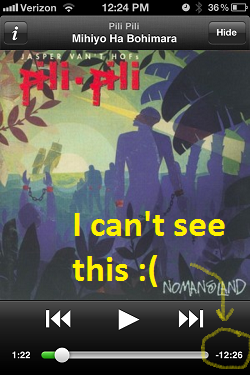
I don't own an iPad (my birthday is soon Amy – in case you need an idea) but if I did I would want to use it in my class now that Spotify has an official iPad App! The biggest reason I would prefer it, over my iPhone, is the font size. The “Time Remaining” is nearly unreadable by me. My class is frequently laughing at me as I sit there, arm extended at full length, trying to read the @#$%^& time remaining in a darkened studio. Yes I know it would be much easier to just bring my readers… I'm just not quite ready to admit my age related vision impairment 🙁
Here's the video that shows the new Spotify iPad App.
Click here for resources to help you with Spotify.
Originally posted 2012-05-08 05:08:03.
