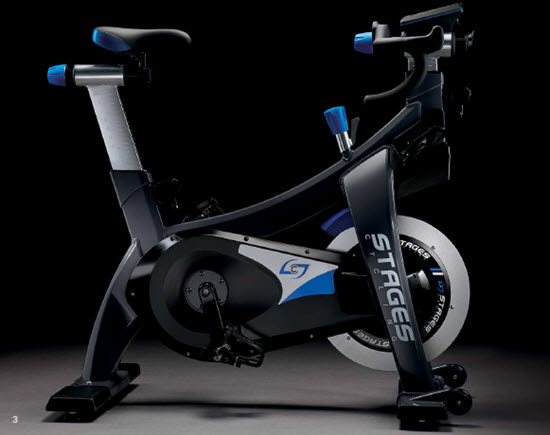
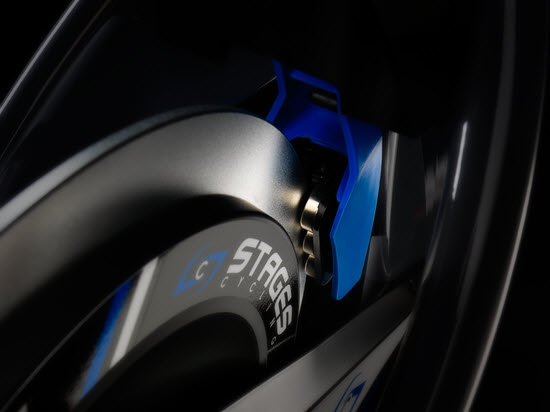
I had the privilege of visiting the Stages Cycling HQ and factory in Boulder Colorado with my buddy Randy Erwin. Director of Indoor Cycling education Cameron Chinatti, along with Stages vice president Pat Warner, were our tour guides. We spent a fascinating couple of hours learning exactly what goes into building the Stages single side crank arm power meter used on the new Stages SC3 Indoor Cycle and available for most road/mountain bicycles.
You know these people are cyclists the moment you walk into the place. Everywhere you look there are bicycles; tucked into every corner, hanging from the ceiling, along every wall – heck, their conference room has probably the coolest table I've ever seen. Instead of legs, the table top is supported by a pair of 70's vintage Schwinn Sting-Ray bicycles.
Cameron explained the hiring process, “you pretty much have to be a passionate cyclist to even be considered… many of these guys have been riding buddies for years.” And I'll add that these “cyclists” are also some of the most brilliant people I've ever met 🙂
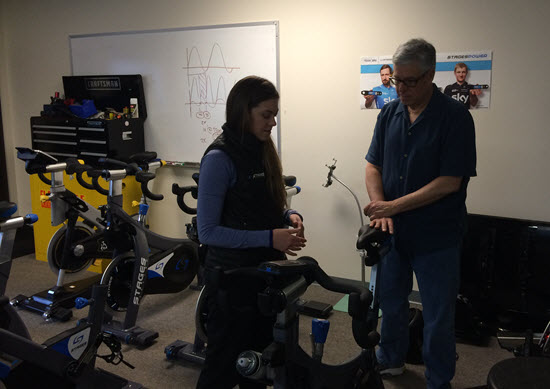
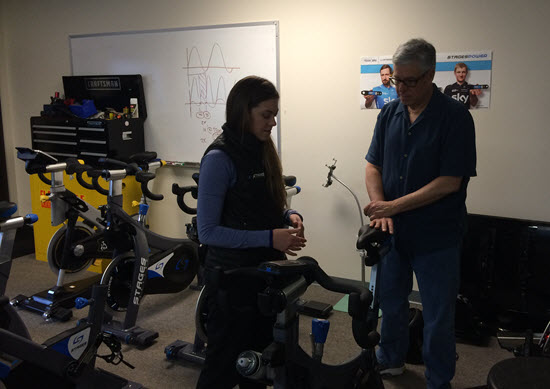
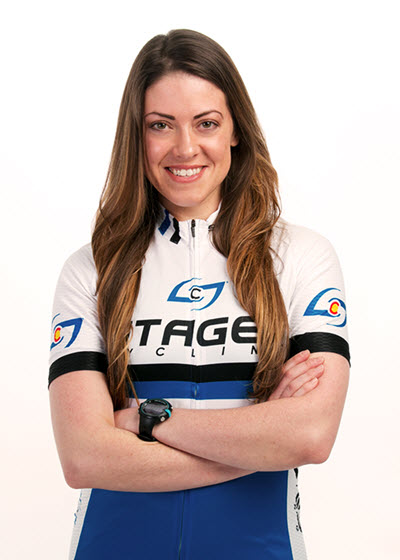
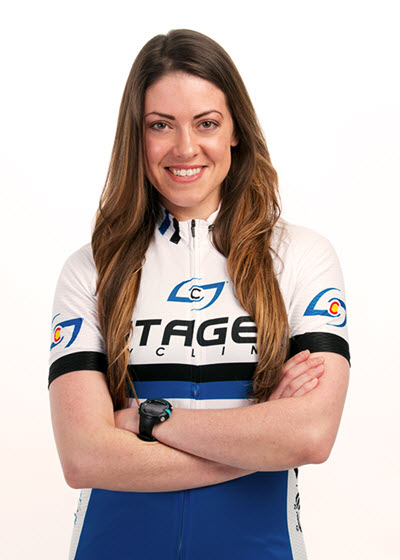
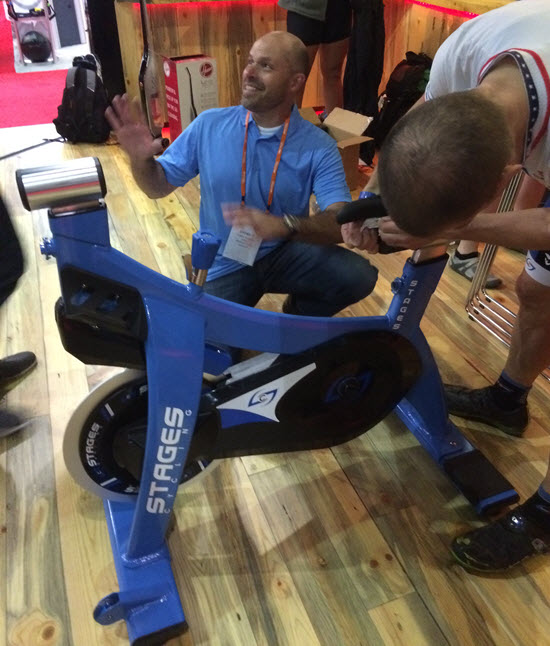
Cameron explaining all the cool features of the Stages SC3 to cyclist Randy Erwin
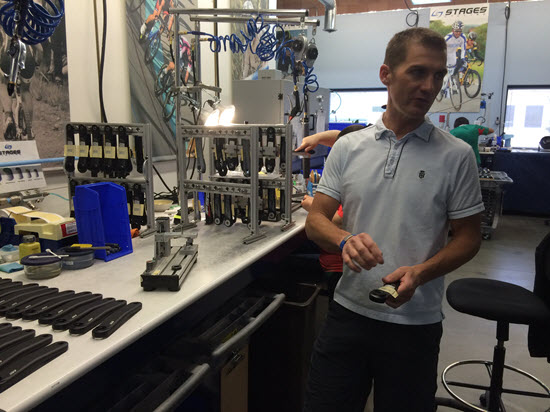
Cameron met Randy and me and our tour started in their official “training room” except it won't be for long. Stages is growing so fast that half of this room has been taken over by manufacturing stations. My friend Randy was very interested in the new SC3 because the Westminster, CO Life Time Fitness (where he's a member) will be the very first location to get these new cycles. Now if we could get Dennis Mellon in there as an instructor…
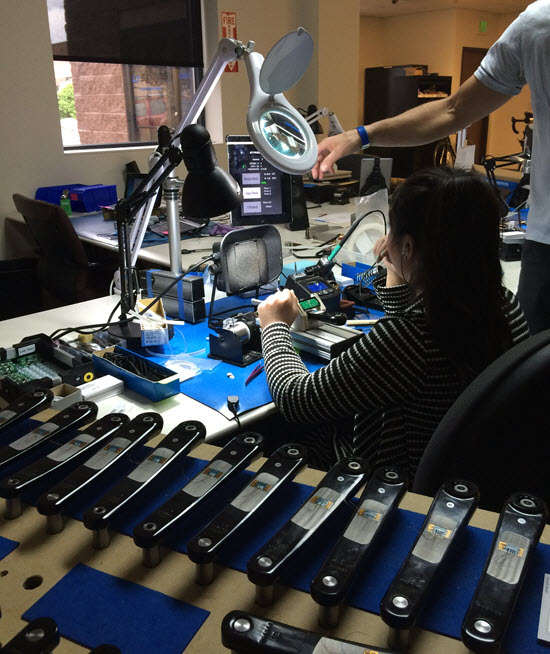
New power meters being installed and tested – this is super technical stuff.
Early in the our factory tour, I asked Pat; “why aren't your power meters built in Asia, like most other technology companies?” His responses made perfect sense to me; “there are multiple reasons actually.” “Stages has become the leading provider of bicycle power meters, after only a few years. We can't afford any preventable issues when it comes to quality or availability. It's critically important that we control the quality of these power meters… we can't if we're dependent on a third party supplier's factory, regardless of where it's located.”
Pat explained how keeping everything in-house provided a solution to a unique challenge they faced. “We manufacture power meters for 16 different model bicycle crank arms, from major suppliers (Shimano, SRAM, Cannondale and FSA) plus the power meter for the SC3 Indoor Cycle. Bicycle cranks aren't made just one size. Multiply each model bicycle crank by the four or more available crank arm lengths and we have to stock over 60 part numbers. Sure, 172.5 is the most common size for a road bike, but how many of each should we be building? The lead time for overseas manufacturers is measured in months – customer's won't accept waiting that long. We have thousands of stock crank arms on hand and we're setup to quickly change production. So if we receive an order for an out of stock power meter, we can normally build one and ship it within a few days!”
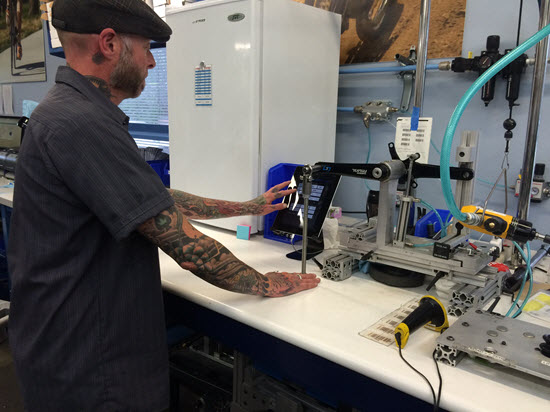
Pat Warner explaining the complicated process that attaches the power meter to the crank arm.
Every power meter is checked for proper calibration and the results captured using a iPad with custom software that's developed in-house too!
The Stages SC3 is build by Giant Bicycles in Taiwan – Pat told me,”those Giant guys are experts at mass producing high quality bicycles and fitness equipment, so we leave that part to the experts. We still produce the SC3's power meter here in Boulder and then ship them out for installation on the cycle.”
Stages has a separate facility, near their main offices, that's use for product endurance and destructive testing. We just missed the completion of a test rig that repeatably pressed down on a handle bar, tens of thousands of times without any failure.
Want to know how long the drive train will last pedaling at a continuous 360 watts? This video shows the test rig that pedals 24/7 for weeks at a time. Not only are they watching to see if something will break, or wear out, but they also record the actual power readings vs what they know their electric motor is pushing.
Quality control – Early production Stages SC3 cycles are unboxed and checked for any defects.
Feel free to leave the lights on! There's the battery charger for the Stages SC3 power meter.
This is the first installment of a new series of posts I'll be sharing on all aspects of the States SC3 indoor cycling bike. The Stages SC3 has taken the indoor cycling world by storm and I believe it's important for all instructors who use this bike to have a clear understanding of all it's amazing features. Those who don't use this bike can also learn from many of its features. The science is the same no matter what bike you use.
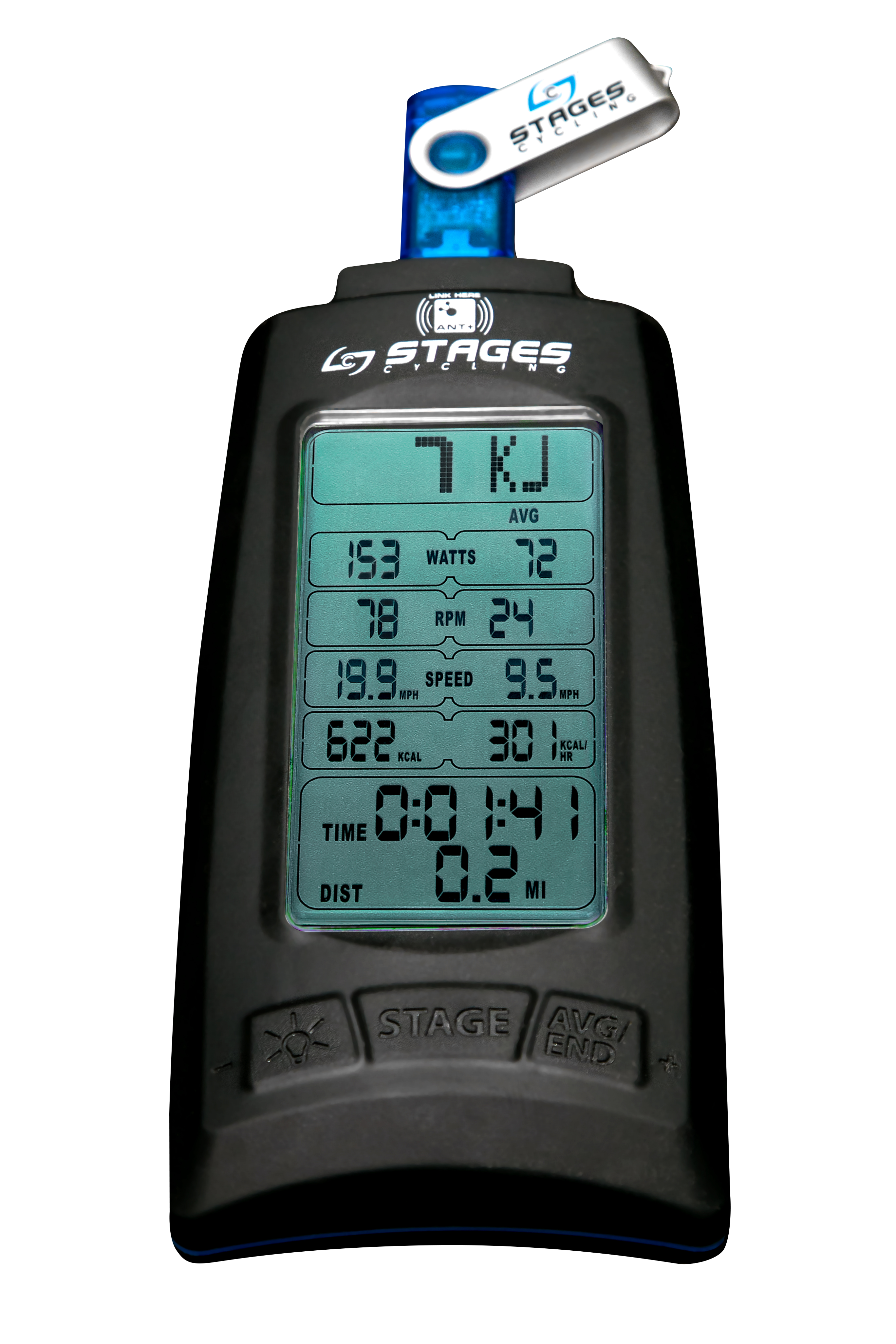
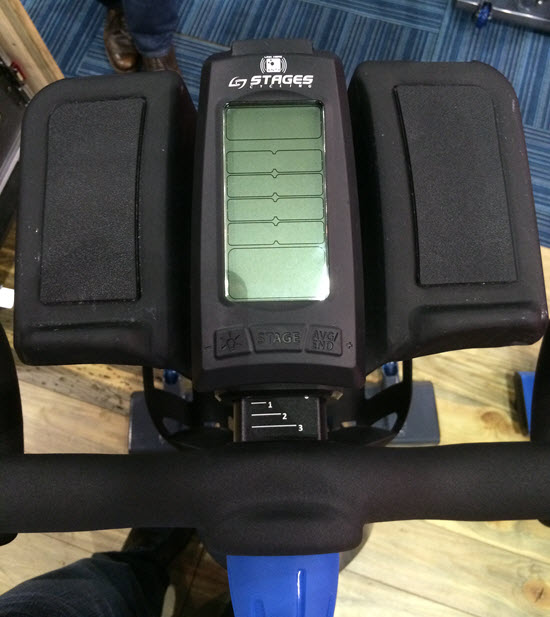
I'm going to start with an overview its console than in future posts I'll explain the metrics that are displayed line by line.
Below is a video narrated by Stages Director of Education Cameron Chinatti that overviews the Stages SC3 Console.
Master Educator Cameron Chinatti with Stages Indoor Cycling joins me for a fun followup to their very successful IHRSA convention where they launched the new Stages SC3 Indoor Cycle. We've got a bunch of videos that relate to my interview, which you'll find below.
One of the highlights from the show was the amazing efforts of two cyclists, during their 60 sec challenge.
First there was
Junior Nationals competitor Dominic Suozzi decided to try his hand at the #60secchallege today. The kid's wearing Converse and he destroyed everyone. 1100 Watts!! That's crazy-ville!
Then how about the huge effort from Kat Haskins … aka TheBarnKat > she's an Instructor at CB Cycle Barn and wasn't an outdoor cyclist, up until now. She won a new Giant bicycle with Stages Power Meter for her efforts 🙂
Here's my interview with Cameron. Enjoy!
Cameron and I discuss their new “Sprint Shift” innovation. Here's a quick video showing how it works. You can read more about how I used this new feature at my review of the Stages SC3 Indoor Cycle.
Before I get a bunch of hate mail from Schwinn Instructors. I make the comment that Stages is the first Indoor Cycling company that is focused on both Indoor and outdoor cycling. Yes I realise that the brand “Schwinn” was first a bicycle company – my first road bike was a green Schwinn Varsity, second was a white and purple Schwinn Paramount. But the Schwinn Indoor Cycling brand has/had no connection with the bicycle company known as Schwinn bicycles. Stages is currently selling products to outdoor cyclists (the Stages Power Meter+ Endurance Training Education) as well as Indoor Cycling studios (the Stages SC3 Indoor Cycle + Instructor Education) Does my comment make sense now?
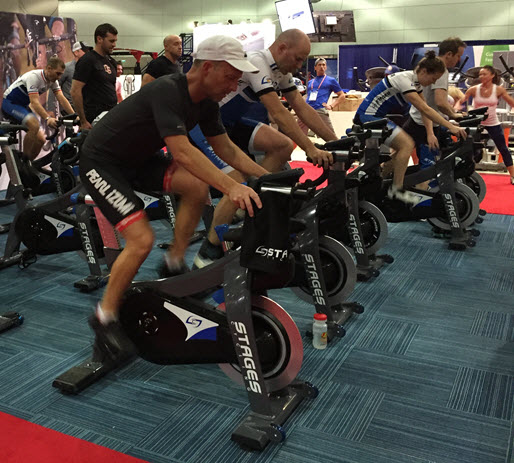
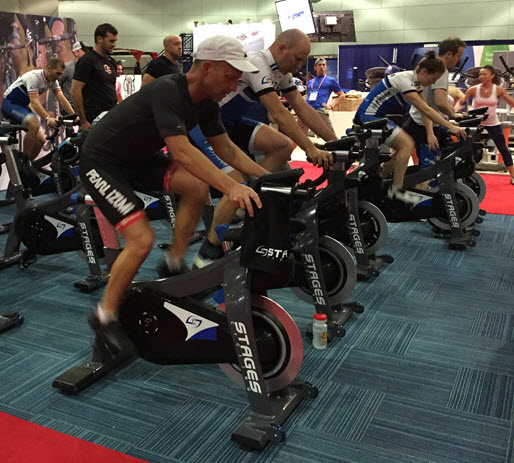
I got about 75 minutes of saddle time on the Stages SC3 during the conference. Two morning classes, a 60 sec challenge (445 watts – 2.78 watts/lb which I felt was OK for a 53 year old) and some undirected free time when I experimented with the SprintShift.
Quick aside:Why does everyone look like they're setup too low in the videos? I had a Facebook comment asking this question and she's right, they do look low. But I can assure you that neither Dunte Hector or Cameron Chinatti riding in this video are set up incorrectly. Over the years, I have developed an eagle-eye for improperly adjusted riders = they looked right to me, riding there in front of them. So why do they look low? I have no idea. Might be an optical illusion, or the shutter speed of the camera is too slow. Do you have any idea why?
Fit – I'm 5′-10″ and I like a long & low reach to the bars. On a bicycle, this is determined by top-tube length. On most Indoor Cycles without handlebar fore/aft adjustment I feel a little cramped. With adjustability an option, I will normally push the bars all the way out – to increase the reach. On the SC3 I felt very comfortable with the reach with the fore/aft centered = this IC appears to have a longer top-tube length. (I didn't measure anything, this is just my general feeling)
I also have long femurs, (thigh bones) which require my saddle position to be biased quite a bit rearward, to keep my knee over pedal. My road bike needed a special setback seatpost to get me in the correct position. Here too I found that there was plenty of room and found the perfect position with the saddle set about 1/4″ back from the center point on the adjuster.
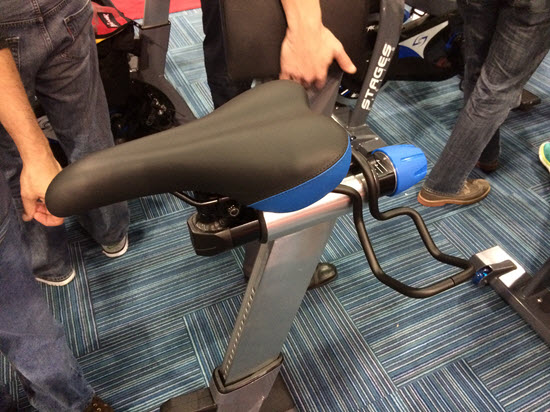
I really like the road bars they are using. They offer some new options for hand positions, while at the same time creates limits – no more seated riders looking goofy with their hands extended way out to the bar ends. The imitation brake hoods (the bump at the end) form a very natural/secure place to rest your hands while standing, hopefully removing the temptation to tightly grip the bars.
All the adjustments include easy to read measurement scales = your participants will be able to quickly make their pre-class adjustments, after their initial fitting. The saddle/handlebar fore/aft are micro adjustable and use a nicely shaped knob that you tighten down to fix your settings. Height at both ends use the new FitLoc over-center lever to place setting pins into very closely spaced adjustment holes.
There are two water bottle holders attached to the frame, which are very easy to reach seated or standing. Why not include them as part of the handlebars? I asked that question to Cameron and she told me that they wanted to keep the bars as light as possible, so they're easy for small people to adjust with only one hand 🙂
The Ride– Smooth / Solid and very Quiet. As I discussed in Part 1, the aluminum frame is very strong and I couldn't detect any flex. All the adjusters stayed securely fastened = I never felt I needed to re-tighten anything during my rides.
The SC3's belt isn't under any tension, which is unique. It's hard to describe this in words… there isn't the feeling like you need to overcome some internal force in the drivetrain. The result is a very light feel, almost frictionless, with just a touch of chain like vibration coming through the peddals.
I'm a big fan of magnetic resistance on Indoor Cycles – you can read why here. The SC3 didn't disappoint as their drive uses this resistance system. The large, screw type, adjuster knob made for predictable and progressive adjustments in the amount of load added. Pushing down on the knob is the safety brake.
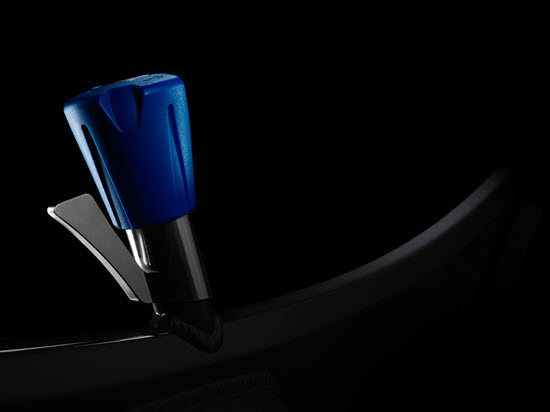
Using the SprintShift lever
If you do a lot of timed below/@/Above PTP intervals, where everyone is recording their average watts using a stage button, you'll love using the SprintShift lever. With apologies to Ron (pocket fisherman) Popeil – when you're running a series of intervals all you need to do is; “Set it… and forget it!”
Here's one way I found to use SprintShift: The Stages Instructors had us doing a fun relay race, as part of each class I attended. Each row competed to see how fast each rider in turn could complete 0.2 of a mile. They had some fun inflated batons that we passed, after completing our two tenths.
To prepare for the race, I practiced to get a feel for the proper resistance I could sustain, for what turned out to be about 25 seconds of work. With the SprintShift lever fully to the right, I set the level so I would see ~500 watts @ 100 RPM (where I work best during a short sprint) and then flipped the lever full left (making it lighter/easier) to wait for my turn. I maintained my 100 RPM cadence until I was passed the baton. Snapping the lever full right brought me to the perfect gear. I punched the stage button and was off. Did I mention I was the anchor person on our team? And that there were two very fit people behind me? So yes, I felt a ton of pressure to get my 0.2 done as quickly as possible.
We talk a lot about including “Best Efforts” (and below/@/Above PTP intervals) as part of your classes here at ICI/PRO. I feel they are an important components of every class I teach – they give my riders a quick understanding of PTP Personal Threshold Power. This answers the question for them; “how much power/watts should I be making, when I want to work hard?” without waiting for a scheduled 20 minute FTP class in the future.
Think forward to the (hopeful) day when I can teach on the SC3, I would have everyone dial in their PTP resistance with the SprintShift lever in the middle position. Then moving it to the left would give me a “Below PTP” working resistance. Bringing it fully to the right would add the “Above PTP” resistance. Cuing a return to whatever cadence we've been using should make for an easily understandable and challenging class 🙂
Power Observations
The power/watts readings seemed steadier/ didn't bounce around as much as what I'm used to on a competing bike. The absolute watts readings I was seeing was very similar to what I'm accustomed to.
I really like how your averages remain displayed for 5 seconds after you hit the stage button. It always takes me a moment to refocus after an all out effort = I enjoyed see my averages before they disappeared.
Bottom Line
I see the Stages SC3 as an excellent Indoor Cycle and it should be on your short list of cycles to choose from if/when you're planning a purchase.
If you have additional questions, or would like to be connected with them for more information, use this contact form.
Accessories
Custom painted Indoor Cycles can make a huge difference to the look of your room. Your Instructors will feel special with a uniquely painted Instructor bike, possibly one that matches your studio's colors. Contact us for pricing and lead times.
The Stages SC3 can be custom painted without affecting the warranty.
I'm here with Amy at IHRSA 2015 and need to thank Stages Cycling for sponsoring our attendance this year 🙂
We'll be riding these brand new SC3 Indoor Cycles later today (they're still packed in a semi) and will be communicating my initial reactions tomorrow.
For immediate release, March 11, 2015, Boulder, CO– Stages Cycling® extends its brand with the launch of Stages Indoor Cycling and the new SC Series–a line of commercial and high-end retail indoor cycling bikes, which bring an array of breakthrough features to redefine the category of indoor cycling.
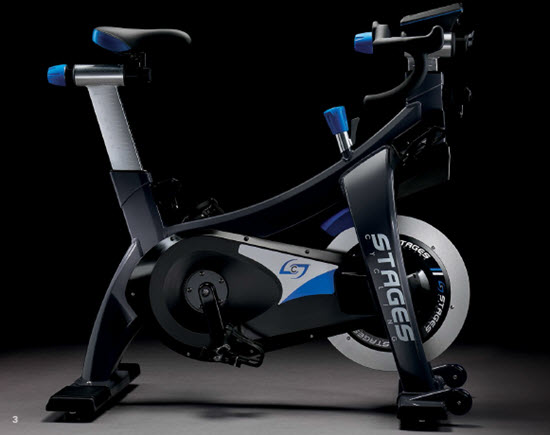
The SC Series launches with two models: the flagship, SC3, with many innovations, including the Stages Power® meter–the same power measurement system that reshaped the outdoor cycling power meter category. A second model, the SC2, is the same in all respects but does not include the Stages Power meter.
The SC Series bikes share two never before seen concepts, which have patents pending: SprintShiftâ„¢ and FitLocâ„¢. SprintShift is a dual-action resistance adjustment, which pairs a traditional micro-adjust dial with a three-position macro-adjust lever. The SprintShift lever allows large, consistent jumps in resistance for intervals and rest. FitLoc replaces the standard twist-to-lock pop-pin height adjustments with a new cam operated pop-pin, making fit adjustments for height lightning fast.
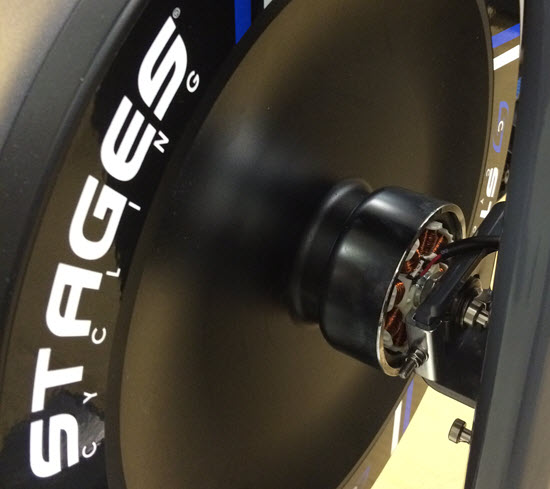
These new innovations are paired with the accuracy, consistency, and reliability of the pro-peloton-proven Stages Power meter on the SC3 model, which sports Stages new rider-powered EcoSCRNâ„¢ console. EcoSCRN uses a hub dynamometer, rather than batteries, to make it the ultimate bike for a data driven studio or cyclist. The Stages Power measurement system provides unprecedented accuracy in power measurement, enabling studios the ability to now train their clients ‘indoors and outdoors’ with the same technology.
“The SC Series has the potential to be a benchmark,” said Pat Warner, the product director for Stages Cycling, who spent 20 years working on indoor cycling bikes in the Fitness industry prior to Stages. “We’ve addressed every major issue we’ve ever seen with an indoor bike. SC3 is certainly worthy of our ‘flagship’ status, with features like Stages Power, SprintShift, FitLoc, and our RoadBarâ„¢. But we’ve also nailed the basics on these bikes, and we’re confident that the ride feel, lack of maintenance, and reliability of the bike will be the features that actually set the benchmark for both the facility owner and the instructor.”
Both of Stages Cycling’s flagship SC3 and SC2 bikes utilize the new CarbonGlydeâ„¢ drive system. CarbonGlyde builds on the unparalleled reliability and lack of maintenance offered by Gates® Carbon Driveâ„¢ carbon fiber belt, with a 5:1 gear ratio and high-inertia flywheel to provide for one of the smoothest, most realistic rides available indoors.
“Stages Indoor Cycling is a new company and new brand,” said Jim Liggett, the general manager of Stages Cycling. “We will be attractive to club and studio customers who are seeking to expand their base business within their Indoor Cycling group exercise offering. Our success with Stages Power has passed the test of professional cycling and we offer this, tested, Stages Power meter to indoor athletes. We feel the combination of a completely new bike with uniquely new features, and our Stages Power meter, allows facilities to offer their members the next category breakthrough. Stages Cycling is a company rooted in cycling. Our goal is to help create indoor cycling athletes who can achieve their dreams in fitness or in cycling.”
“We also realize that–while we know and do power better than anyone in the Fitness industry–some cycling studios have a different focus. So we’re bringing the SC series to market with two flagship bikes, one with the Stages Power meter, and one without, so that we’re prepared to meet every indoor rider, and every indoor facility on their own preferred terms.”
Stages Cycling will show the SC Series bike line for the first time publicly in Los Angeles, at the Los Angeles Convention center on March 12 and 13 at Booth 2735 in IHRSA 2015 International Convention and Trade show.
The Stages SC Series bikes will be available both commercially and at retail for home use. For sales information contact:
For North America / Canada Sales inquiries, please contact: Les Wiehe 435-659-9114 lwiehe@stagescycling.com
For International Sales inquiries, please contact: Paddy Murray 781-206-4376 pmurray@stagescycling.com
For Stages Cycling University / Instructor Training, please contact: Cameron Chinatti 615-499-6029 cchinatti@stagescycling.com
For further press and product information, please contact: Laurel Mylin 503-866-8157 lmylin@stagescycling.com
–end–
Stages Cycling® LLC, based in Boulder, CO, with staff having well over 100 years of combined experience in the Commercial Fitness and cycling industries, launched the Stages Power® meter at Interbike in September 2012. The Stages Power meter immediately made waves in the power measurement category. Stages Indoor Cycling delivers the metric that works for every rider, every instructor, every athletic club and every cycling program.