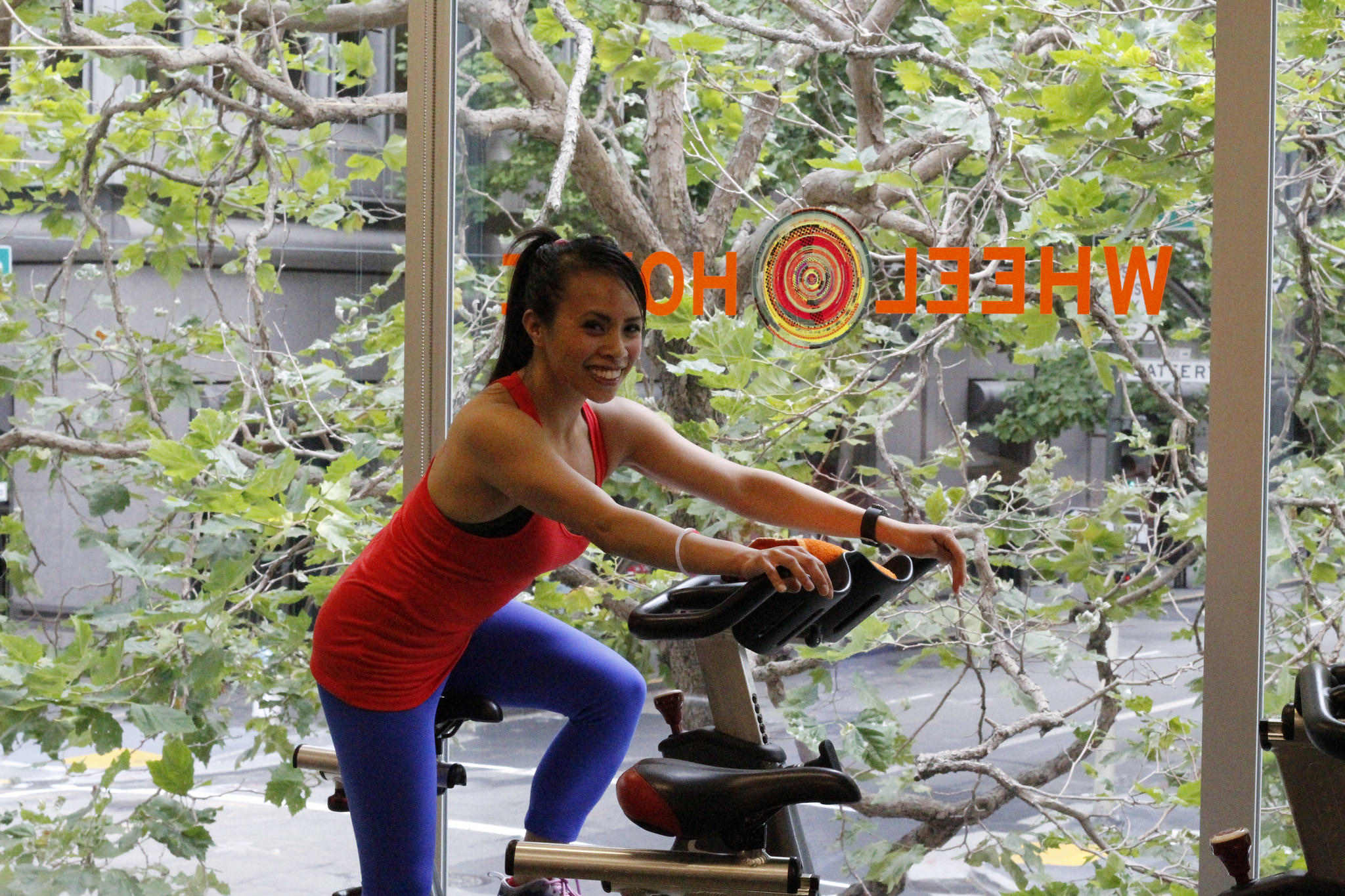
ICI/PRO Podcast host Joey Stabile talks with Suhail Maqsood of the Wheel House in San Francisco and John Bogosian of Zingfit about the importance of keeping your customers.
This was a great conversation, and many of us overlook the most valuable asset that we have in our businesses, our customers. Suhail and I have a great talk about the importance of the customers and what we can do to increase their experience with our club and how we can safeguard their privacy while retaining our branding.
You can learn more about The Wheel House here at their website.
You can learn more about Zingfit here at their website.
No stunt is too dangerous for extreme motocross competitions.
What caused the SoulCycle phenomenon? Why are their riders so passionate, loyal and willing to spend $34 dollars a class, when clubs and studios had been offering Indoor Cycling classes for 10 or more years – long before SoulCycle's launch in 2007? The research done (and reported here) by future studio owner Callie Bowling finds Cycling Studios that are offering class formats similar SoulCycle's appear to be doing well, but studio startups following traditional / cycling specific formats are struggling. Sadly many have already closed. Why?
One plausible explanation is that for a long time now, Indoor Cycling has been too focused on the negatives, “don't do this [contraindicated] … and don't do that [contraindicated]” while at the same time asserting rules and restrictions on the sport, [if you don't do it outside…]. Now I get that the intent here has been to try and ensure our rider's safety, butcould all of these rules/limitations/contraindications be causing unintended consequences?
My theory
So let me throw out a possible theory for you to consider. NOTE: my intent here at ICI/PRO is never to tell you what to think… you're too smart for that. Rather, my hope is that you thoughtfully consider what's written and come to your own conclusions.
Is it possible that people are turning to SoulCycle classes, for reasons similar to the rise in popularity of Extreme Sports?
Growing up in the late 60's and 70's there were no “Extreme Sports” – although I should probably be dead based on how much danger I was exposed to daily. That is, I enjoyed a lot of freedom as a kid – if you're of a similar age, I'll bet this was the same for you. We spent summer days in the suburbs pretty much unsupervised. Neither my mom, summer sitter, or my neighborhood friend's moms, knew where we were most of the day. We did pretty much whatever we wanted and created our own play. We got everyone together for pickup games of all types daily. Yes we got in trouble on occasion. Yes we got hurt a few times, doing dumb things like falling out of trees we shouldn't have climbed, crashing our mini-bikes without wearing a helmet, etc. We survived. Sure we had youth sports (little league baseball and football) but there was very little parental involvement. I rode my bike to practices/games and, with the exception of my grandmother who seemed to attend every game, my parents were rarely involved in my play while I was growing up.
Everything was different for my two daughters and kids across America, growing up in the 1990's. Amy and I parented like every other parent our age. We knew where our kids were pretty much every minute of the day. “Play time” was often initiated, structured and supervised by us. Why? Because we wanted to ensure our kids safety, based on concerns that I now see were really overblown.
Organised youth sports (soccer and later softball) started at age 5. Games and practices were religiously attended by both parents. I coached both my girls until they were teenagers. As a youth sports coach, I had first hand knowledge (very intense phone calls and on-field conversations) of how incredibly involved and controlling some parents were in their daughters lives.
Thankfully, Amy and I recognised the negative impact our actions were/or could have on our girls and we backed way off. For many who didn't, all of that parental supervision and control didn't end well. Multiple friends of my daughters quit sports completely, having been burnt out by excessive amounts of structured practice. These kids just wanted to play and have fun. But their parents never gave them the chance.
What should have been enjoyable, playtime activities with friends, became joyless, purposeful, objective driven work. And a lot of kids grew to hated it.
The problem isn't limited to moms and dads. Schools, for a multitude of reasons*, have imposed restrictions and limitations on “play time” during recess to the point where it's hard to believe you actually could have fun. Don't believe me? Try teaching your five year old to follow all these playground rules I found for an elementary school in California. After reading through the very detailed list of playground rules, I'm thinking I would give up and just instruct my child to sit quietly on his hands 🙁 Here's how the list of rules begins:
Playground Rules
Play Structure
Play with SAFETY in mind at all times. Students are always to walk in the playground equipment area. Those running will be removed from the area. No tag games are allowed in the playground area.
Swings: * Students sit on swings facing the field area
* Students can swing to a count of 50
(1 swing consists of a forward and backward motion)
* Students wait behind the green pole to take turns on the swing
* Students should never be allowed to jump over the swing seats, twist swings, or
stand on swings
* Students must swing independently. No pushing from a friend!
Enter Extreme Sports
It no secrete that youth have a tendency to rebel against authority. Sociologists have figured out that many young adults are acting out their rebellion at the parental and societal intrusion on their play, by participating in Extreme Sports. Now, instead of climbing trees, doing an oly-under while pushing your friend on a swing and occasionally sneaking out at night as kids, we have people jumping off buildings and doing flips with motocross bikes 🙂
I did some research and I found a book that you can read at this link; The Sociology of Sports: An Introduction. The author makes a compelling argument > Extreme Sports are in fact a response to the excessive structure imposed on children's play.
Excerpt from The Sociology of Sports: An Introduction – page 53
Many sports have become so rule-oriented that people have sought alternatives to “traditional” sports.
So, are people flocking to SoulCycle because it's the alternative to rule intensive Indoor Cycling programs? I believe in part they are. After taking a few SoulCycle classes last fall, I wrote a series of reviews that you can find here, here and here > opens in new tabs. I came away thinking that part of the appeal of SoulCycle is that the class is very challenging physically – and I don't mean just cardiovascularly…
Is there purpose to all of these extraneous movements?
Critics of SoulCycle (and similar) classes point to how non-cycling specific movements; jumps, push ups/rhythm presses, “tap-backs”, figure eights, etc… have no proven training value and/or diminish the potential training value of riding an Indoor Cycle… like an Outdoor Cyclist would. For those reasons, along with perceptions the some of these movements may be potentially dangerous, we’re told we should not include these movements in our classes as they’re “Contraindicated”.
Based on what I saw at SoulCycle (and other similar classes I’ve taken) my feeling is that critics are completely missing the point. IMO these movements are a critical part to the appeal of these classes. It is a thing of beauty, watching a room full of people exactly on the beat and rising and falling in unison. I’ve heard this described as “tribal” behaviour, similar to fans doing the ‘wave’ at a sporting event. It’s a very powerful way to connect a group of people together. And at the same time, these jumps are very challenging to perform correctly — which I feel is another reason for the success of SoulCycle that I explained in this post.
In case you're wondering, what started my thought process here was a provocative post from CB Cycle Barn's Owner Karen Casler. She made a statement, by way of the below image, in this post at the Indoor Cycling Instructors Facebook group. You might be interested in reading the 100+ comments, including mine near the end where this theory first popped into my head.
Are you an independent thinker when it comes to conducting a fun, effective, entertaining and motivating Indoor Cycling class? If so please consider joining us here as an ICI/PRO memberwhereeveryone is welcome — no matter where, our how, you choose to teach!
*Yes, I agree that there are a lot of legal liability issues that drive institutional decisions. It's just that I've talked to too many school administrators, who's personal interest in “protecting the children” seemed more important than whether or not the kids will actually have any fun.
Chrispins sent me a note earlier this week about how the iPhone/iPad Class Builder App will now work with Spotify playlists. Fantastic! I've been waiting for someone to create an Instructor App that uses Spotify.
I have a sort of love-hate relationship with the Spotify App… I love the huge selection of music available for $10 a month, sharing playlists and especially the cross fade – it has my playlists sounding like a near professional mix, with no extra effort. But I hate the tiny numbers they use for the track length timers. If you're a 30 something year old Instructor, with youthful eyes, those itty bitty numbers are probably not a problem. I (and there's a good chance you) on the other hand, have reached the start of my Golden Years where everything looks a little fuzzy without my readers.
Class Builder has BIG NUMBERS – which is awesome and that feature alone is enough for me to look past the $19.95 cost of the App. The options to add cues, tied to each specific track, could really simplify teaching a well crafted profile. Projecting the class profile's training zones on a screen would be cool if your studio's system will accept the video signal from your device.
Class Builder does have a few limitations…
Class Builder requires a premium Spotify account
No off-line mode… only streaming using WiFi.
But before you purchase Class Builder, with the plan that you'll be using music from Spotify, there's something important that you should be aware of – Class Builder doesn't offer a play music off line, option. To use Spotify in a class, where you're using the Class Builder App as the music player, you'll need to be connected to a reliable wireless internet connection. Which is fine if you've got one. In the studio where I teach, the WiFi is weak and when I've tried to use it in the past I was repeatedly asked to sign in to the WiFi multiple times. So I'm doing some testing to find if I can feel comfortable using Class Builder.
No option for Local tracks
Spotify will only stream Spotify tracks. Because Class Builder can only stream music, it can not play your local iTunes music tracks.
I realize this is can be confusing. Let me try to explain: Let's say you want to include a fun remix or mashup MP3 that you have in iTunes, in a playlist on your iPhone/iPad. The only option is to sync your device with your computer, using the same WiFi to connect between them and then set the playlist on your device to Make Available Off Line or my iPad now says Download Playlist.
Because Class Builder has no ability to download, or make tracks available off line, there is no option to include your local files (iTunes) in a playlist used with Class Builder.
No cross fade or EQ either
There was some early discussions about Class Builder on one of the Instructor Facebook groups. People were having a hard time understanding why, for example, Class Builder wouldn't follow the settings they've made in the Spotify App or play in an off line mode. It took me a while before I understood where the confusion was coming from; Instructors were rightly thinking that “I have everything set correctly on the Spotify App… why isn't this working?”
Class Builder doesn't use the Spotify App on your iPhone – Class Builder is a completely separate App that can access your premium Spotify account. I haven't tried it, but I'm guessing you could delete the Spotify App off your phone and Class Builder would continue to steam music from Spotify.
Realizing that much of what I've written here is conjecture, I've scheduled an interview with the App's developer Gene Nacey, from Cycling Fusion, for early AM Friday. We'll explore this latest version of Class Builder. If you have any questions you'd like me to ask him – please leave a comment below. Friday 8/8 update: scheduling issues have moved this out until next week – stay tuned.
P.S. If you already own Class Builder, the Spotify option was included with the latest update. From the Home Screen go to Settings > tap the Spotify logo > enter your Spotify User and Password. If you've been playing with this please let us know your experiences.
What message do you send from the bike, while conducting your class?
If that's that's of interest to you, here are two short videos to help you.
First is communication expert Alexa Fischer. She sets up her video on body language this way…
I was at a networking event recently (actually enjoying it, as I am wont to do), shaking hands, making small talk, when I saw her — arms crossed, head down, avoiding eye contact while she alternated between sipping her drink and scrolling through her phone.
And this made me think two things:
1. My friend, we’ve all been there. Who among us hasn’t felt nervous at an event filled with new people?
2. I want so much to come over and say hello! And ask you where you got that great haircut! But your body language is telling me you’d rather … not.
In today’s video, we talk about how body language affects how others view us, how our own body language affects how we feel, and how we can read someone’s body language and use that information to choose our words.
If you missed hearing our past interview with Alexa you can find it here.
To build on the concept of projecting confidence, take a few minutes to watch Johnny G and see how he presents that “outward energy” on the bike.
Watching Johnny has me considering how often I sit up and project openness – rarely now that I think about it.
Do you spend the majority of your class down? Or are you sitting up frequently to reinforce an important point or simply to extend that outward energy to your class?
There's an old saying that goes; “I've been at this so long… I've forgotten much of what I didn't know, when I first started.” I've taught Indoor Cycling classes since 1998ish. A long time ago for sure. Even back then I had an advantage over most new Instructors. I'm married to the “Senior Group Fitness Instructor” in my family. Amy began her fitness career in 1994 and Spinning® in 1995. She was there for many of my early classes to help guide and critique me and my classes. I had her positioned front-center in the class during my first audition at Life Time – yes, I passed 🙂
So a lot of time has passed between those first classes and today. It's hard for me to think back on the nervousness and insecurity that's common in most new instructors. What's needed is a newer Instructor who's willing to share their ideas and solutions. That sounds like my friend Lena Hershey 🙂
This page at leanlena.com has links to multiple articles writen by Lena > New Instructor Tips specifically for those of you just getting started in your teaching carreer 🙂
Greetings from Santa Monica CA (training here for a new job). I was out and about last night in the beautiful weather and heard this fantastic 66 rpm dance tune. I can't wait to get back to use it in my class tomorrow and thought you might like it too.
Written and produced by a Russian DJ and electronic music producer, this feels like a full on 4:08 climb push. A nice challenge for everyone 🙂
Have fun with Arty's ‘Up All Night':
The Spotify link:
And free download for our ICI/PRO members:[wlm_private ‘PRO-Platinum|PRO-Monthly|PRO-Gratis|PRO-Seasonal|Platinum-trial|Monthly-trial|PRO-Military|30-Days-of-PRO|90 Day PRO|Stages-Instructor|Schwinn-Instructor|Instructor-Bonus|28 Day Challenge']