
by Joan Kent | Jul 13, 2015 | Engage Your Students, Health and Wellness, Master Instructor Blog

Most IC instructors have the client’s best interest at heart. We may not all agree on every point, but we do want our participants to do well, get the results they seek, and feel great. That probably goes not just for how they work out, but for what they eat, as well.
It’s a safe guess that most instructors wouldn’t mind at all if their class participants stopped doing the following things — immediately and forever.[wlm_private ‘PRO-Platinum|PRO-Monthly|PRO-Gratis|PRO-Seasonal|Platinum-trial|Monthly-trial|PRO-Military|30-Days-of-PRO|90 Day PRO|Stages-Instructor|Schwinn-Instructor|Instructor-Bonus|28 Day Challenge']
1. Eating “Good For You” Foods They Hate
The feeling of deprivation can make us do strange things with food. Feeling deprived can result from eating so little food that they’re always hungry, always thinking about food, always ready to gnaw the legs off the furniture.
We know it’s a binge waiting to happen. But there’s more to it.
Several years ago, during an appointment, a frustrated client stomped her foot at me and demanded, “Joan, do you ever enjoy eating?!”
My answer was an enthusiastic, “Yes, of course.” It’s true that we might need to give up certain foods — including some of our favorites — to get the results we want.
But let’s look at the good news. There are always foods we can and do enjoy that will fit into our food plan — even if we stop eating sugar, for example. Plenty of delicious foods are out there that don’t contain sugar.
The main point of this, however, is to get your participants to avoid eating foods they hate. Please. They shouldn’t eat them because they heard how “healthy” they are. They shouldn’t eat them because they read about the antioxidants they contain.
They shouldn’t keep eating them because they’re worried about their health. Chances are you can find a different food for them that contains the same healthful nutrients as that hated food. In a food they won’t hate.
Most importantly, if they don’t like what they’re eating, they’ll feel deprived — as surely as if they were skimping on quantities and semi-starving throughout the day.
Eating foods they hate is just another binge waiting to happen.
2. Using Food As Their Entertainment Or Reward
How do we use food for entertainment or reward? We eat when we’re bored. We eat to procrastinate on that work project we dread starting. We eat to take a break from that work project we started but aren’t enjoying. We eat because we got through a killer cycling class that morning. We eat because we had a great day. We eat to celebrate hitting our weight loss goal that week.
Feel free to fill in other favorite entertainment or reward uses of food.
In the early days of an athletic training program for which I was the nutritionist, a participant refused to follow the nutrition guidelines for the program. Her rationale was simple: She worked out hard and was entitled to eat whatever foods she wanted. Who could argue with that? We all get to make our own decisions.
When her training coach took weight and measurements at the end of the program, though, it was disappointing for her. Hers had all increased. It was a shame, too, because she probably would have performed better athletically if she had followed the food plan.
It seems unusual that we’d eat more food — or eat junk — when things go well. But, to use just one example, endorphins (beta-endorphin) may be released when mood is “up” and positive.
Beta-endorphin affects the brain’s satiety center. It makes us want to eat more. It doesn’t matter whether the original trigger was positive or negative.
When we’re ‘up,’ it’s not surprising that we want more of that up feeling. And we may end up eating foods that trigger the release of more endorphins.
More sugar, please.
3. Using Food As Their Primary Stress Reliever
What does it look like when we eat to relieve stress? We eat when we’re frustrated. We eat at the end of a bad day. We eat in the middle of the bad day. We’re much more likely to go for junk food when we’re stressed.
Eating when we’re stressed might seem like a minor issue, but any stressed-out moment is a bad time to eat. The digestive system basically shuts down — reduced production of saliva, lack of peristaltic contractions throughout the digestive tract, and other stress changes. It all means the body isn’t ready for food.
Because foods change brain chemistry, they can change our mental/emotional state. When our moods are low, it’s almost an instinct to look for something that will lift us out of that low mood state.
Even animals do it. Researchers have said that animals don’t eat for calories or nutrition per se, but for “optimal arousal.”
That’s why food choices when we’re stressed go in the direction of big brain-chem changes. Sugar is often used as a stress reliever because it triggers changes in brain chemicals that are felt readily.
But other comfort foods are used — frequently in large quantities: mashed potatoes, mac & cheese, spaghetti, biscuits, grilled cheese sandwiches, chips.
If your participant’s favorite comfort food isn’t on this list, it’s probably still a state-changer.
State changing is the key. They won’t binge on broccoli when they’re stressed — unless it’s smothered in cheese or sauce. That’s because broccoli doesn’t change brain chem, but those toppings will.
You’d probably prefer that they avoid these stress-driven, high-calorie blowouts.[/wlm_private]
by John | Jul 9, 2015 | Instructor Tech Help, Instructor Training, iTunes, iTunes & Spotify Training, Latest News, Music, Spotify
Both of these questions have pretty much the same solution…
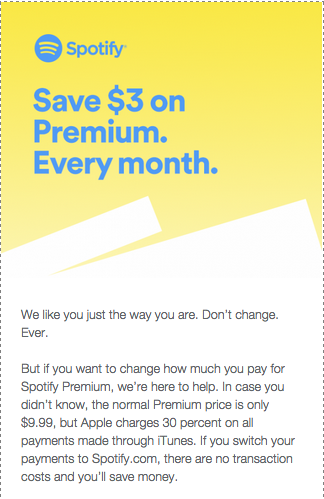
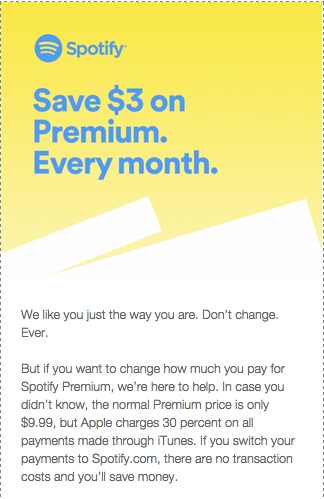
Spotify is jumping in Apple's face with this and I find it kind of funny 🙂 Turns out that if you're paying your monthly Spotify subscription through iTunes, you are paying an extra $3.00 a month. Why? Because iTunes charges an extra 30% on top of recurrent subscriptions.
Spotify is trying to raise awareness around the fact that it's cheaper to subscribe on the web instead of through Apple's App Store. The leading subscription music service plans to email iPhone customers the below note encouraging them, if they haven't already, to start paying at Spotify.com and save a few dollars. “In case you didn’t know, the normal Premium price is only $9.99, but Apple charges 30 percent on all payments made through iTunes,” the email blast reads. “You can get the exact same Spotify for only $9.99/month, and it’s super simple.”
The message is followed with a step-by-step tutorial that explains how to shut off auto-renew through iTunes (so Apple won't keep charging you the higher $12.99-per-month rate) and transfer your account to the web – something that can only be done once your current subscription lapses. “Pardon us if you can't do this immediately. Your current plan needs to end first,” Spotify says.
This will only apply if you downloaded and subscribed to Spotify using your iDevice. Most of us (me included) used our computers and subscribed directly with Spotify.
But this got me thinking; how do I cancel my free trial to Apple Music?
Turns out it's easy to cancel any monthly subscriptions.[wlm_private ‘PRO-Platinum|PRO-Monthly|PRO-Gratis|PRO-Seasonal|Platinum-trial|Monthly-trial|PRO-Military|30-Days-of-PRO|90 Day PRO|Stages-Instructor|Schwinn-Instructor|Instructor-Bonus|28 Day Challenge']
Open the Music App on your phone and click the silhouette icon in the top-left corner.

Next choose View Apple ID and Log In.

Then under Subscriptions > Manage
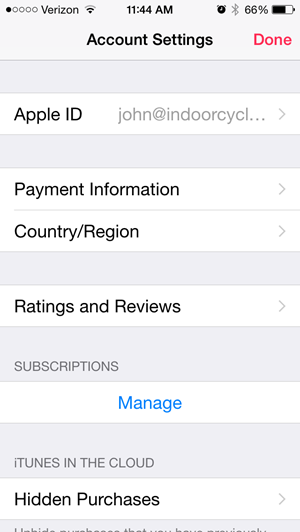
This screen will show your Apple Music and other auto-pay subscriptions, including Spotify if that's how you're subscribed.
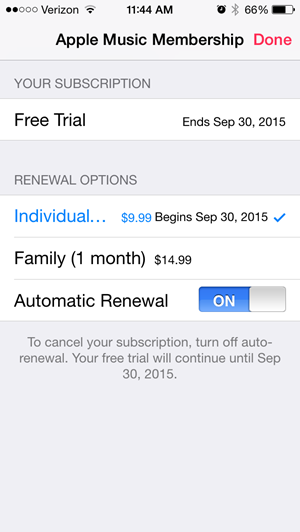
NOTE: cancelling won't end your trial early.
Please let me know if you have additional questions. [/wlm_private]
by John | Jul 7, 2015 | Best Practices, Engage Your Students, Latest News

Not sure how I feel about this new show shot in an Indoor Cycling studio in LA. I've had a few regulars mention it to me at the club. One told me that she's excited to learn more about the sex and drama filled life I lead as an Instructor 🙂
Hollywood Cycle episode #1 is tonight on E! Entertainment Television
You may have already seen the trailer
https://youtu.be/e6h3rQlZUzI
Now you can also get some advice on what not to do in a cycling class >
“Hollywood Cycle” stars Nick Hounslow, Nichelle Hines and Aaron Hines give the down-low on what to avoid during their intense spinning sessions. Listen in!
There's more here in these interviews from USA Today.

by Sally Edwards | Jul 6, 2015 | Engage Your Students, Master Instructor Blog, Zone based Heart Rate Training

The USA Women won the World Cup finals in soccer yesterday!
The US team coaches are using heart rate training, aka Heart Zones Training, extensively in their preparation for what lead to this victory.
I wanted to share with you an article released yesterday about how that training is accomplished using training load points and player position specificity – and comments that I made in that regard in the article. You can read it here.
While members of the U.S. team will no doubt play their hearts out during the Women's World Cup final against Japan, a coach on the sideline will be receiving real-time data about their actual hearts.
Credit forward-thinking coaches who embraced sport science to improve performance: Each U.S. player wears a heart rate monitor — not unlike one you'd find at your local sporting goods store — when she trains and plays games.
But what makes these special is where the information goes and how it's used.
Whereas a commercial monitor (or “wearable”) is designed for information to go to a wrist unit, an iPhone or iPad, and be used by the individual, for the U.S. women, there is a receiver that simultaneously collects the heart rates of 28 athletes to be analyzed by a coach.
[That “receiver” is the same as what's used to connect participants to the Display Training systems in cycling studios – John]
“What evolved [with the technology] was the ability for coaches to not only record the data, but be able to see it live,” says Josh Simonsen, a training specialist for Polar, the company that supplies the U.S. team with its heart rate system.
The data shows how hard a player is working, and can help a fitness coach determine everything from individualized training programs to deciding how much rest a player needs after a tough game. “If you take the women's national team, they're all fit. But it comes down to what type of fitness each player has,” Simonsen says.
What type of position an athlete plays also makes a difference, explains Sally Edwards, a heart rate expert and founder and CEO of Heart Zones, a fitness technology company. “In team sports, each player's position has unique physiological requirements, so the forward on a soccer team has to have different training than a defender,” says Edwards. “Some positions might need quick acceleration. Others might need endurance late in the game.”
With the use of sensor technology, a training program can be tailored to each player to make the fit even fitter.
If you'd like to learn more about this technology and how it could improve your team's performance, Use this contact form to request more information.
Sally
Sally Edwards, Founder and Head Heart
Heart Zones, Inc.
by John | Jun 29, 2015 | Audio PROfiles, Instructor Training, Latest News
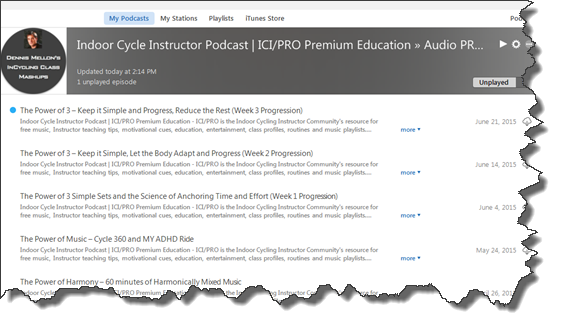
We just completed an update of the ICI/PRO feed to make it more user friendly.
ICI/PRO members get access to a special “Super Secret iTunes Feed” that will deliver a condensed listing of all of our downloadable Audio Profile Podcasts + full class mixed .mp3 playlists to iTunes or the Podcast App on your phone.
This latest update striped out everything but the important bits = now you'll easily find the audio profiles and mixed mp3s in iTunes or your favorite RSS feed reader.
To take advantage of this update you'll want to delete your old ICI/PRO feed and then re-subscribe using the RSS link shown below if you're logged in.
[wlm_loginform]
NOTE: This is a separate Podcast feed from the free Podcast. So you'll want both 🙂
If you need some help > here's a tutorial for iTunes or you can quickly setup your iPhone /iPad using this method.
Another way to access this RSS feed is directly through your browser. I know that Firefox will display the feed if you click the RSS link above – not sure about Safari. Chrome will work after you install this free plugin.
by John | Jun 27, 2015 | Instructor Resources, Latest News, Your Fitness Business
SoulCycle is preparing to go public with an IPO later this year.
Indoor cycling fitness chain SoulCycle Holdings LLC has hired investment banks for a U.S. initial public offering expected to come later this year, according to people familiar with the matter.
SoulCycle's IPO preparations underscore the growing popularity of boutique chains that cater to specific workout methods such as spinning, yoga and barre. The chains, which often charge per class rather than a monthly membership fee, have been taking market share from traditional big-box gyms.
SoulCycle has more than 42 U.S. locations, and plans to open 50 to 60 studios worldwide by next year, according to its website.
So would you purchase shares in SoulCycle?
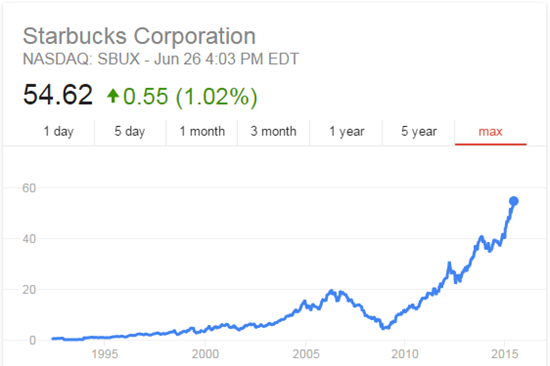
After watching SoulCycle for years and seeing what a money machine they've become, I'm thinking I will. In fact I'm going to compare them to Starbucks and predict that SoulCycle will make investors a lot of money for the same reason Starbucks has been such a solid investment* > both their customers admit to being addicted to their products.
WHAT IT'S LIKE TO BE $16,000-A-YEAR ADDICTED TO BOUTIQUE FITNESS
A few weeks ago, while mindlessly trolling Instagram, something stopped me in my tracks: My friend from high school, Michaela Miller, who is currently working on a master's degree in public administration from NYU, had screenshot her upcoming SoulCycle schedule. “475 rides in 365,” she boasted of her “SOULiversary,” the birthday of her inaugural class. “Stepping it up with an even STRONGER starting lineup.” After gawking at the fact that she was planning a Wednesday triple–as in three, 45-minute classes in a single day–I shamelessly pulled up my calculator app. Some quick math revealed that my friend's dedication to cult-loved $34 spin sessions (before the price of shoe rentals and water) could easily run her $16,000 in a single year.
Despite all the negativeness directed at SoulCycle, they have shown the rest of the Indoor Cycling industry how to be successful. Not to mention positively changing the lives of thousands of participants…
For Miller, the benefits of being die-hard include daily clear-headedness, a built-in support system, and being held accountable. “I'm definitely less flaky as a person,” she says of committing to ten or more classes a week all over Manhattan, New Jersey, and Brooklyn. “I used to be notorious for missing trains, planes, parties, dinners, but since I started doing Soul, I'm early to things. I show up on time. It sounds silly, because we all should do that, but I was late a lot.” To minimize the financial impact (she says she's only on the hook for half of the classes she takes), Miller buys packages and nabs free rides via a group of instructors who now make up her inner circle. She even gave up a pack-a-day habit. “I would never have quit smoking if it wasn't for Soul,” she says with a laugh. “It was between SoulCycle and the cigarettes.”
NOTE: This is not intended as financial advice, only to alert you to this future opportunity.
