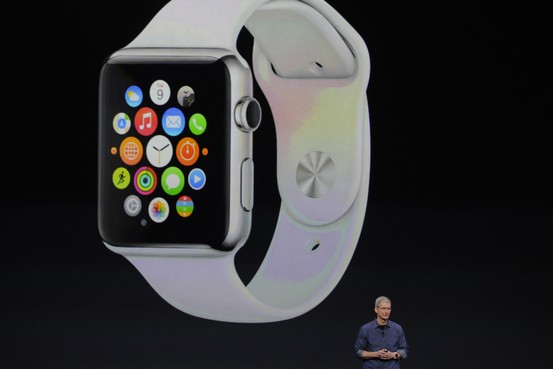
Apple revealed their new Smartwatch today – there's not much information available yet, but I'm betting it will turn the fitness industry on its head. Disclaimer, I own Apple stock and my prediction is that the Smartwatch will become the de facto fitness device in the very near future.
And I'd be sh***ing my pants if I was Polar or Garmin.
Why? Because the iPhone is a really lousy fitness accessory. There I've said it. Despite being able to run all those wonderful fitness and cycling Apps, the iPhone sucks to use when you're exercising.
They make very cool bike mounts so you can use your iPhone as a bicycle computer… except the battery won't last longer than a few hours with the display on and GPS enabled.
Ever try to run with an iPhone strapped to your arm? Try to change songs? Don't bother, you can't without stopping.
Indoors it isn't any better. How many people use their iPhone in class? I've only seen two in all my years of teaching.
But we love our iPhones, so we've put up with how cumbersome they are to have along with us.
Put it on your wrist and everything changes. It will be as convenient to use as a … wristwatch… a wristwatch that runs cool fitness Apps!
Our participants will want to wear their new Smartwatch in class. And what will they do with it? THEY'LL MONITOR THEIR HEART RATE – and maybe THEIR POWER/WATTS. They might also want to record their data + upload and track their progress.
The Apple Smartwatch will make Indoor Cycling 2.0 cool 🙂
The Smartwatch is supposed to be out in early 2015. Unless Apple has figured out how to detect your heart rate from your wrist, the folks from Scosche and Wahoo better crank up their production of BLE HR monitor straps
I can't wait to see what happens 🙂
Next Day Update: I'm seeing my prediction about BLE monitor straps being unfounded. The video below explains that the Smartwatch includes optical sensors like the Scosche = the heart rate monitor is built in, so no additional strap is needed.
It’s squash season! Winter squash — almost all of them — are among my favorite foods. They’re an excellent source of starchy carbs, which are necessary for training, and don’t add the undesirable elements of sugar or gluten.
People ask how I cook squash, and my answer is shocking but true. I microwave. (As mentioned in previous posts, I’m a lazy cook but determined to eat healthful foods.) One safety note: larger squash, such as butternut, can be difficult to cut when raw. Most roasting/baking instructions require cutting the squash in half before placing it in the oven, so be careful. If you decide to be lazy like me, you can microwave without cutting first.
Acorn squash seems to be everywhere these days. It can be eaten as part of a quick pre-training meal. The meal could include any protein source you choose, from dinner leftovers to vegetable protein powder. Reheat the acorn squash, if desired, and top it with some raw, organic coconut oil. It’s a fast, healthy meal and can get you through a tough workout.
Stuffed acorn squash makes a nice dinner side dish. You can, of course, use virtually anything you like to stuff it. One combination I’ve played with is brown rice, wild rice, chopped vegetables, and pine nuts. If you go easy on seasonings, this could also serve as part of the pre-training meal above.
Another terrific squash is delicata. It can be substituted for acorn squash in either dish above and offers a little variety.
And how about spaghetti squash? It can be eaten just like any other squash, seasoned whichever way you prefer. But it also has that added fun-factor because it can be used exactly like spaghetti and topped with your favorite sauce to make a gluten-free “pasta.”
My favorite squash dish combines two winter standards. Butternut has a fantastic flavor but is often watery. Kabocha (aka Japanese pumpkin) has a drier, firmer texture but tastes bitter. Combining the two is easy. Cook both, let them cool, and discard the seeds. Scoop out the squash from each one, place it in a bowl, and use a potato masher to blend them. It’s really quick. Pour out the water from the butternut squash as necessary.
The taste of this combo is good enough to be eaten plain with no seasoning. But, obviously, you can season it if you want, with any seasonings you choose.
Whether you already like squash or try it for the first time it this season, you might miss it (as I sometimes do) the rest of the year. Here’s one way around that. A few years ago, I discovered canned, organic pumpkin. Look for a brand that contains pumpkin and absolutely nothing else. You can treat it exactly the way you would oatmeal or quinoa in my no sugar, no-bonk breakfast suggestion from a previous post. Season it according to your preference. I tend to use cinnamon at breakfast, but sea salt, freshly ground pepper, allspice, nutmeg, curry, and many other seasonings can work quite well anytime. If you stock up on several cans, you’ll have it year-round.
My plan this year is to try some of the squash varieties I’ve never tried before. If you have a favorite recipe, please feel free to pass it along to us. And please let me know how squash works as part of your pre-workout meal.
I love seeing long-time sponsor Pearl iZumi offering a special clothing sale I can share with our ICI/PRO Platinum annual members.
Through the end of the month members can purchase anything Pearl makes at our PRO/Purchase 40% discount and pay no shipping.
The clothing and footwear displayed are all current models – not a few old/discontinued/closeouts they're trying to dump.
Which has me poking around on our special website page this morning. My current want need is for a cool weather jacket, for mornings when it's below 45°F or so at the start. That's too cold for just arm-warmers and my Pearl winter jacket is way too much for a rapidly warming day… I need something in between.
This looks like it might work 🙂
Many ICI/PRO members report saving the entire cost of their $97.95 membership with just a few purchases. I will save $70.00 on this jacket alone and I haven't begun to think about Christmas presents. In case you're wondering, the total value of our sponsorship with Pearl goes into your discount. We don't benefit from your purchases.
Click here to start your ICI/PRO Platinum subscription today.
Have you ever noticed that some of your students react more strongly to sugar than others? That they seem to want it more often, crave it frequently, and want more even after they’ve eaten some? The reasons are genetic. I love that because it takes all the “blame” off the person and de-personalizes the reaction by making it chemical. We can’t be blamed for something we can’t control, right?
As an indoor cycling instructor, you may hear all about students’ problems with sugar. You’re also in a unique position to help them. Your students know you, trust you, and follow your recommendations.
So what is this genetic, chemical thing that goes on in people who are susceptible to sugar addiction? It’s in two parts — carbohydrate sensitivity and sugar sensitivity.
Carb sensitivity simply means exaggerated insulin secretion to sugar and some other carbs. The extra insulin can cause glucose to drop, causing cravings. The cravings are typically for foods that will raise glucose quickly. Sugar is an obvious culprit in that regard. The glucose drop can also trigger hunger, so it’s likely that the carb-sensitive person will crave sugar, eat it, and eat quite a bit of it.
Who’s likely to be carb sensitive? Typically people with a family history of one or more of these: alcoholism, diabetes (including mature-onset), hypoglycemia, hypertension, or obesity. Another factor is central adiposity (apple-shaped body). That apple shape is the typical characteristic of men, but women with that body type are more likely to be carb-sensitive.
The other aspect — sugar sensitivity — is about neurochemistry. People who are sugar-sensitive seem to have low baseline levels of several brain chemicals — beta-endorphin (or endorphins), dopamine, and serotonin. To simplify (oversimplify!), the fact that those 3 chemicals are lower than normal makes these people feel crummier than normal.
Who is likely to be sugar-sensitive? People with a family history of alcoholism, other addictions, depression or other mood disorders, or a personal history of PTSD (post-traumatic stress disorder).
Let’s return to sugar. When we eat sugar, we get a brain release of beta-endorphin. That triggers a dopamine response because the two tend to go together. But when a sugar-sensitive person eats sugar, the beta-endorphin response is greater than normal — and so is the dopamine release.
Their serotonin will be exaggerated, too — because of carb sensitivity and the high insulin release. The more insulin we secrete, the more tryptophan (the amino acid used to make serotonin) travels to the brain, and the more serotonin we produce. It’s pretty linear. So carb-sensitives — who release extra insulin when they eat sugar — end up making a lot more serotonin.
And what does all of this have to do with addiction?
Dopamine and beta-endorphin are involved in the good-feeling, reward part of addiction (including sugar addiction). That means people who are sugar-sensitive may feel rotten without sugar, but hugely better than normal when they eat it. Obviously, that’s pretty reinforcing. It encourages repeat behavior, both in animals and in humans.
Then there’s serotonin. Serotonin is involved in seeking behavior — how much trouble we’re willing to go through to get the addictive substance we want. Once again, the exaggerated response comes in here. Extra insulin leads to extra serotonin, and that leads to stronger seeking.
To recap, it kinda works like this for a carb-sensitive, sugar-sensitive person: She/he may feel crummy without sugar. The giant-sized reward caused by extra-high dopamine and beta-endorphin makes Ben & Jerry’s seem pretty appealing in the middle of the night. Reinforcement from eating it may provoke that desire on many nights, while the extra serotonin is what makes someone drive to the store in a bathrobe at 2:00 am to get it.
What I love about this hormonal and neurochemical viewpoint is that it takes all judgment off the person, who can’t fight those genetics any more than we can fight our eye color. There’s nothing wrong with feeling compassion, rather than judgment, for someone’s compulsions. Judgment never helps anyone, although compassion certainly can.
What besides compassion can help your students? Changes in nutrition are most important, but if you’re not comfortable tackling addiction, you can still help. Don’t underestimate the organized, structured workouts you offer in your classes.
You may already know that workouts increase brain levels of beta-endorphin, dopamine and serotonin. (More on serotonin and training in a future post.) Encourage consistent participation from your sugar-addicted students, especially any who are in recovery from alcohol or other substances.
Even if they don’t want to work out some days, your class will help them that day AND in the long run — and make you feel great that what you do so well can be so beneficial for them.
ICI/PRO is sponsoring a series of informational webinars, featuring industry experts from the leading companies in our industry. These live events will be invaluable for Studio Owners, managers and anyone planning a Indoor Cycling Studio.
Our first is entitled: Clients, new and old: How to keep them all engaged is scheduled for September 16th at 3:00 Pacific / 6:00 Eastern.
Clients, new and old: How to keep them all engaged
When it comes to attracting new clients, effective marketing is often the difference between surviving and thriving. Join us to learn how to develop a marketing plan that will bring new clients in all year long–and turn them into dedicated clients, too.
We’ll cover:
Strategies for every stage of client interaction, from the first visit to the first year and beyond
The numbers that matter when it comes to increasing your client base
Loyalty programs: how to create your own, and what to encourage your clients to do
Pre-registration is required and you can register here and we'll send you reminders so you don't miss the event.
We'll be recording this webinar and it will be available exclusively to everyone who's registered – so please register even if you can't make the live webinar.
Presented by Michael Goldsmith, Senior Regional Sales Manager at MINDBODY Online
Michael Goldsmith is one of two MINDBODY Senior Regional Sales Managers, leading a team of over 40. As a”recovering” attorney with thirty years of business experience, Michael relishes coming to work every day to help MINDBODY's fitness clients run their businesses more smoothly.
There's a lot of pressure on clubs and studios to upgrade to the latest technology… those basic, conventional bikes just don't cut it when there's a new competitor down the street.
So what does a struggling fitness studio do to come up with the cash (two grand or more per cycle) for a room full of the latest from Schwinn, Star Trac, Keiser or FreeMotion?
How about running an online fundraising campaign to raise the money? Could that ever work?
We will know next month when Ypsi Studio closes their indiegogo campaign on September 21st. They're running what they call SchWinning at Ypsi Studio. Owner Julia Collins is hoping to raise enough money to upgrade to new Schwinn AC Performance Indoor Cycles for her Ypsilanti, Michigan studio.
With clients looking to stay on track with the most up to date exercise equipment, Ypsi Studio owner Julia Collins has launched a Indiegogo campaign to help raise the money needed to upgrade the indoor-cycling bikes the studio is currently using.
“I’m a small-business person and I’ve been in this business for 10 years. Gradually over those 10 years I’ve expanded from a tiny one room place to a place with two floors and different classes and several employees,” Collins said. “Every time I was making profits, I was putting it right back into the business.”
However, those profits are not enough to upgrade the equipment for her customers.
Collins is hoping to raise $25,000 so the studio can purchase 13 new indoor-cycling bikes. Currently the studio has several bikes they’re using that are in good condition, but they’re nearly 10 years old.
According to the campaign website the bikes the studio is looking to purchase are comparable to bikes offered in other fitness studios in the area. They will not only allow the user to exercise, but also monitor RPM, calories burned, heart rate and how long you've been riding.
Didn't the author leave out the most important part? Power!
Good luck with this Julia! I've made a note to follow up with the results of her campaign. You can learn more and pledge your support here.