Which heart rate monitor is best for you — digital or analog?
One Button Analog Blink Heart Rate Monitor
As a heart rate monitor, i.e. ZONING fitness enthusiast, you can now choose between two different types of heart rate monitors — digital or analog. But, what is the difference between a digital and an analog heart rate monitor? And which of the two is best for you? The answer lies in the transmission of the heart rate number, the bpm or beats-per-minute. And that transmission — that wave or that binary code — can make all of the differences to you.
First, both digital and analog heart rate monitor transmitter belts detect the same electrical activity of the heart’s contraction using sensors. The sensor in your transmitter belt can be viewed by looking at the back side of the belt which goes next to your skin. On each side of the elastic strap there is a soft and black rubber-like material that is usually oval in shape. There are always two the sensors — one on each side of the transmitter — that detect the electrical changes in the heart beat by using the amplitude of the EKG wave of the heart muscle.
Both digital and analog transmitter belts and watches are equally accurate. What is different is how they transmit the beats-per-minute of the heartbeat to the wrist top watch. And, that watch must either have a digital or an analog receiver that can accept that signal and convert it to a number that displays on our wrist or on your forearm or on your mobile device like an iPhone.
Analog transmission uses signals to the watch that are exact replicas of a sound wave. Analog signals can interfere with other nearby signals and this challenge is called the “cross talk” of two signals. The main advantages of analog heart rate monitors are the following:
Compatible with most, now about 99%, of the cardio machines at the gym,
Analog transmitters and receivers in the watch are less expensive
The signal is carried through water so swimmers and those doing water activities can use a heart rate monitor.
The disadvantage of analog heart rate monitors is that if you are within 3 feet of another analog wave transmitter which can be another person wearing a transmitter belt or another source of an analog signal you will experience “cross talk”. In this case, the receiver in the heart watch will accept both signal sources and add them together and you will get an incorrect number until there is only one signal for the receiver to sense.
Two Button Blink Digital Heart Rate Monitor
Digital transmission converts the heart’s EKG activity into a digital signal using binary code which is made up of 0s and 1s. Digital transmission is a clearer signal because it is impossible with packets of data rather than analog wave signals for interference. Digital heart rate monitors are more expensive yet have the following advantages:
The technology is newer
Digital signals do not interfere or “cross talk with other users or other signals.
Digital signals can be used with Bluetooth and ANT+ receivers in mobile devices like iPhones and others tools.
Digital heart rate monitors will not work for most swimmers because digital signals do not transmit from the transmitter to the watch under water. Here’s an example for you. If you are working out with another person who is using a heart rate monitor, the digital monitor is better because it will not receive both watches data and hence cross talk or allow interference.
What’s the best heart rate monitor for you — digital or analog? The answer is simple: it depends. It depends on price with analog less expensive, it depends if you are working out with others, digital is better because there is no cross talk, and if you are a triathlete or a swimmer — well — it depends because you cannot use it for swimming. My answer — just get a digital and get a less expensive analog and you have the best of both worlds.
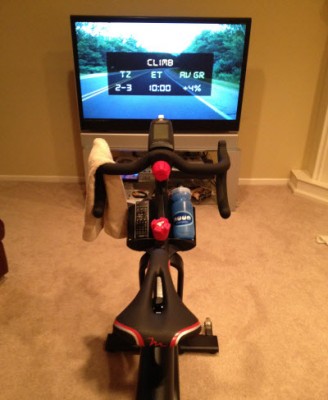
At the end of our first class on the new FreeMotion Indoor Cycles last Sunday, I spent close to 30 minutes answering questions from participants about the cycles and the Power meters:
How many Watts should I be making?
Why did I have to turn it up so high before I saw any real increase in watts… didn't you say power had a lot to do with cadence?
It said I was riding at 23 mph… was I really?
Why doesn't the calorie totals match up between my Garmin Heart Rate monitor and the console?
Why could I create more power, at a lower heart rate, sitting instead of standing?
I felt like I needed to work so much harder on this bike… why is that?
I'm going to be soliciting answers from our Master Instructor PRO Team for their responses to many of these questions. But I wanted to address the specific question/comment mentioned by multiple riders; these bikes make you work a lot harder – they're more like riding outdoors… why is that?
For those of you who have ridden (or teach on) a FreeMotion S11 series, Keiser M3 or Schwinn AC Indoor Cycle you probably already know the answer: Magnetic Resistance 🙂
And no, it isn't because they are watching their watts readings.
Magnetic Resistance more closely resembles the effect Air Resistance has on an outdoor cyclist, which if you've ridden outside, or simply stuck your hand out the window of a moving car, realize is substantial. On a flat road above 20 miles per hour >95% of your energy is being used to overcome wind resistance.
I found this graph (and added some additional details) to help you understand the differences.
For the sake of simplicity I have taken some liberties with the graph, but here's what I feel you should know:
The Horsepower graph is based on: 0.2hp = Strong Cyclist, 0.4hp = Competitive Cyclist, > 0.6hp is Tour de France caliber Pro Cyclist.
The thin purple and blue lines represent the amount of Power needed to overcome wind resistance and ride at the listed speeds. Notice how sharply the line curves upwards and more than twice the Power is needed to ride at 30 mph vs. 20 mph.
The dashed blue and red lines are the effective resistance created by Magnetic and Friction based Indoor Cycles respectively.
In my Epic Wine Country Audio PROfile I offered these suggestions for cueing load/resistance dependent on the type of friction system your cycles use:
How you cue the addition of intensity is very important in an Indoor Cycling class of any format and its different dependent on the type of Indoor Cycle you’re riding.
– With any Indoor Cycle that uses friction to create the resistance I suggest adding resistance to cadence. Class is pedaling ~ 90 RPM and then add load to reach intended intensity. This has the effect of preventing “runaway pedals” when your students start with a small amount of load and then accelerate. The momentum in the spinning flywheel negates what little load there was.
– If you are riding a FreeMotion S11, Keiser M3 or Schwinn AC with magnetic resistance you can add resistance to cadence or you can do the exact opposite, adding cadence to resistance.
You've never heard that before, have you? It’s why I see magnetic resistance as being superior.
Here’s why:
My biggest struggle (besides getting people to be quiet) is how to best communicate load in class. If you have been paying attention in class you have noticed that when you slow your pedals (on a conventional friction IC – any Spinner, etc… ) they get heavier. We have all seen the person who was supposed to be accelerating out of a climb start bouncing like they have no resistance at all. This happens because as your student pedals faster, the added centrifugal force overcomes the fixed amount of friction, making it easier and easier to pedal, until it’s like they have no load at all. Not Good! Cycling is all about endurance. We want them to endure it! The solution is to establish leg speed and then adjust load to regulate the work they are doing.
Indoor cycles with magnetic resistance (S11, M3 and AC) work very differently. As the speed of the flywheel increases the Eddy Currents that create the load increase as well. So these Indoor Cycles actually get harder to pedal as cadence increases, just like a real bicycle. So with these types of cycles cue your students to set their load at a slower RPM and then simply increase cadence to add intensity.
Give this a try in you next class and let me know the results.
Out with the Spinner NXTs and in with the FreeMotion S11.9s
I just got confirmation that the Life Time Athletic club, where I have a Sunday 90 min endurance class, will have 65 new FreeMotion S11.9 indoor cycles for my next class!
There had been a lot of rumors, but I couldn't get confirmation until today from our Group Fitness dept head. I'll be meeting with the FreeMotion representative this Friday when they do their install.
It's about time. Two years ago I got all excited when two Schwinn AC performance bikes magically appeared in this studio… but then nothing more. Cue crickets chirping here.
I called Cameron Chinatti today and told asked her to help me with my first class and she has agreed to record a First Class With Power Audio PROfile later this week 🙂
Can't wait to update everyone about my experience.
Meet Emmy Ragali, the owner of Go Cycle Studio in Chicago IL. Emmy is the first Beta instillation site for the Top Power Display System from Performance IQ.
I wanted to learn first hand what Emmy's experiences were using the Top Power display to show the wattage and RPM of each Keiser M3 her participants are riding.
You may have concerns about bringing competition into your class and so do I. During the interview I asked Emmy some specific questions about how her class accepted the competitive atmosphere that develops by having everyone's data displayed on a big screen.
While I was reviewing the Go Cycle website I noticed this link to an evaluation form where participants can give feed back on the quality of the Instructor and their class – I see this as an excellent idea and Emmy explained to me that it has been very helpful to her and her Instructors.
Listen to the Podcast below to hear all about Top Power.
Here's a walking testament to the utter fallacy of (220 – your age) as a predictor of Maximum Heart Rate. Paul Pinkhouse Camerer is having his 93rd birthday today. To celebrate the occasion, Pinkhouse and a few of his friends will all train together at his home/cycling studio. During the training Pinkhouse will spend a large portion of the ride around 150 bpm – which is way above his age predicted maximum HR of 127bpm. Actually Paul has been cycling and participating in running races above his “Maximum HR” for years 🙂
Sally Edwards introduced me to Paul (Pinkhouse comes from the color of his home… which as you can guess is Pink) three years ago at a Heart Zones conference in Colorado. I recorded Podcast episode #18 with Paul while I was there, but many our our newer subscribers may not have heard it as it has dropped off the iTunes feed. Thinking it would be fun to republish it in celebration of Paul's 93rd birthday here it is again.