It’s a given that different people come into our classes with different expectations, needs and goals. How can we as instructors/trainers accommodate their individual needs without alienating any single group?
Let’s take two hypothetical participants — Susan and Bob. They’re the same age, but Susan is interested primarily in weight management, arguably the most common fitness goal, while Bob is interested in getting stronger, fitter and faster on the bike because he rides outdoors frequently and races regularly. Can these two find happiness in the same indoor cycling class?
I’ve resolved this with a reasoning that works for me. First, I needed to define my professional role as I see it, which may differ from how the fitness industry sees it. As an instructor/trainer, my job is to create a situation and an environment in which members can experience the benefits of physical exercise, and nothing more. Which benefits these are will vary with the individual, and it’s important that I never assume what they could or should be.
Even though Susan tells me she wants to lose weight and Bob says he wants to race bicycles, I know from experience that what the members want is often far removed from what they need, regarding the benefits that training has to offer. Here’s an easy trap, though: I have to be careful not to presume to know what they need.
The goal-oriented approach to training has a built-in limitation. I have known many members who, after 10 years of trying to “get something” out of exercise (e.g., weight loss), were frustrated and disheartened. Maybe they had some limited success from time to time (that I even helped them achieve), but it didn’t last.
If a workout session has to produce a result, you have a paradigm for unhappiness. Instead, my current approach is to create a training session that allows a person to get whatever he/she needs from the workout without interference on my part. I keep in mind that the average member will not understand this approach right away, so the training has to be about something they can understand and offer them some fundamentals of training.
So I teach indoor cycling. This is because the bike has brought balance to my life. It has been a source of both hardship and delight, but the practice of cycling has made me happier. I look forward to riding my bike, whether indoors or out, every day.
I explain early on that I will ask them to ride as if they were riding a real bike outdoors because there are excellent reasons for everyone to train that way, no matter who they are: greater enjoyment of the class, for example, and good technique that will prevent them from wasting energy, so they can apply the energy to creating power. (The last point will clearly help Bob, but it helps Susan as well. The stronger the trainings make her, the more power she can generate, and the more calories she’ll burn.)
Now my job in class is simple: Teach the bike. Completely. Offer my students structured trainings that have helped me and never assume what they need. If it’s in my heart to lead a training on riding big gears in the hills, that’s what I do. What the students get, they get, and I don’t over- or underestimate my influence on it.
Sure, a student with a specific goal may need individual attention. If Susan really wants to lose weight, I can make recommendations and/or referrals. The same goes for Bob. My job as an educator is to show them how to modify what I teach — which is a valuable skill they can use in any class they may take in the future. I offer suggestions but recognize that this is their path. I can’t overshadow it with what I think they should do with, or gain from, their training. That’s not my job and would be a misuse of the trainer role.
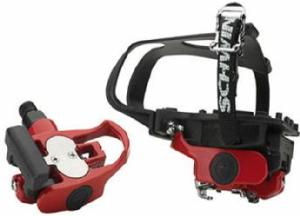
Schwinn Triple Link Pedals are a common upgrade for any brand of Indoor Cycling bikes. As a new Indoor Cycling Studio will need to purchase 20 – 50 of these pedals, a small savings can really add up! I did some research for our new CyclingStudio.Org community site and found that Sportsmith.net appears to currently offer the best pricing on Schwinn Triple Link Pedals.
If you are using these pedals you may want to check out the Red Pedal Tool (my very own invention) that solves the problem of safely removing the shoe basket without hurting yourself 🙂
I need to publicly thank both Cameron Chinatti, the Education Director for Stages Indoor Cycling along with Marketing Director at Foundation Fitness & Stages Indoor Cycling, Laurel Mylin for believing in ICI/PRO and co-sponsoring our conference this year.
Cameron will be conducting the Stages Essentials Instructor Certification as a Pre-Con on Friday 9/30 and will also be presenting four sessions during the conference.
Of course this turns our conference planning on it's head. I plan to have the final registration details completed by Monday 5/9 night for ICI/PRO members to make their selections.
I have opened early registration for those of you wanting to get a jump on everyone else. This year we are offering you the chance to make multiple payments, rather than one lump sum. Here is the link to register.
Last year the hotel sold out. Even if you are thinking about sharing a room I would suggest that you reserve a room here’s the phone number to the hotel 978-750-7987 and tell them you are in the Indoor Cycling group. We will be helping connect those looking for room-mates. NOTE: Our block of reserved rooms extends from September 28th to October 4th for those of you wanting to come early or stay a day or two longer.
Listen to the Podcast below for more information about Stages Indoor Cycling and their participation in the conference.
This Podcast is was originally published in 2008, I have updated it with our new Podcast host information and I am representing it now. I hope you enjoy it, Joey
Dr. Alinda Perrine, O.D., M.P.H. and Red Jersey / Master Trainer with Heart Zones USA conducted the Level 1 & 2 Indoor Cycling certification programs I completed during the Active Healthy Living conference this past weekend. I felt the program was very well presented and would prepare a new instructor to teach a very effective class.
Alinda is a true cyclist. She and her husband operate Free Spirit Adventures in Caldwell, West Virginia and she recently completed a “Ride Across America” with another ride planned for next year.
What I liked best was the emphasis on Training (which is measurable) vs. Exercising (which tends to be just wasting your time).
Instructing your participants on how to know if their body is prepared for exercise through a “Delta” test – Listen to the Podcast and see this link for more information.
Proper techniques for conducting sub maximal tests to determine Max or Threshold Heart Rates
Lots of discussion about Heart Rate specific class profiles.
Listen to the Podcast below for additional details or subscribe using iTunes or Zune.
Schwinn Cycling Master Trainer Denise Druce presents our latest class profile; Lead The Pack!
About Denise:
Denise Druce is widely considered one of the leading health and fitness professionals in the state of Utah. She is the producer in a series of 28 home workout DVDs, she teaches and trains athletes at the University of Utah, and is a Master Instructor for 24 Hour Fitness. Denise was featured as a trainer in SELF magazine, inspiring over 500,000 women to participate in the SELF Fitness Challenge. She and her husband, Michael live in Salt Lake City with their three boys.
A popular choice for Performance Tandems and Single Speed bikes.
Rules are not necessarily sacred; principles are. — Franklin D. Roosevelt
My cycling background revolves around the chain. My coach used to say, “The chain is sacred.” It vibrates, and that’s precisely what gives the bike its feeling of life. The vibration brings the rider a deeper sense of, and connection with, the bicycle. Without that vibration, without a chain, a bike is dead. I’ve believed, taught, and ridden this way since long before belts were introduced to Indoor Cycling.
If you had asked me back then about building a bike with a belt, I would have said without hesitating, “Don’t mess with the chain.”
Because of my background and the coaching I got, I can argue for the chain better than almost anyone. Those arguments, though, are philosophical, not focused on moving the industry of Indoor Cycling forward.
From my new perspective, working for a company (Indoorcycling Group, ICG) that makes a spectacular line of bikes with belts (LIVESTRONG), the conclusion is clear. The belt requires less maintenance, has fewer breakdowns, improves pedaling technique, does not allow for momentum-based recovery, makes the rider work more efficiently, is quieter, and is safer for new riders. It will save the club owner money, decrease liability, train participants more effectively, and make less noise.
No one on the management side of the club business would need to hear more to choose a belt. For economic reasons alone, the industry will go this way. It’s generally wise to ride an elephant in the direction it’s going. It seems foolish to push for a chain drive in light of that.
But here’s another thing to consider: 95% of the people who get on an indoor cycle won’t understand that “the chain is sacred.” They will notice only that the belt is quieter and smoother. This was the point that sold me. Although I tried relentlessly to find people who understood why I insisted that the chain is sacred, few people got it, almost no one felt it. Not even instructors who were currently teaching on chain-driven bikes.
Instructors whose jobs depend on the Indoor Cycling industry should not need any more convincing. Convincing club members who are used to chain-driven bikes, however, may take a bit more work.
The first thing I ask them to do is tell me what they like about bicycle riding. After they go on for a while, I ask them what they like about indoor cycling. That, too, goes on for a while. Regardless of the individual answers, the key point is that indoor cycling is quite different from riding outdoors: no need to balance, different movements, different hand positions, fixed gear, and more. There are many differences, all far more noticeable than the drive train.
Next, I ask them what other kinds of bikes they've ridden. Performance bikes only? How do they react when they see someone riding down the road on a cruiser in flip-flops? My point is a bike is a bike. You’re not a consummate rider if you fixate on what you think a bike should be. In fact, you’re less a cyclist than the overweight woman struggling on the hybrid. She has more grit. She’s happy just to be riding. THAT is a cyclist.
I ask them if they know which bike is the best in the world. It’s the one you’re on 🙂
Cycling is sacred, not the chain. I dig the vibrations and the sound of all the chains in a peloton as much as any roadie. But chains are secondary to the circular motion of the pedal stroke. The continuity of the circle is what creates the sense of peace that allows you to get outside your mind. The chain or belt simply permits the transfer of power to the forward motion. It’s the motion that makes you feel like you’re flying.
If you want to call yourself a cyclist, get past the chain. Respect all bikes. Find peace in a smooth circle with a belt and satisfaction in the increased work it puts your legs through without the free-spin of a chain.
With good instruction, a belt won’t detract from the class experience — and may very well add to it.





 Schwinn Cycling Master Trainer Denise Druce presents our latest class profile; Lead The Pack!