
by Tom Scotto | Jun 12, 2026 | Master Instructor Blog
 Whenever I think of recovering faster, I hear my dad in the back of my head telling me to sleep faster when I only had 4 hours until the morning. I by no means want you to start short changing your recovery time nor trying to psychologically speed up the process. I do want you to consider how fast your heart rate recovers and some valuable information we can provide to educate our riders.
I’ve mentioned numerous times that I use recovery between efforts as a litmus test to determine whether a person is working at the appropriate intensity. The length of time given for recovery is often directly linked to the level of intensity we expected. For intensities that fall in the 80-95% range, I often provide a minimum of 3 minutes of recovery before the next effort. To put more context around this, if I was asking my riders to maintain a hard effort of 80% or greater for 3 to 5 minutes, I would provide 3 minutes for them to recovery. In a similar fashion, I may throw 4 to 8 short 1-minute intervals at them with only 30-60 seconds of intermediate recovery (between intervals), but would then give them 3-5 minutes to recovery after the set.
With both of the above scenarios in mind, I would expect riders to “need” at least 2 minutes to allow their heart rates to drop (near 60-70%) with the third minute providing some transition time before we launch into the next challenge. The bigger issue is always, did they work hard enough? And frankly, without a heart rate monitor it is very subjective. They may say, “I felt like it was hard, but then I recovered within a minute and now I’m ready to go”. It is far more objective for a rider to say, “I ended that last interval with my heart rate at 165 BPM and 2 minutes later it went down to 130 BPM”.
So what’s happening when someone pushes very hard and does not recovery very much within the 3-minute period? This is a question a few riders asked me this week. Here are 3 possible answers:
(1) The rider may be deconditioned and has possibly pushed himself or herself too hard. This is common with indoor classes that cater to all levels of fitness. Some riders do not have the body awareness and find themselves beyond their limit. They usually don’t have to stop riding, but you may want to suggest they take more time to recover before jumping back in. This suggestion is a sign of a mature and professional instructor who is not just interested in beating the riders to a pulp.
(2) The rider is just tired from a long day or is maybe lacking sleep or has not eaten well. This is where you can ask if this is a common occurrence or something they are just experiencing today. Similar to the rider above, they may need to sit out a few efforts or drills and then jump in once they feel recovered.
(3) The rider is borderline over-reaching or over-training. This is sadly a “silent-killer” in the fitness world. People workout on a regular schedule, regardless of whether the intensity and volume is correct, and eventual find themselves plateauing because they have not taken time to recover. I would ask this rider, “when the last time you took a light week or a total week off?” If they didn’t know or it was more than 5-6 weeks ago, I would strongly recommend they take the next 5-7 days off. Now, they don’t have to do completely nothing during those 5-7 days, but the intensities should be very light (50-60% perceived effort). If a person didn’t feel they had the disciple to go easy, then I would recommend they refrain totally.
As fitness professionals, we have to be prepared to help people deal with the challenges they experience as they strive for a healthy body. This includes saying the hard things (because they don’t want to hear it – which is why they are where they are at). So how can our riders recover faster after hard efforts (a sign of good fitness), it just may be that they need to pay more attention to their body’s signals for overall rest. It is our job, to provide the valuable input that helps them make an educated decision. Eventually then need to believe that rest and recovery IS training.
Originally posted 2012-02-16 18:52:36.
by John | May 17, 2026 | Best Practices, Engage Your Students, Master Instructor Blog
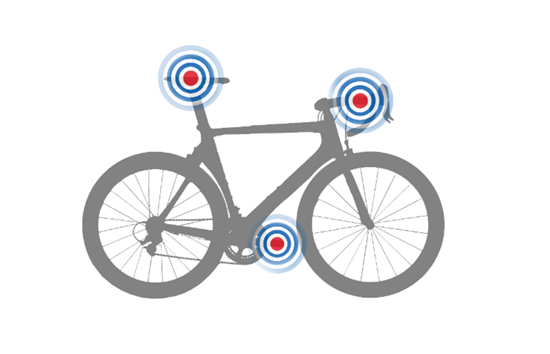
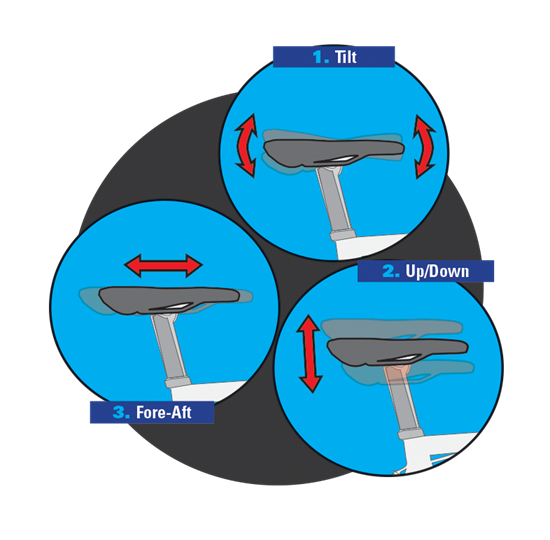
The guys at BikeFit.com do a great job using infographics to communicate the process of proper bicycle fit. Today they sent out these images and I wanted to share them with you. Each details the multiple points of adjustment that can be used to ensure a comfortable setup.
If you really want to become a bike fit expert, check out everything you can do with this iPad app.
Adjustable points of contact on a bicycle.
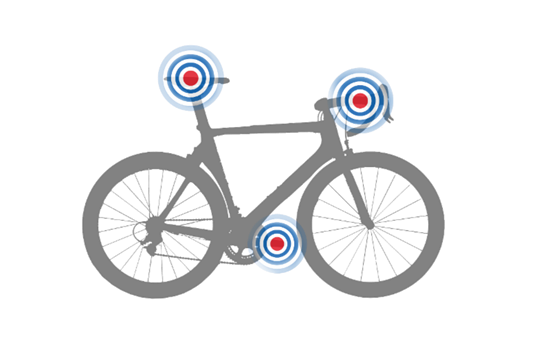
5 points of cleat adjustments
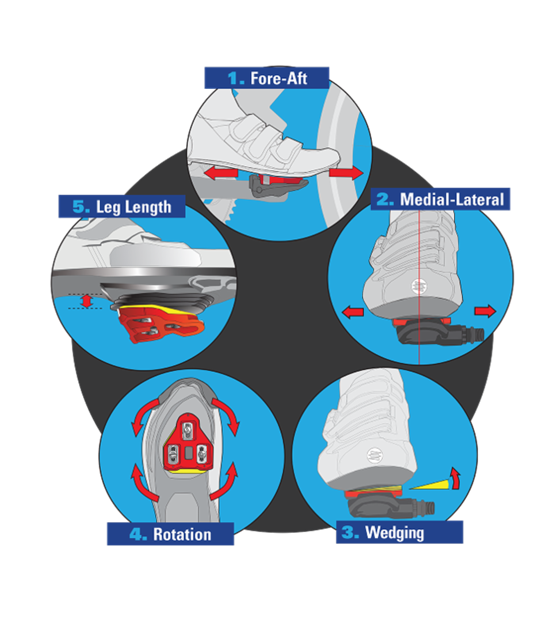
3 points of saddle adjustments
Handlebar adjustments
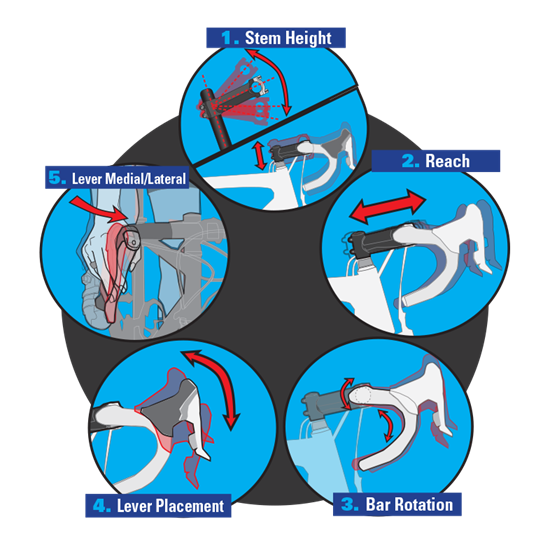
Having been through a three hour, professional fitting like what BikeFit.com offers – I have experienced how many of these adjustments are effected by others… i.e. saddle fore/aft affects height and reach to the bars, cleat position can require a change in saddle position, etc…
A comprehensive fitting is really important for someone who is riding thousands of miles a year and/or is super concerned about efficiency = getting the maximum amount of power to the road.
So how detailed should you be with a new participant? After setting up people for over 15 years, it's my view that you just need to get them close and feeling comfortable. You obviously don't have 3 hours and with the exception of the Keiser M3, the adjustments on Indoor Cycles are too coarse to really fine tune a person anyway.
Originally posted 2015-09-10 09:57:04.
by Tom Scotto | Apr 26, 2026 | Master Instructor Blog
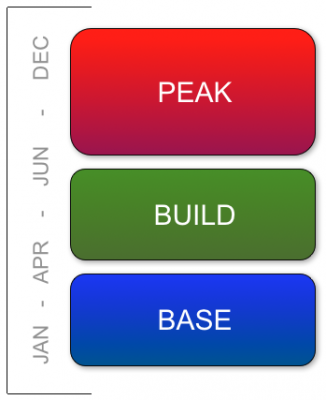 A number of instructors (and riders) have asked me how one should approach the next training phase and how to know their class is ready. These instructors are usually believers and followers of a periodized format for delivering the focus of their indoor classes. So considering we are rolling towards the end of March, this is the perfect time to address our focus beyond base training.
How Do We Know Our Class is Ready for More?
Let’s answer the easy question first. Well…sort of. The short answer is that it doesn’t matter. Hey, at least I didn’t say, “it depends”. The reason it doesn’t matter is because we have riders at all levels plus those that will pop into our class without notice, so we never really know who will be present from one week to another. Thus everyone will be in different places with their training and level of fitness. For this reason, I like to keep things on a general schedule for those faithful regulars that use our classes for consistent training (See the image for a general timeframe for each basic training phase). I also like to stay on the periodization model because it conveys the message that “we have a plan” in this class. Having a longer-term plan for how one delivers classes is also a great way to keep people coming back. For example, I will make the following announcement before introducing a new profile, “So as you know we have been focused on “X” (whatever that is) for the last 3-4 weeks and now we are going to build on that with today’s ride”. I’ve seen new riders turn to the person next to them to ask what type of rides they missed. I’ve even had people come to me after class and tell me that they are new (which I knew), wanting to know what was ahead for the next few weeks. The bottom line: they now want to be a part of what we are doing and don’t want to miss a class.
Obviously, as always, we need to provide options and give people permission to work at their own levels. Make sure to emphasis the point that everyone is at a different level and place in their training, so no one feels behind or unsuccessful during class.
What’s Next?
For those that have been following a periodized model, our focus has been on aerobic development / endurance, leg speed and muscular endurance (moderate climbing). With this foundation in place, from both a physical and educational sense, we can now get more specific in our focus and start shifting from volume to intensity. So what does this mean? The training done during base is designed to target general fitness and conditioning. The training performed during the next phase (often referred to as Build) begins to focus on developing muscular strength and power. With this shift in focus also comes an increase in intensity (bringing with it more recovery — hopefully). This can be a hidden trap for instructors because many will continue to increase the intensity, but not provide more time to recovery. In effect, intensity is not effectively increased because without appropriate recovery, people can work as hard as they need. Hence mediocre-ville and a dreaded plateau in fitness often follows.
This is often where taking the time to educate your class goes a long way. Having gone through 12 weeks of base training and understanding the purpose makes it easier to transition their mind to the concepts of training at a higher level.
Keep an eye out for my latest Audio PROfile entitled “CycleSTRONG” for an introduction to pure strength training — a perfect ride for the next phase of training.
Originally posted 2012-03-15 17:35:29.
by | Apr 14, 2026 | Instructor Training, Master Instructor Blog

By ICG® Master Trainer Vanessa Wilkins
Cycling instructors are a special breed, and all a little different. There are those who coach, those who teach choreography, those who talk heart rate and RPM, and those who teach meditation on the bike. I always strive to take a little piece from each style of instruction, to stay the open-minded student and, most importantly, to find my own voice among the throngs of others.
Cycling instructors by nature are fervent, even opinionated. Because of this, we may attract a special type of student — people with a bit of an edge, people who need to grunt it out and really feel something at the beginning or end of the day. Our most endearing quality can sometimes blind us: we are sometimes opinionated and studied to a fault.
Our discipline, indoor cycling, has been taught one way for so long it’s difficult to embrace any other. But to say there’s only way to move or study a discipline is simply narrow-minded. It limits our ideas and our teaching. When we stop learning, we stop truly teaching.
If mastery could be measured in watts or years on the bike, I’m sure many of us would line up with raised hands to be counted. I submit that mastery is best demonstrated when we stay open to new ideas and enjoy new ways of putting science, innovation and, yes, FUN together when we teach.
My mentor recently pointed out to a group of us, “If you continue to teach form and function only, your classes will eventually become stale. Members and students will stop waking up at 6:00 am unless you provide them with a training concept. A participant will eventually need something more to wake up to than ‘GO GO GO.’ You need to be willing to dig a little deeper and take people a little further.”
The best instructors I’ve found have this uncanny ability to touch, inspire, and excite — and usually not just with a great song. It’s that special blend of art and science that’s truly engaging.
That brings me to this point. It’s much easier to spot a bad instructor than a good one. When you attend a class and the instructor is terrible, you can feel the grumbling and unease in the room. You can easily point out the faults: the music is too loud or uninspiring, the voice too nasal, the cues unclear.
But when you attend a good class and the instructor suddenly announces, “Last Song,” you think, “Where did the time go?” Even though you may not have agreed with every cue or liked all of the songs, you find that you were riveted, captivated and engaged in the activity.
I’m suggesting that, although we might not agree with some of the innovation that has been happening in the cycling community, we should at least acknowledge that it’s a good thing to get people to move, period. All people, cyclists and non-cyclists alike. If it takes push-ups on the handlebars, bikes that move side-to-side, or forward motion video to reach people who would never otherwise set foot in a cycling studio, so be it.
I have come to terms with the fact that I may not get all of my participants to do a century ride with me. Hell, I may not get my participants outside at all. What I can, and should, do is my absolute best to get people excited about cycling. Out of their heads and into their bodies. Safely. If only indoors. If only for 60 minutes.
If the best way to do that is to borrow a great idea or technique from another instructor, I’m open to it.
Originally posted 2012-09-17 07:10:41.
by John | Mar 27, 2026 | Best Practices, Master Instructor Blog, Spotify

I started to share this over at pedal-on.com and quickly realized that this is another Best Practice for Indoor Cycling Instructors.
Suggestion to anyone reading this who is planning to use Spotify in class.
A cycling coach / friend of mine taught me that race day is never a good day to try something new.
The mark of a Rookie is someone who changes his seat height the night before a big event, or slams the latest energy drink on the way to the race – only to find the new saddle height feels weird and uncomfortable… and the stimulants have your heart (and mind) racing so fast you're worried about what effect all of these changes will have on the race you've trained months for that you're an emotional wreck as you roll to the line and are off the back before the end of the 1st lap.
Experiment during your training and only bring what's familiar to the starting line. Same is true with using Spotify in your class. I've lost track of how many calls and emails I have gotten that begin with; the first time I tried to use Spotify in my class ____________________ happened. It worked perfectly at home… I have no idea why it didn't __________.
Show your professionalism by doing a dry run at your studio before you attempt to use Spotify to deliver your class music.
Teach a whole class by yourself and experiment with your new toy;
- Will it play with Air Plane Mode turned on?
- Can you find your playlist if it's buried in a folder?
- Is the cross fade working correctly?
- Hit a few of the wrong buttons… do you know how to get back?
- Accidentally tap the shuffle (no, just tapping it again won't return it to ordered play) … can you quickly turn shuffle off?
- Get sweaty and try to scroll through the playlist – can you without inadvertently changing tracks?
- Have some sweat drip on the screen – will you resist the temptation to wipe it off with your towel = changing songs? or learn that you can dab the screen without messing everything up?
- Do your local files play when the should?
I'm sure this is only a partial list of the potential problems (feel free to add your own) you could suddenly be faced with, if you run into class without taking the time to become proficient with Spotify.
Originally posted 2013-02-02 12:27:43.
by Tom Scotto | Mar 24, 2026 | Master Instructor Blog
 The purpose of my last article was to spur you on to start thinking about the approach to your classes at the beginning of the year. Being a coach, my natural tendency is to sway you toward a periodized approach. I was definitely very happy with the responses from the last article which could be summed up as “so, how do we do it?” As promised, here is a simple approach to early season periodization for indoor cycling that I have been using for the last 10 years.
Quickly….What is Periodization?
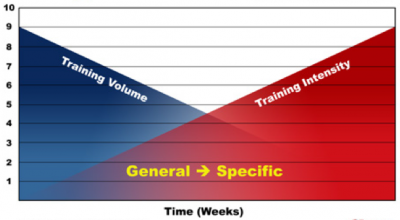
Periodization is a process of structuring training into progressive phases or blocks of time. In addition to the structure, there is a determined progression to the training from week to week and month to month. The progression manipulates a variation of Training Volume, Training Intensity and Training Specificity with a focus on the end goal (which could be anything from a pure fitness goal to preparing for a charity ride, century, cycling vacation or competitive event) or peak fitness. Although we are going to focus on the early season (or Base period), here is a simplified periodization plan I use for indoor cycling so you have a picture of how the Base period fits into the rest of the year:
- BASE Period: January – March
- BUILD Period: April — May
- PEAK Period: June — September
- TRANSITION Period: October — December
Keep in mind that how long and when each of these periods occur throughout the year is purely a function of the goals of a specific person or athlete. The above is a generalized approach I found suitable for indoor cycling classes.
Another DISCLAIMER
I’m going to reference 5 to 6 different ride profiles in the upcoming paragraphs. Unfortunately, I’m not going to be able to go into the details of each of these profiles for the sake of time and sanity. Each of these profiles could be an article or AudioPROfile in and of itself.
The Benefits of this Approach
Having a plan engages riders more because they often feel obligated to join in or continue. And it doesn’t matter which point a rider enters your plan. You may start your periodization plan in January and then get a new rider each week all the way through to March. No problem. Although each of the workouts is challenging, the overall intensities and specificity will be lower than usual, making it easy for new-comers to jump-in. The fact that they walked into a “plan” many times keeps them coming back because they don’t want to miss anything else. Plus, a periodized approach is a smart, proven training method which appeals to the cycling community as a whole and will draw more cyclists to your classes.
As a side note: Most of the classes I teach meet only once per week and thus there is only 1 training focus per week. The class that I have that meets twice a week gets the same ride twice. They appreciate a second chance at it, as they are often better prepared (mentally) to be successful the next go-around. Plus in the “real” world of cycling, many of these workouts/rides would be done 2-3 times during the week anyway.
The Plan
First I’ll layout the weekly plan and then I will give a brief explanation of each ride. Notice that in this plan, the same ride is not repeated for 6 weeks and the schedule takes you right into April.
- WEEK 1: Threshold Test
- WEEK 2: Aerobic Development
- WEEK 3: Leg Speed / Cadence Work
- WEEK 4: Muscular Endurance
- WEEK 5: Aerobic Endurance
- WEEK 6: Muscular Strength
- WEEK 7: Test / Review
- WEEK 8: Aerobic Development
- WEEK 9: Leg Speed / Cadence Work
- WEEK 10: Muscular Endurance
- WEEK 11: Aerobic Endurance
- WEEK 12: Muscular Strength
- WEEK 13: Threshold Test
Threshold Test
There are a number of ways to do a threshold test. My preference is the Foster Talk test which identifies 2 ventilatory inflexion points: VT1 (ventilatory threshold 1) and VT2 (ventilatory threshold 2). I’m going to use VT2 (or approximately 80% perceived effort) as the upper limiter on all of the remain class profiles below. Here is another method of performing a 20-Minute Threshold Field test posted on June 25, 2011 – https://www.indoorcycleinstructor.com/icipro-instructor-training/zone-based-heart-rate-training/is-a-20-minute-threshold-field-test-realistic-for-your-class-part-3/.
Another side note: I use the early part of the Threshold class to talk about proper form and technique while taking time to walk around the room and make necessary (wanted) adjustments.
Aerobic Development
This class consists of short aerobic intervals of 30 seconds to 2 minutes. It is easiest to break these intervals into sets using a 1 to 1 (work to recovery) ratio. The target intensity for each effort is VT2.
Leg Speed / Cadence Work
Another interval structure where the variable is now leg speed. Two common ways to structure these intervals is to either do a set of 1-2 minute efforts at 90 RPM, then do a set of 1-2 minute efforts at 100 RPM, etc. You can also approach it like a pyramid and design a set that starts with an effort at 90 RPM, then 100 RPM, etc. There are dozens of cadence drills one could use to build a nice varied class. Keep in mind that the speeds you target should be appropriate for your demographic of rider. The goal of these classes is to obtain the leg speed, while maintaining a smooth pedal-stroke technique, and without driving one’s heart rate above VT2.
Muscular Endurance
These are basically long climbs of moderate intensity ranging from 7 to 30+ minutes each. I tend to mix up the class giving them a climb closer to 7 minutes, than another at 14 minutes and yet another at 21+ minutes. It gives them a nice (duration) goal. The cadence range is closer to 65-75 RPM and heart rates should stay below VT2.
Aerobic Endurance
These are long steady-state efforts (with some gentle rolling roads) ranging from 4 to 10 minutes. This time the target intensity is VT1 or closer to 70% of their perceived effort. Like in most base building workouts, the stimulus is “volume” or duration and NOT intensity. And believe you me, if done correctly, are equally as challenging (physically and mentally).
Muscular Strength
Similar to the format of Aerobic Development, these are shorter interval sets of 30 seconds to 2 minutes, but the focus is on workload or heavy force on the legs. Cadence should range closer to 55 to 70 RPM. Be sure to caution riders who may have injuries before you introduce these. As always, rides should be instructed to work at their own pace and strength.
Test / Review
This is what I call a “Freebee”. I build a class consisting of 1 or 2 drills from each of the preceding weeks (same music and all) and present it as a test. “Let’s see how we have been progressing over the last 5 weeks. Take note of which drills are your strengths and which are you weaknesses. I’m happy to talk with you after class if you would like some guidance on how to adjust your training based on what you’ve learned.”
Rinse and Repeat
Yup, go through the previous 5 profiles again as you help your riders continue to build their fitness base. I like to leave the second threshold test to the very end. One generally gets a better result (or noticeable progress) after 10-11 weeks of focused workouts, and it is a great segue into the next phase of training.
Remember, BASE training is not boring but dynamic, varied and purposeful. Although the intensities are not near-max, the duration of time spent during each effort is longer and recoveries are often shorter (because…well…the intensities were not as high). Have Fun!
Originally posted 2011-11-18 17:54:48.
