I had an awesome phone call from the Better Business Bureau (BBB) today. The nice man told me that because of our sterling (we've never had a complaint) reputation, the BBB had upgraded our company's rating to A+… their highest rating 🙂
Like many other business, our actual name (Deep Breath In, LLC) is different from how we are known publicly – indoorcycleinstructor.com and ICI/PRO. The only place you'd see our name is on your credit card statement – which has to be listed as Deep Breath In, LLC vs. ICI/PRO. This has, at times, created some confusion; “honey, what's this charge on our credit card from Deep Breath In, LLC?”
Of course that wasn't the only reason why he called – the BBB offers a special “Accreditation” (which would remove the “This Business is not BBB Accredited” notification) for an annual fee of $490.00. I thanked him for recognising that we take very good care of our ICI/PRO members, but I would pass on the additional expense.
Is your business BBB Accredited? I don't know for sure, but I'll bet that it's more important for higher ticket products or services. I am curious to know if you feel it's worth the $500.00 a year cost.
In many of my “The Power of 3” posts I have written about the importance of “anchoring” time and effort. In it's most basic terms this means that the shorter the interval the higher the effort. If you instruct on bikes with power, then a higher effort should also translate to a higher wattage. This “anchoring” concept holds true as long as riders are given appropriate rest or recovery after each interval or hard effort. If riders are not given enough recovery between intervals their effort may still be high but their output or wattage will start to drop as fatigue increases. The ability to see this phenomenon is one of the most “powerful” features of a bike with a wattage meter.
The theme for my Above Threshold classes this month is to show my participants the importance of recovery. Over the last few months I've been using a lot of interval sets where I decrease the interval time from interval to interval and I expect to see a higher average wattage for each interval. For example I may have my participants perform intervals of 5, 4, 3, 2, and 1 minutes, each interval is followed by a 2 minute recovery, with the goal of increasing average wattage for each interval. This month I'll have my riders perform the same intervals, but I plan on reducing the recovery time to as low as 30 seconds between each interval. At the beginning of the month I expect to see wattage drop from interval to interval, as the body fatigues from lack of recovery. In the middle of the month I expect the see wattage held steady from interval to interval and by the end of the month, as the body adapts, I hope to see wattage again increase as the interval time decreases.
The body is truly an amazing organisms and it adapts to the stresses it faces, be patient and enjoy the process.
[wlm_private ‘PRO-Platinum|PRO-Monthly|PRO-Gratis|PRO-Seasonal|Platinum-trial|Monthly-trial|PRO-Military|30-Days-of-PRO|90 Day PRO|Stages-Instructor|Schwinn-Instructor|Instructor-Bonus|28 Day Challenge']
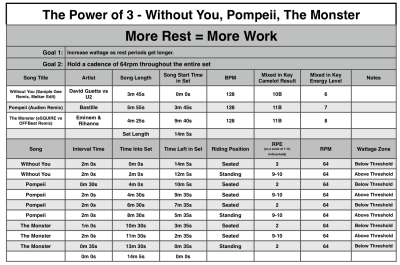
The Power of 3 – “More Rest = More Work”
“Without You (Sample Gee Remix, Melker Edit)” by David Guetta vs U2
“Pompeii (Audien Remix)” by Bastille
“The Monster (eSQUIRE vs OFFBeat Remix)” by Eminem & Rihanna
3 song harmonically mixed track, to download Right Click > Save As / Save Target As to download. Open in iTunes and then you'll see this in your Spotify Local File folder.
Sugar is big nutrition news these days, and sugar addiction is getting the attention it deserved a long time ago when only a few nuts (like yours truly) were talking about it.
I searched recently for the mainstream “wisdom” on getting rid of sugar cravings. The suggestions I found display a poor understanding by the various authors of what makes us crave sugar.
Below are some of those suggestions, and why I doubt their effectiveness. Of course, almost everything will work for some people, but as a rule, these aren’t things I’d recommend to my clients.[wlm_private ‘PRO-Platinum|PRO-Monthly|PRO-Gratis|PRO-Seasonal|Platinum-trial|Monthly-trial|PRO-Military|30-Days-of-PRO|90 Day PRO|Stages-Instructor|Schwinn-Instructor|Instructor-Bonus|28 Day Challenge']
Turn your attention to something else. This approach is a good match for the next one on the list.
Change the scenery & take a walk. Whoever proposed these two solutions thinks cravings are “all in your head”, so the solution must be to focus your thoughts on something else.
Talk to a friend. If you believe that a sugar craving is an emotional phenomenon, this suggestion seems reasonable. It’s less reasonable if you look at the physiological side of cravings.
Meditate. If you think cravings are the result of a way of thinking or feeling, or a result of stress, this may seem reasonable. And it can change brain chemistry, so it could work.
Avoid stress. Of course, that sounds fantastic. Who wouldn’t want to avoid stress? But it’s not always realistic. Besides, what if you’re already stressed? What do you do then?
This advice also doesn’t distinguish a craving from the urge to eat. That urge to eat when stressed may actually be an inborn reaction. Even animals do it. It’s not always the same thing as a craving.
Drink water. This is ALWAYS good advice. But a craving isn’t necessarily the result of dehydration. Thirst can be mistaken for hunger, and, apparently, the urge to eat is sometimes mistaken for a craving (see “Avoid stress” above). But they’re not really the same.
The following suggestions might be effective temporarily, but could backfire in the long run.
Eat a little of the craved food, then divert your attention. This shows a misunderstanding of the neurochemical effects of sugar. Yes, eating sugar will take away the craving — after all, you’re eating what you craved. But it will probably come back later with a vengeance. And if you eat sugar and the craving goes away, why would you even need to turn your attention to something else?
Eat the craved food, then something healthful. Sorry, you’ll never convince me that sugar cravings will be “cured” by eating sugar plus kale. The craving will return big-time later, and the sugar may make kale (or other healthful food) seem unappealing.
Eat a decadent, delectable version of the craved food and savor it. How slowly and voluptuously you eat the food has nothing to do with eliminating the craving. Eating sugar will always stop a sugar craving — but that’s short-term at best.
Eat fruit. As if fruit isn’t sugar. If you recognize that it is, this suggestion is the same as the rest of the food suggestions above.
My recommendation is to treat a craving like what it truly is: a neurochemical phenomenon. Since it’s neurochemical, it’s physiological. Would we tell someone to get rid of the flu by changing the scenery? By diverting her/his attention? Those are good things to do, but they might not be an effective answer to a physiological problem.
In a previous post, the causes of sugar cravings were described, and all were neurochemical.
Addressing neurochemistry may be a better way to fix a neurochemical problem. Use liquid B-complex, suggested in a previous post, for short-term relief. (It really works.) Change your diet for a long-term cure. (It really works.) Get a coach for ongoing support, because those two suggestions can be easier said than done.
Yep, I'm teaching another class where we're using weights!
I'm pretty excited. I'm subbing a Cycle Sculpt class tomorrow! Cycle Sculpt is a branded class format at Life Time Fitness, designed to attract the crowd who would be interested in a SoulCycle like class. This won't be my first time teaching this format – a little over a year ago I had the privilege and wrote about my experience here.
This class format has been evolving. Instead of using weights/bands while on the bikes, now we split the class up into two groups; half ride while the other half completes Boot Camp style circuit training on the floor.
It's like herding cats
Yesterday I discussed with Kadi (it's her class) how she conducted the class. She explained that it can get a little chaotic with so many people moving around the room – she typically has ~50 people. “Give each group a simple objective that they can complete on their own” was her advice, along with doing my best to keep everyone smoothly moving and focused.
As a side note I will be interested to see how many people I recognise. My previous experience was that most of the participants were completely unknown = they don't come to regular cycling classes.
I'm all about self-directed work. So I created the simple profile below and I'm (pretty)confident everyone will be able to follow it successfully 🙂
[wlm_private ‘PRO-Platinum|PRO-Monthly|PRO-Gratis|PRO-Seasonal|Platinum-trial|Monthly-trial|PRO-Military|30-Days-of-PRO|90 Day PRO|Stages-Instructor|Schwinn-Instructor|Instructor-Bonus|28 Day Challenge']
I'm doing a pretty normal warm up with a series of accelerations during the second track.
A.R. Rahman — Bobbleheads Life Time calls these a Reset = not a real recovery, but a reduced effort ridden to a short fun track.
Avicii — Heart Upon My Sleeve 3:30 Best Effort (this class will still incorporate Power/Watts) that starts one minute into the song. Here's where everyone can observe their PTP.
Jens Buchert — Crypton Recover and discover Base Watts – the wattage that has you working just above “Chatty” (early part of Zone 3 HR using a 5 Zone system).
Each track that follows is about five minutes long. The “On” (riding) group will directed to complete these distances each time they're on the bike:
Men ride 1.5 miles (at 20 mph this should take about 4:30)
Women ride 1 mile
Then complete the segment at “Base Watts” If you get Chatty that means you're not working as hard as you've been assigned.
I love hearing comments like; “I'm giving it everything I've got!” when I'm off the bike, working the room. I asked for their Best Effort and they are delivering. The only thing left is handing out their ribbons 🙂
So what makes for a great Best Effort track? My personal belief is that it needs sound very powerful when played LOUD and has a building intro to give riders a chance to get set. That's pretty much it. Cadence RPM is open and of course you'd want it at the length you intend.
[wlm_private ‘PRO-Platinum|PRO-Monthly|PRO-Gratis|PRO-Seasonal|Platinum-trial|Monthly-trial|PRO-Military|30-Days-of-PRO|90 Day PRO|Stages-Instructor|Schwinn-Instructor|Instructor-Bonus|28 Day Challenge']
Samples — Malbec is perfect for that last three minute/Big Finish/Best Effort. Nice 20 second intro before a big hit @ 93RPM to send you on your way. Then there's a quiet section, a minute into the effort, where you can question everyone with:
Is this really your best effort? If not add it now and hit the Stage button again to re-commit.
Here's an interesting mashup your class might enjoy.
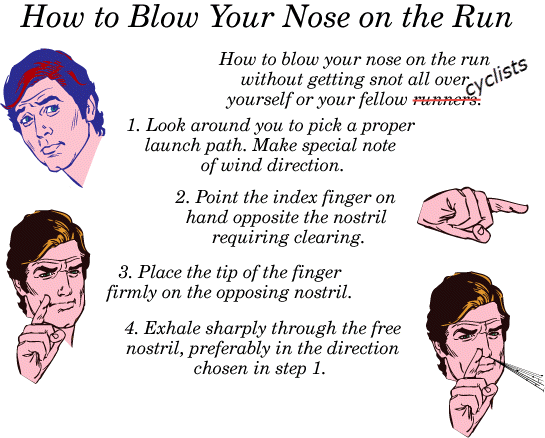
Disclaimer: this method may not be socially acceptable in your club or studio – but it works great out on the road riding solo – don't even think about trying this on a tandem!
The condition is called exercise-induced rhinitis > your nose runs when you exercise. Mine does, a lot and it always has. I don't normally give a second thought to how I go through two or three hand towels in a typical class, to keep my sinuses mucus free .
I hadn't, that is, until this interesting exchange after my class this morning…
“I appreciate how you use two towels.” The woman speaking was a long time regular and her comment came as I was thanking people at the door as they were leaving.
“Come again?” “I'm not sure what you're talking about.”
“You use two separate towels while you teach the class.” “One to wipe the sweat off your face… and the other to blow your nose.” “I appreciate that” she said with a big smile.
I didn't know how to respond. I stammered for a few moments until I could offer a sheepish (and slightly embarrassed); “Thank You!”
As she walked out I felt a bit guilty. Yes I had two towels on the bike, but I wasn't very particular which one I used and for what. You can bet I will be in the future 🙁
Exercise-induced rhinitis is one of those weird maladies. Some people are prone to getting a runny nose when they workout and some don't. I'd add it to the list that includes the sweat-ers and non-sweat-ers. I'm not sure > is sweat-er even a real word? You get the point… people who leave a big puddle under their bike and those who appear to no more than glow during a hard effort.
To the best of my knowledge, beyond taking an antihistamine before you teach, there's really nothing can do other than ensure you have a supply of towels or plenty of tissues.
Which brings up the issue of towel management
Found this at http://blog.rateyourburn.com/blog/post/2012/08/01/which-indoor-cyclist-are-you-16-types-of-spinners-i-always-see-in-class.aspx
Toweling off during class is an integral part of what we most of us do (those of you who just glow consider yourself lucky). So it surprised me to find we've never discussed proper Instructor “towel management” here at ICI/PRO – ever. In fact I did quick google search and found nothing beyond this graphic from rateyourburn.com poking fun at anal retentive particpants. Like everything else we do, you'd think there's a Best Practice. Here are my thoughts.
Towel(s) size and placement
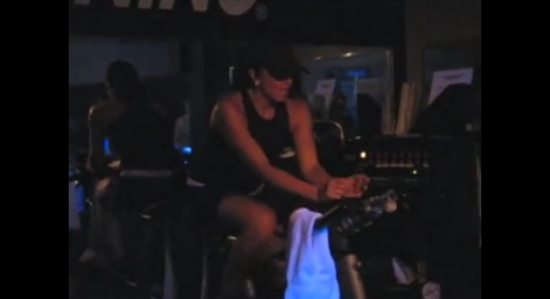
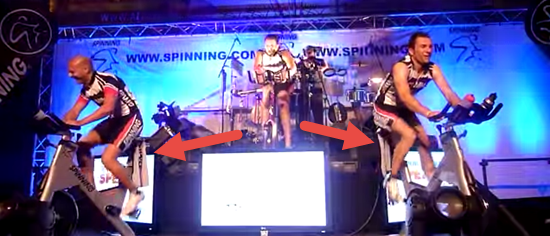
Having a towel hanging from your handlebars can look a little tatty – not to mention it obstructs the view of your legs like you see here.
The better place to hang your towel is on the seat slider that extends beyond the saddle on most indoor cycles. This Spinning® Master Class shows good towel placement.
With your towel behind you, it's always within reach, but partially hidden from your participants – and ready to whip around your head when you really want to stir things up!
At LifeTime we have two sizes of towels: big bath (not beach) size and hand-towels. My preference is to start the class with three hand towels; one on the handlebar (which is small so it doesn't impede rider's vision) and two spares on the stereo cabinet.
One of which I'll only use to blow my nose 🙂
What's your solution… or do you just plug one nostril and let-er-fly?