Have you have ever faced this dichotomy in your class?
Two riders, call them Bob and Susan (not their real names) are sitting front, center, smiling at you. You know them both and what you know about them causes you to almost freeze with indecision about how you will coach the class.
Here's some background on the two:
Bob is 40 years old and a somewhat competitive cyclist. Bob comes to your class to get stronger/fitter/faster (which is what he wants) so he needs to Train ~ 80% of his time in ZONE 1 to develop aerobically and the remaining 20% in ZONE 3 – above AT/LT. From a Training perspective, Bob should spend as little time in ZONE 2 as possible (junk miles). But the upper part of ZONE 2 is exactly where Bob performs during (long/fast club ride, RR or TT) so Bob's training in ZONEs 1 & 3 is to make him stronger in ZONE 2 when he is competing. Bob also understands that the hard work in ZONE 3 will leave him a bit trashed – which he accepts as the cost of getting stronger.
Susan is a 40 year old Mother of three kids who isn't training for anything, unless you count her continuous battle maintaining her body composition at an acceptable level. She's in your class to burn calories…specifically body fat if at all possible. She wants to leave your class with the energy she needs for the rest of her day while also not having her sugar stores depleted to the point where her low blood sugar level has her stopping at the doughnut shop. I would argue that Susan needs to spend the majority of the class in ZONE 2. There is where she can maintain the highest level of intensity for the longest period of time, without feeling exhausted, needing to recover and eating everything she sees after class.
With few exceptions, the majority of our classes are made of students are more like Susan than Bob… and arguably the #1 reason people come to class is for weight management.
Does it then make sense that we design classes much more for Susan?
Are we boring/alienating Susan when we sit there and proudly explain how our class is scientifically designed to help Bob?
In her post about not teaching to the squeaky wheel, Cameron Chinatti lays out some excellent points on how no one at your facility should be valued higher than anyone else. Easier said then done. I find myself wanting to teach to a class of Bob's, even while smiling back at Susan.
Beyond her role as the Senior Group Fitness Instructor here and at the other clubs where she teaches, Amy is a very accomplished Makeup Artist … where she finds herself today. So I get to give my suggestion for a track you might want to consider for an upcoming class. I've used it (them) for years but this past Monday I received a response unlike any before; Women near the back of the room yells “THIS SONG IS SO AWESOME! It actually shocked me with how loud she was. She had only heard the first few bars from Rods and Cones from the Blue Man Group and that was all it took:)
What I enjoy most about many Blue Man Group tracks is how they build – perfectly suited to use for a “Big Finish” if that's your style. ~ 63 RPM, I use Rods and Cones as the platform for a series of Sprints over it's 5:58 length – starting with heavy pedals and using the rise and fall of the intensity to cue each new effort. Let me know if it works for you. Here it is in Spotify
In my play list Rods and Cones followed this remix of Twilight Zone. It's an interesting mix, you're 4 minutes into a song most everyone knows before there's any vocals. It may have caused the reaction that followed. BileeEdits-Twilight Zone by bileebob
While I was at Club Industry last month Josh Taylor walked me through a number of the improvements Star Trac has made to the new Spinner bikes/cycles. I'm never sure which word to use… they only have one wheel so technically they are “cycles” but I'm guessing you understand either way.
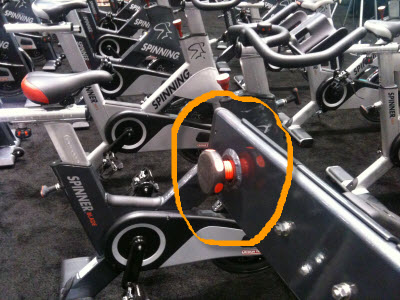
Providing a stable, secure platform for the riders in our classes is part of them actually enjoying the class. So if the cycle feels a bit tipsy because the floor isn't perfectly level, most manufactures offer adjustable “feet” on the bottom of each corner where you can make adjustments for an uneven surface. It sounds good in theory; put a rubber “foot” on a steel bolt, which is then screwed into the frame rail. Turning the “foot” changes it's length/height and you can easily adjust the bike to set flat on the floor.
But in real life that steel bolt tends to be corroded from sweat and nearly impossible to turn after a few years of use.
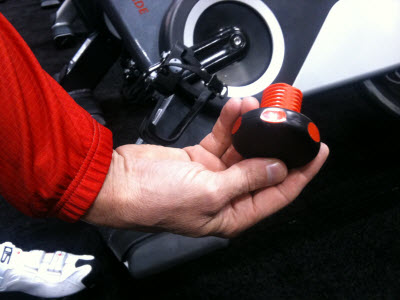
Enter Star Trac's very elegant solution; don't use steel, manufacture the bolt/foot adjuster from high-strength plastic. As you can see in this picture of Josh holding their new adjuster bolt/foot. Looking at the diameter of this thing makes me think it will support any giant who shows up at your studio.
One other thing: I'm aware of a club here in Minneapolis where they use the adjusters to tilt the cycle upwards slightly. I'm aware that cyclists on trainers will do something similar and the Tour de France bike you've seen advertised on Versus touts how their cycle tilts for and aft. Does it make sense to do this [wlm_firstname]?
With over 8,000 instructors receiving our weekly newsletter, my email address ends up in 8,000 contact lists. On occasion, I would receive random SPAM emails (see below) from people who's email account had been compromised in some way. Typically one, maybe two a month… this week alone I have received 10! This tells me there is something going on and all of us need to be careful clicking links in strangely worded emails.
Your email privacy here is as secure as humanly possible 🙂 We use the premium version of Mail Chimp to manage the distribution of our newsletter lists. I've found that Mail Chimp's service has many more security features than Aweber, who we used in the past.
What would I suggest you do if you receive an like this? Reply to it with a note saying you believe the account has been compromised.
Why? Because the owner of the account may have no idea of the problem. By replying back you are helping whomever correct the problem. (often as simple as changing their password) Then they can look in their Sent Email folder and contact everyone, asking them to ignore the message and know that the problem has been corrected.
Today I bring you something a bit different. A very intense, fully orchestrated 65 bpm climb that starts out very strong and then backs off at 1:59 for a quick quiet segment (which you know I love for queuing opportunities). We never lose intensity though, even in the short quiet segment. And then…bam!!! 3:30 comes along and the beautiful build starts and really hits at 3:45 to the finish at 4:27. I am so looking forward to using this X-Men First Class Soundtrack #11 (X-training) in my Thanksgiving class. I am co-teaching a 90 minute class with someone you might know…his name is John Macgowan. I gotta put together a good class for that morning! I don’t want everyone thinking he is the only one that can work them hard.
I already know that many of you would enjoy an option to iTunes or Spotify. So I started this morning at 5:30am and set about learning everything I can about Google Music. I want to be able to help you decide whether or not this new music service from Google is a good option for you as a Spinning/Indoor Cycling Instructor. I'm particularly interested to see if Android Phone users will finally have a service equal to iTunes.
You can learn more about Google Music here and get started if you are adventurous 🙂
Google Music, what I know so far:
The primary service is “Cloud” based, which means the music files are stored on a remote file server up in the clouds. Google want's all your computer files; music, pictures, software, etc… everything on their servers, not on your computer. If you use any online email service; Gmail, Yahoo Mail, Hot Mail – those are all Cloud based services. iTunes and Amazon both offer a similar Cloud based system. Why should you care? I'll be explaining that in a future post.
Google Music's files are MP3's – already for MixMeiser
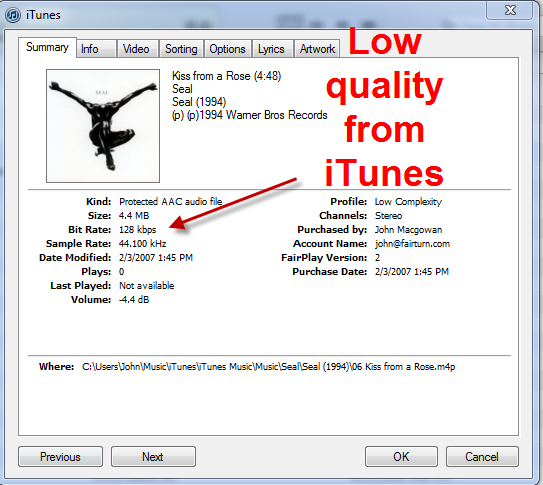
The first file I downloaded was at a very high quality bit rate of 320kbps. I normally don't pay attention to bit rate but this got me looking to see how this compares to iTunes. See the screen shots below for comparison.
Yes, you could probably dump iTunes and convert over to the Google Music Player – but don't do anything drastic just yet.
Google Music free tracks! You can find here– but like iTunes, you need to set up your credit card for future purchases.
When I saw Google Music had opened my first thought was; “oh great, more new software to learn” 🙁 If you felt something similar while reading this, my advise to wait and see what happens. I will be creating a number of tutorials for our ICI/PRO members that will explain everything you need to know about using Google Music. Stay tuned…