This can't feel right - and what is that white strap sticking out? Communicate it!
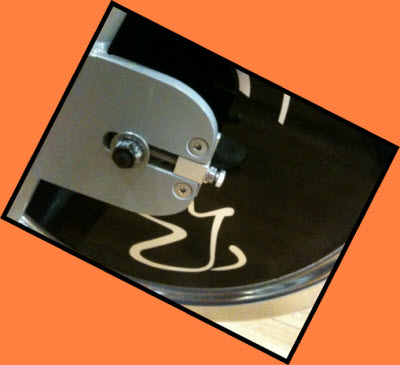
In my class this morning I noticed that the saddle on one of the Star Trac NXTs was way out of adjustment. Ouch! That can't feel good to ride on no matter male or female. When I got closer I noticed that there was a white strap sticking out from the slider adjustment mechanism. This is a common problem that Josh Taylor showed me is solved on the latest NXT/PRO/Blade model Spinning bikes.
To communicate a problem like this in the past, I would run around looking for a pen and something to write a note on. Then, if I wasn't distracted by anything, bring the note into our Dept Head's office, with the hope she could understand what I had written (I admit – I have some pretty crappy handwriting) and would have someone make the repair before the next scheduled class. Very inefficient and it maybe the reason why in the past my requests weren't acted on…
But not this morning 🙂
Today I just snapped a quick picture with my iPhone and texted it to her. This picture clearly shows both problems. My Dept Head can then forward the pic to the maintenance people. Total time; about 30 seconds!
While I was taking pictures I noticed how the chain adjuster on this cycle was near the end of it's rage of adjustment.
Clearly time for a new chain - before someone gets hurt.
This means the chain is very close to needing replacement, i.e… it's worn out and there's a real potential for failure. A broken (or derailed chain from being too loose) is the most likely event that will injure one of your students! The time to replace the chain is now, before someone gets hurt and you are left wondering if you should have your own liability insurance policy to protect you from the near certain lawsuit to follow.
So I clicked another pic and hit “send” for a second time.
Before you panic and think I’m going to throw the holiday chaos at you before Thanksgiving – ‘Tis the Season for PLANNING! How are you going to approach your classes next year? Do you have a strategy? Are you going to try something different? Do your riders know your plans?
Maybe you don’t think this way and that is understandable. I’ve been a coach for the last 10+ years and a competitive athlete for 20. I think in seasons and training plans and my approach to indoor cycling classes is no different. If you don’t currently approach your indoor cycling classes with a plan, I’d like a chance to encourage you to do so.
Forget Cycling (What???). It Just Makes Sense
The holiday season (Nov-Dec) is a natural time of transition regardless of your spiritual or traditional background. People take time off of work. There are a plethora of parties. Generally, less “physical” activity and more eating. So in many ways, people take some (needed) time off of their usual training structure and enter the new year (Jan 1) less conditioned. Then there are those who are looking for that clean starting point to make that resolution to get fit. Again, for historical and traditional reasons, January 1 is the most popular kick-off point. Regardless, of which side of the fence one falls, a plan or approach should be taken to either bring one back to top fitness or starting building a foundation of fitness for the first time. Without a plan or taking the time to consider one, we just plow right into the new year doing the same thing with little regard to where our people may be starting from. So how will you bring your riders into fitness next year?
And Yes, Even Cyclists
Smart cyclists know they need to take a break from training and allow their bodies to fully recover (and gain all that adaptation). Due to the weather and the general cycling season, riders will take their “break” in the November-December timeframe. A break is defined as chill-time on the bike. Less mileage. Less intensity. More fun and social. In addition to giving the body a break, the mind needs time away from training structure to rejuvenate. The result of all this fun and rejuvenation is de-conditioning — and this is good! The bottom-line again is that even the cyclists in your class will need to ramp their fitness back up in the new year and will be starting with less fitness as they wander into your studio on January 1.
Create a Plan
I recommend structuring the first 3 months of the year (Jan-Mar) as a progressive increase in volume and intensity (hello Periodization). Cyclists refer to this as base-building. It is a time to intelligently condition both the cardiovascular and muscular systems to lay the ground-work for more challenging efforts later on. In the upcoming weeks I will be writing an article to specifically address using periodization for indoor cycling. The “real” challenge is that BASE is one of the 4-letter words of training (specifically indoors). I conjures up thoughts of mind-numbing endless seated efforts with barely any intensity. This is mostly misconception. Although this type of low-intensity endurance work is a good part of a cyclists training, there are other aspects that require attention that may be better suited for the indoor cycling studio. These would include aerobic development, leg-speed (cadence) work and muscular endurance. Translation: moderate aerobic intervals, leg-speed drills and moderate to long climbs. Then there is always the threshold field tests (a la Foster Talk Test) to help your riders figure out where their fitness is. Not an easy class in the least, but a helpful guide for your riders to create training zones and target proper intensities. So lots to do if done appropriately. Honestly, the only time I’ve seen instructors struggle with this approach is due to a lack of understanding of overall (and cycling) training principles and insecurity. Both can be overcome.
Announce Your Plan
Create a plan and DON’T keep it a secret. I’ve already announced to my riders what we will be doing through the holiday season and how we will be approaching our rides starting the first week in January. I’ve made them aware of how strong they will become and the goals they will hit. This is also a time to plant some goals in their heads. Maybe it is just a fitness goal or their first century ride. Let them know the different things they can focus on next year to keep themselves on track. Oftentimes, we’ve been in the fitness game so long we forget how our riders think (or don’t). Make some suggestions and ask them to talk to you about it, but reinforce how your approach to training is both intelligent and will lead them to success regardless of their goals.
In addition to getting your riders to think, announcing your plan shows that your indoor cycling class provides value. It is well thought out and establishes YOU as the expert. Otherwise, we become just a timeslot. A place to sweat, hear some music and possibly lose a few pounds. Our classes are so much more.
So much of western fitness revolves around adrenalin-driven, kinetic (or should we say “hyperkinetic”?) energy. Yet there is power that comes from quiet — and that was the concept of a recent training I ran in my indoor cycling classes last week.
Keeping the energy mellow does not require making the training easy. Instead, it’s training that comes from energy that’s centered, rather than frenetic. When I taught these classes, I asked the participants to focus on internal motivation — their own desire to train and work hard — more than on any external motivation that might come from, say, the energy of my coaching with loud cues to push themselves (or whatever), or loud music with a driving beat.
This unconventional approach worked well, and got the participants to work hard while staying focused and internally driven. Here’s how the class was structured.
I used eight songs, as follows:
Going to California (music only) — Tribute Band Karaoke
Porcelain — Miami DJ Collective Two-song warm-up to start.
Good For Me — Above & Beyond 8:00 hill climb at 70 rpm, increasing resistance every 2 minutes: three levels seated, last one standing, all to music that is solid but not driving.
Hearts Have Turned to Stone — Elton John and Leon Russell 4:00 limited recovery at 100 rpm, using quiet music with an easy feel, letting the heart rate drop only 15-20 bpm.
In the Dark — Tiesto Second hill climb, as described in #3.
Dark Hollow (live) — Grateful Dead Limited recovery, as described in #4.
Burned With Desire (Rising Star Dub) — Armin Van Buuren Third hill climb, as above.
White Flag — Dido Full recovery and cool-down. You'll want to add your personal favorites to lengthen this to suit your class.
Our true ability is accessed through stillness, far more than through external sources, such as pounding music or sharp commands. A successful performance that comes from someone who is not really sure what happened is a memorable, and even spiritual, experience. Getting someone to experience an enhanced sense of himself/ herself, of aliveness and vitality while cycling, can anchor that person to training in a way that the external, “adrenalized” push can never do.
Obviously, there are reasons to coach and teach differently on different days. To ask participants to go inward on occasion and find personal reasons to drive their training (and themselves) is a shift of focus and consciousness that can be, at the very least, a stimulating change of pace. It can also be far more than that if properly coached.
In addition, it might turn the next high-energy class, by contrast, into an even more exciting and distinct experience.
It has taken me a while, but now I understand why many Instructors and Studio/Club owners are resistant to adding Indoor Cycles with power… they don't want a class full of riders, with heads down, totally focused on the what the computer is showing. We all want our participants focused on us…
Many of us take pride in teaching an authentic class that is a close as possible to riding out doors. On the road you had better keep your head up, eyes forward, or you will soon end up in the ditch or plastered over the back of a parked car. Not good.
Don't we want the same behavior from our indoor students? I do. Then doesn't it make sense to give everyone a way to see their performance data somewhere other than on a tiny screen that forces them to look continuously down?
In this previous post I discussed a new system from Performance IQ that takes the wattage, cadence and total energy created and displays it on a big screen or flat panel monitor in the front of the room. Effectively placing it where your student can easily see it (and you at the same time) while maintaining the proper “head up and eyes forward” form we are trying to instill in our classes.
Here is the interview that I promised with Mark Davids and Tae Yoo from Performance IQ where we discuss their new Top Power system. If you teach or own a club with Keiser M3s I would love to know if you feel this would be of value to you and your students.
UPDATE 8/2013: This system now works with any of the ANT+ enabled power consoles found on these Indoor Cycles; Freemotion S11 series, Schwinn AC and the new Spinner Blade ION.
I never imagined I would love a song that started out with a piano and Conn electronic organ, but I do. The instrumental layers and vocal harmonies of this AMERICAN (finally!) soul/indie pop band from LA are so interesting. I could suggest most of the songs off the CD, Pickin Up the Pieces by Fitz and the Tantrums, but I picked out “Tighter” for today’s Friday Favorite. It is a 60 rpm, 4:56 climb that I use as my last profile climb before heading into our final flat and recovery. The song builds nicely and at 3:05 breaks open with beautiful vocals and supporting strings for a great final push.
I hope you like it as much as I do. Here is Fitz and the Tantrums and “Tighter”:
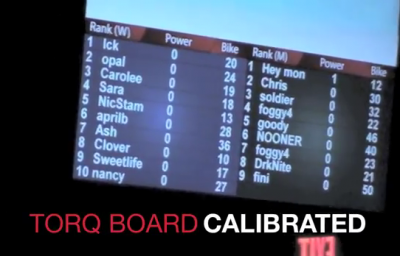
Flywheel's Torq Board – screen shot from youtube video
Updated: 11/23
Flywheel Sports is a chain of Indoor Cycling studios who started in New York city. They have had tremendous results and growth, now with 12 locations in three states; New York, Florida and Illinois. A big part of their success has come from a proprietary retro-fit system they have engineered to measure each rider's power and then display the real-time results on a screen. From their website:
… Additionally, for those who thrive on competition, Flywheel has developed the TorqBoard— an in-studio display that provides riders with the option to compare their performance against the rest of the class in real time.
The reason many students come to your class is for the community. Sure you maybe a great Instructor and include a lot of specific training into each profile you teach, but I'm convinced that the added element of friendly completion Flywheel's Torq Board brings is a big part of their success. Participants who are not achieving their personal fitness goals – read weight management goals – have a tendency to stop coming. We all understand that working harder (when appropriate) in class will increase fitness and burn additional calories. That's why so many of us are excited about power; for the first time our students can truly see what “working harder” feels like. Throw in the friendly completion part and you have the recipe for a fabulous sold out class
Beyond competition between riders, I see a remote display system like Flywheel's TorqBoard as solving multiple problems I'm hearing and seeing at clubs who have (or are considering) adding power based classes to their schedules:
Students have their heads down, completely focused on the display console – not on the instructor. With everyone riding with eyes forward they stay connected with you, the Instructor.
I can't see the display in a darkened class. A quick scan of your class will probably reveal an average participant age of 45-55 years old. Many of us (including me) have limited eyesight due to our age and when you dim the lights I'm nearly blind 🙁
Let's just add a constant back light to the console. Great idea until you realize that you will be replacing batteries at an even quicker rate than you do now.
Too many potential “computers” to fail. Henry Ford was famous for saying, “parts left off cause no service problems”. What if there was a system that eliminated the “computer” on each bike? Instead use a common system and eliminate some of the cost and maintenance concerns.
So let's say you think Flywheel's TorqBoard looks like something you would like to have in your studio… you can't have it. It's not for sale unless you are ready to become a franchised Flywheel Sports studio.
Enter Performance IQ and their new Top Power remote display system for studios using any of the Indoor Cycles with Power, including; FreeMotion S11.9, Keiser M3i, Schwinn AC or Spinner Blade Ion. Watch the shot video below to see this plug and play system at work at their second Beta site, Cycle Quest studio where I'm teaching. While it doesn't remove the existing “computer” on each cycle, it does solve the first three concerns I have listed above 🙂
To fully take advantage of Performance IQ's wonderful features, studios will want to offer a Bike Reservation system and data collection system that sends out those wonderful emails to each participant, showing them how many calories they burned in class.