by Joey Stabile | Feb 12, 2020 | Best Practices, Class Work-Sets, Creativity Indoor Classes, Instructor Training, KEEPING IT FUN, Master Instructor Blog, Training With Power
Welcome to the The Weekly Ride by Cycling Fusion:
No more hunting for new music or counting out cues. Here is your ready to ride document, that can be displayed from your phone, or printed out onto cue cards. This ride is timed out, down to the second, to make your life as easy as possible!
(more…)
Originally posted 2018-01-30 09:00:13.

by John | Feb 7, 2020 | Indoor Cycling Bikes, Instructor Training, Product Reviews, Training With Power
Spinning joins the Training With Power Wars
Star Trac had the new Spinner® Blade Ion on display at IHRSA. I rode one during Josh Taylor's 6:30 am demonstration ride this past Thursday. After the class I discussed the Ion's new features with Josh. I then got an overview of Spinning's new Spinpower™ education from Program Director Angie Sturtevant, which I'll share as a separate article.
Basics
The “Ion” differentiates this bike with Power from the conventional Spinner Blade. It uses the same chain drive and friction resistance system, found on all Spinner® Indoor Cycles.
Console / Monitor
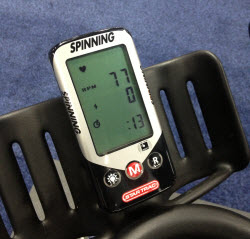
Very simple… and I'm a huge fan of simple, so right away I appreciated how easy it was to use the Ion's console. I was told they are making a few minor changes so the final version may look different. Working down from the top, the display shows:
- Heart Rate
- Cadence
- Power
- Elapsed Time
Just three buttons
- Left button turns the back-light on/off. It doesn't time out because it doesn't need to preserve battery life. It will stay on until you want it dark or you stop pedaling. I might not have this completely right – but you get the point – the light will shine all class 🙂
- Center button scrolls through screens displaying; real time and averages + calories
- Hold down the Right button for 2 seconds resets the Elapsed Time – Josh explained that this button will also add a “digital marker” to any Ant+ enabled devise, identifying the beginning or end of an interval, similar to the “Stage” button found on other consoles.
Josh made the point during his demo ride that their console will show ZERO watts when there's no resistance, regardless of the cadence = this will show all of our “spinners” that they aren't doing any real work until they've added some load.
Free Registration Required to read the rest — Click Here. Opens in a new tab.
[wlm_ismember]
Measured Power

Strain gauge measures the amount of pull on the brake pad.
The Blade Ion measures power with a strain gauge connected to the brake pad – again more simplicity. This technique is actually over 100 years old and how the horsepower of early engines was measured; by measuring the force acting on the brake, as the flywheel tries to drag the brake around it's circumference.
If you have an NXT available you can see exactly what they are doing. Remove any resistance and start the pedals turning slowly. Now carefully touch the slowly turning flywheel with one finger. Feel how it wants to drag your finger along? Can you see how the harder you press against the flywheel, the more effort it takes to hold your finger in place? By measuring that force, the speed of the rotating flywheel and then doing a bit of math, we could calculate Power.
That Black Box contains the strain gauge and replaces the normal brake pad holder on the standard Blade or NXT – which begs the question; will they ever offer a retrofit power meter for older NXT's?
What about Calibration?
I was told that the Ion will be factory calibrated and that no other calibration will be necessary – which I find very hard to believe.
This isn't the right time to get into a lengthy discussion over what I see as fundamental differences between; how the Ion measures the amount of Power coming out vs. how FreeMotion (and also any bicycle crank arm/spider or pedal based power meter) is measuring the amount of Power the rider is putting into the cycle. Or if it's really of any value…
So I don't leave you hanging here, the factory calibration may indeed accurately display the amount of coming out of the Ion forever… but does that precisely reflect the amount of power the rider is putting into the cycle?
What I'm questioning is there's a lot of drive train (multiple bearings and the chain) between the pedals (work in) and the brake mechanism (work out). This engineering article describes the efficiency of bicycle chain drive system and how losses can vary between 2% and 20%. I'm sure Star Trac's engineers have a very sophisticated algorithm to work all this out on a new Ion – but what happens over time? Worn chains and bearings, sprocket alignment and chain tension will all have an effect. Potentially some of the Ion's in your studio could become favorites because they display a higher wattage, relativity to the amount of work introduced by the rider, simply because its chain is in better alignment. Does that make sense?
No Batteries Required

Angie said she likes this because it's “green” (no batteries to throw out) – this blue light is a very cool touch.
Hands down my favorite feature of the Ion is how it charges itself. Josh told me that it incorporates a smart charging system that will allow the batteries to discharge before recharging. That wire runs from the hub charging unit & cadence counter up to the handle bars.

Phone cord allows adjustment.
How it felt to ride & my overall reaction.

Adding a cool blue Instructor platform will be de rigueur for any studio with Blade Ions
Let me start by saying Star Trac makes a phenomenal Indoor Cycle. Solid and smooth – I'm sure Jeff Wimmer had his hands on these. They fit me perfectly – or after riding & teaching on them for all these years do I fit them perfectly? Either way they're very nice to ride… and you hear the yeah-but coming… but I've really become a fan of magnetic resistance over the past 4 years. I understand how Spinning's® brand goes to the “feel” of a Spinner® and that “feel” comes in part from a friction based resistance system. I prefer riding magnetic and was disappointed that the Ion still uses a friction brake.
I also felt weak/less powerful on the Spinner Blade Ion. Or said differently, for a given amount of effort, I was seeing a lower wattage number than I'm used to seeing from a recently calibrated FreeMotion or a Schwinn AC. You could add embarrassed to my list of feelings. I actually felt compelled to cover my readings while Josh was off the bike checking in with his class 🙁
Thinking it may just be me, I went directly to FreeMotion's area and jumped into a class with Cameron Chinatti. Nope, it wasn't me. There on a familiar cycle, I was seeing/feeling my normal ~250 FTP. So back to the Ion (different bike this time) but the same results. A similar effort/HR and only saw ~180 watts.
I talked to Angie about this and she suggested that you just can't compare the two, they're different. I've asked Angie to join me on the Podcast to discuss this in detail and will let you know if/when she'll come on as a guest.
Later that morning I also tried a little experiment that I've wanted to do for years…
What happens to your Power / Wattage when you accelerate from a set point, say; 100 watts @ 60 rpm to 90 rpm on friction based system, as compared to a magnetic system? Do they react the same way?
You can read my follow up article to learn more: Comparing Spinning’s® Friction to FreeMotion’s® Magnetic Resistance
Stay tuned for the results + some thoughts on Spinpower™ later this week.
[/wlm_ismember]
Originally posted 2013-03-24 11:20:19.
by Joey Stabile | Jan 22, 2020 | Best Practices, Class Work-Sets, Creativity Indoor Classes, Instructor Training, KEEPING IT FUN, Master Instructor Blog, Training With Power
Welcome to the The Weekly Ride by Cycling Fusion:
No more hunting for new music or counting out cues. Here is your ready to ride document, that can be displayed from your phone, or printed out onto cue cards. This ride is timed out, down to the second, to make your life as easy as possible!
(more…)
Originally posted 2018-01-30 09:00:13.
by Joey Stabile | Dec 26, 2019 | Audio PROfiles, Best Practices, Class Work-Sets, Creativity Indoor Classes, Instructor Training, KEEPING IT FUN, Master Instructor Blog, PRO/Playlists, Training With Power
Welcome to the The Weekly Ride by Cycling Fusion
Welcome to our new era of The Weekly Ride, you get:
- Full Ride PDF
- Apple Music Playlist
- Spotify Playlist
- File to Download the Ride directly into My Fitness DJ (Yes, no Programming)
- The Ride will be available for purchase in the iClass Builder Store (No Programming)
- A Podcast of the ride being delivered by a master instructor.
(more…)
Originally posted 2018-12-17 20:25:24.
by Gino | Dec 8, 2019 | Training With Power

Note: Gino's articles are supposed to be for ICI/PRO members only. He feels very strongly about this subject and asked that I make it available for everyone. – John
As an Indoor Cycling / Spinning® instructor, you know how important good air flow is. Don’t you? What??? You LIKE your students to sweat buckets!?! It proves how “kick-ass” your class is? Uh… well… not so fast. If that were true, then just build a bunch of steam rooms and saunas and let people sit and sweat. Ah, but it’s not that simple is it? You know they don’t lose real weight that way. It’s just water. But really, it’s worse than that.
(more…)
Originally posted 2009-09-18 16:46:12.
by Gino | Nov 22, 2019 | Instructor Training, Master Instructor Blog, Training With Power

Coach Gino gets an assist from a professional statistician.
Let’s Try This Another Way
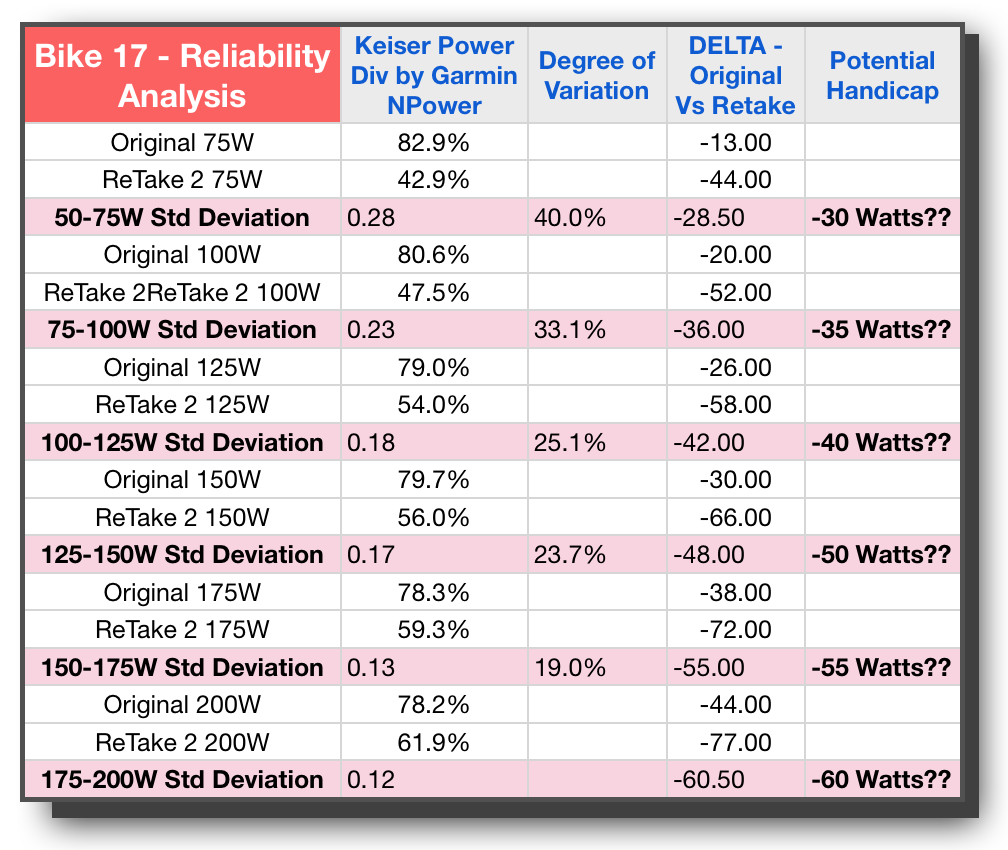
After testing 14 different bikes, with 6 of them also being repeat tested at least twice, I was pretty disappointed to see the data I reported in our last blog. This was never meant to be just an academic exercise. This had pure practical motivation. I wanted to be able to do real and reasonable competition in class. I wanted to encourage more tantalizing trash talk among my most competitive riders. I wanted to let some of my “little old ladies” throw it down against some of the guys who think bigger is better. I needed the bikes to be on an even scale to do this in good conscience, and handicapping them against a reputable objectively measured power meter seemed like a no-brainer to do just that.
But alas, the numbers from my work up to this point lead me to a conclusion I simply had not anticipated; that each bike within itself may vary day to day with regards to what power it will display given the same force being applied. This was an assumption that myself and many other “defenders of calculated power” have held on to for these past 4 years or so – that it doesn't really matter if the power is accurate compared to what would be measured with a real power meter, as long as that power was consistent. In other words, we could know if our training was making us better or not by pre and post testing on the same bike. It would simply generate a relative value so we could know if we improved a lot, a little or not at all. Each year at Winter Training we would assign bikes so that we could be assured of this “fact”. This was indeed the fundamental assumption that prompted the entire notion that a handicap could indeed be created, if we had a objective way to get at power simultaneous to seeing the bike's power display.

Unfortunately, as you could see from the numbers reported the last time, they varied so much within the same bike, from one testing episode to the next (even despite painfully recreating the same circumstances of a consistent rider, environment, time of day, method of execution and all the like), that this assumption was not true for at least 50% of the bikes. Undaunted by this surprisingly sad turn of events, I started to ask around for an available statistician that might be interested in this research. I wanted a more experienced extra set of eyes and less personally invested perspective so that they could let me know if I am doing something wrong. Was I measuring the wrong way, perhaps working with false assumptions, not controlling enough variables, etc. I didn’t want to give up just yet — I had already invested too much time and energy.
3 More Bikes Tested, 3 Times Each
One of my regulars referred me to Sarah who is both a cyclist and teaches statistics at a nearby university. We met a couple of times to discuss what I had done so far, and she spent some time and thought on the issue, and created a new protocol. We would focus on just 3 bikes, took them out of commission so no one else would ride them, made sure she conducted/directed me as I rode/tested each bike. These trials would be done on three different days, in random order as generated from a random table of numbers. This video takes us through one of those three sessions.
In the next blog post, we will discuss the results of these 9 trials.
http://vimeo.com/82319421
Indoor Cycling Power Accuracy & Validation Research from Cycling Fusion on Vimeo.
Originally posted 2014-02-19 03:04:24.