Hey [wlm_firstname] how hard should I be working to; get faster, lose weight, build endurance, ect…
Answering that is the age old dilemma many of us face when questioned by our riders. We try to be helpful by offering subjective descriptions of what both thresholds should feel like. We give breathing cues, run special FTP classes and/or include Best Effort intervals into our class. They're all designed to help our participants discover (for themselves) their threshold hearts rates and/or threshold wattages. We can get close… but at the end of the day they're still subjective measurements = not always as accurate as we would like.
Breathing gas exchange monitors can scientifically measure the two thresholds. Systems like those from New Leaf and Korr can objectively measure the changes in our breathing levels of O2 and CO2. They work well, but are very expensive to own (you can no longer purchase a New Leaf cart, now that they were purchased by Life Time Fitness) and individual metabolic testing can run to $200.00 or more. The actual tests are rather unpleasant, requiring you to wear a very uncomfortable mask – trust me on this > I've had over a dozen tests and would dread doing another.
The only other option was blood lactate testing during a graded exercise test at a university or sports performance center. Here they prick your finger every two or three minutes, while you work to failure during the assessment. I haven't done one of these personally, but it sounds equally unpleasant.
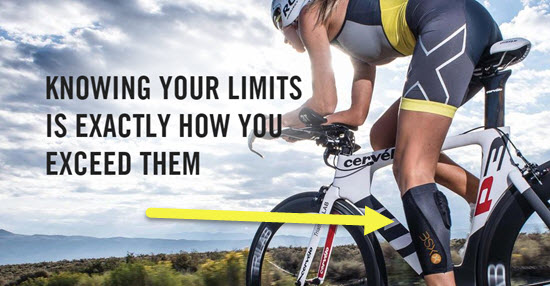
Enter the new BSXinsight – a wearable device that optically measures your O2 levels = this could be exactly what all of us training athletes were looking for. Pictured above, the BSXinsight is positioned on your calf using a compression sleeve. It wirelessly communicates with a smart phone and the data is displayed by (you guessed it) their special app.
Don't just listen to your body, look inside it.
Data and gear are only as good as their ability to improve your riding. Now you can access the most powerful training metric in endurance sports, making every mile more effective and putting every piece of technology you already use into valuable perspective.
BSXinsight uses revolutionary technology that allows you to see inside your muscle, measuring your lactate threshold and generating personalized training zones. Stop trying to “feel” whether you’re pushing too hard or leaving too much in the tank and let the science of your body speak to you.
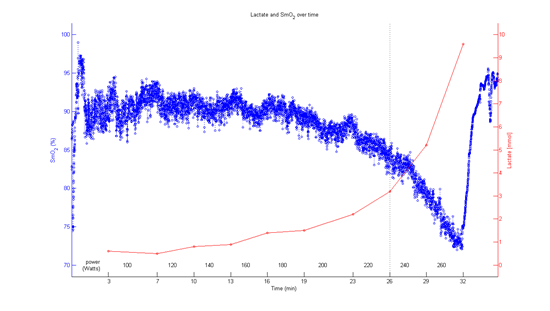
Clearly identifying LT2 threshold
I just finished a fascinating conversation with one of the principals of the company. They have offered to send me a demo BSXinsight to experiment with. When I'm done I'll be sending it to Dennis Mellon for his feedback. Once we are done accurately learning our own LT and overlaying it with our Heart Rates and wattages, we will record an episode with the company spokesperson so we can share what we've learned with all of you.
I'm super excited to announce that ICI/PRO is teaming up with the owners of Full Psycle Indoor Cycling; Paul Harmeling & Shelly Scott. We are hosting our first Full Psycle/PRO Performance IQ Training on February 14th at the Full Psycle Studio in the Lincoln Park area of Chicago, IL.
1/20 update: There's just two open seats remaining.
I've taken over a dozen classes that incorporate PIQ Display Training – at studios across the country. In only one did I feel like the Instructor really understood how to effectively integrated PIQ into the class. That class was Paul Harmeling's and you now have the chance to learn from the person I see as the expert in teaching Display Training Indoor Cycling classes!
Can't make this workshop? If you would like to receive notifications of future events join this email list.
Listen to this short interview with Paul, where we discuss the details of the training we're providing February 14th.
This 6 hour, comprehensive training workshop will include two complete master classes. They'll be taught by Paul Harmeling & Shelly Scott – co-owners of Full Psycle.
To complement the Master Classes, we will be offering the following:
Understanding the basics of PIQ – presented by Tae Yoo
Troubleshooting and Best Practices
Training With Power for Indoor Cycling Classes – presented by Me John Macgowan 🙂
Maximising the functionality of Performance IQ and effectively class presentation using:
Power Screen/Race Mode
Heart Rate Training Screen
PTP (Personal Threshold Power) Screen
Watts/Lb – Weighted/Leveling/Handicapping Mode
Teams Screen
Building Entertaining Display Training Class Profiles
Creating Speciality Classes with PIQ
Get people excited about Display Training with Social Media
Using PIQ data to bring consistency to your Indoor Cycles
We are limiting attendance so we can include multiple opportunities for participants to demonstrate what they've learned. Instructors will need to conduct teach-backs throughout the workshop.
Tae Yoo is taking us all out for dinner Saturday night as the end of a great day of PIQ!
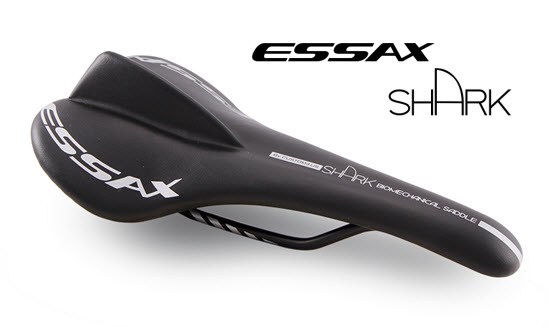
Essax is a brand of bicycle saddles located in the province of Alicante (Spain). Our company has over 25 years experience in the manufacturing of technical products in polyurethane foam and leather, which assures our knowledge and experience.
Above all, we are cyclists who manufacture for cyclist, which means that we make from our passion our work. Therefore we know from first hand what users needs and what the requirements of the sector are.
http://youtu.be/f6gnUTNbaWQ
What is the fin for?
This is the key to this whole Bike Fitters ensemble. Its position indicates the rider how to place his sit bones so that they are well supported in the seat. It interacts with the user giving information how to be seated on the saddle. In the hundreds of biomechanical studies for the development of this product, the result of them told us that the vast majority of riders had sensory perception being well positioned on their saddle as where reality showed they were rotated or only supported one of the two Ischia
So the purpose of the fin is to locate you and your sit bones correctly, fore/aft on the saddle. This, Essax is saying, is super critical on multiple levels; comfort over time, pedal force imbalances, hip stability and overall power development. That sounded really familiar…
There are multiple factors that affect how you produce power and what ultimately gets displayed by the console. A few months ago I wouldn’t have believed you, if you tried to convince me that (beyond the level of comfort you feel) a bike’s saddle design could add or subtract to the power I could create.
I believe it now.
Back in March I had a professional bike fitting on my new VeloVie with none other than the Bike Fit Guru Chris Balser. I figured that I had a few dollars left because of the incredible deal I got and, with one kid graduating for college this Friday, why the heck not?
I was a bit naive about what all was entailed in a 2 hour fitting. I thought Chris would be super focused on getting my seat height exactly right, maybe futz with the tilt of the handlebars. Stuff like that. Nope. For close to an hour we tried out different saddles, 11 in total. That’s right, Chris had me ride on a trainer, trying 11 different saddles, to find the perfect saddle that (his words) your ass can find easily. Here’s what we finally decided on… a Fizik Kurve.
As a sidenote – I have two years/~6500 miles on my Fizik Kurve Chameleon Saddle and absolutely love it. Chris was exactly right to choose it for me > Everytime I sit on it my butt finds exactly where it belongs.
Can you effectively cue proper saddle position?
Short answer IMO is you can try, but my personal feelings are that most Indoor Cycle saddles are too big (FreeMotion being the exception) and too soft, to be really “findable” for most people's derrieres. That doesn't mean you shouldn't make the suggestion to move around and see if you're in the best position.
Just don't cue this once, early in the class and then forget about it. Give everyone time to settle into their positions and then ask everyone to reacquaint themselves with the saddle. If you've taught for any length of time (and you're paying attention to small details) you have seen how many of your riders visually appear to relax at some point in class. For me, I notice it during the first welcomed recovery I give them > typically following the first “Best Effort” interval they've completed.
Like everything else you do as an Instructor, you should be experimenting on yourself and then decide what & when makes the most sense.
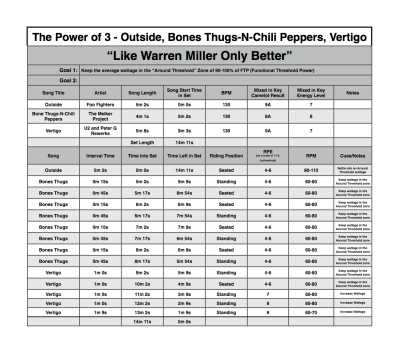
“Bone Thugs-N-Chili Peppers” by The Melker Project
“Vertigo (Redanka Power Mix” by Peter G ReWerk
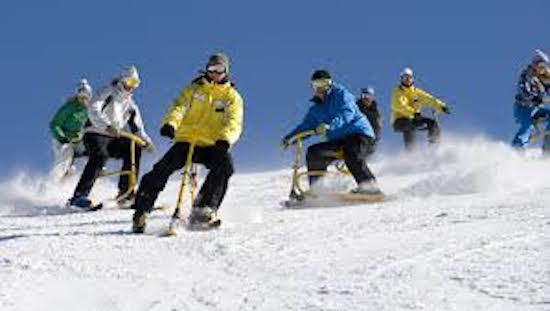
As many of you know, I live in Colorado and skiing is one of my family's favorite winter activities. Every year we used to look forward to the release of the latest Warren Miller ski movie as the unofficial start of ski season. It became a family tradition to get tickets to the Friday or Saturday night showing at the Paramount Theater in downtown Denver. The later the show the rowdier the crowd, everyone was so amped to get the ski season started. I also knew that the new release meant fresh ski footage and music for my video cycling class. Over the years the footage has remained top notch, but the music has gotten worse and worse, it has gotten so bad that we stopped attending the show two years ago. That year the music was so bad that I wished I had brought my ear buds so I could have put together my own playlist, on my phone, while watching the movie.
[wlm_private ‘PRO-Platinum|PRO-Monthly|PRO-Gratis|PRO-Seasonal|Platinum-trial|Monthly-trial|PRO-Military|30-Days-of-PRO|90 Day PRO|Stages-Instructor|Schwinn-Instructor|Instructor-Bonus|28 Day Challenge']
This got my sons, Seth and Christian, and I thinking that we should start using the awesome ski footage that is available on the internet and put it together with music that people actually listen too. Over the years we have created quite a library of ski videos, many that I use in my indoor cycling classes, that we believe is like Warren Miller, only better. I hope you enjoy the work we have done and let me know what you think.
3 song harmonically mixed track, to download Right Click > Save As / Save Target As to download. Open in iTunes and then you'll see this in your Spotify Local File folder.
As a nutritionist, I hear many clients say they want to lose weight — to look better, have more energy, improve their health. But losing weight can also help you increase your power on the bike.
Ratios intrinsically provide two ways to improve the ratio — by manipulating either variable. The results of improving both variables can be dramatic.
As covered in a previous post, efficiency — the ratio of work output to expended energy — can improve with increased work output or decreased energy expenditure (or both).
In the same way, your power-to-weight ratio on the bike (measured in watts per kg) can improve with increased power or decreased body weight, or both.
Power is itself another ratio, of work to time. If work increases or time decreases, the result is greater power. ICI/PRO is currently covering this topic in depth.
So that provides 3 variables in the power-to-weight ratio: increase your strength (work), increase your speed, or decrease your body weight (or all of them).
Why Lose Weight?
Even if you’re not overweight, weight loss may improve your power-to-weight ratio. It need not — and shouldn’t — involve a strict “diet” that leaves you hungry most of the day.
It does involve careful monitoring of your numbers — how many calories you burn (using your power meter or, preferably, a wearable calorie counter 24 hours a day), and your calorie intake.
The goal is to eat fewer calories per day than you burn, but not by much, just 150 to 300 calories. If that feels too restrictive, drop the deficit to 100 calories. The result would be a slow decrease in weight that you can stop or reverse at any time.
These days, the general recommendation for weight loss is rapid loss. (Is that to match up with HIIT and the shorter-and-harder approach to fitness, I wonder?) Rapid weight loss is said to keep the “loser’s” motivation high.
Yet gradual weight loss — while also training for power — has the advantage of maintaining fat-free mass (FFM) so you won’t lose strength, an important variable in the power ratio.
Holding On To FFM
Weight loss often decreases muscle mass, especially rapid loss. But in the long-running (13-plus years) weight-loss program for which I was both the nutritionist and a training coach, we typically saw steady or increased FFM while the participants lost weight at a slow, sustainable rate.
That helped them maintain strength and power so they could do the training, which was frequently high-intensity. The intense training, of course, was designed to increase strength and power.
Maintaining FFM also prevented participants from having to drop calorie intake more and more (and more) for continued weight loss.
Don’t Bonk
Make sure you don't restrict calories on the ride itself. Whether you’re riding outdoors or doing tough power training in the studio, under-fueling before or during the ride could cause you to bonk.
Even without bonking, you may still feel week and have difficulty working up to your capacity — the power you’re trying to improve. Fuel as usual while riding.
Keep the calorie restriction small. Cut back a little more on days that you’re not training hard, or at least save the restriction for after the ride. If your power ride is late in the day, early A.M. calorie cutbacks may work. Just keep your pre-ride meal about the same as usual, and eat or drink whatever you need on the bike.
Be strict about post-training refueling (covered in a previous post) so you can train well the next day.
Technique and Efficiency
In all of this, don’t forget that better technique on the bike will help you waste less energy by reducing the energy needed for pedaling, reducing energy lost as body heat, and retaining more energy for your next pedal stroke. Your functional strength, a power variable, will increase.
Combining good technique, all the power training tips you’re currently getting here on ICI/PRO, and gradual weight loss will help you dramatically increase your power-to-weight ratio on the bike.
This has to be the hardest Indoor Cycling video of all time – ride along on the 13 incredibly steep climbs that make up this annual event on the Saturday after Thanksgiving. I like to coach riders to climb each of these hills using a different cadence > but always above the PTP we will establish during the first climb. Crazy fun!
You can purchase the video or you can suffer with everyone in real time by watching the live event. From their press release:
The Pittsburgh Dirty Dozen will be broadcasted live over the internet from start to finish. This cycling race, over the steepest 13 hills in Pittsburgh, will take place on November 29, 2014 at 10:00am with interviews in the staging area beginning at 9:30am.