
by John | May 4, 2020 | Instructor Training, Strength Training

The increase was a 67 to 76% increase in energy expenditure for all standing cycling
conditions. Image from the study.
New research sponsored by ACE demonstrates that standing (vs. sitting) burns more calories, as long as you keep everyone out of the saddle long enough. This study was conducted by a team lead by Dr. Len Kravitz at the University of New Mexico.[wlm_private ‘PRO-Platinum|PRO-Monthly|PRO-Gratis|PRO-Seasonal|Platinum-trial|Monthly-trial|PRO-Military|30-Days-of-PRO|90 Day PRO|Stages-Instructor|Schwinn-Instructor|Instructor-Bonus|28 Day Challenge']
The study you can download here; Metabolic Cost of Weighted Vests During Standing Cycling was designed to look at the effect of adding additional weight (with a weighted backpack) to an Indoor Cyclist and learn the metabolic affect from how long you're out of the saddle:
Abstract
Whether cycling on the road or pedaling in a club cycle class, this mode of activity is done using
both seated or standing positions. Previous research has examined the effect that cycling position
exerts on physiologic parameters such as heart rate (HR), oxygen consumption (VO2), or rating
of perceived exertion (RPE) during exercise (1—3). This research was intended to simulate hill
climbing, which is applicable to a majority of road cyclists. However, no prior research has
examined the effect of wearing a weighted vest during stationary standing cycling. As well, no
research has investigated the effect of extended bouts of stationary standing cycling (1, 2, 3 and
4 minutes) on metabolic parameters. The implications for this research may directly impact
individuals engaged in fitness center stationary cycling classes, which have become very popular
in recent years.
Anything to burn more calories
I met Dr. Kravitz in the Fall of 2012 at a fitness conference. Once he learned my interest in Indoor Cycling, he excitedly told me about his idea to study the potential training and calorie expenditure effects of adding weight to an Indoor Cyclist. If I'm remembering correctly, he expressed the understanding that weight loss / weight management is high on the list of reasons our riders come to class. If strapping on a backpack full of bricks was going to help someone reach their goal weight, I was all for learning more – and then share it with you.
Based on the chart above, it doesn't appear that adding weight has nearly the affect that simply getting everyone out of the saddle does.
The first minute is just practice
The biggest take-away from this study for me, was the huge jump in calorie expenditure that occurs beyond the first minute.

Will seeing this change how you structure time out of the saddle?
Energy expenditure stabilized between minute 3 and 4 on all standing cycling conditions. This information provides program design suggestions for personal trainers and club cycle instructors desiring to optimize caloric expenditure utilizing research-driven methodology. Clearly, the inclusion of standing cycling bouts for 2 to 3 minutes during a cycling bout meaningfully increases energy expenditure. This increase in oxygen demand occurs during standing, with or
without a weighted vest (up to 15%BW was used in this study). According to Tanaka et al (3), this energy expenditure increase is attributable to the increased muscle blood flow and/or involvement of a larger muscle mass with standing cycling.
[/wlm_private]Dr. Kravitz's team has done a number of other studies that you may find of interest. I interviewed Doctoral student Micah Zuhl in 2012 and discussed the article he co-wrote with Dr. Len Kravitz entitled HIIT vs. Continuous Endurance Training: Battle of the Aerobic Titans. ICI/PRO Podcast #201 — HIIT vs Endurance Training with Micah Zuhl
Originally posted 2013-11-10 09:00:43.
by Joey Stabile | Feb 19, 2019 | Health and Wellness, Instructor Tech Help, Instructor Training, Off Season - Winter Training, Strength Training
Exercises to Boost Hip Strength
When discussing muscles involved in the pedaling motion of cycling, most people think of quadriceps and hamstrings. While these muscles certainly play an important role, the many muscles of the hip also deserve attention, and the weight room is the perfect place to keep them functioning properly.
Before discussing different strength and mobility exercises, we should first look at activation exercises for your Gluteus Maximus (referred to as the glutes) muscles. The reason for needing to activate your glutes is simple–as a population, we spend way too much time sitting, and as a result, what happens is what noted spinal researcher Stuart McGill terms gluteal amnesia–your glute muscles can “go to sleep” and not function properly.
When your glutes aren't functioning properly, other muscles (hamstrings and lumbar extensors) are called in to do the job of the glutes, mainly hip extension. Think of hip extension as the downward action of pedaling.
The problem is that these muscles aren't designed to be prime movers–they're designed to support the action of the glutes. Inability of activating the glutes can result in low back pain (low back muscles compensating), hamstring strains (overacting hamstrings), hip pain (resulting from hamstring-dominant hip extension) and knee pain (poor glute medius strength).
So, to activate your glutes, try the Single-Leg Hip Lift. Here's how it's done: Lie down on the floor with your legs bent and lift one foot off the floor. Lift your hips up in the air, concentrating on contracting your glute muscles. Make sure you keep your toes of the working leg up as shown. Pause for a second or two and lower. Perform 2 to 3 sets of 8 to 12 reps on each side.
Hip Mobility: Keeping your hips mobile is important for overall hip function and athletic performance. Mobility refers to the ability of your joints to move through a pain-free, unrestricted range of motion. For cyclists, hip mobility is critical since pedaling occurs in one plane of motion, and after miles and miles in the saddle, hip tightness and restriction may develop. The following movements will help with hip mobility.
Split Squat: The traditional split squat is a great exercise to get started on hip mobility. To make this exercise even better, concentrate on contracting your glute on the trailing leg to help stretch your hip flexor.
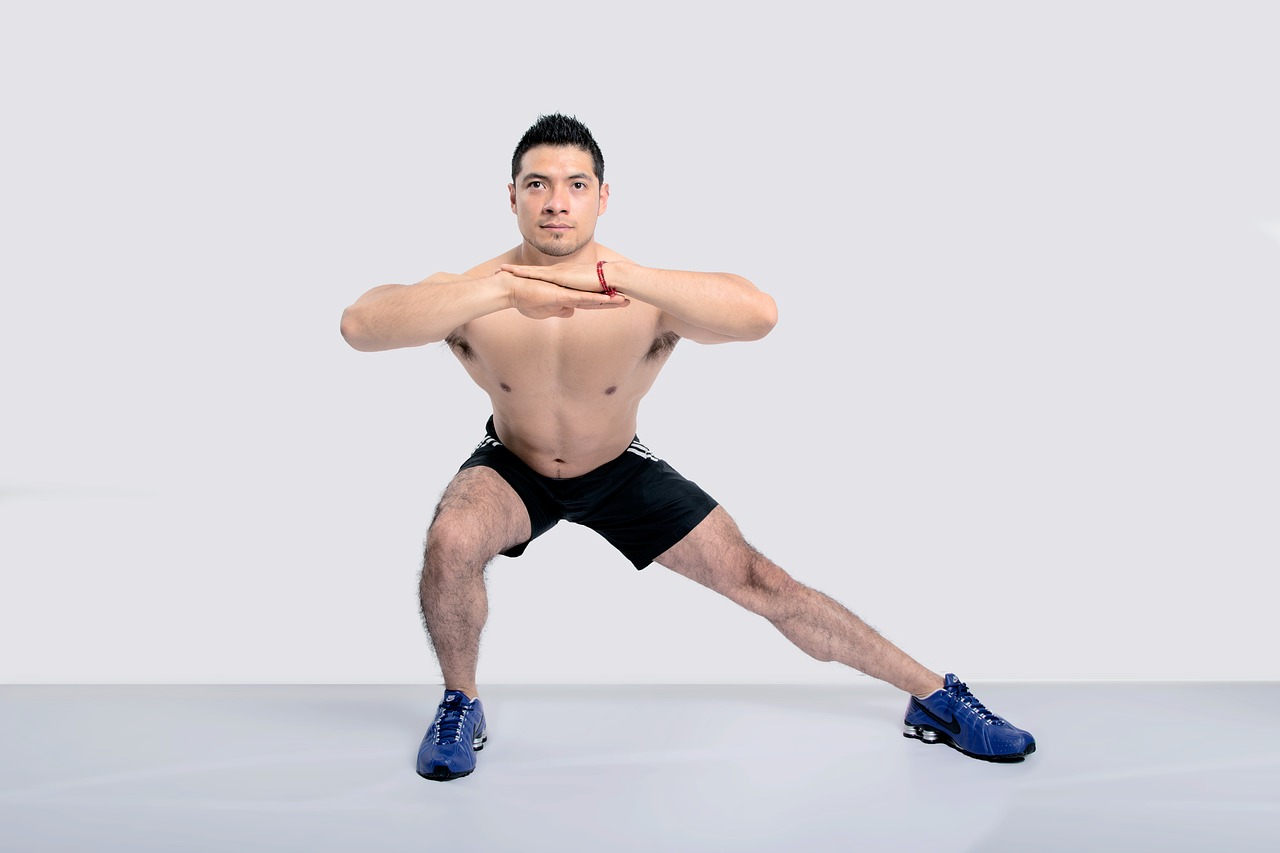
Lateral Squat: Stand with your feet approximately double shoulder-width apart. Shift your weight to one side and drop your hips down and back, keeping your knee over your toes and your weight over your bent leg. Pause for a 2-count, return to the starting position and repeat to the other side.
Hip Strength: If you are currently doing a regular strength-training program, chances are you're already doing some foundation exercises for your hips. Squats, lunges, leg presses, and step-ups all work the prime movers of your hips. Along with these exercises, it's also important to do some supplementary exercises to work your hip's supporting muscles. you've probably heard of your shoulder's rotator cuff. Well, your hip also has a cuff, or a group of muscles that help stabilize and support movement. For these exercises, you'll need a mini-band, a longer thera-band or tubing (both are sold at many sporting goods stores, or can be purchased online), and a cable-column unit.
4-Way Mini-Band: Place a mini band around your ankles and spread your feet about shoulder-width apart. Keeping your legs relatively straight (you want the motion to come from your hips) and toes pointing forward, walk forward 10 steps, then backward 10 steps. Take a short break and then walk to the right 10 steps, then to the left 10 steps. Again, focus on keeping your legs straight and toes pointing forward. It is very important to start with a light-resistance band. You'll be working the smaller hip stabilizers, so you don't need a lot or resistance.
X-Band Walk: For this one, you'll need a large band or piece of tubing. Step on the band and spread your feet shoulder-width apart. Form an “X” in front of you with the band and stand up tall with your shoulders down and back. Keeping your toes pointing forward, take 10 steps to the right, pause and then return.
4-Way Cable Hip: You'll need a resistance band for this one. With this exercise you're focusing on four movements: flexion, extension, abduction and adduction. Stand up straight while doing the exercise. If you have to lean excessively, step closer to the anchor point of your band to decrease resistance. You'll find that not only are you working the muscles of the leg that's moving, the muscles of your stance leg will work quite hard stabilizing and balancing.
Modifications to Traditional Exercises: Our hip joints are very mobile and allow for movement in three planes of motion: the sagittal plane (flexion and extension), frontal plane (lateral movements), and the transverse plane (rotation). Knowing that, here are several modifications you can make to your traditional exercises to work your hips through a more complete range of motion.
Lunge Variations: You can do traditional lunges, or even clock lunges where you keep one leg stationary for 12 to 6 and then the other leg stationary for 6 to 12. To make the movement a touch more difficult, hold weights in your hands while you perform the exercises. There are Lateral Lunges, Rotational Lunges, Lateral Step-Up, and Rotational Step-Up as well.
Please see the full article for complete descriptions and videos of the exercises: https://www.active.com/cycling/articles/11-exercises-to-boost-hip-strength?cmp=18N-PB2000-S20-T9-cycling-AR2&eps=title_1004667

by Joey Stabile | Oct 17, 2018 | Engage Your Students, Health and Wellness, Strength Training

Protein Power: It’s Not Just for Muscles (Part 2 — Appetite Control)
By Joan Kent, PhD, and Shawn Bevington
Protein is used to make hormones, which are messengers in the body. They’re produced in one part of the body and then distributed — through blood, interstitial or other body fluid — to other organs or tissues. There they modify activity and function.
This brief post will focus on just a few hormones and how they affect appetite.
*CCK (Cholecystokinin) – Satiety is the feeling that you don’t need another meal because you’re still satisfied from the last one.
CCK is arguably the most powerful satiety hormone in the body. It reduces appetite by stimulating the function of the brain’s key satiety center, the VMH (ventromedial hypothalamus).
CCK is released when we eat protein and fats. It affects our food preferences by reducing the desire for carbs.
Anyone who suffers from an exaggerated desire for carbs probably needs to eat more protein. Vegans, for example, may experience strong cravings for carbs, including sugars. Finding a true protein source is a key factor in reducing vegans’ cravings. More on that in Part 3.
Eating adequate protein can also be key in conquering sugar addiction for this same reason.
*Ghrelin – Ghrelin increases appetite by stimulating the brain’s lateral hypothalamus. The LH can be seen as a ‘feeding’ center.
Eating protein can help to reduce ghrelin release. In healthy men, a high-protein breakfast decreased post-meal ghrelin levels more than a high-carb breakfast. The high-protein meal also slowed gastric emptying. Researchers attributed both effects to the secretion of CCK and glucagon, both triggered by protein.
*Glucagon – Glucagon is a hormone made in the pancreas. Insulin is, as well, but the functions of the two hormones are oppositional and work to balance glucose levels.
Insulin also tends to be a fat-storage hormone, while glucagon moves fats out of storage and into the blood stream so they can be utilized as fuel, rather than stored.
While many foods trigger the release of insulin, only protein foods trigger glucagon. Glucagon is also secreted when we exercise.
As mentioned above, glucagon and CCK seem to control appetite by modifying ghrelin levels.
Don’t miss protein and brain chemistry, age, and the vegan solution in Part 3, right here this week!
Shawn Bevington is a holistic health coach, certified by the National College of Exercise Professionals (NCEP). He has been a fitness trainer for six years, and boasts another seven years of activity in various programs, including football, shot-put, pro wrestling and other strenuous sports. Self-motivated, Shawn has spent years researching on his own – and putting that information into practice with his clients. His knowledge, skill and experience have made him a sought-after fitness trainer, both by clients and by colleagues who bring questions to him.
Dr. Joan Kent has a PhD in Psychoactive Nutrition. She was the first to document the brain chemical pathways of sugar addiction and to explain the sugar/fat seesaw hormonally and chemically. Joan has helped hundreds and hundreds of clients with metabolic conditions — diabetes, hypertension, heart disease, cancer — as well as clients with inflammation and mood disorders. Joan has written 2 best-selling books: Stronger Than Sugar, on conquering sugar addiction, and The Sugar-Free Workout, on fueling before, during and after training for optimal performance. Visit www.LastResortNutrition.com and grab your free gifts.
by Joan Kent | Jun 8, 2018 | Engage Your Students, Health and Wellness, Strength Training

Frequently, I recommend protein powder to supplement dietary protein, but my clients aren't always sure exactly what to do once they have it. That’s the topic of this post.
Why Protein Is Important
Protein has numerous functions in the body, starting with the obvious one that it can be converted to glucose for energy.
Because I’ve covered protein in previous posts, I’ll keep this part brief. Protein is used to form hormones, enzymes, blood, body tissue, hemoglobin, antibodies, transport proteins, and much more.
As protein enters the small intestine, it triggers CCK, a powerful satiety hormone. CCK curbs carb cravings significantly. People who don’t get adequate protein often have strong sugar cravings.
Protein provides the amino acid precursors for brain chemicals that have many functions. Those amino acids can, for example, raise dopamine and norepinephrine for alertness and improved mood. Eating sufficient protein can reduce the need for caffeine — which triggers the same brain chemicals. But while caffeine depletes those chemicals, protein increases their production.
Another example is tryptophan, used by the brain to make serotonin. Serotonin enhances satiety and mood.
And protein provides several B vitamins that act as catalysts in forming all three of the brain chemicals above.
Why Protein Powder?
I’m not suggesting that you give up real foods and use protein powder instead. But protein powder is convenient. It’s light and portable and needs no refrigeration. Here are some suggestions for specific situations.[wlm_private ‘PRO-Platinum|PRO-Monthly|PRO-Gratis|PRO-Seasonal|Platinum-trial|Monthly-trial|PRO-Military|30-Days-of-PRO|90 Day PRO|Stages-Instructor|Schwinn-Instructor|Instructor-Bonus|28 Day Challenge']
Vegetarians / Vegans
Powdered protein is great for those who don’t want to eat meat. For vegans, who don’t eat any animal products, vegetable protein powder might be the best way to get high-quality protein in the diet.
Please recall that non-animal sources of ‘protein’ often aren’t. Nuts are not protein; they’re unsaturated fat. Beans, rice and quinoa are definitely carbs.
Vegans often experience sugar cravings. Vegetable protein powder could be a top method for vegans to stop cravings long-term.
Post-Training Fuel
As detailed in a previous post, refueling within 30 minutes is ideal. The best post-training meal is a combination of carb and protein in about a 3-to-1 ratio (the original research used 2 to 1).
Powdered protein will keep in a gym locker and mix with water as part of a solid post-workout “meal.” Just add good starch. Potatoes are excellent after workouts; other starches work, too.
Travel
Travel is an obvious time for the convenience of protein powder. A couple of years ago, I attended a 5-day seminar in a remote area. We were told it would feature only vegetarian cuisine. I brought 15 envelopes of raw vegetable protein powder and mixed one with water at the start of each meal. With my protein needs taken care of, I could enjoy the meal with no problem.
Conquering Sugar Addiction
For reasons explained above, having protein throughout the day can help you end sugar addiction by changing brain chemistry and preventing sugar cravings. Many brands of protein powder are out there, so find one with no junk — especially no sugar.
Don’t make the same mistake as a client of mine who had a serious sugar addiction. Instead of buying plain, unsweetened powder and mixing it with water (per my instructions), she bought French Vanilla and mixed it with orange juice. “The protein drinks are delicious!” she told me, but her sugar cravings got worse.
“Delicious” is usually a telltale sugar sign. Unsweetened protein — whey, pea, vegetable, soy, other — plus water won’t be delicious but will be helpful.
On the Go
Away from the office and a snack room, it might be difficult to find protein if you can’t stop for a meal. Depending on the hours you’ll be in the field, protein powder may help. Carbs are easy; we can find salads and other carbs almost anywhere.
Plan B
As suggested in a previous post, leave an envelope or two of protein powder in your car for emergencies. Take care of the protein and the rest of the meal will fall in place.
So skip granola bars, “energy” bars, chocolate-hazelnut spread, electrolyte drinks. The main benefit of protein powder is it’s a true protein source when ordinary foods aren’t available.
[/wlm_private]
by John | Feb 12, 2018 | Health and Wellness, Instructor Training, KEEPING IT FUN, Latest News, Master Instructor Blog, Strength Training
This is interesting to me. Why choose to study this?
Talk about opening “Pandora's Box” – this is bound to get a few conversations going…
Cameron Chinatti from Stages Indoor Cycling alerted me to this. ACE (American Council on Exercise) published a scientific study that looked at the effectiveness of pedaling backwards. Please download the PDF and read it in it's entirety, so you have a complete understanding of the purpose and results of the study.
That ACE chose to study this at all is very interesting (and a bit confusing) to me. We've all been taught that we should always pedal forward and never backwards. So what's the point looking into this activity? The intro talks about the potential cross-training effects. Oh, and there's a quick bit about how variety can help prevent boredom…
Discussing this topic, I felt I needed to break it down to these three questions:
- Is backwards pedaling beneficial?
- Is backwards pedaling safe?
- Should you consider adding backwards pedaling to your classes?
#1 Is pedaling backwards beneficial?
In the conclusion of the study, ACE says:
The Bottom Line
This study showed that pedaling backward on the Cascade cycle elicited higher heart-rate and energycost values than pedaling at identical workloads in the forward direction. The increase in physiological response was reflected by higher muscle activation of the quadriceps muscles (vastus medialis, vastus lateralis and rectus femoris), which is consistent with the subjects’ descriptions of feeling like they had to “pull” the pedals when cycling backward. “The concept of specificity tells us that pedaling forward should still make up the vast majority of a cyclist’s training,” explains Dr. Porcari, “but the subtle differences in muscle activation seen when pedaling backward can be very beneficial.” Dr. Porcari recommends treating backward pedaling as a change of pace and a form of cross-training that better targets the quads. Maria Cress, a member of the research team for this study, points out that by improving quadriceps strength by pedaling in the backward direction, cyclists will experience improved strength for regular cycling. “They will be able to work at a higher workload at a lower RPE and heart rate,” says Cress, “which means that incorporating backward pedaling into your routine will eventually make pedaling forward mentally and physically easier.”
So the researchers are saying backwards pedaling is beneficial. These folks from UWL are exercise scientists after all and include Dr. Carl Foster. Dr. Foster's research has validated most of the zone based heart rate training you've learned – regardless of the source.
#2 Is backwards pedaling safe?
Let's start with this. All of the Indoor Cycling certifications recommend against pedaling backwards. But here's where my confusion comes in… why would ACE even consider studying and publishing this? They have to know that there will be many Instructors who will read this and think; “ACE isn't concerned about pedaling backwards, so I don't need to be either!”
I can already see the responses on Facebook; “ACE doesn't know what they're talking about… they don't understand cycling like Spinning®/Schwinn/Keiser/Stages/etc..
So why wasn't ACE concerned?
ACE quotes the manufacturer of this recumbent:
The Cascade CMXRT recumbent exercise bike is designed to mimic the real road feel of cycling outdoors. Its website says that the bike offers “quiet bi-directional resistance [that] lets you pedal forward and backward throughout the whole 360-degree pedal stroke for a more effective workout.”
I'm guessing that ACE saw this and thought; “you can pedal their bike both directions. Let's use it to see if backwards pedaling is beneficial.” Except…
ACE is mistaken about this part.
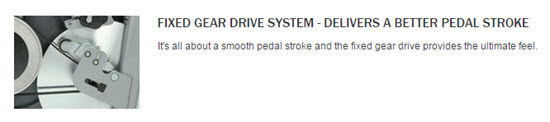
The Cascade recumbent is fixed gear drive
In the sidebar included in the study, ACE makes this comment:
Of course, bike safety is another issue entirely. Before telling participants in a group exercise class or a personal-training client to start pedaling backward, be sure that the bike you are using is designed to do so. It is important to note that this research was not conducted on a fixed-gear cycle, but rather on a specifically designed recumbent bike that provides resistance in both directions.
As you can see in the above screenshot from Cascade's website that their recumbent does have a fixed gear drive system, just like every other Indoor Cycle – the one exception being CycleOps which uses a freewheel.
What ACE should have highlighted is this recumbent uses magnetic resistance, combined with an aluminum flywheel. The eddy currents that create the magnetic resistance don't care which direction the flywheel spins = that's where the provides resistance in both directions comes from. The aluminum flywheel is light enough that it doesn't create the huge rotational momentum (and resulting “run-away flywheel” effect) experienced with a friction resistance system that uses a heavily weighted flywheel.
There isn't anything special/unique in use here. All of the Indoor Cycling brands (FreeMotion/ICG/Keiser/Schwinn/Stages offer a similar magnetic resistance. So it's my view that this experiment could have been conducted on any ICs with magnetic resistance and ACE would have seen similar results.
Quick side note: I jumped on my personal indoor cycle that has magnetic resistance and a Stages Power Meter, to try backwards pedaling. Believe it or not, I'd never, ever tried this before. The Stages Power Meter did display cadence, but the watts stayed at zero. So no backwards pedaling, power training for me 🙁
What struck me was how I felt everything flipped; where I could add the most force was lifting my lead foot, as it came forward and up. Pushing down seemed very awkward and I didn't feel I could apply much pressure.
#4 Should you consider adding backwards pedaling to your classes?
I wouldn't. There doesn't appear to be enough positive benefits, in contrast with the possible injury. Not to mention pedaling backwards just looks wrong/goofy, So I can't see including it in my class.
If you are thinking; “My class is super experienced and we'd like to try this”. I'd love to know your experiences.
One more note: I briefly rode this recumbent cycle when I was at IHRSA. The manufacturer, Cascade Health and Fitness, and ICI/PRO are currently conducting a small study of our own. We have two clubs who are using recumbents, along with conventional indoor cycles, to see if they can be successfully integrated together in a group class. Our objective is to see if adding a few recumbents can make classes more accessible, to people who have physical limitations that prevent them from riding a stationary bike.
by Joan Kent | Jul 19, 2017 | Big Box Instructor, Instructor Training, KEEPING IT FUN, Master Instructor Blog, Strength Training
If you’ve done stomps in your cycling workouts, you may think I’m crazy when I say this, but I’ve always liked them. They’re extremely tough but appeal to that twisted part of me that enjoys hard training. (I know: you’ve got that part, too.)
If you haven’t done stomps, they’re designed to increase power in the saddle. I believe Chris Carmichael is generally given credit for the training, but his guidelines differ from the ones I know. The Carmichael method involves 15- to 20-second stomp intervals. Here's Chris' description at www.active.com
In Performance Max, the program created by Jim Karanas, we used 60-second intervals with a 60-second rest, and followed the format below.
A solid warm-up is essential, since stomps are difficult and can stress the knees and the lower back. Roll the legs for several minutes. Begin an alternating pattern of 2:00 of seated high cadence (110-120 rpm); 1:00 of 80-rpm standing runs; 1:00 seated with resistance at 80 rpm; 1:00 of recovery at 90 rpm. Go through the pattern several times, as your group requires. Change the order, if desired.
A stomp interval is 60 seconds; the recovery interval is 60 seconds. Allow 22 minutes for 10 stomps: a set of 5, a short break, another set. The break I used was 3 minutes total: one minute of the usual recovery after stomp #5, then 2 more minutes (sit out one stomp cycle). It’s enough, but you could go longer. Resistance during stomps is high to very high and drops during recovery. Recovery cadence is individual, but I suggest 90 to 100 rpm.
– Stomp at 80 rpm. Fatigue will tend to slow the legs, so it helps A LOT to have an 80-rpm song to beat-match. We almost always came back to Hallogallo by Neu! because it’s a pretty precise 80 rpm. The fact that it’s 10 minutes long helps sustain the energy of the training. Play it twice or change music for the second set.
– Keep the body centerline on the bike. During the stomp, don’t move side to side, as you would in climbing. Keep hands in position 1.
– Rules for a beautiful, circular pedal stroke don’t apply during stomps. Exaggerate the down-stroke and smash against the resistance, without moving the body side to side. I cue it as “punching the pedals.”
– Heart rate isn’t the point. However, there are no HR limits on this exercise, and HR can spike quite high if the rider is seriously stomping without modifying the resistance. (Intervals under 60 seconds may yield lower heart rates.)
Avoid longer stomps. One instructor used 90-second stomps, but that means easier stomping, so what’s the point? A full-out, 60-second stomp will start to bring on failure at the 50-second mark, so 90 seconds requires reduced intensity. That makes it … something, just not a stomp.
Avoid “mushy” cueing. The instructor of the 90-second stomps would cue the stomp with, “Okay, you guys, do another stomp now.” There’s NO WAY that will elicit a stomp from your riders. It will get you something, but absolutely not a stomp.
One time, the above instructor’s cue was so mushy, I actually missed the start of the interval. That simply never happened when Jim Karanas cued stomps.
So I recommend Jim’s cueing. It starts about 5-6 seconds before the stomp interval. In a firm voice, say, “And load the bike … AND … STOMP!” The slight pauses and the delivery are intended to let the word “stomp” hit the first second of the interval. Cue time during the interval — say, at 30 seconds and again with 10 to go.
If there’s a way to use some feature on the resistance knob to mark the resistance used on the last stomp, it makes things much easier than trying to re-determine resistance for each interval. Cue that reminder for your riders.
Resistance can be ferocious during stomps. Every time I do them — about 8 trainings per year in the PMax calendar — I notice that, despite growing leg fatigue as the intervals proceed, I can still raise the resistance for each stomp. Don’t ask me to explain that, but it’s too consistent to be a fluke. It even happens when I do stomp training on my own. As a result, I started cueing the riders to keep increasing the resistance so they’d get the added strength benefit.
If you use high-intensity intervals in your classes, this training could fit right in with your approach. Because the emphasis is on strength and resistance, stomps may offer variety, say, a change from speed intervals. If you try stomps, please let me know how they work for your classes.
Originally posted 2014-09-23 08:17:39.
