
by John | Mar 26, 2021 | Class DVDS & Videos
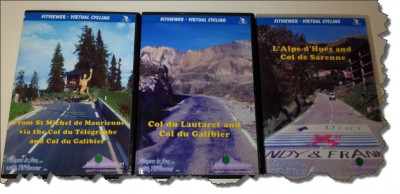
I love a fun contest where I get to give away something cool to our members 🙂
TeleAnimation – the company in Bavaria that produces FitViewer Indoor Cycling training videos asked if we would promote their comprehensive catalog of virtual cycling videos that include some of the famous Tour de France climbs like; Alpe d'Huez, Col d´Izoard, Col de la Madeleine, Col du Telegraphe,Col du Galibier and many others.
FitViewer's DVD selection includes 83 HD videos and include these locations:
These are very “pure” HD virtual ride videos. There are no riders (except for those randomly passed), no metrics (profiles or other training information) and no music; you would use your own anyways.
Many of these videos running 90 minutes to two hours – Alpe d'Huez is just under 3 hours at 175 minutes – which will make for an awesome endurance class next winter!
You can download a 10 minute sample here: http://www.fitviewer.com/tmp/AlpeDHuez-Promo.mp4
TeleAnimation sent me (3 sets) of these three titles; Alpe d'Huez РCol de Sarenne, Col du Lautaret РCol du Galibier and Col du T̩l̩graphe that I'm giving away to three lucky ICI/PRO members.
Entering the contest is as easy as leaving a comment below. Tell us where you teach and a short – fun/interesting story or fact about your class, studio or club.
That's it.
We'll pick three Instructor comments at random on June 30th. They'll all be able to lead their classes over the long, punishing Tour de France climbs in July.
Podcast: Play in new window | Download
Originally posted 2012-06-19 10:08:34.
by Jim Karanas | Mar 26, 2021 | Indoor Cycling Group - Team ICG, Instructor Training

Whenever I teach an Indoor Cycling class, I try to create an experience that takes the students beyond exercise. A class can affect students even more when video is added. So far, though, video has been used in classes more as a backdrop to create atmosphere than to augment the experience.
The trick to teaching with video is to act as if the ride is real.
When we teach, we can make our students feel that they’re somewhere else through cueing, guided imagery and choice of music. When we dim the lights, play the perfect song, and describe riding through the desert under a full moon on a road with no cars, we can immerse the student in that imagery. Whatever doesn’t add to it detracts.
Can you imagine that same scenario with a disco ball? No congruence. The same holds true for leading a ride profile that has nothing to do with the video playing behind you, and never even referencing it. The video grabs the student’s attention from time to time but doesn’t create virtuality on the ride.
To make video more than a diversion or backdrop, we must embrace it. Then we can create an experience in our classes like never before.
John Chambers of Cisco Systems describes “telepresence” as technology that makes us feel present somewhere other than our true location. A popular application is videoconferencing.
Telepresence allows our students to feel themselves in the video. This leads to immersion, where a student’s self-awareness blends into the absorbing surrounding environment.
Video can create immersion in our students. The acronym ‘SIT’ describes the coaching process:
– Simulation references the video as a real-life scenario. “We’re on Highway 89 in the Arizona Desert, heading to Glen Ferry National Park. It’s 95 degrees with zero percent humidity. The road rolls, and we’re moving at 25 mph.”
– Interaction adapts the training directly to the video. “Our next stage is a straight-line climb, averaging 5%. Stay in the saddle and pedal at 70 RPM. Match your pedalling to the beat of the music.”
– Telepresence helps the class feel present in the video through cueing (words and voice), music (genre, tempo, structure), and the workout (cadence, resistance, intensity and choreography). “You’ve ridden hills like this before. Relax. Control your breathing and fall into the tempo of the music. It’s mellow. Let the music carry you up the hill. We’ll peak our HR at the summit of this climb. We’ll ride the first 3 minutes in the saddle and stand for the last 2, increasing resistance every 60 seconds without losing one RPM.”
With this link, (it's a big HD file so you may need to wait for it) you can download a segment of an HD virtual class, created by the Indoorcycling Group of North America, in conjunction with Virtual Active. When we use video this way — selecting words, music and a workout that make sense to us with the footage — our students achieve immersion. Note from John – you really want to watch that video 🙂
The degree of immersion will vary with the club setting and your comfort, which grows with experience. But even instructors with less experience can create immersion. As your coaching develops, your students’ immersion will deepen. The focus is less on the instructor and more on the video and the thrilling sense of forward motion it creates.
Video quality and high-def imagery enhance the forward motion feel, thus immersion. Virtual Active’s video enhances indoor cycling in a way that’s been missing till now.
You are now ready to begin delivering a complete and synergistic experience for your students.
Podcast: Play in new window | Download
Originally posted 2011-12-12 20:03:15.

by Joey Stabile | Mar 26, 2021 | Best Practices, Cycling Fusion, Instructor Training

While it may seem redundant to say, most indoor bikes do not move. Please, stop and think about that for a moment. We are not talking about forward motion or distance, of course an indoor bike (or an outdoor bike on a trainer) does not move forward. But what about the other motions that are involved in cycling.
When a rider is out of the saddle, most riders sway the bike from side to side a bit. Why does this happen? Generally, it is the mechanical reality of the situation due to applying extreme power to each pedal. Since the pedals are not on the centerline of the bike, applying a large force to the right pedal will, physically speaking, apply a rotational force that pushes the top of the bike to the right and the bottom of the bike to the left. Without this counterbalancing motion, the wheel would kick out to the side. By swaying the bike in the opposite direction, the amount of force that can be applied to the pedals is increased without crashing.
The second primary aspect of swaying the bike is that it allows the rider to engage their upper body (especially core and arms) into the movement which increases power.
Take a moment and watch some of the pros race, they only have about a 12 degree sway; less than most avid riders. This is due to their efficiency and power.
The second motion that we want to consider is the flexibility of the bike frame. I learned a great deal about this from Kirk Frameworks Co. (http://kirkframeworks.com). There are three basic types of frame flex: Vertical, Torsional and Bottom Bracket/Drivetrain. It is important to understand that these different types of frame flex are more or less related to each other.
Vertical Flex
A frame with the proper amount of vertical flex will have a very smooth ride. More importantly, it also offers better control and handling.
Lateral/Torsional Flex
Torsional flex is when the head tube and seat tube are twisted relative to each other, and thus are no longer in the same plane. All frames, regardless of material or quality have a good deal of torsional flex. Try this sometime — sit on your bike with it pointed straight at a mirror. With your butt on the saddle and your hands on the brake hoods, push your hands to the left and your butt to the right. Watch the frame twist.
Bottom Bracket/Drivetrain
When a rider pushes down on the pedal he also, for better or worse, pushes sideways. This is because the pedal is off to the side of the bike and is not in the bike’s centerline.
When the rider pushes down with the right foot the bottom bracket flexes to the left. When the bottom bracket is pushed to the side, it stays there until the force that was holding it there is released. So at the top of the pedal stroke the bottom bracket starts its sideways move and at the bottom of the stroke it returns to neutral. In returning to neutral it applies that returned energy to the drive train and then to the road. This flex and return smoothes out our power transmission to the ground, making acceleration smoother and optimizing traction.
Frame Flex
With the exception of a few new bikes on the market, most indoor bikes do not provide movement side-to-side. Because of this limitation, riders must emphasize relaxation when riding and allow gentle upper-body movement. Attempting to maintain a still upper body can place the spine and surrounding muscles at risk from the forces being generated by the legs.
Originally posted 2019-02-08 21:41:46.
by John | Mar 26, 2021 | Spinning Class
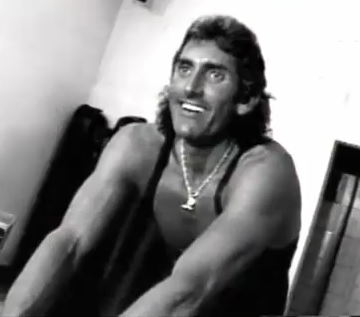
If you're new to the whole “Spinning” thing, this video from 1995 featuring Johnny G is an amazing look at the beginning of his new concept of riding indoors. This was posted over at pedal-on. It's interesting to see Johnny's early manufacturing partner Schwinn and the original Johnny G Spinners. If you watch carefully you'll see a few things that some would consider “contraindicated” movements. If Johnny G is doing them… are they wrong?
Originally posted 2012-06-17 05:26:14.
by John | Feb 7, 2021 | Kranking
I participated in a Krankcycle orientation yesterday at 501Spin in Minneapolis. Part of the training used the Suunto Fitness Solution I will be talking about it on our next podcast but wanted you to see my interview from IDEA.
Originally posted 2010-08-29 09:09:31.
by John | Dec 24, 2020 | Engage Your Students, Heart Zones USA, KEEPING IT FUN
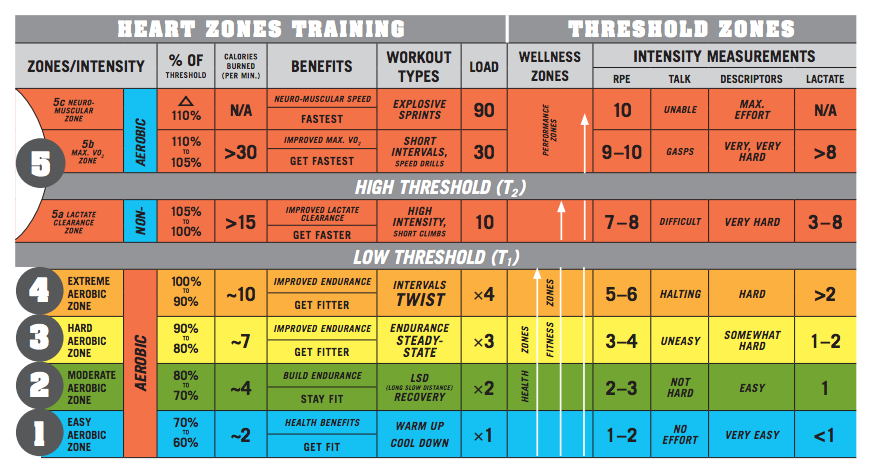
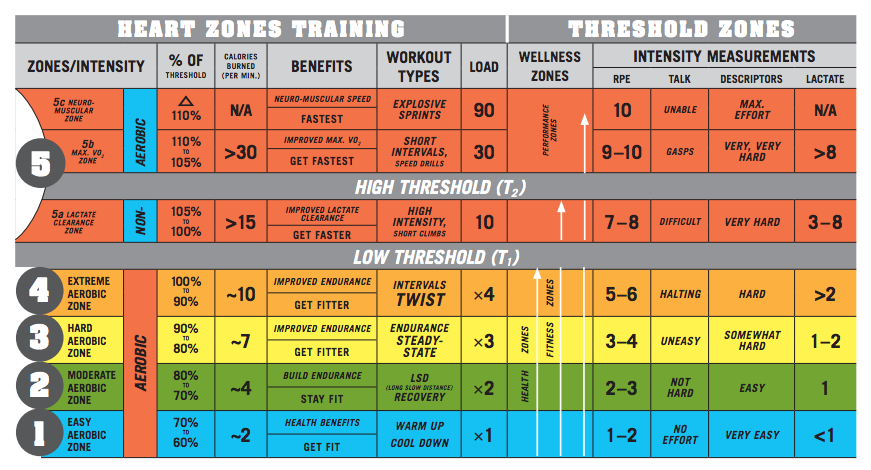
My friend Sally Edwards makes an excellent point here that applies equally to any endurance athlete and affirms our discussion from Podcast 368 — Does Intensity Trump Duration?.
It turns out that very fast runs are good for you–and that moderately fast runs (those just above threshold, in the Black Hole) are not. That’s because Black Hole runs are too slow to cause enough stress to make your body want to strengthen itself, and too fast to allow you to go long enough to improve your endurance. Studies of top runners find that they (by design or not) minimize their time in the Black Hole.
How fast is the Black Hole? In terms of pace, heart rate, and the Heart Zones chart, the Black Hole is actually a very narrow band. It starts at threshold, right as you enter Zone 5, and goes about 5 percent higher. So, if your threshold heart rate is 150 bpm, your Black Hole would extend from 150 to 157 bpm. That means if you really want to improve, your fast runs should roughly start at a second threshold: 158 bpm.
**This post is one of several in an excerpt series from the book, Be a Better Runner by Sally Edwards & Carl Foster**
But don't discount fun exercise = running/cycling that you enjoy just for how it makes you feel. Many people have no interest in structured “training”, they exercise because they find it fun.
Why There’s No Such Thing as Junk Miles
Whether you’re in training or not, every ride has a purpose–and just about every one is legit
Fun, however, is a legitimate purpose. Stress relief is a legitimate purpose. The fact that you can finally ride outside after being trapped inside by a wall of snow and ice for six weeks, structure be damned, is a legitimate purpose. The only non-legitimate purpose I can think of is if you’re out there joylessly slogging through some self imposed workout because you feel like you need more miles when those miles are not a) making you happy b) making you faster or c) building your reserves, but rather a) making you miserable, b) making you slower and c) breaking you down.
As an A type male, it was difficult to understand the whole “fun exercise” concept. What's the point of taking this class, if you're going to talk through it?
Once I understood that for some folks, Keeping It Fun is the objective, it became a lot easier to accept the appeal of SoulCycle type classes… and their wild success 🙂
Originally posted 2017-03-12 08:40:23.


