Gary Hawkins from Ride Fit contacted me last week about a new virtual cycling training video he had produced. Except this video doesn't feature typical cyclists – it's designed for people who train indoors on an ElliptiGO.
If you've never heard of an ElliptiGO you can join the club – it was completely news to me. But they are supposedly getting popular and they even have their own World Championships.
Now why am I asking if this could be the next big thing?
When I first watch the video I have to admit I thought they looked a little goofy to me. An elliptical for the road? Who would want that?
I called Gary and asked him; “who's buying these ElliptiGO things?”
“Mainly runners.” “They really like how low impact they are to ride.”
The indoor/outdoor cyclist in me started to say something snarky about people who choose to punish their bodies because they aren't smart enough to use the wheel… but I caught myself and asked Gary; do you know how many runners there are, compared with cyclists?
“Not sure, probably a lot more.”
So I checked and after a quick search it looks like committed runners out number committed cyclists by something like and an order of magnitude = 10 times as many runners.
Many of us are trying to build our classes by attracting cyclists. What would happen if we offered a group class that appealed to all those runners?
When Tom Scotto told me he wanted to lead the opening ride at the conference last year using a live band, I was a bit skeptical. “How exactly will that work?” I asked him. “Don't worry about anything John… I'll take care of all the details… this is going to be awesome” was Tom's response.
And awesome it was and take care of the details he did!
Tom planned this ride to perfection – he even jumps in with the band to play drums at one point as he lead all of us on a journey through a series of towns based on different musical genres. I have to say I was very impressed as we rode from Funkville to Rockville and followed the intensity profile from ClassBuilder on the screen. Be prepaired to take notes as Tom has a bunch of great cues that you can use in your own class.
I knew that the crew from Cycling Fusion was filmed the event, but we never offered it for you to watch and learn from. So Gene's making the video available as a sort of reward for taking this short survey – you'll be taken to the video after completing the survey.
Joining Tom on stage are a very attractive front row made up of ICI/PRO Teammates; Stages Indoor Cycling Master Trainer Cameron Chinatti,The Senior Group Fitness InstructorAmy Macgowan, Spinning Instructor and Studio Design expert Barbara Hoots and of course Gene Nacey from CyclingFusion.com. There's also crowd shots that include many of the participants 🙂
ICG® believes the brand Be Your Own Hero® represents a way of liberating ourselves and raising our quality of life through service. It’s possible for everyone to be heroic. To live life as a hero — and view yourself as doing so — is not ego. It’s a personal commitment to helping others with your unique talents, day in and day out, while making an occasional statement that commands attention on their behalf.
Anna Mei is an Italian schoolteacher in her 40s, married and helping to raise two children with her husband Stefano. She lives her life heroically. Her talent is ultra-distance cycling. On top of family and job, Anna chooses to ride her bike incredibly long distances, day in and day out, to support, and raise money for, the Butterfly Children — children who suffer with Epidermolysis Bullosa.
This is how she shares and helps others, using what she was given at birth. That’s being a hero, and it’s not always easy. Anna gets tired, hurt and injured like everyone else. Her life has ups and downs. Being Her Own Hero simply means she reminds herself every day that living life as a hero obliges her to get on her bike and call attention to the Butterfly Children.
Early this year, Anna set a new world record for miles ridden on a track by a woman — 441.55 miles in 24 hours. Riding in circles. When you speak with Anna, she rarely mentions the record. Instead, she talks about the Butterfly Children.
This past weekend, ICG® sponsored Anna in the 24-Hour World Road Championships in Coachella Valley, CA. I was her crew chief and honored to be part of her team. It was a tremendous display of heroism on Anna’s part.
The event began at 6:00 p.m. The cyclists would race through the night and then the next day in the blistering desert heat near Palm Springs. Starting at night means you’ve already been up for 12 hours prior to the race start, making the final 12 hours during the day even more challenging.
The race started with great promise. Anna was racing alongside legendary ultra-cyclist Seana Hogan, who had surpassed Anna’s 24-hour world record in June by riding 445 miles. Six hours into the race, Anna suffered a crash during a handoff. For a handoff, the rider must ride dangerously close to the support vehicle to take fluids and food while riding. The lacerations on Anna’s legs were extreme, but she had no broken bones, and the bike was not damaged.
Any cyclist who has crashed and gotten back on the bike understands the pain of riding with road rash. Only an ultra-cyclist can understand what it means to have to do it for 18 more hours.
After dawn the route changed, and support vehicles were no longer allowed to follow the riders. We had to remain at the Start/Finish line as Anna repeated a 30-km loop. We saw her every 55 minutes or so. During her third lap, Anna called me. She had been driven off the road by a car and crashed into a ditch of sharp stones and broken glass. We raced to the scene and saw that the lacerations on her arm were more extreme than those from her earlier crash. These would require stitches. Again, no broken bones, and the bike was still ride-able.
Stefano, an ER nurse, cleaned the wound and applied temporary bandages. Without hesitation, Anna got back on her bike. She had 6 more hours to ride in near 100-degree heat.
Anna finished the race, totaling 349.2 miles, enough for 3rd place. She’d put in an incredibly brave 24 hours. What was most heroic about Anna was that, after the finish, there was no thought of how well she might have done if she’d had a better day and hadn’t suffered two crashes. This race was a cry for people to pay attention to the Butterfly Children. That’s all.
Living life heroically is a quiet, personal experience. There’s no want. It’s a simple choice to use attributes you were born with, or developed in life, to help others and occasionally to make a statement that draws some attention.
If you tell Anna she’s an inspiration, she’ll thank you. But that’s not what she’s after. She’d prefer that you support the cause to which she has dedicated herself. That’s why she heroically rides her bike every day.
Living life as a hero has a personal cost. Stefano’s anguish and fear as his wife got back on the bike after her second crash made that clear. He understands, though, that this raises his wife’s quality of life — and, through her efforts, that of others.
Anna is truly a hero from within. She wouldn’t be happy living life any other way.
###
To learn more about Epidermolysis Bullosa, “the worst disease you've never heard of”, and help the Butterfly Children, please click here.
More and more I'm hearing and seeing how Instructors are experimenting with riding in with the class, rather than presenting up-front-and-center on the traditional “Instructor Bike”.
It's fun to mix it up and IMO, an imperative when teaching to a structured Virtual Ride DVD.
But riding away from the music controls creates a technical difficulty; how do you make adjustments to the sound volume?
I witness this firsthand, while riding in an unnamed (but very attractive) Instructor's class this morning.
Her playlist included a bunch of very interesting mashups of popular tunes. Which made for a great class… except that a number of tracks had been mixed at varying sound levels. After hitting play, our unnamed Instructor took her position with the rest of class in the front row, leaving her iPod up on the sound equipment cabinet. Everything was going as planned until one of the mashups came on REALLY LOUD! She hopped off her cycle, walked up to her iPod, quickly turn down the volume and returned to her bike. Problem solved.
Solved that is until the next song which was very quiet. Not wanting to disrupt the class any further she left it where it was, leaving me wanting to yell out “turn up your music!” Out of respect for another Instructor, I didn't say anything during her class.
But I will offer you two possible solutions, Amy:
I can order you a very long cord for your iPod.
I can lend you my Bluetooth receiver and show you how you can connect wirelessly using your Android phone.
I'm here to help and you know where to find me.
Actually there's another reason I've found to go wireless – many accessory cases prevent the 1/8″ plug on the connection cord from being fully inserted into your phone. So it doesn't work with the case installed 🙁
In my case I was forever taking off my iPhone's case so I could plug in the cord. When I got tired of the hassle, I quit using the case altogether. And then promptly dropped my iPhone, breaking the back glass panel – not good. So a Best Practice for any Instructor is to invest in a $25.00 (with free Prime shipping) for this Bluetooth receiver and not need to invest in a $549.00 replacement iPhone.
Speaking of riding along with your class… I Shazam'd this track last night, Come Along from Vicci Martinez. It conveys the essence of exactly what I'm trying to communicate to my students as we push through a tempo Threshold effort together. There's a wonderful refrain the you can add to your cuing at the 2:27 mark; Time Fly's, Make a Statement, Take a Stand… and finishes with; Take… Your… Shot!
Simplicity is the ultimate sophistication. — Leonardo Da Vinci
The tendency of the western mind is to expand and be progressive. The desire to “take it to the next level” is part of that, the goal of it. Progression is inherent in physical training. Until periodization became popular, all cardio-based training was based on progression. With periodization, cardio training still progresses, but in circular modules.
One of the things indoor cycling has been said to do is help someone “take it to the next level”. I used to use the phrase all the time. It suggests linear progress, which I’ve come to realize is not optimal, or even possible, in all training situations.
People like progress. Cyclists, club members, our class participants like to see themselves getting stronger. We like it ourselves. There's value in achievement. Achievement is invigorating.
Progress toward most goals is accompanied by measurement. In cycling, the attitude is, “If you can measure it, you can improve it.” Progress toward goals is also accompanied by learning. Learning to use heart rate effectively. Learning better technique. Learning to train with power. If we keep learning and adding more, the premise is, we’ll progress ever faster. In some cases, that’s true.
For a while, and up to a certain point.
A lifetime of training and riding a bike undergoes an ebb and flow (see my post “The Four Levels of Motivation”). As we continue to train over a lifetime, we of course get older, and desire often ebbs. The excitement behind achievement diminishes, largely because our performance does, along with our energy. We need, and search for, ways to bring back the energy.
The thing is we often look for energy in the wrong place. What can actually provide the greatest return of energy is not increased achievement, analysis or learning, but a return to simplicity.
Over centuries, the wisest philosophers have advised us to keep things simple.
Cycling, particularly indoor cycling, is simple. It’s a basic relationship among cadence, gear/resistance, and intensity. More accurate ways to dissect and measure a workout, or complex structure and patterns, will at times increase performance. After a while, though, they will just induce fatigue. That’s because our greatest source of energy will never be metrics. Or thinking. Over-analyzing will actually make things worse.
This is when a return to simplicity is best for a rider.
When you rollout, or start a class, the shift in consciousness is profound. The repetitive, circular action of the pedals creates a state of mental relaxation. This isn’t the time to over-cue, give detailed instruction and make things “mental.” The sensation of internal energy can’t be sensed when the mind is busy. If the mind is allowed to clear so the body experiences the simple act of turning a pedal stroke, then we (and the students) can feel the energy, the alertness, the aliveness, whatever you want to call it.
Turn off the computer. Forget performance. Feel the energy that comes from the sheer pleasure of riding a bike.
Measuring things, making things complex can sometimes be good for training. Over time, though, it can create fatigue and kill desire. Riding a fixed-gear bike with the computer off is one of the simplest and best ways to reinvigorate someone — and reconnect someone with the joy of riding a bicycle.
If you want to be successful, it's just this simple: Know what you're doing. Love what you're doing. And believe in what you're doing. — Will Rogers
Bicycling is a repetitive-motion exercise that can lead to tightness in several major muscle groups.
Static (traditional) stretching gradually lengthens a muscle to an elongated position and holds that position for 20 seconds. When done properly, static stretching slightly lessens the sensitivity of stretch receptors in our muscles. That allows the muscle to relax and stretch to a greater length.
In the last few years, however, several studies have found that doing static stretching before playing a sport actually makes you slower and weaker. This is because the lower sensitivity of the stretch receptors makes us less able to move fast or freely.
Static stretching is recommended after cycling and has a variety of benefits when done properly. Still, many elite athletes in all sports are ditching post-training static stretching altogether, and using “dynamic” stretching as a viable warm-up technique prior to exercise.
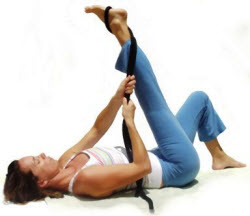
In 1995, I witnessed a stretching demonstration by a trainer named Jim Wharton. Using a rope, he taught me a method of flexibility training known as AIS, or Active-Isolated Stretching. Aaron Mattes, a kinesiologist and world-renowned expert on flexibility, developed this technique. I had the good fortune to study with both Jim Wharton and Aaron Mattes. I’ve used AIS every day for the past 17 years and have trained thousands of students to perform a 20-minute dynamic-stretching routine before riding. Most of them — seriously — continue to do it daily.
Cycling contracts skeletal muscles that attach to bones by tendons. Each muscle has sensory structures called stretch receptors that monitor the state of the muscle and feed the information back to the central nervous system. Stretch receptors are sensitive to the velocity of the movement of the muscle and the degree that it’s lengthened.
The Golgi Tendon Organ is a stretch receptor located at the insertion of skeletal muscle fibers into the tendon. It provides the sensory component of the Golgi tendon reflex, also known as the stretch reflex. The stretch reflex is a protective mechanism that attempts to prevent over-stretching and tearing of the muscle fibers.
AIS uses the body’s natural stretch reflex to enhance flexibility. Because it’s movement-based, it also dynamically stimulates blood flow and muscle extension through movement. These factors make it optimal for warm-up.
After a couple of seconds of stretching, a muscle begins to contract as a result of the protective stretch reflex. This is to prevent excessive elongation and a potential muscle tear. The key to AIS is not to continue stretching beyond this point. Static stretching continues, and that’s why it diminishes performance.
The Active-Isolated Stretching technique involves holding each stretch for only two seconds, rather than 20. The stretch is repeated 8 to 12 times for a progressive muscle release. This degree of repetition dramatically increases blood flow to the muscles to enhance warm up.
This method of stretching is also known to work with the body's natural physiological makeup to improve circulation and increase the elasticity of muscle joints and fascia.
The shorter stretch, however, needs to be coupled with reciprocal inhibition. This is another natural response of the muscle. Contracting the muscles on one side of a joint relaxes the muscle on the other side of that joint. When performing AIS, you actively contract the antagonist of the muscle you are trying to stretch (the agonist). This promotes an enhanced release in the target muscle. The antagonist contraction also stimulates blood flow and generates body heat.
Active-Isolated Stretching does many things that static stretching cannot:
– AIS provides a transition between inactivity and physical exertion.
– AIS assists the pre-exercise warm-up process by increasing blood flow and soft-tissue temperature. This makes is both a stretch sequence and a warm-up technique, and settles the long-running debate in the fitness industry about whether or not it’s necessary to warm-up prior to stretching. With AIS, both occur together.
– AIS produces supple, relaxed muscles, which have a higher capacity for activity.
– AIS reduces the likelihood of muscle cramping, tightness and pain.
– AIS increases and maintains the range of motion in a joint.
Personally, I’ve performed upper- and lower-body AIS daily, both pre- and post-riding, for 17 years. I attribute much of my athletic longevity and my body’s ability to perform at a high level to Active-Isolated Stretching.
AIS is one of the stretching methods most used by today's athletes, massage therapists, personal/athletic trainers, and fitness professionals. AIS allows the body both to repair itself and to prepare for daily activity.
To learn more, simply google Active-Isolated Stretching. An extensive YouTube library depicts the stretching techniques, and numerous websites have images of how the stretches should be done.