This is post one in a multi-post series that will explain how to use and select music to compliment your class. As the series progresses, I will be sure to include the links to the previous posts so that the entire series can be found in the latest post.
As an instructor, music can become the most challenging part of any indoor class; however it can be one of the most important parts of the class. I have heard it said that we are not DJs on a bike, we are cycling coaches. While I may agree with the sentiment, we can not underestimate the importance of music in the delivery of a class. You could structure the most ideal training program with the very best designed drills, but if your music is off and does not match the work, chances are very good that the class will disappoint your riders. While we believe that the class focus and design should be well thought out before the music is added, the addition of music to your drills will truly make or brake your class.
What is it that makes the selection of music so crucial; music is a one of the most powerful mediums. It can facilitate communication that goes beyond words, enables meanings to be shared, and promotes the development and maintenance of individual, group, cultural and national identities. Music can alter movements, moods and emotions. Few other items that you come in contact with can effect such a wide range of human functions and feelings.
So, how do we begin with the so important task of selecting the right music for your class? It all begins with belief. You must believe in your music and your playlist or your class will not believe in it either. While there are seemingly endless types and styles of music and everyone in your class can have a different preference, it is your ability to believe and sell the ride that will matter. To make it a little easier, if you incorporate some basic principles, you will succeed more times than not:
Know Your Demographic
The demographics of an indoor cycling class can be affected by many factors including your club’s location (city vs. suburbs), day of the week and time of day that your class is offered, and if your class is designed around a specific focus or theme. One of the easiest ways to accomplish this principle is to take the time to learn what your riders like by simply asking them. You will never be able to please everyone all of the time, but people appreciate being listened to and will respect you if they believe your are doing your best to give everyone something they enjoy. Please, remember to remind your people that not all great music is great indoor cycling music and that it may take a few weeks to get their requests into one of your rides.
For Foundational classes (beginner), remember the overall focus is to provide a fun environment for people to gain some initial cycling fitness or possibly just fitness in general. With the exception of the warm-up (and possibly the cool-down/stretch), working songs should be music your riders will recognize, and maybe even sing along to. While the beat matching of the ride is still critical, you should take extra time with this group to be sure the music is fun and will keep them coming back for more.
For intermediate and advanced classes, it is critical that the music be beat-matched and of similar intensity to the work that you are asking of the riders. When we ask more of the riders, this also demands more of us as instructors. We need to put in the extra time to find “just the right music” that will not only support our drills, but it will also enhance them. Ideally, the riders should be able to close their eyes, or look away from the cycle display, and still hold the proper cadence by focusing on the beat and feel of the music. Aside from the beat, the intensity is also important: an epic climb demands an epic musical work to help us reach the summit.
One of our foundations at Cycling Fusion is that songs used for the first warm-up segment should NOT have vocals. The warm-up is where you spend a good portion of the time introducing yourself, the purpose of the class and give various instructions such as safety guidelines, proper position and how to gauge the level of effort. It is important that your voice be the only one heard in the cycling studio during the warm-up so riders have a clear understanding of expectations and how to approach the class.
In the next post, we will talk about Pulse, BPM and RPM and how using them will enhance your ride and heighten the student’s experience.
Sprints, speed work, accelerations, cadence building drills-whatever you call them, we all use them in our classes. I love collecting songs that have a natural pick up (usually on the chorus) to use for this purpose. Today I'm sharing two of my favorites along with the timing that I use in my classes. I hope you can work them into your next cycling profile!
Both songs are by Danish metal band Volbeat.
Lola Montez: I use this song for accelerations on the chorus at :25; 1:13; 2:25 and 4:00. Each acceleration is approximately 25-30 seconds. Recoveries get longer as the song progresses.
Work Set Length: 13:44 + 7:17 recovery [21 minutes]
The Sprint Shift on the new Stages SC3 bike is your interval training solution. Left position for easy, Center position for medium, Right position for hard. Make micro-adjustments with the resistance knob during the interval. Could it be any easier?
Now, I am a big believer in training with power, benchmarking your effort, and documenting your progress. All three are important for successful long-term cycling training but people sometimes misunderstand my position as “all science, timed intervals — no fun.” That's not the case at all!
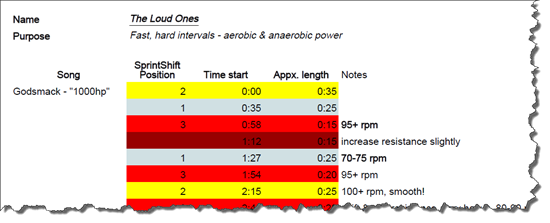
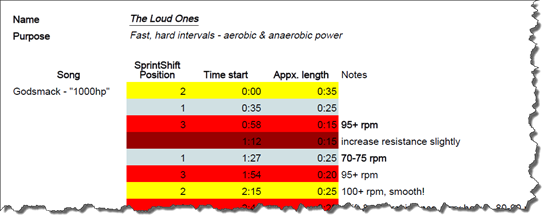
For the 3 songs below, all I would track is total distance traveled. My riders would hit “The Loud Ones” maybe once every 10 rides and see if they went farther. You could also use average wattage or average speed – it is still a benchmark, just not a complicated one.
As for the science, these are aerobic and anaerobic power intervals – near maximum, brief efforts with short rests. This makes you strong during the frantic parts of road races, during time trials on hilly terrain, and when you want to inflict some pain on your group ride mates. The ride gradually slows in cadence as the resistance and length of efforts creep steadily upward.
But don't think too much about all of that. Do a quality warm-up with 2 or 3 very short sprint-type efforts, tell your participants they are in for some HARD WORK, then just turn it up, follow the music's energy, and have some rough, fast, sweaty fun!
[P.S.: You really just have to feel the music to get the transitions. Don't try to follow the time stamps to the letter. But the Sprint Shift makes that possible! Call each position (left, center, right) “gear 1, gear 2, gear 3” if you like. Slam the lever into gear and ride hard!]
[P.P.S.: After “Little Man,” I like to throw in one long, steady effort, usually to “Animus Vox” by The Glitch Mob. You can take your pick of ‘finisher.']
Have you ever watched a commercial and wondered, “What’s that song?”. I’ve seen this Diet Coke commercial dozens of times and every time I see it, I find myself humming this song for hours. I googled it, but could just have easily Shazamed it if I’d had my phone next to me. (If you’re not Shazaming, you should definitely try it! It’s a great way to find and save new music to use later in your classes!)
If you like to use Christian Rock (or even if you don’t) in your classes, this one is perfect. Check out these lyrics:
Brave Fight like a soldier Brave Rise like a warrior Brave Won't stop till the final day Brave I want to be stronger Brave Gonna be bolder Brave
And last, here’s a favorite that I used in this week’s playlist by one of my favorites, Haik Naltchayan. I used it as a long, steady climb in and out of the saddle:
I'm not embarrassed to say that I like country music. Country is a genre that many indoor cycling instructor avoid, but I embrace it. I get more complements about playing country music than any other genre. Country music IS popular and has a HUGE following. I live in Denver and a few weeks ago U2 was playing the Pepsi Center, a 20,000 seat venue and Luke Bryan was playing Mile High Stadium, a 75,000 seat venue, on the same night. Luke Bryan sold out U2 did not!
This week I mixed together 3 new country songs:
Homegrown by Zac Brown Band
Play It Again by Luke Bryan
John Cougar, John Deere, John 3:16 by Keith Urban
All 3 songs are about 3 minutes and 30 seconds long. I like to use this music mix for three 3 minute intervals with 30-40 seconds recovery after each. Since the energy and tempo “feel” lower and slower I like to ride at a cadence of 60-80 rpm for this set. Listen below to how I used this set in class.
[wlm_private ‘PRO-Platinum|PRO-Monthly|PRO-Gratis|PRO-Seasonal|Platinum-trial|Monthly-trial|PRO-Military|30-Days-of-PRO|90 Day PRO|Stages-Instructor|Schwinn-Instructor|Instructor-Bonus|28 Day Challenge']If you use video I also mixed together the videos of these three songs.
3 song harmonically mixed track, to download Right Click > Save As / Save Target As to download. Open in iTunes and then you'll see this in your Spotify Local File folder.
This AM at around 6:23, I dripped sweat onto my iPhone's screen and accidentally switched on Shuffle. Of course I didn't realize my error until this great new track I'm using for openers comes on, for the second time.
Wait… didn't we already do this song?
Oh, Crap! Now what do I do?
There are few things that scream ROOKIE INSTRUCTOR louder than manually switching between songs during a class.
Unsettling to be sure. Keep your cool John… smile… pretend you planed the class like this 🙂
So instead of freaking out, grabbing my phone and trying to get back to my intended track, I just rolled with it 🙂
I normally use three, 30 second hard efforts as my openers. To mix things up this morning I decided to use just two. The track I used is below which features two 45 sec segments; @ 1:00 and then again at 3:17.
The second time I had everyone repeat their efforts, while paying attention to their perceived effort. The song has an awesome build before you hear the I Don't Got Time For Pain that keys the 45 second big effort! It's about 62 RPM. I cue everyone to add load until they feel the need to stand, wait for I Don't Got Time For Pain and it's accelerating off to the races.