When John asked me to document my trip to IHRSA 2015 I thought it would a quick and easy post about the trip and what I saw while I was there, but when I finally sat down to write this post I realized what a “long strange trip it has been” and it starts long before I boarded Southwest Airlines flight # 4812 from Denver to Los Angeles last Wednesday.
I started working in the fitness industry way back in 1992 at The Sports Training Institute in New York City. I had just graduated from State University of New York College at Cortland with a degree in Physical Education and a minor in Coaching. The problem was that there weren’t any new teaching jobs available, so I thought for the time being I could work as a trainer, make some money, enjoy the big city and wait for some PE positions to become available. The problem was that personal training is addicting, you are surrounded by like minded highly motivated fit people all day. Your fellow trainers become great friends and training partners and you clients, many who are very smart and successful people, become your mentors and this is something that is very hard to leave. So I didn’t I went “All In”. I completed an ACSM, American Council of Sports Medicine, 4 day workshop, passed the certification test to become an ACSM Health Fitness Instructor and went down the road of changing lives through fitness. I spent the next 3 years commuting from my family home in the upstate town of Highland Falls NY to the city, a 60 minute train ride, every day. It was exciting, our gym was one of the most respected training facilities in the city, we saw actors, politicians, professionals athletes and many more of the rich and famous everyday, not a bad gig for a 23 year old kid.
I was still living at home was because in my junior year of college my mother had passes away after a 2 year battle with lung cancer, so after graduation I decided to go back home and help my father take care of things at the house and help raise my 2 younger brothers. Now it had been almost 5 years since her death, my family had moved on from this tragic loss and I felt it was time for me to get on with my life and I had a big decision to make, I was either going to move into NYC or move away and start a new life in another state. For some reason Colorado had always intrigued me maybe it was the songs of John Denver or the fact that I had taken up triathlon and Boulder Colorado was and still is the Mecca for multi-sport athletes. I contacted some of my Pi Kappa Phi brothers, whom had moved to Colorado after graduation, asked if I could crash at their apartment until I found a job and my own place and set a moving date for the day after Christmas 1995.
I rolled into Denver around New Years Eve and was ready to make a go at a new life, I filled out employment applications at every gym and health club in the area. This was in the days before the internet so you couldn’t just perform an google search for the best health clubs in an area. I was lucky enough to be awarded a Personal Training position at what I later found to be and still believe is the best health club in the Denver area if not the country, Greenwood Athletic Club. This place was big and beautiful, everyone was so fit, healthy and happy. I felt like I had landed a dream job!
The next 6 months, at Greenwood, was probably the most important and impactful of my entire adult life. First, I met my wife, Blair. She had come to Greenwood after back surgery and needed some rehab and training exercises and as luck would have it I was given her contact information to set up her training sessions. After our first meeting I was hooked but not being “that” kind of trainer I simply didn’t feel it would be professional to ask her on a date, so what I did was give free session after free session until she finally got the hint and SHE asked me out. We were married in July of 1996 and now have twin 15 year old boys, Seth and Christian. During this time I also met a group of highly motivated and inspiring triathlon training partners. This was a group of people who made me believe that no goal is impossible. I had never dreamt that I could complete an Ironman distance triathlon, but with this group believing in and helping me I have now reached the finish line in 8 of these 140.6 mile events. Now I take great pride in helping other triathletes go farther than they ever imagined possible.
The final and most important event as it relates to this post, because obviously meeting my wife was the most important event of this 6 month period, was the introduction of Spinning®. I’ll never forget how excited our GM, Steve Krum, was when he returned from IHRSA the year Johnny G launched the Spinning® program. Steve wanted Greenwood Athletic Club to be the first club in Colorado to have this program and started recruiting instructors the minute he got back in the club. Being a competitive triathlete and personal trainer Steve thought I would be a good fit for this amazing new program. Before I could help launch the indoor cycling program at Greenwood I was offered a position as Fitness Director at the Sports and Fitness Center at the Jewish Community Center of Denver. I was excited to offered this management position and felt like this was the next step in my fitness career but I was really going to miss Greenwood and felt like I was missing out on the launch of fitness’s next “Big Thing”. It took me 2 years of prodding and negotiating with my General Manager and Executive Director to finally bring indoor cycling to the JCC. I got certified through Maddog Athletics, began teaching 3 classes a week and so began my indoor cycling journey.
From my very first class I was hooked. It just felt right, it was the perfect forum for me to share my love of fitness, riding, coaching and music. It also let me utilize the skills I had been taught while majoring in physical education. Class after class I worked to improve my presentation skills, refined my cueing, searched for the most motivating music and experimented on the perfect work to rest ratios for an indoor cycling class setting. As new technology emerged I embraced it; cd burners, mp3 players, iPods, laptops, video, clipless pedals, cadence meters, heart rate monitors and then finally power meters and heads up displays. My goal was to use every new technology to make my classes more motivating and engaging. I also went to every training I could find and afford. To me the Master Instructors were like Rock Stars, they had huge followings, cued perfectly, used all the new technology and were just great instructors. I always learned something new at every training. I thought it would be cool to be one of them, to also share this love of indoor cycling with other instructors, but I told myself I wasn’t articulate or charismatic enough to ever break into that top tier group of instructors. So, I took all this new knowledge, from every training, and used it to teach the best classes I could. Class after class and year after year I worked to become the best instructor I could be. After about 10 years of teaching, training and managing, I could sense that my time left at the JCC was short. The new Executive Director had a completely different vision for the the Fitness Center than mine and I figured it was time to move on.
Prior to leaving the JCC I had been in contact with some of my old friends that were still working and/or working out at Greenwood Athletic Club and they put me in contact with all the right people. They all gave me stellar recommendations and when I eventually left the JCC I was able to hit the ground running with positions as Personal Trainer, Masters Swim Team and Triathlon Coach and Indoor Cycling Instructor. I had always hoped to eventually make it back to Greenwood, I figured I would go do my time in the “minor leagues” and eventually get called up the “majors”, but life in “minors” was comfortable and easy, I had developed a great system of management had an exceptional staff working for me I also had a steady following of training clients and solid group of indoor cyclist that came to my classes. Life in the “majors” was a lot different, Greenwood is considered one of the best health clubs in the country, they have the best of everything; staff, trainers, group exercise instructors, equipment and a beautiful facility. If I was going to survive here I was going to need to really step it up! I was and still do wear a lot of hats at Greenwood but for the sake of this post I’m going to focus on indoor cycling.
Through the years I had developed my very own teaching style. I like my classes to “flow” from one interval to the next, one position to the next and one song to the next. I also like to build on what we do early in the workout throughout the class profile. I had been teaching this way for years and many of my riders at the JCC had been riding with me through this evolution so they just got it. The new riders at Greenwood had never experienced anyone who taught this way and my first few classes were a disaster. As anyone who has ever worked in the fitness industry knows, members don’t like change. I was told that my class was just too complicated, the members just want a killer workout. I was terrified I was going to lose my classes, I had worked so hard to be good enough to work at this club now I might get sent back to the “minors”. I was confident that my unique style would be successful but I realized that it might be too much too soon at this new club so I took a step back started with much simpler profiles and slowly started layering in my progressions. After a short time I began to develop a following and eventually was filling my classes like the other top instructors at Greenwood.
One day one of my riders approached me after class and told me about a long business trip he was going and how he wished there was a way I could record my classes so he could take them with him when he was on the road. This got me thinking and before long I had purchased a digital audio recorder and the necessary cables to hook up to the mixing board in the cycling studio. This was the birth of “Dennis Mellon’s InCycling Podcasts”. At first I just recorded my classes and would transfer them to a thumb drive for anyone who wanted them, then I built a website, www.dennismellon.com and made each class available to stream, but then I learned about podcasting and realized if I formatted each recording properly they could be available for download in the iTunes Store. Once my podcast was approved by Apple and available in the iTunes Store I needed to figure out a way to market it and get more followers to move up the charts, this is when I started looking into social media. I read a few articles on how to market with social media, created a Twitter and Facebook account and was a on my way.
One of the techniques used to create a large social media following, especially with Twitter, is to search for like minded people and “Follow” them. Proper Twitter etiquette is to “Follow Back” anyone that “Follows” you. In a very short time I had a few thousand “Followers”. Another technique used to increase your social media presence on Twitter is to “Re-Tweet” the posts of some of the “Power Users” on your “Follow” list. I had been listening to every episode of the Indoor Cycling Instructor Podcast hosted by John Macgowan and as an industry leader I figured he was someone that I should be “Re-Tweeting”. After a few weeks of re-tweeting all of John’s posts I received an e-mail from him that simply read “Why aren’t we working together?” I e-mailed him back and we set up a time to talk.
During this initial conversation John and I spoke about teaching experience, styles and just about everything indoor cycling. We agreed on much more than we disagreed on. John asked me if I would be interested in submitting a class profile and that next week we would record my class description of this profile and it would be available to the members of his website. I was so nervous, this was my opportunity to show the world the teaching style that I had been refining for over 15 years. The profile I presented was named “A Little Bit of Everything” (https://www.indoorcycleinstructor.com/icipro-instructor-training/music/icipro-podcast-287-little-bit-everything-audio-class-profile/). My playlist employed a new song selection technique called “Harmonic Mixing” which requires each song to be in a harmonically compatible key so songs sound like they flow together, which fit perfectly my flowing profiles. John loved it! He even recorded a podcast with me where we discusses this new music mixing technique. I felt like I finally hit the “Big Time”, I was contributing to the “Premier independent resource for Indoor Cycling Instructors around the world.”, hits to my website were going through the roof and I was getting e-mails from around the world from people telling me how much they enjoyed the class recordings that were available on my podcast “Dennis Mellon’s InCycing Podcasts”. Life was good! The recognition was rewarding, but what was most satisfying was hearing how I was helping other instructors improve their classes and receive that coveted compliment “That was the best class I have ever taken”.
John and I started working together more and more and one day he asked me if I had ever considered being a Master Educator/Instructor. I think I laughed at the question, I told him of course I’ve thought about it and would love to be that elite class of instructors who train other instructors, but there was no way I would ever get the opportunity and that I didn’t think I was good enough. John assured me that I had what it took and that many of his contributors had gone on to be Master Educators/Instructors, I told him it would be great if that happened but I wasn’t going to get my hopes up. Then one day I received an e-mail from Laurel Mylin, GM at Stages Indoor Cycling asking if we could set up a time to talk. Laurel and spoke for quite some time about education, experience, Stages Indoor Cycling, we also spoke for a while about the new Spinner Ion Blade that Greenwood had just purchased and the new Spin Power Program that I had just completed. As our conversation was winding down I thought about what John had said about so many of his contributors becoming Master Educators/Instructors and I figured I should let Laurel know I would be very interested if there was an opportunity. Laurel said that they had been watching me for while and that there may be an opportunity with Stages and that something “REALLY BIG” was going to be happening with the company in 2015. She told me she would pass my information along to Cameron Chinatti, Director of Education and I should be hearing from her soon.
After talking to Cameron on the phone, observing her present multiple times and Cameron watching me instruct, I was hired on with Stages Indoor Cycling as a Master Educator. This is a great honor and huge responsibility. I now have the opportunity to shape the direction of indoor cycling for years to come, an activity that has been part of my identity for so long. I know it’s just a bike that goes nowhere, but it has helped so many people reach fitness and weight loss goals they never dreamed were attainable or maybe the time spent in on this bike that goes nowhere is the best part of someone’s day, never dismiss the power of the ride.
So, last Wednesday, as I sat awaiting take off of Southwest Airlines flight # 4812 from Denver to Los Angeles I had a tear in my eye as I thought about all the people who helped me and all the hard work it has taken to get to this new chapter of my life and fitness career.
In Part 2 I’ll write about the actual IHRSA 2015 experience.
Liquid B complex is the only Nutrition Magic I know. It can stop a sugar craving within a few minutes. But every so often, people will tell me they tried it and it didn’t work. How could that be?
Careful questioning revealed a few common reasons that prevent B complex from working effectively. Here’s what I’ve discovered.
Not Using Liquid B Complex
The liquid formulation seems to speed up the effect so we can feel it within a few minutes. Tablets take longer and might be good for regular supplementation, but a “craving emergency” is better dealt with by using liquid B.
If you already take a daily B-complex tablet, you can safely add liquid B on a day that you get a craving. On the other hand, if you’ve used liquid B for a craving before taking your usual dose of B, there’s no reason to take the tablet that day.
A one-day “overload” of B vitamins won’t be harmful, but it’s best to avoid it on a regular basis. (If you have any questions about this, please check with your doctor.)
Taking B12 Instead of B Complex
For reasons I’ve never been able to understand, people misinterpret “B complex” as “B12.” It’s possible that this dates back to the once-upon-a-time practice of getting B12 injections for energy.
Whatever the reason, B12 is only part of the complete complex — and not even the most important B vitamin in trampling cravings. Yet this misinterpretation has happened so often, I now clarify immediately whenever I recommend B complex to a client.
So again, use LIQUID B COMPLEX. Not tablets, not B12, not any other individual B vitamin.
Not Eating Any Protein
When this mistake is made, it’s usually by folks who haven’t worked with me as clients. All of my clients know I stress the importance of protein.
Protein is a key element in the craving-killing plan. B vitamins work as catalysts to help form specific brain chemicals. Those chemicals can end cravings (and also prevent them) when they’re at optimal levels. But the brain chemicals are made from amino acids — which we learned in 7th—grade biology as “the building blocks of protein.”
We can’t make the necessary brain chemicals without protein.
Junking Out On Sugar First
If you’ve eaten half a bag of cookies, please don’t expect B vitamins to stop you from eating the other half. The neurochemical changes that the cookies have set in motion are powerful — and even more powerful for some people than for others.
For reasons beyond the scope of this post, those brain changes will probably make you want the rest of the cookies.
Suffice it to say there’s simply no way that a teaspoon of liquid B complex can override the strong effects of whatever sugar you may have just eaten. The most helpful idea is to use B vitamins to stop your craving so you don’t eat the cookies in the first place.
I’ll throw in a side note. If you find it too easy to reach for cookies because you’re home and they’re conveniently located in your kitchen cabinet, please do yourself a huge favor: Don’t keep cookies in your kitchen. Throw away the ones you have. Don’t buy more.
It Works If You Work It
Liquid B complex is still the only nutrition magic I know. It’s effective; it’s quick. But it’s not a stand-alone miracle. It’s best used as part of a sincere attempt to reduce dietary sugar.
Please stay aware that B vitamins are a short-term solution for stopping sugar cravings. Getting rid of cravings permanently requires changes in diet.
And, yes, changing diet can virtually eliminate cravings. Think of the freedom that could mean for your students.
I got about 75 minutes of saddle time on the Stages SC3 during the conference. Two morning classes, a 60 sec challenge (445 watts – 2.78 watts/lb which I felt was OK for a 53 year old) and some undirected free time when I experimented with the SprintShift.
Quick aside:Why does everyone look like they're setup too low in the videos? I had a Facebook comment asking this question and she's right, they do look low. But I can assure you that neither Dunte Hector or Cameron Chinatti riding in this video are set up incorrectly. Over the years, I have developed an eagle-eye for improperly adjusted riders = they looked right to me, riding there in front of them. So why do they look low? I have no idea. Might be an optical illusion, or the shutter speed of the camera is too slow. Do you have any idea why?
Fit – I'm 5′-10″ and I like a long & low reach to the bars. On a bicycle, this is determined by top-tube length. On most Indoor Cycles without handlebar fore/aft adjustment I feel a little cramped. With adjustability an option, I will normally push the bars all the way out – to increase the reach. On the SC3 I felt very comfortable with the reach with the fore/aft centered = this IC appears to have a longer top-tube length. (I didn't measure anything, this is just my general feeling)
I also have long femurs, (thigh bones) which require my saddle position to be biased quite a bit rearward, to keep my knee over pedal. My road bike needed a special setback seatpost to get me in the correct position. Here too I found that there was plenty of room and found the perfect position with the saddle set about 1/4″ back from the center point on the adjuster.
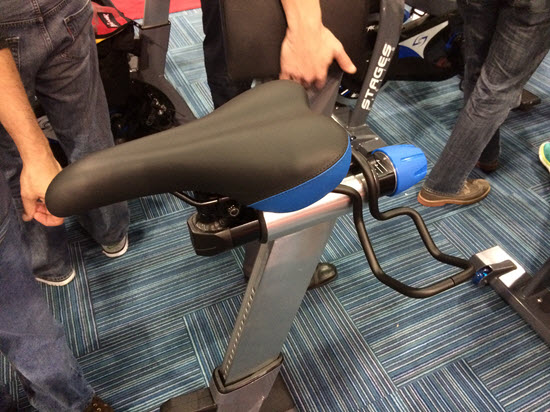
I really like the road bars they are using. They offer some new options for hand positions, while at the same time creates limits – no more seated riders looking goofy with their hands extended way out to the bar ends. The imitation brake hoods (the bump at the end) form a very natural/secure place to rest your hands while standing, hopefully removing the temptation to tightly grip the bars.
All the adjustments include easy to read measurement scales = your participants will be able to quickly make their pre-class adjustments, after their initial fitting. The saddle/handlebar fore/aft are micro adjustable and use a nicely shaped knob that you tighten down to fix your settings. Height at both ends use the new FitLoc over-center lever to place setting pins into very closely spaced adjustment holes.
There are two water bottle holders attached to the frame, which are very easy to reach seated or standing. Why not include them as part of the handlebars? I asked that question to Cameron and she told me that they wanted to keep the bars as light as possible, so they're easy for small people to adjust with only one hand 🙂
The Ride– Smooth / Solid and very Quiet. As I discussed in Part 1, the aluminum frame is very strong and I couldn't detect any flex. All the adjusters stayed securely fastened = I never felt I needed to re-tighten anything during my rides.
The SC3's belt isn't under any tension, which is unique. It's hard to describe this in words… there isn't the feeling like you need to overcome some internal force in the drivetrain. The result is a very light feel, almost frictionless, with just a touch of chain like vibration coming through the peddals.
I'm a big fan of magnetic resistance on Indoor Cycles – you can read why here. The SC3 didn't disappoint as their drive uses this resistance system. The large, screw type, adjuster knob made for predictable and progressive adjustments in the amount of load added. Pushing down on the knob is the safety brake.
Using the SprintShift lever
If you do a lot of timed below/@/Above PTP intervals, where everyone is recording their average watts using a stage button, you'll love using the SprintShift lever. With apologies to Ron (pocket fisherman) Popeil – when you're running a series of intervals all you need to do is; “Set it… and forget it!”
Here's one way I found to use SprintShift: The Stages Instructors had us doing a fun relay race, as part of each class I attended. Each row competed to see how fast each rider in turn could complete 0.2 of a mile. They had some fun inflated batons that we passed, after completing our two tenths.
To prepare for the race, I practiced to get a feel for the proper resistance I could sustain, for what turned out to be about 25 seconds of work. With the SprintShift lever fully to the right, I set the level so I would see ~500 watts @ 100 RPM (where I work best during a short sprint) and then flipped the lever full left (making it lighter/easier) to wait for my turn. I maintained my 100 RPM cadence until I was passed the baton. Snapping the lever full right brought me to the perfect gear. I punched the stage button and was off. Did I mention I was the anchor person on our team? And that there were two very fit people behind me? So yes, I felt a ton of pressure to get my 0.2 done as quickly as possible.
We talk a lot about including “Best Efforts” (and below/@/Above PTP intervals) as part of your classes here at ICI/PRO. I feel they are an important components of every class I teach – they give my riders a quick understanding of PTP Personal Threshold Power. This answers the question for them; “how much power/watts should I be making, when I want to work hard?” without waiting for a scheduled 20 minute FTP class in the future.
Think forward to the (hopeful) day when I can teach on the SC3, I would have everyone dial in their PTP resistance with the SprintShift lever in the middle position. Then moving it to the left would give me a “Below PTP” working resistance. Bringing it fully to the right would add the “Above PTP” resistance. Cuing a return to whatever cadence we've been using should make for an easily understandable and challenging class 🙂
Power Observations
The power/watts readings seemed steadier/ didn't bounce around as much as what I'm used to on a competing bike. The absolute watts readings I was seeing was very similar to what I'm accustomed to.
I really like how your averages remain displayed for 5 seconds after you hit the stage button. It always takes me a moment to refocus after an all out effort = I enjoyed see my averages before they disappeared.
Bottom Line
I see the Stages SC3 as an excellent Indoor Cycle and it should be on your short list of cycles to choose from if/when you're planning a purchase.
If you have additional questions, or would like to be connected with them for more information, use this contact form.
Accessories
Custom painted Indoor Cycles can make a huge difference to the look of your room. Your Instructors will feel special with a uniquely painted Instructor bike, possibly one that matches your studio's colors. Contact us for pricing and lead times.
The Stages SC3 can be custom painted without affecting the warranty.
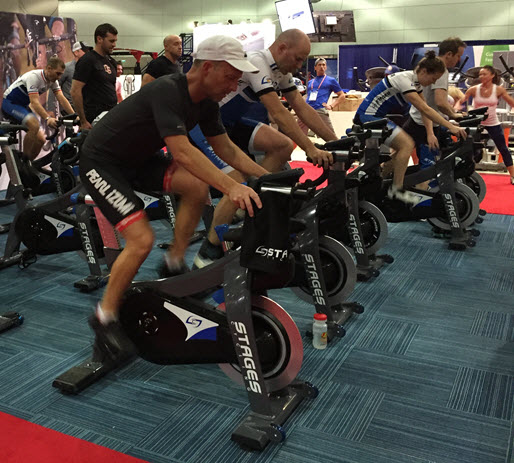
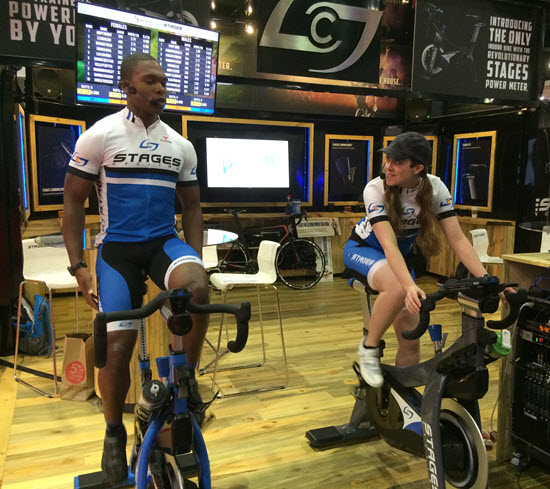
Stages Master Educators Dunte Hector and Cameron Chinatti leading the morning ride at IHRSA
IHRSA 2015 was the first public appearance of the Stages Cycling SC3 Indoor Cycle. This was a total surprise to me and I have no idea how Stages Master Educator Dennis Mellon was able to keep his mouth shut for so long. We talk weekly and it must have been killing him not to be able to tell me about their latest project 🙂
Going forward, I feel it's important to disclosure that Stages Cycling sponsored (paid) my and Amy's travel to, and lodging in, Los Angeles to take part in the launch of their new Stages SC3 at IHRSA 2015.
If parts of the Stage SC3 look familiar, there's a good reason. The engineers who designed this Indoor Cycle have a long and storied history of product development with indoor cycles and power consoles. It was explained to me that the design criteria for the SC3 was; take all of the engineering team's collective experience and build the ultimate, commercial Indoor Cycle. Did they succeed? Let's find out…
The Basics
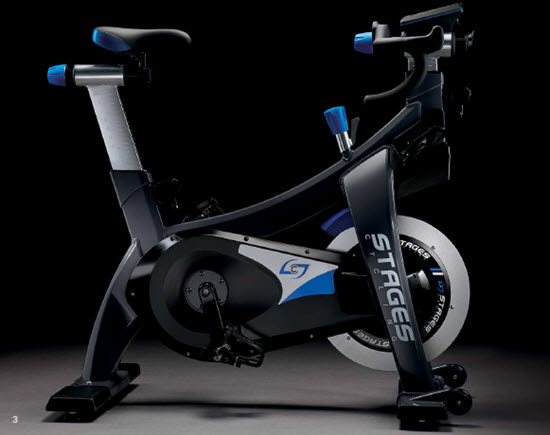
Frame – Aluminum… and lots of it. This is a very solid/substantial IC > perfect for studios with big, powerful riders – or – those offering unconventional classes with a lot of movement.
Drive – CarbonGlydeâ„¢ drive system. Yes, this is the same Gates belt as other manufacturers are using, but there are fundamental differences with the other components of the drive train, that give the SC3 a very different feel. Because they don't run the belt under tension (there's a tiny bit of slack you can feel as you move the pedals back and forth) the SC3 is noticeably quieter than the Schwinn AC and it's tensioned Gates belt. It also retains a slight, chain-like vibration, but doesn't buzz like the AC. Stages is so confident in their drive system that they offer a 10 year warranty on the CarbonGlydeâ„¢ belt. Correction: Stairmaster's engineer Travis Vaughan alerted me to my error describing the Schwinn AC's Gates belt as “tensioned” – which it's not. I didn't intend to infer that they used a tensioner like what's used with Poly “V” belts. Instead I should have described the differences as; the AC runs it's belt taut (zero slack) vs. the SC3 which, when properly tensioned, has a very small amount of slack.
Resistance – Magnetic > surrounding an aluminum flywheel. Screw style adjustment and includes the new Stages SprintShiftâ„¢ three position lever . More on that below.
Handlebars – Road Bike Style Drop Bars – there's a reason that handlebars on road bikes haven't changed over the last 100 years > these fit us (humans) the best. Please don't ask me; “butwhere is position #3 John?” It's standing, with your hands surrounding the brake hoods, exactly where your hands belong when you're out of the saddle 🙂 It's here where you have the most leverage to power through a steep climb and it eliminates the temptation to “over reach” while seated.
Saddle – nice. Not too narrow… and not to wide/fat. Forgive me for saying it this way, it's very close to (might be exactly the same as) the saddle on the Schwinn AC > we have one on the back of our Trek Tandem. Amy loves this saddle and it's been comfortable for her for thousands of miles. Trust me on this one… I'd have heard all about an uncomfortable saddle.
The Power Meter
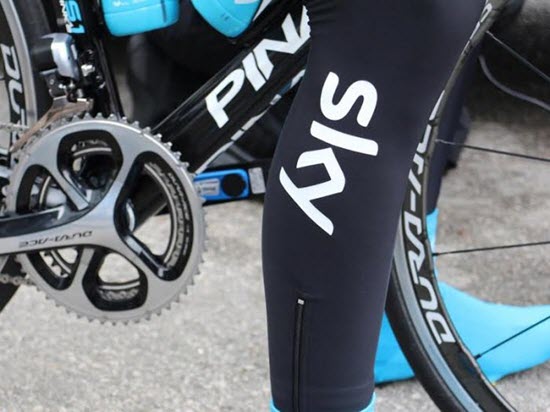
Good enough for TDF winning Team Sky Professional Racing Team
The heart of an Indoor Cycle that features power measurement is, of course, the power meter. The new SC3 is using the same technology used by Team Sky – winners of two Tour de France bicycle races and they're going to continue to use these power meters in 2015.
I could devote an entire article on just this topic and will have more as part of the ride portion of this review. In the interest of time I'll give you the important bits:
2,000 hours of battery life using two AA's – yes the display console is self-charging.
Same hardware, design, and accuracy found in the Stage Power® meter, which is used by professional cyclists’ and used in the world’s most famous cycling races, including the Tour de France.
ANT+â„¢ and Bluetooth – so it will connect with your iPhone or Android without any adapters.
Supposedly accurate to +/- 2.5%. I say “supposedly” because I have no way to verify their claims – but I bet Team Sky does 🙂
Display Console
It's important to separate the power meter, from the display console. Although most studios will choose to purchase their new SC3's with the new Stages EcoSCRNâ„¢ console, you don't have to. The Stages power meter will work with any Bluetooth or Ant+ device, like an iPhone or Garmin. You could also choose to wirelessly connect the Stages power meter directly to Display Training systems from Performance IQ or Spivi.
Here's a short video showing it in action during one of the 60 sec challenges.
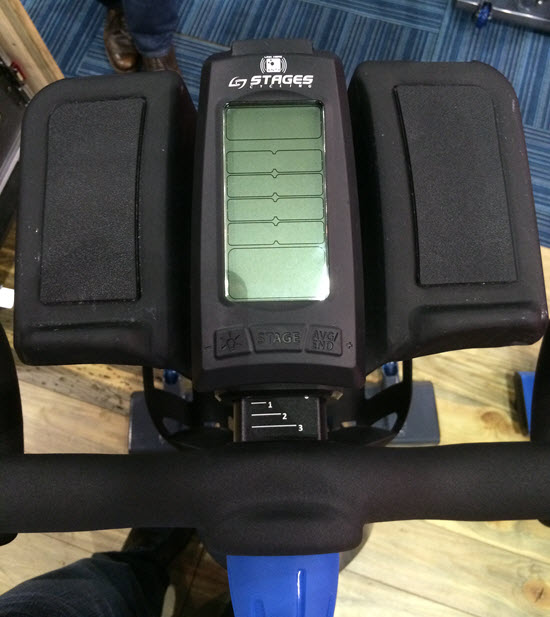
The EcoSCRNâ„¢ console is self-powered = no batteries to replace ever… that's the Eco part 🙂
No exposed wires > I was told they've very neatly packaged the cable that connects the flywheel generator to the console = a long life of raising the handlebars up and down.
Constant backlight if you choose 🙂
Stage button to record intervals > there's also a nice feature that your averages remain displayed for 5 seconds after you end a stage.
Stages SprintShiftâ„¢ is a three position “shifter”, that provides course adjustments quickly. I want to describe it as a sort of cruise control, where you flick your finger and instantly resume your previous speed/resistance level.
Think of doing a repeating series of intervals. We cue everyone to add load, ride the segment and then recover. Now repeat it again. With SprintShift you can set your initial load with the lever full right. Move it left for recovery and then return back to the exact resistance instantly, by moving the lever all the way to the right.
There's some interesting physics at work here. If you use the SprintShift at lower resistance levels, the amount of change between each level remains relative & realistic. But start with a big gear and the changes are incrementally larger.
There are multiple ways you could incorporate this in your class and we'll find more over time. I'll describe a relay race we did in the ride part of the review where it was very helpful > we won! I'm sure Cameron and Co. will have some fun suggestions for using SprintShift when I interview her in the next few weeks.
If you've ever fought over a stubborn screw type seatpost of handlebar adjuster, you'll enjoy these new FitLoc cam style adjusters. Watch the video and you will see how quick and easy they are to operate. Also, they've kept the weight of the bars low, so it takes very little strength to raise them, using only one hand.
There was some self-delusion to go along with lots of new fitness products and services.
There were a few things of interest at IHRSA this year that I'd like to tell you about:
NOTE: I completely overestimated my available time to write my review of the Stages SC3 = I hope to have it completed by Sunday… but don't wait for me if you're planning to pull the trigger on a studio > The SC3 is a solid IC option and I wouldn't have any reservations recommending it for your new studio.
Recumbent Indoor Cycling Classes?
This banner was the very first thing you saw walking into the LA convention center. My first impression was; “that's dumb… who would ever want to ride a recumbent bicycle in an Indoor Cycling class?”
As I walked past this display I did a double take and then it hit me > there's a huge population of people who are intimidated by the skinny, little seats on Indoor Cycles. Obese/overweight people for starters and you can't forget Seniors. Together they make up a sizable demographic that we are completely missing. They're two groups who would really benefit from the comfort of riding on a recumbent, with its large seat and easy to step through design.
UPDATE 3/16 – you can hear from a fitness director, who's been including recumbents in her classes with great success, in this podcast.
I talked at length with the representative from Cascade Health & Fitness about helping them establish a few beta recumbent cycling locations. They are very motivated to meet with anyone who's interested. Please let me know using our contact page.
Spinning® / Star Trac
There's a belt hiding in there.
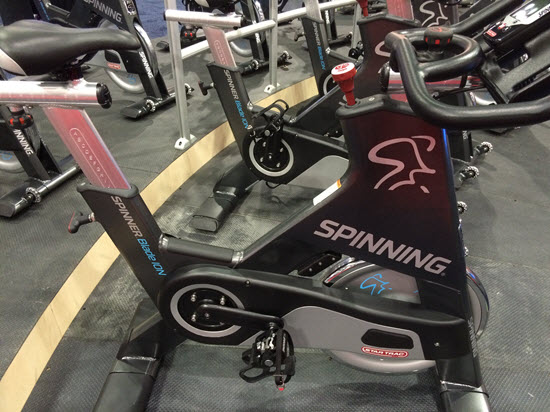
Star Trac has expanded their Black Belt option to the full line of commercial Spinner® Indoor Cycles, including the Blade Ion. But you wouldn't know it just by looking at it. Where the NXT carries the “Black Belt” logo on the frame, the Ion has no markings indicating if it's chain or belt drive.
I rode the Ion briefly and my initial impression was that this belt is both quiet and smooth. Yes you're missing the feel of the chain, but whatever they've done, the Ion didn't have the vague/weird feel some bikes using a similar flat belt have.
I discussed the question of, “why not use the Gates toothed belt?” with Mad Dogg Athletic's CEO John Baudhuin. John explained that they had experimented with the Gates belt years ago. What they found was a drive system that uses a heavily weighted flywheel just works better with the flat belt they've chosen. Which makes sense, the brands using the Gates belt (Schwinn/FreeMotion/Stages) all are using a much lighter flywheel.
Schwinn
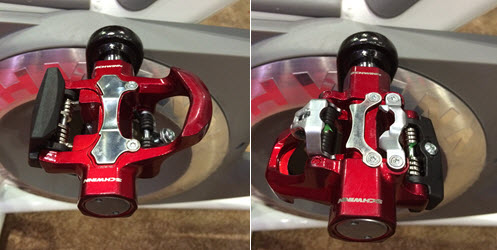
Schwinn has completely redesigned their Triple Link Indoor Cycling Pedal. No, unfortunately my Red Pedal Tool won't work with the redesigned shoe basket. This pedal has much larger bearings on both ends for increased reliability + they attach using the Morse Taper that's similar the Spinning® pedals.
NOTE: these can only be used with a new Schwinn AC – older versions use conventional 9/16s threaded pedals. I'm waiting on clarity from Schwinn to learn if this new pedal will be offered in a 9/16 threaded version.
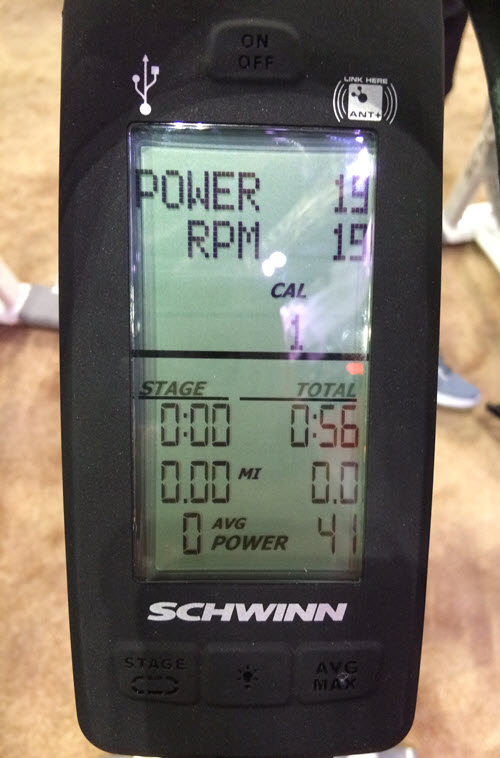
There's another upgraded Mpower Echelon (version 2) console and power meter for the AC performance. They've made a substantial number of changes and improvements to the (previously Red) Echelon console and I'm hoping to have a Schwinn representative on the podcast to discuss all of them soon.
Keiser
http://icipromedia.s3.amazonaws.com/Keiser_M3.wmv
Refresh your browser if you're not seeing the video above.
Did you know that the new M3i has a stage/interval timer? I didn't until Amy and I spent some time with Dennis Keiser. While we were chatting I made the suggestion; “you know Dennis, I would really like to have the option to record the average wattage during a short interval… you should consider adding that in the future.” Dennis's response was; “we all ready have it.” We all went over to a M3i and Dennis showed us (video above) how easy it is to start and stop the stage/interval timer > all you need to do is stroke the gear-shift lever all the way down and then back up 🙂
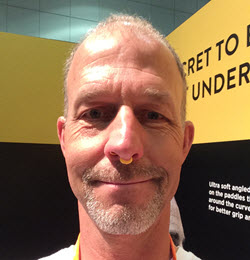
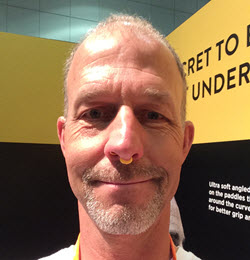
Finally, a nose ring that actually does something… but would you wear it while teaching?
I connect with the ‘gear heads' in my classes by reminding them how our bodies convert a carbon based fuel source (food) into the energy that powers a bicycle. Which is very similar to how the engine in your car creates the power that propels you down the highway, using another carbon based fuel source > gasoline or diesel.
No matter what source of fuel you're using, converting it into useful energy requires Oxygen (O2) and lots of it. Your car needs to ingest 15 pounds of O2 for every one pound of fuel burned. Not surprisingly, you need to breath in & out about the same amount of O2 to burn a pound of your last meal.
What limits the performance of both you and your car, is its ability to efficiently move air in and out.
There's a huge aftermarket industry that sells various components to improve how your car breathes. Now there's Turbine – a new sports breathing device from an Australian company that they say will improve how you breath, potentially increasing your performance.
HOW DOES THE TURBINE ENHANCE MY BREATHING?
Turbine increases airflow through the nose by an average of 38%, helping to reduce the feeling of breathlessness. Simply put, by dilating your nose (even slightly) you can increase the amount of air going in and also, importantly, increase the amount of exhaust air (CO2) you can expel. And, as you know, when you’re going hard, every little bit helps.
Using Turbine allows you to breathe more efficiently with every breath, enabling the body to focus energy on the muscles that need it, when they need it.
When exercising, oxygen is extracted from the air in your lungs, absorbed into the blood stream and circulated to enable muscular contraction. Supplying your exercising muscles with the air they need, has a high energy cost; Turbine may help reduce this. Try it today and find out for yourself.
I tried out a Turbine during the show last week. I was amazed by the instant improvement in my ability to breath comfortably in and out through my nose. I brought home a few samples and will be trying them shortly to see if they can help me ride faster/stronger.
They make a companion product for eliminating snoring, that Amy was excited for me to try. They call it mu:te.