In order to excel in a sport or activity, it’s necessary to train specifically for that activity. The term “cross-training” refers to a routine that involves different forms of exercise. The idea behind it is to permit recovery of the primary muscles used in the primary activity, while maintaining a high level of fitness. Cross-training is thought to limit stress on a given muscle group because different activities use the same muscles in slightly different ways.
Foster et al (1995) tested the cross-training hypothesis that athletes can improve performance in one mode of exercise by training in another, despite the principle of training specificity. It was found that muscularly non-similar cross-training does contribute to improved performance. A runner, for example, could use cycling to enhance muscle strength and reduce the chance of an overuse injury, while improving or maintaining aerobic capacity.
Current cross-training methods offer recovery for the primary muscles only by using them differently (e.g., substituting cycling for running). As a result, finding a cross-training activity for the indoor cyclist that permits complete rest of the primary muscles has been difficult, unless the athlete enjoys swimming — and that uses the legs, too. Besides, this approach won’t help in cases of leg injury.
Many resources recommend indoor rowing. Rowing is a fantastic cardiovascular exercise, but people misinterpret it as upper-body training. As rowing technique literature will confirm, however, rowing uses the legs predominantly. So, once again, we’re using the same muscles, just in a different way.
Non-cardio activities, such as Pilates, have also been recommended for cross-training. Yes, alternative activities can improve some aspects of fitness and provide a different perspective. But what happens to cardio in the meantime? How long can you cross-train without losing cardio fitness? In the case of an injury, time away from the activity could be long. Also, for the enthusiast with little time to experiment, alternatives may feel like a distraction from the preferred activity.
So the dilemma remains: What’s the best form of cross-training for the indoor-cycling enthusiast?
The UBE (upper-body ergometer) has been a long-standing option, but it doesn’t typically generate sufficient intensity to maintain fitness for the primary endeavor. Besides, it isn’t fun. Yet there’s a solution somewhere in there.
Pogliaghi et al (2006) studied the effects of cycling and arm-cranking on peak oxygen consumption (VO2 max) and ventilatory threshold to determine the cross-training benefit of each modality. Results showed cross-training benefit, due to central (i.e., cardiopulmonary) adaptations. Even though the muscles used in arm-cranking were not those used in cycling, the cardio stress to the heart and lungs was significant enough to register a true cross-training benefit.
Arm cranking is the perfect cross-training activity for the indoor cyclist. It’s the most effective form of exercise for maintaining cardio fitness while completely resting the legs. It can be used for general recovery or during periods of injury, and provides enough stress to maintain central cardiovascular fitness. But what about the fact that the UBE is boring?
The KRANKcycle® by Matrix Fitness, introduced fairly recently, fills the need perfectly. It’s easy to learn, and can then be used to generate serious, high-intensity training. Because of the short crank-arms and narrow crank axis, the intensity can be much higher than with a UBE. It can be used in a group setting, namely the cycling studio. The movements easily parallel those of indoor cycling. Finally, unlike using a UBE, Kranking’s a lot of fun.
On a day following an intense cycling class, you could take it easy on the bike — or you could rest your legs and Krank. Hard. The muscles need the rest, not the heart.
If you’re fortunate enough to have access to a KRANKcycle, bring one or two into your cycling space for the cross-training benefits Kranking can offer your students. If you don’t have access now, you might want to look into it. It’s the only true cross-training for cycling you can find, and offers other fitness benefits, as well. There’s nothing out there quite like it.
How would Tom Scotto lead a virtual Indoor Cycling class? You're about to find out. In our latest Audio PROfile, Tom walks your through teaching to Club Ride In France – DVD #1 of the three part France Series of videos from Global Ride.
Past Audio PROfiles, that are the companion to Indoor Cycling DVDs, have been very popular and we plan to offer more of these in the future.
The music used in the Global Ride DVDs is actually quite good and I suggest you follow Tom's advice and used it – just be sure to choose the “No Coaching” option. Or you might try using the coaching track and ride along with everyone else.
Info about Club Ride In France DVD
Coaching Tracks
Since the first DVD made in Hawaii, Global Ride has been providing coaches from all over the world to help you get the most out of these virtual rides. Each coach having their own style and objectives. With the France series you can ride to the DVD's Featured Coach, Fiona Ford, a British Triathlon coach, National Championship and International Gold medallist for World & European Triathlon, Aquathlon & Duathlons.
This DVD also explores a bit of role-playing to help transport the rider into the scene both mentally and visually. For a different coaching track, Gene Nacey & Tom Scotto play two coaches out for a ride with their students, each vying for open spots with Triathlon Europe.
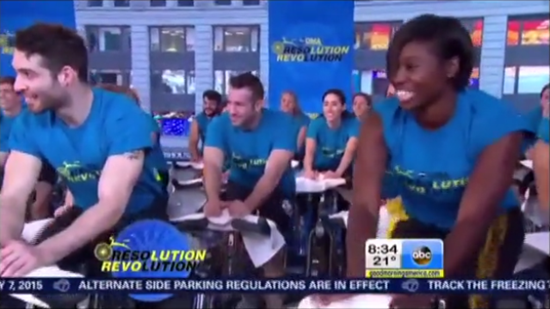
Five million viewers of ABC's “Good Morning America” TV program were treated to a wonderful promotion for Indoor Cycling this past week. As I watched I just couldn't help myself and began humming REM's Shiny Happy People. That was exactly what I was seeing > hundreds of shiny, happy people enjoying riding inside. I can't think of a better way to kick off 2015!
I'm of course describing the nationwide 2015 SoulCycle resolution ride that aired Jan 7th live on “Good Morning America.
What a way to jumpstart January! SoulCycle joined Good Morning America today for its Resolution Revolution. We tapped it back on SoulCycle bikes in their dressing rooms and hallways as well as in Times Square – while GMA showed live feeds from Soul classes happening in Bethesda, Chestnut Hill, Coral Gables, Short Hills and West Hollywood! Check out this video clip of all the action, including an interview with instructor ANGELA DAVIS on how to stay motivated as well as an update on our SoulScholarships Program. It was a good morning, indeed!
Here's the video of the event if you haven't seen it.
FTP, a concept refined by power authority, Dr. Andy Coggan, is an estimation of the amount of work you are able to do in an hour. It serves as the basis for loads of other important metrics (e.g. TSS, CTL, ATL, TSB, etc.) that will be covered in future entries. Most immediately, the FTP value serves as the cornerstone to setting up training zones.
Rather than asking athletes to attempt a one hour maximal effort to determine FTP, I prescribe the method that Hunter Allen, co-author with Dr. Coggan of Training and Racing with a Power Meter, has developed. The protocol itself is actually quite simple: after a substantial warmup, start a lap on your head unit, and smash it for 20 minutes, as hard as you can. The average power recorded for the 20 minute test is multiplied by .95 to estimate what your “hour of power” (or FTP) would be.
The ideal terrain for a 20 minute test is a moderate (3-5%) steady climb that can be ridden safely without interruption (e.g. no stop lights). Of course, most of us might not have access to terrain that meets these requirements. A flat road (with the same requirement for safety) will do and of course, riding the test on a stationary trainer indoors is a great alternative.
“Smashing it” for 20 minutes might sound pretty straightforward but, to get the most out of your test, some smart pacing will be required. When prescribing an FTP test to my athletes, I encourage them to break the test down into smaller, more manageable chunks, like four-five minute efforts. For each five-minute time period, have a soft goal for average wattage. Trying to increase the average power for each five-minute segment (compared to the segment prior) will go a long way to helping you achieve proper pacing. As you get to the end of each five-minute portion, take an assessment based on your rate of perceived effort (RPE) and ask yourself, “Can I keep up this intensity? Can I increase the intensity for the next five minutes and the remainder of the test?” When it comes to the last few minutes, you should be at full effort, eking out every last bit of energy to assure that you have averaged the highest power possible. I refer to the wattage goal as “soft” because no matter what the goal power might be, you are going to be limited by your feeling on a given day. You might be able to do more work than you anticipate and you might not be having the absolute best day and will potentially fall short of your expected power output. Don’t let expectations get in the way of having your best test. Remember, the goal of testing isn’t to meet a particular number but rather, to measure your best performance you can do on a given day. Being in tune with your RPE is critical.
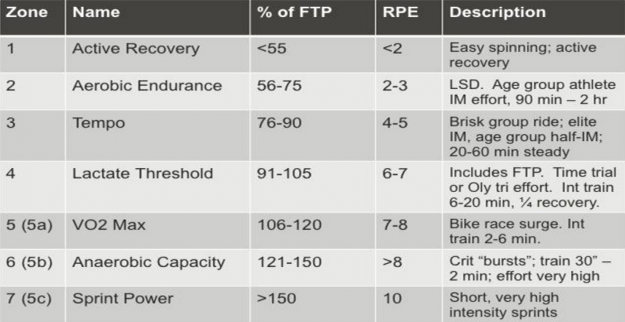
With your new FTP number in hand (best 20 minute power x .95), you can create training zones. With some simple calculations, you will be able to determine your training zones based on Allen and Coggan’s chart below.
Now that you are armed with your training zones, I suggest you record some of your regular rides and take a look at the files afterward to see how much time you are spending in each of your zones. This information can go a long way to helping determine what the demands of a ride/race/event are and potentially guide your training a bit, to meet those demands.
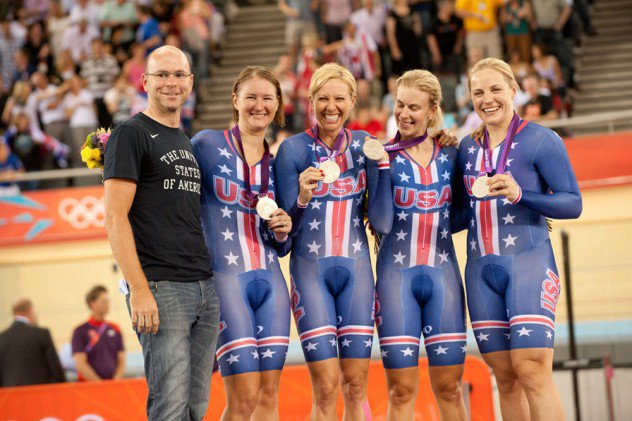
ABOUT BEN SHARP: Formerly a program director for USA Cycling, Benjamin Sharp is the resident Power Education Specialist for Stages Cycling. Prior to joining the Stages Cycling team, Benjamin spent seven years coaching the USA Cycling National Team. Under Benjamin’s guidance, riders racing for various national programs won 13 World Championships, and stood on 8 additional World Championship podiums. Benjamin’s crowning achievement was coaching the US women’s team pursuit team to the silver medal at the London Olympic Games in 2012. An accomplished athlete in his own right, Benjamin has amassed more than a dozen national championships in a cycling career that has spanned three decades. Benjamin is a USA Cycling Level 1 coach and has earned the USA Cycling Power Certification. As a coach, Benjamin’s strength is making accessible to the masses, the science of high performance elite athletics. As a Continuing Education provider for Stages Cycling, Benjamin now spends his time educating professional, amateur, and indoor athletes alike on the virtues of training with power.
This video gives me goosebumps every time I watch it!
Premium Members can download this Video for free by following the links below:
[wlm_private ‘PRO-Platinum|PRO-Monthly|PRO-Gratis|PRO-Seasonal|Platinum-trial|Monthly-trial|PRO-Military|30-Days-of-PRO|90 Day PRO|Stages-Instructor|Schwinn-Instructor|Instructor-Bonus|28 Day Challenge']
Right Click on the blue underlined link
Select “Download Linked File As”
Select a download location
Once file is completely downloaded, find it in the location you selected
Drag the file into your iTunes or Spotify library OR
Right Click on the file and Select “Open With”
From the drop down menu select “iTunes” or “Spotify”
File should begin playing and is now part of your iTunes or Spotify library
To download the above media on a PC:
Right Click on the blue underlined link
Select “Save Link As”
Select a download location
Once file is completely downloaded, find it in the location you selected
Drag the file into your iTunes or Spotify library OR
Right Click on the file and Select “Open With”
From the drop down menu select “iTunes” or “Spotify”
File should begin playing and is now part of your iTunes or Spotify library
Click here to watch a video on how to download media files from ICI/Pro.
Suggest finding someone who looks like this to help you evaluate your online registration system – or review the one you're using now.
Prospective Indoor Cycling Studio owners have hundreds of both challenging and easy decisions to make, long before they're ready to launch. Considering that your new studio will be a real business and the purpose of your business is to make money, the registration system you choose* to collect your money is pretty darn important… in fact it's crucial IMO. With multiple solution providers of online registration systems – how do you choose?)
I'd start by answering the: how easy/intuitive are the registration and collect the money process?
In the online world, marketers describe collecting the money as a conversion – I call it making a sale. Conversion percentages = what percentage of visitors who somehow end up on your registration page actually convert? Conversions don't always equate to sales. They can also be; create a user's profile, register for a class or even just join your email list.
Any difficulty the visitor experiences during the process can reduce the number of successful conversions (you don't get the money).
Now I don't need to tell you that different people, react to online “difficulties” or “frustrations” differently. You could throw any amount of digital confusion at either of my two girls and they'd still figure out how to register for your class. But there are potential customers who aren't comfortable with online anything.
Testing the registration and collect the money process
You're probably not the right person to test and compare online registration systems. The fact that you are here reading this tells me you are comfortable using a computer and are probably routinely using it to make purchases online.
I suggest finding someone in your life who's not all that comfortable with technology and ask them to help you evaluate the various systems. For some of you it could be your Mom (hence the Mom Test), a friend or family member that's similarly technophobic.
Here's how I would structure your “Mom Test”.[wlm_private ‘PRO-Platinum|PRO-Monthly|PRO-Gratis|PRO-Seasonal|Platinum-trial|Monthly-trial|PRO-Military|30-Days-of-PRO|90 Day PRO|Stages-Instructor|Schwinn-Instructor|Instructor-Bonus|28 Day Challenge']
Contact each company's representative and ask for a link to the home page of an actual studio that uses their system/software.
Collect each studio's link
Sit down with your evaluator and have them go through a complete registration process: Create a user's profile and then register and pay for an actual class. Yes, this will cost you a few dollars > what you learn will be invaluable.
But please don't waste their time and ask the studio owner to refund these small purchases.
While your evaluator is going through the registration process, You Need To Sit On Your Hands and offer no direction or assistance. Just watch exactly what happens and how she/he responds.
How quick was the process?
Was there any place where they got stuck
Did anything happen/change that caused them to question anything? Am I doing this right? Why was I taken here? etc…
With any luck you'll have a fun time doing this and learn a lot about what works and what doesn't, making your final choice easier. After all, you and your successful studio is going to be married to this software for years to come 🙂
[/wlm_private]*Of course this isn't the only reason you would decide on one registration vendor over another. If you have other questions you can ask me here.