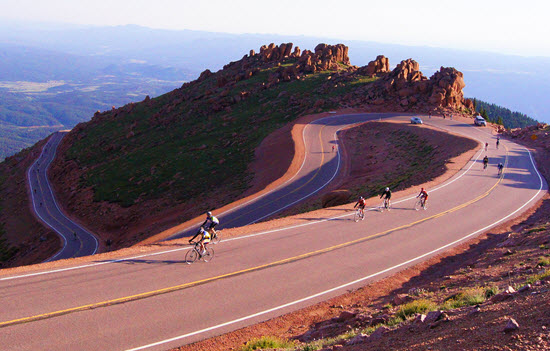
You'll be quicker up Pikes Peak after a winter training indoors with power!
While Performance Enhancement Specialist Dennis Mellon and I were getting warmed up to record his Audio Class PROfile Mashup – HIIT vs. Party on the Bike, we spent a few minutes discussing his thoughts and observations on coaching with power.
Were his participants seeing any improvement after a full winter training indoors with power?
If so, how are they comparing their performance year to year?
Has Star Trac been able to improve the consistence / accuracy of the Blade Ions?
Can we depend on riders bringing their own technology (HR Monitor, iPhone App, ect…) to class for the purpose of tracking performance?
Or is it better to provide rider data/metrics tracking as a service of the studio?
During our conversation Dennis makes an interesting comment about a summer class format, that could be of interest to the cyclists and endurance athletes who abandoned you this Spring. Many training plans call for very specific HIIT (High Intensity Interval Training) – which is difficult to complete on the road, but easy to do indoors. It may make sense to ask one of the local endurance coaches in your area if they would be interested in bringing their athletes indoors once a week to your studio.
You can learn more about Dennis here at his website.
If you'd like to learn more about automated rider data/performance tracking from Performance IQ with the Spinner Blade Ion or any of the other Indoor Cycles with power, please contact me and I'll connect you with the right people.
Indoor Triathlons are very popular here in the frozen north, offering club triathletes the chance to swim bike and run long before its warm enough to be outside.
In the past, the Life Time club where I teach used Spinner NXTs with a Spinning computer for the bike leg. Participants would run up from the pool, jump on a bike and pedal as fast as they can until the reached the prescribed distance. The clever one's figured out that the amount of resistance they used had no effect on how quickly the computer added mileage, so you had a bunch of flailing legs @ 130 RPM with no resistance = not really doing any real work 🙁
But not this year…
With all of our NXTs being replaced with Indoor Cycles with power, the participants in the Indoor Tri actually needed to “TRY” and ended up really working for their mileage this year!
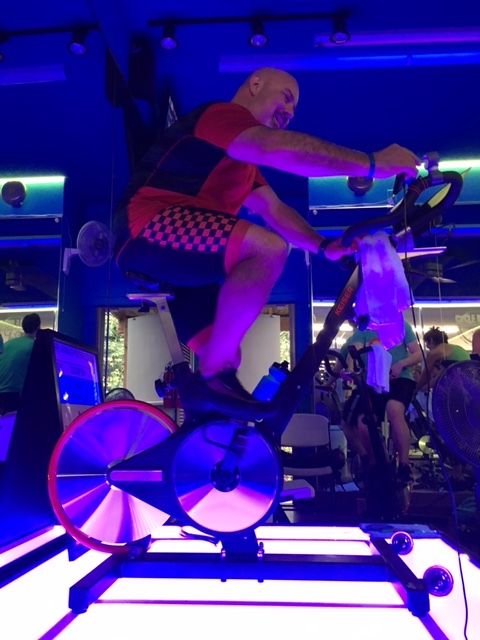
I took this picture while I was riding a FreeMotion S11.0 at 115 RPM, but with no resistance. You can see in the display that even though I was pedaling very fast, I wasn't producing any power because I had zero resistance. No power = no speed and more importantly, no distance is recorded.
I talked with a couple of finishers about their experience, especially what the bike leg was like, compared to last year.
“It was a lot harder.”
“More like riding outdoors.”
“I completely over did it trying to keep up with the guy next to me. My legs were junk by the time I started the run.”
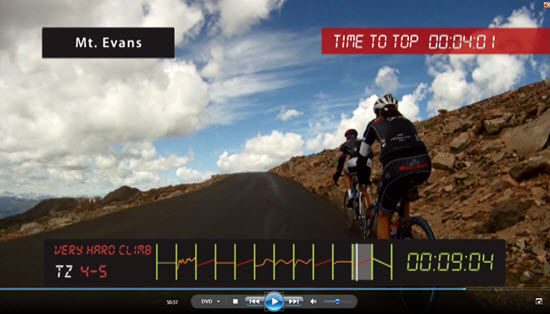
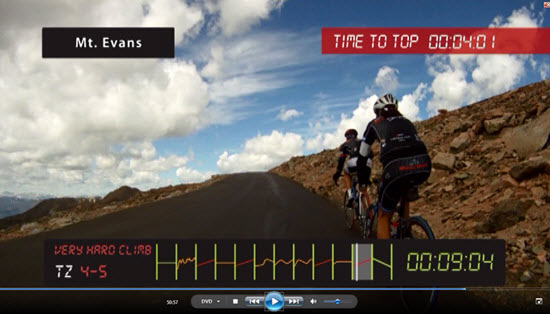
Screenshot of the Big Finish from Tour Of The West – heading into & above the clouds .
With the weather starting to break here in the frozen north, today [Sunday] is my last scheduled Performance class for the season. To celebrate our (hopeful) return to riding outdoors, I thought it would be fun to ride along with this new Indoor Cycling DVD from Epic Planet – Tour of The West.
This 60/45 minute video is a compilation of five minute long segments, from past titles, that includes various terrains. This should make for an excellent interval class, with lots of climbing, intermixed with plenty of fast flats.
I'll be coaching my riders to be working, as usual; Below/@/Above the PTP we'll discover during the first climb – segment #3 Mt Lemmon Climb. Alternately, you could easily coach this as an Interval set Below/@/Above Threshold Heart Rate, if you don't have power.
You might need some remote control for this
My preference is to ride along with the class, facing the screens, whenever I'm teaching to video. That way a can comment on what they're seeing + easily view the countdown timer. You'll need to have control of either your music… or the video, to pull this off professionally. With the of the video segments being exactly 5 minutes long, you'll want to change songs with the video. My playlist below is comprised of ~5:00 min songs (not exact), so you'll want to skip ahead a few times to keep the music and video in sync. Now if you've got a really long cord for your iPhone you're set. If not, my solution is to use an inexpensive Bluetooth receiver. You can learn more about using these simple devices here & here.
Tour of The West Class Profile
[wlm_private ‘PRO-Platinum|PRO-Monthly|PRO-Gratis|PRO-Seasonal|Platinum-trial|Monthly-trial|PRO-Military|30-Days-of-PRO|90 Day PRO|Stages-Instructor|Schwinn-Instructor|Instructor-Bonus|28 Day Challenge']
Featuring Epic Planet Video [ Title ] – the segments shown in Red are skipped if you select the 45 minute play option. My preference for a 45 min class, is to use the 60 min version and forward past #s 8 – 9 & 10. The first four segments conform better to my class format. You can obviously skip any three segments you choose, or if you're feeling devilish, repeat #5 [Beartooth Pass] to create a 10 minute threshold effort 🙂 Just make sure you have the video remote handy.
#1 [Wine Country] – Warm up > Let's get this class started! I take everyone through very purposeful series of intensity increases. The track Eireann is ~ 95RPM. Your objective to begin to feel warm and your effort should have you noticing that early change in breathing that signifies crossing over VT1 (Aerobic Threshold)
#2 [Saguaro East] – Openers > Repeated hard efforts, with the last one reaching Threshold. We slow the pedals to ~ 64 RPM to match the track Daybreak and I have everyone add load until they sense they need to stand > which we do. There's a nice build of intensity in the music that really hits at 1:00 where we accelerate to as fast as possible and hold for 30 seconds. I have my participants “walk”, with very slow cadence, during the recoveries. Follow the changes that you hear for around 30 secs on/off. Pay attention to the time on the countdown timer. I'll have everyone really push for the final minute. This should have everyone breathless (or close) so we get that first, painful trip to threshold out of the way.
#3 [Mt. Lemmon] – Four Minute “Best Effort” > I love these and my classes tell me they enjoy them as well = I include them on every ride I do, regardless if I have power meters or not. Use the first minute as an easy spin and to describe the effort to follow. If your power bikes have a stage timer, I encourage you to use it to time and record the maximum amount to work everyone can do during the last four minutes of the climb.
#4 [Monument Valley] – Establish “Base” Watts/Effort > I'll tell my class: On a group ride, you often don't get the chance to fully recover after a long climb. You have to keep up so you're not dropped, so you take whatever recovery you can grab. This often means you need to recover, while you continue to work, abet at a lower effort level.
Now that we're warm and aerobic, we'll use this fast flat (Call me the Breeze) @ 100RPM to establish the wattage or RPE, that has us early into Zone 3 – just above the transition in your breathing. I like to describe this as “above chatty”… and it is. VT1 is where your class begins to shut up and ride, because their need for O2 has them losing interest in talking with their neighbor.
NOTE: from here on we're limiting recoveries to no lower than “Base” Watts/Effort (HRs above Zone 2 / VT1) Your riders can recover there > it just takes awhile longer. This is a great opportunity to train out that need to; WORK – FULLY RECOVER. You never get that chance in the real world, why would you include it in your classes?
#5 [Beartooth Pass] – Five Minute “Performance Climb” > Between your “Base” and “Best Effort” is an intensity where you can perform for a long period of time. I make this time “self directed” by simply telling them; you've got a 5 minute climb somewhere between your base and best effort. You decide if you want to lead at the front… or struggle along at the rear.
Next you enter a series of rollers and short, steep climbs
#6 [San Diego] – Watch and ride these rollers. This segment includes a steep, 45 sec all out effort to keep up.
#7 [Mt. Baldy] – More rollers that have you powering your way over a 1:29 min and 1:50 climb
#8 [San Diego] – Hits with a sharp climb right at the start. Plenty of fast downhill action to stretch everyones legs.
#9 [Aspen] – 5 minute climb > back to a performance climb here. The rider's in this video don't appear to be working very hard = we just need to sustain the effort to keep with them. You're saving energy so you can beat everyone to the top of Mt Evans.
#10 [Sedona] – Begins with a gentle climb that flattens out to a nice fast flat were everyone should quickly find and maintain their Base Watts.
#11 [Mt. Evans] – BIG FINISH! > here's where everyone can demonstrate their physical endurance. THE RACE ISN'T WON AT THE BEGINNING… YOU NEED TO CRUSH THEM AT THE TOP! Here I'm asking for an effort above their 4 min “Best Effort”, for the complete 5 minutes. I don't care how they do it, I just want an average Watts / above Threshold HR for the total time. Get after it!
#12 [Wine Country] – Cool down and recovery
Here's the full playlist
Let me know how this worked for you. [/wlm_private]
No, these don't include anything from Andrew Zimmern
This short post covers 6 relatively unknown — and odd — tips that can help us control how much we eat.
Odd Tip #1: Hide Your Breakfast Cereal
This first tip comes from Brian Wansink, PhD, who is well known for his work on food psychology and eating behaviors. His research has revealed that simply keeping breakfast cereal in full view throughout the day — say, on the kitchen counter — has an impact on weight.
Two facts came forward with this.
It didn’t make a difference if the cereal was junky (Fruit Loops, Cocoa Puffs) or more healthful (oatmeal). Just keeping it visible was the salient factor.
Also, the difference in weight between revealers and concealers averaged 21 pounds.
Since it doesn’t affect meals directly, keeping cereal in the kitchen cabinet seems like an easy way to help control food intake.
Odd Tip #2: Change Your Plate Color
I’ve come across this tip in two ways.
1) Using a plate that’s the same color as the food you’re eating encourages eating more food.
Of course, meals typically include several foods of different colors. A practical way to use this might be to think in terms of side dishes you’d like to limit. For example, if the side dish is white — potatoes, pasta, white rice — it might be a good idea to avoid using a white plate.
2) Then there’s the color blue. Eating from a blue plate seems to make people eat less. One theory is that the color blue is “off-putting.”
I wonder this matches up with the first part because there’s no blue food. (Yes, blueberries are purple.)
So if we want to keep eating lots of vegetables, maybe we should avoid green plates(!).
Odd Tip #3: Limit Your Food Variety
Variety seems to make us eat more. That could be one reason that a buffet-style meal encourages overeating.
But I’ve also heard that keeping too many different types of food in the kitchen could have a similar effect, prompting us to want to sample the different foods.
Maybe the best way to enjoy variety would be to change shopping lists from week to week, rather than buying lots of different foods at one time.
Odd Tip #4: Use Smaller Serving Spoons
The test study I read about used M&Ms to investigate how people ate from a big, full bowl of the candies in an office setting. Apparently, a large scoop invited greater M&M consumption than a teaspoon.
I wonder if there’s an unconscious link between the number of “spooning” actions and how much food we’re willing to take. One scooping action may seem less greedy than 5 teaspoons, even if the quantity is the same.
A practical way to make use of this at home might be to use a smaller serving spoon for the foods you’d like to limit (for example, mac & cheese) and a larger one for vegetables and other healthful fare.
Odd Tip #5: Change Your Eating Rate
Slowing down is a meal tip that’s been around for a long time, and it seems intuitive that eating slowly would decrease food volume. But that didn’t seem to work for women, although it did for men.
What worked for both men and women was to begin the meal at a normal rate of eating, then slow down to about half speed for the rest of the meal.
The article I read didn’t specify exactly when to slow down, so I’d suggest just after the initial hunger has passed.
Odd Tip #6: Eat Smaller Food.
Cutting food into very small pieces seems to limit the amount we’ll eat.
Again, I wonder if it relates to arm action, the plate-to-mouth action. If it takes more of those actions to eat the food, maybe we unconsciously limit the number of times, rather than the amount of food per se.
Whatever the reasons behind these odd tips, they don’t involve eating different foods or counting calories, just a simple shift in behaviors.
I’m for whatever works, so why not give them a try? And if they help with holidays meals, so much the better. Please let me know which, if any, work for you.
Do you have any understanding of using Earthing / Grounding to enhance recovery? How about PEMF or Thermogenics?
Many of the top endurance athletes in the world are using these technologies to speed and enhance recovery – including IRONMAN Triathlete, Endurance Coach and ICI/PRO Team member Ben Greenfield.
I hate to admit it, but these technologies were almost completely unknown to me until this interview with Ben and I'm guessing you may appreciate learning about these alternative recovery tools as well.
During the interview we discuss Ben's live health and fitness conference he has scheduled for March 8th and 9th in Spokane WA.
Discover The Fastest Way To Get A Better Body, Enhance Performance, Cut Through Diet Confusion, Blast Body Fat & Live Longer — At The “Become Superhuman” Live Event On March 8 & 9, 2013.
It’s time to cut through all the useless diets, workouts, supplements, drugs, books and plans — and instead find out what really works when it comes to losing fat fast, performing at your peak capability, living longer, and having the energy the way your body is supposed to actually have all day long.
Listener's interested in learning more about Ben's event can click here – be sure to use coupon code icipro to save $50.00 on the registration fee.
You can listen to the interview below or click here to subscribe to our free podcast in iTunes.