Paul Camerer, AKA Pink House, is walking proof that (220 – your age, shoe size, mailing address, phone number … or anything else) will not give you an accurate Maximum Heart Rate number to base your training zones. Paul is 91 (92 this December) and regularly rides at 30 or more beats above his “Age Predicted Maximum Heart Rate”. The guy is precious and I had the privilege to interviewed Paul back on Podcast #18 when he was only 90.
Here is an update about Paul from Sally Edwards' blog.
Pinkhouse (aka Paul Camerer) almost 10 years ago, started the first “garage gym” named after the color of his east Sacramento home. Today, he is nearing his 92nd birthday and he wanted to continue to demonstrate that maximum and threshold heart rate do not decline with age as many believe. Pinkhouse is but one example that the age-adjusted formula 220-age=maximum heart rate is useless. Don’t use this formula.
The picture to the right is taken of the final average heart rate from today’s ride using the “Gymbotron”, a device that displays heart rate on a screen or wall. Pinkhouse rode 20 beats above what the max heart rate formula would calculate (220-91=129 bpm). He averaged 149 bpm for 52 minutes. That is he rode 20 bpm above his calculated maximum heart rate. The point Pinkhouse is demonstrating is that his maximum and threshold heart rates have not dropped a beat over the last 30 years that we, the Heart Zones Training certified trainers, have measured it.
I taught my last class today. My last ride so-to-speak. It all started seven years ago. I had been Spinning® for years. That day our regular instructor asked me to lead her class. She was just too sick.
To me – a pilot – it was like being asked to safely land an airliner because the pilots were incapacitated. Truth be told, I was far more prepared to land a 747 than lead the class. But I did it, and that is where my ride as indoor cycle instructor began.
Penning this post for ICI/PRO is – for the most part – where it ends. A memoire of sorts that highlights milestones of my journey from certified but lost, to Master Instructor, what I learned along the way about our craft and our industry.
Realizing the joy of being in the front of the studio, I took the first of countless certifications the next month. A one day, eight hour class. Leaving that afternoon I realized what I didn’t know.
I knew that to be the instructor I wanted to be, would require more than eight hours. So I did what all red blooded Americans do, a Google search on teaching indoor cycling.
Lucky for me John understands search engine optimization. ICI/PRO was top of the list and my life as an instructor changed.
Back then John was publishing ‘podcasts’ and posts talking about something he called Indoor Cycling 2.0. What?? I was in my car a lot in those days with my iPod plugged into the radio. I listened to it all trying to figure the best way to integrate such wisdom into my teaching.
There were guest speakers who discussed everything from music to very cycle specific training.
There were posts from this guy, Gene Nacey, who had started a company called Cycling Fusion. Gene wrote a book back then about training with power. The forward, written by Sally Edwards. Who were these people and why are they always talking about heart rate, power and cadence?
ICI/PRO offered class profiles with music suggestions. I found these very helpful but they had names like muscular strength or climbing power or aerobic volume training. It was all very overwhelming.
I realized what made it so overwhelming was that I had not really been educated. That my eight hour class hardly scratched the surface of what ‘training’ on an indoor cycle was really about.
My experience taking classes was just the opposite. My favorite instructor never did any of this stuff. I had reached a defining moment. Indoor cycling version 1.0 or 2.0.
I chose 2.0 because it had the education I yearned for and the structure that seemed missing from the classes I took. I had always been a fan of heart rate. Moreover, the new bikes at the JCC – where I was trying to land a sub job – measured heart rate and had power meters. I knew that seemed like the perfect combination but – at the time – had no idea why.
I got the sub job and a fair amount of opportunity to teach in those early years. I began my quest to get better through education. My sub classes (all I had at the time) were – unbeknownst to them – my guinea pigs.
Having read Gene’s Power Training Book there were some questions. I had found a way to land a ‘regular’ class in prime time by offering to do a power training course. I had questions, so I called him.
Gene is the quintessential professional. He always gave freely of his time to answer my questions. But he warned me, “Chuck where you are going you will discover a culture, the culture of indoor cycling. Good luck.” But more on that later.
Later that year he was doing the official launch of his new company, Cycling Fusion by hosting a summit of some of the most nationally regarded indoor cycle instructors. I’m not sure where I found the nerve, but I offered to kick off the summit suggesting that I was representative of the new 2.0 instructor. To my surprise Gene said yes.
The rest is history. My relatively short, but incredibly intense career really began at that summit, west of Denver high in the Rocky Mountains at Keystone Ski Resort. Why? I met Sally Edwards. Talk about unbridled energy. Sally – the only person ever inducted into both triathlon halls of fame – epitomizes it.
Suffice it to say that when I ran into Sally at the Denver airport after the summit I knew I was home. John led me into the room, Gene opened the window and Sally was the sunshine that poured through. There are not enough words to describe the learning one experiences working with Sally Edwards.
But if Sally was the sun shining on my personal learning crusade, Jim Karanas was the fresh air flowing through the open window.
Jim was indoor cycling 2, 3, 4 and 5.0 way before anyone ever heard of a ‘podcast’. Sadly, Jim left us a while ago, but his legacy lives on in all of those he touched. From Jim I learned to put the icing on the cake. That at the end of the day, it was not about me or just about heart rate or power, cadence or cycle specific training. It was about bringing to class the ability to touch each rider such that they were sure I was teaching class just for them.
When I made the choice to give up leading classes I did it with the knowledge that I had met my own challenge – to understand the whole of indoor cycling yes, but to touch the people who trusted me in a positive manner. How did I know? Simple really, rider feedback. Additionally, I had grown past the place where I was committed to only one way. I was comfortable teaching outside the keep-it-real philosophy that had governed my every thought for so long. I knew that Indoor cycling 2.0 was only a pass to explore and learn, not a rigid protocol to vigorously defend. That my job was not to suppose I knew what my riders needed, or how they got it, but to provide for them what THEY thought they needed that day. I can do that. I have done that. I am content. I have moved on but I have not forgotten.
In the coming weeks I will give John some additional posts written but never submitted. Posts that take a close, perhaps inside look at the realities of our industry. Fruit for thought or maybe, fuel for a fire.
It has been my privilege to have met and worked with so many great and talented individuals.
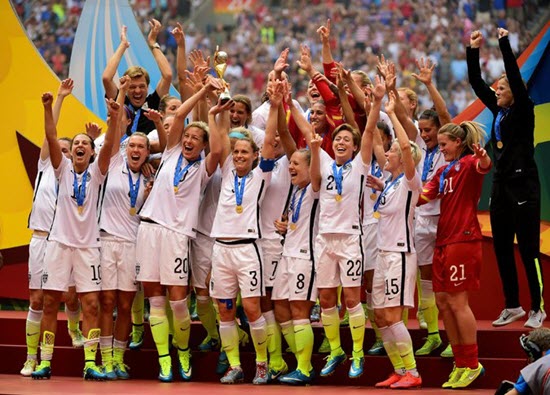
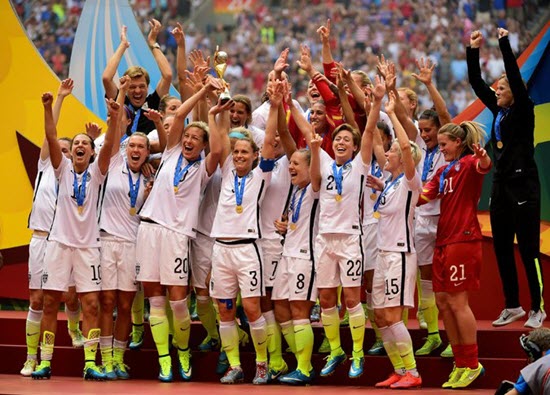
The USA Women won the World Cup finals in soccer yesterday!
The US team coaches are using heart rate training, aka Heart Zones Training, extensively in their preparation for what lead to this victory.
I wanted to share with you an article released yesterday about how that training is accomplished using training load points and player position specificity – and comments that I made in that regard in the article. You can read it here.
While members of the U.S. team will no doubt play their hearts out during the Women's World Cup final against Japan, a coach on the sideline will be receiving real-time data about their actual hearts.
Credit forward-thinking coaches who embraced sport science to improve performance: Each U.S. player wears a heart rate monitor — not unlike one you'd find at your local sporting goods store — when she trains and plays games.
But what makes these special is where the information goes and how it's used. Whereas a commercial monitor (or “wearable”) is designed for information to go to a wrist unit, an iPhone or iPad, and be used by the individual, for the U.S. women, there is a receiver that simultaneously collects the heart rates of 28 athletes to be analyzed by a coach.
[That “receiver” is the same as what's used to connect participants to the Display Training systems in cycling studios – John]
“What evolved [with the technology] was the ability for coaches to not only record the data, but be able to see it live,” says Josh Simonsen, a training specialist for Polar, the company that supplies the U.S. team with its heart rate system.
The data shows how hard a player is working, and can help a fitness coach determine everything from individualized training programs to deciding how much rest a player needs after a tough game. “If you take the women's national team, they're all fit. But it comes down to what type of fitness each player has,” Simonsen says.
What type of position an athlete plays also makes a difference, explains Sally Edwards, a heart rate expert and founder and CEO of Heart Zones, a fitness technology company. “In team sports, each player's position has unique physiological requirements, so the forward on a soccer team has to have different training than a defender,” says Edwards. “Some positions might need quick acceleration. Others might need endurance late in the game.”
With the use of sensor technology, a training program can be tailored to each player to make the fit even fitter.
If you'd like to learn more about this technology and how it could improve your team's performance, Use this contact form to request more information.
Sally
Sally Edwards, Founder and Head Heart
Heart Zones, Inc.
Hey [wlm_firstname] how hard should I be working to; get faster, lose weight, build endurance, ect…
Answering that is the age old dilemma many of us face when questioned by our riders. We try to be helpful by offering subjective descriptions of what both thresholds should feel like. We give breathing cues, run special FTP classes and/or include Best Effort intervals into our class. They're all designed to help our participants discover (for themselves) their threshold hearts rates and/or threshold wattages. We can get close… but at the end of the day they're still subjective measurements = not always as accurate as we would like.
Breathing gas exchange monitors can scientifically measure the two thresholds. Systems like those from New Leaf and Korr can objectively measure the changes in our breathing levels of O2 and CO2. They work well, but are very expensive to own (you can no longer purchase a New Leaf cart, now that they were purchased by Life Time Fitness) and individual metabolic testing can run to $200.00 or more. The actual tests are rather unpleasant, requiring you to wear a very uncomfortable mask – trust me on this > I've had over a dozen tests and would dread doing another.
The only other option was blood lactate testing during a graded exercise test at a university or sports performance center. Here they prick your finger every two or three minutes, while you work to failure during the assessment. I haven't done one of these personally, but it sounds equally unpleasant.
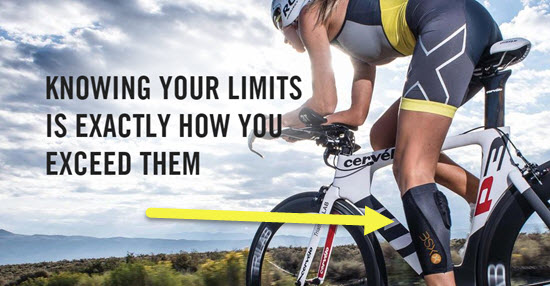
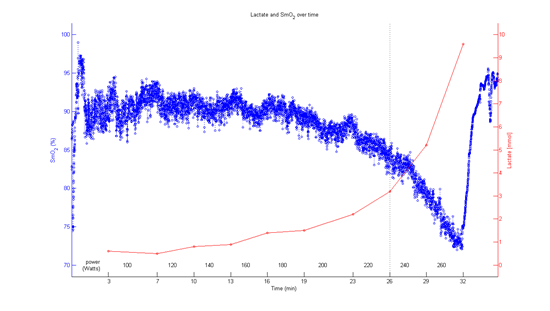
Enter the new BSXinsight – a wearable device that optically measures your O2 levels = this could be exactly what all of us training athletes were looking for. Pictured above, the BSXinsight is positioned on your calf using a compression sleeve. It wirelessly communicates with a smart phone and the data is displayed by (you guessed it) their special app.
Don't just listen to your body, look inside it.
Data and gear are only as good as their ability to improve your riding. Now you can access the most powerful training metric in endurance sports, making every mile more effective and putting every piece of technology you already use into valuable perspective.
BSXinsight uses revolutionary technology that allows you to see inside your muscle, measuring your lactate threshold and generating personalized training zones. Stop trying to “feel” whether you’re pushing too hard or leaving too much in the tank and let the science of your body speak to you.
Clearly identifying LT2 threshold
I just finished a fascinating conversation with one of the principals of the company. They have offered to send me a demo BSXinsight to experiment with. When I'm done I'll be sending it to Dennis Mellon for his feedback. Once we are done accurately learning our own LT and overlaying it with our Heart Rates and wattages, we will record an episode with the company spokesperson so we can share what we've learned with all of you.
When should you go hard… and when should you take it easy?
It's a great question. Often our response depends on very subjective feelings = we may think we know, but we really aren't completely sure.
As Jim Karanas pointed out in his Intervals post this week, we are often too focused on the Work component of exercise and not enough on the Recovery.
So how can you know when your body is rested and ready for more work? Athletes have for years used resting heart rate as a measure to understand. If it's elevated above normal maybe it's time to take it easy, or if normal, time to hammer.
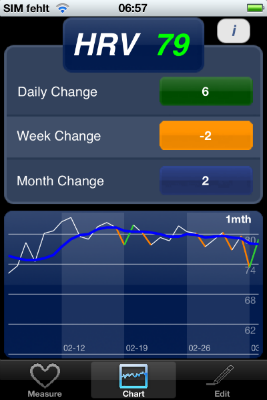
My guest today is Simon Wegerif, an expert on HRV and the founder of myithlete.com. Simon feels he has a more scientific method of deciding if & when your body is recovered and ready for more.
ithlete is an application for either iPhones or Androids that measures and tracks Heart Rate Variability (HRT).
We're using a new player now and iPhone & iPad users will now (finally) be able to play the Podcast directly from your device. Yes I realize it's a little ugly, I'm working on getting a better looking version.


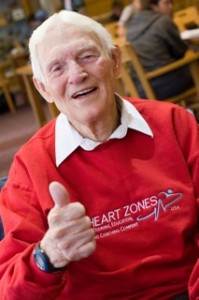 Paul Camerer, AKA Pink House, is walking proof that (220 – your age, shoe size, mailing address, phone number … or anything else) will not give you an accurate Maximum Heart Rate number to base your training zones. Paul is 91 (92 this December) and regularly rides at 30 or more beats above his “Age Predicted Maximum Heart Rate”. The guy is precious and I had the privilege to interviewed Paul back on Podcast #18 when he was only 90.
Pinkhouse (aka Paul Camerer) almost 10 years ago, started the first “garage gym” named after the color of his east Sacramento home. Today, he is nearing his 92nd birthday and he wanted to continue to demonstrate that maximum and threshold heart rate do not decline with age as many believe. Pinkhouse is but one example that the age-adjusted formula 220-age=maximum heart rate is useless. Don’t use this formula.