Everyone agrees that indoor cycling classes using heart rate are more effective and even more fun to teach. This post is not about which HR training principles to use or the best way to determine training zones. You or the facility at which you teach can decide those things.
This is about how to get your students to wear HRMs in the first place.
I’ve used HR-based training in all my classes since 1998. 100% of my students wear HRMs in every class. Instructors ask me how I achieved that.
Use HR-based training yourself.
You can’t convey the benefits of HR training unless you fully appreciate them. Once you adopt a specific training regimen, note your results so you recognize how the body is changing internally. My first awareness was on the rowing ergometer. (There weren’t many indoor cycling computers in 1998.) I was amazed at how my HR/power correlation improved with the use of periodized training.
If you don't prove to yourself the efficacy of HR training, you won’t present it to others with conviction.
Don’t Worry About Understanding Everything at First.
HR training science can get technical. You can use it and appreciate its benefits without understanding the science fully.
For instance, Polar offers Ownzone, a way of determining HR training zones based on Heart Rate Variability (HRV). HRV is not the easiest thing to explain. It's fascinating but takes a fair amount of study to understand fully unless you have lots of technical training. Still, Ownzone is an effective way to determine a student's HR training zones without a max-effort test.
One of the most interesting things about HR-based training is that it keeps evolving. Yes, there are way too many interpretations of the same information, but it's interesting to read and learn.
Perfect Your Pitch.
Sometimes I hear instructors ask if anyone wants to borrow or use a loaner HRM to try in class. Not surprisingly, the response is minimal. Your pitch is important. This is mine.
I never announce it. I walk over to a new student, hold up a HR strap and say, “Have you seen one of these before? No? This is a heart rate monitor. I want you to wear it today. It’s going to change your life.”
No one has ever refused. There’s no question in my mind that using a HRM will change his/her life. If you have that level of conviction, people will try it. They’re not paying for the loaner and have nothing to lose.
Carry Loaners.
I can't tell you how many of my HRMs have disappeared over the years. What's odd is that just as many HRMs come into my life as I lose. I no longer consider them an expense. If you want to teach with HR, you have to carry loaners. Get them on students at the start of every class.
You won't have enough for everyone and don’t need to. That's part of the fun. Carry three or four, plenty to get the class going. The others will want them next time. Then they’ll buy their own.
Cue Both Ways.
This is the clincher. It comes down to your cueing ability. You must make everyone feel part of the class but still demonstrate the efficacy of using HRMs.
Selective cues will make everyone see that the students using HRMs are actually getting a better workout than those who aren’t. It's extra work, but powerful. Example:
“Great job on that climb. Now spin your legs to recover, but not all the way. If you're wearing a HRM, I want you to drop your HR no more than 20 beats. Those of you without a HRM will not be able to do this as effectively, but you can still do it. Regain control of your breathing, but don’t feel as if you're cooling down. No shift in body temperature. This is only one of the reasons I want you to wear HRMs. They enable you to control the amount of recovery you allow yourself.”
Keep It Simple.
I was just talking about this with Team ICG® Master Trainer Chuck Cali. At ICG® Academy in SF, where we showcase Myride®+, we have many first-time cycling students. As we switch all of our classes to HR-based training, we have to be careful not to give too much information too quickly.
I call this Qualitative HR training. I don't talk about zones, threshold or HRV to start. I ask the students to watch their HR with respect to how they feel and what they’re doing. At what HR do you first start to breathe more consciously? Where’s your HR when you start to sweat? When you can't talk? When your muscles burn? When you’re cross-eyed and drooling?
Don't get rid of RPE. Simply get everyone to have FUN training with HR. There will be plenty of time later for numbers and metrics. And another post….
Can an Indoor or Outdoor Cyclist measure their power using only Heart Rate?
I personally find it hard to believe, and yet CycleOps says their new PowerCal will do exactly that. Now if I had seen this advertised on some late night infomercial I wouldn't have given it a second thought, but CycleOps is one of the leaders in Power measurement for both Indoor and Outdoor Cyclists… so it must work – right?
I contacted Angie Sturtevant from CycleOps and she has connected me with their product specialist. Maybe I can get him on the Podcast to explain how this works.
In the mean time here is a short video from CycleOps discussing the PowerCal.
Reaching the end of the MS150 yesterday Amy commented to me that she was still relatively fresh and willing to go longer… which was the exact opposite from last year when we arrived completely trashed at the end of both days. I was in complete agreement and began to wonder why I too felt great at the end of 150 miles in the saddle and didn't feel like I wanted to eat everything I saw for the next 24 hours.
Pulling up front, for 150 miles, riding the bus
The question we both had was WHY? This was the exact same route, distance and trusty Trek Tandem. (We call it the Bus) Our training was about the same both years… so that wasn't it. This year was a little bit cooler and there was a minimum amount of wind… helpful, but we have ridden in the wind before without needing a nap the minute we got home. So what was it?
Then we figured it out. This year we managed our intensity while pulling our team for nearly the entire distance; 150 miles over two days. And while averaging ~20MPH for the total distance we found ourselves ready for more. That's right, we pulled the whole thing 🙂
Now if you are confused as to how we were able to ride for hours without a break and still felt fresh at the end, it's really simple. I used my HR monitor as a GPS, instead of a Speedometer. Let me explain…
In years past we had two very strong members on our team: Dana and Jim. They could ride very comfortably at ~ 24 MPH, seemingly forever. Now if you don't ride outside trust me when I tell you that riding a steady 24 MPH pace takes a very fit and strong cyclist. Our strategy for the ride was to use Dana and Jim's strength to pull most of the time and the rest of us would keep up, riding in a nicely disciplined pace-line behind them. Sounds like a good plan except for one thing: with a combined total weight of ~320lbs (Me, Amy and the Bus) riding in a pace-line becomes a bit of a challenge. After years of racing both bicycles and motorcycles, riding very close to others is easy for me. Yes, Amy trusts me. Our problem was in responding to all the small changes in speed that occur in a group. In any pace-line these changes in speed can create a sort of Slinky or accordion effect that has riders in the back constantly slowing and then accelerating to catch back up. What can be easy for a single rider becomes a series of intense intervals on a 320lb tandem. Because the Slinky gets more stretched out, the farther back you are, we found that we needed to sit in the number two or three position.
As the third strongest bike in the group, Amy and I took occasional turns up front. The expectation (maybe peer pressure is a better way to describe it) was to maintain a constant 24 MPH. With one eye on my computer and one on where we were going, our pulls lasted until we could no longer keep our target MPH. I didn't pay any attention to my HR monitor other than a quick look to confirm what I was already feeling; I was way over my T2 – anaerobic threshold. Despite what you may think, both riders tend to work equally hard on a Tandem. Equally hard in relation to their level of fitness that is. If I'm above Threshold, then Amy will be as well. With both pedals solidly connected there is no way for the Stoker in the back to coast.
The end result was a fast, but very exhausting MS 150 that left us completely spent at the end of both days. And did we EAT! We would skip every other rest stop and when we did stop I would be shoving PB&J's down as fast as the volunteers would hand them to me.
This year was very different.
Guided by my Blink - Not my Speedometer
With no Dana or Jim this year we were a bit concerned about setting a respectfully fast pace that would have us showing off our sponsor's jersey, while passing hundreds of other cyclists. Amy and I decided to sit up front for a while and experiment with our speed on the flat sections. While monitoring my HR with my Blink HR monitor this is what we found:
17 MPH = ~140 BPM
19 MPH = ~ 146 BPM which is my T1 (Aerobic Threshold) or what I refer to as JRA (Just Riding Along)
21 MPH = ~ 154 BPM
23 MPH= ~ 162 BMP my T2 (Anaerobic Threshold)
So we settled into a very steady 21 MPH which we were able to maintain for hours at a time. If we encountered a change in grade or headwind I kept my HR right there in between both Thresholds, without concern for our actual speed.
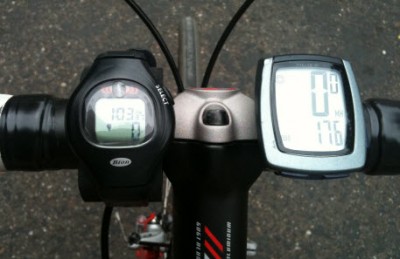
In this post I mentioned that I was using a Blink Heart Rate monitor because I can't see the numbers any more. It's flashing light shows me when I'm below JRA ( T1 or aerobic threshold), between T1 and T2 (T2 is anaerobic threshold) or above T2. Very simple. I like simple when it comes to trying to communicate with my class.
ICI/PRO member Chuck Cali has a fun video he shot as a way for users to learn a very simple assessment of T1 and T2. Except he doesn't call them T1 and T2… Instead he talks about Blue, Yellow and Red. Very simple 🙂
Please watch this and consider if this would be something you could teach on the bike as an introduction to Heart Rate training.
Here is Tom Scotto's first post in his official capacity as a Master Instructor here at ICI/PRO –
Indoor cycling instruction keeps progressing and improving and so do the bikes we ride. Today, many of our indoor bikes have more than the ability to add and remove resistance. Bikes are now providing us with cadence, heart rate, power, time and a host of other measurements to guide our rides and training. So I thought it would be good to talk about what these numbers actually mean and get some response from our knowledgeable community about experiences you’ve had or ways you’ve incorporated these tools into your classes and teaching.
“KILLER” Calories
OK, they are really not “Killer” calories but that is how is sounds much of the time when I hear people talk about it. We are referring to kcal. This is a scientific abbreviation for kilogram calories or kilocalories. It is generally used to indicate a “small calorie” or gram calorie. When written properly, it is presented with a lowercase “c” as in “cal”. However, like many things we try to understand these days, the inconsistency of how it is display and how it is calculated can create more confusion. So, by its original definition, kcal is 1000 “small” calories or simply a Calorie (note the uppercase “C”).
Without nose-diving into a verbose science lesson (which I’m not qualified to give), kcal or Calories is simply a measurement of energy needed or required. In science terms a kcal represents the approximate “energy” needed to increase the temperature of 1 gram of water by 1 degree Celsius. So on the bike kcal is simply a measurement of how much “energy” we are generating.
So how does the bike know this? Enter the joule.
Since these bikes are also calculating power output (watts — we’ll talk about that in another post), a joule is the measure of energy from the amount of force (mechanical work) required to move an object. Joules can be converted to calories (1 joule equates to 0.2389 calories or 0.0002388459 kilocalorie) – YIKES!!!!! Let’s just say that with my math skills, I’m glad computers can figure this stuff out.
Enough of that Brain Twisting — Is kcal Useful or Accurate?
In a “very” general sense 1 kcal = 1 calorie, but it is better to think of this as the energy that you produced during your ride rather than how many calories your body burned while riding. Here are some factors that affect the true conversion from 1 kcal to 1 Calorie:
(1) Muscle Mass
A person with a higher percentage or body fat will usually burn LESS calories than a person with more muscle mass. Since body fat percentage affects a person’s metabolism, it will affect how much it will cost them (energy) to do a certain amount of work.
(2) Fitness Level
A person who has a greater fitness level will more likely burn LESS calories than someone who is not as fit for the same amount of work or activity. Hence the benefit of training and adaptation.
(3) Body Weight
A person that has more body weight may require LESS energy to push (move) a certain workload (force) than an smaller, lighter person.
(4) Mechanical Efficiency
A rider with good form, posture and technique will fight the mechanics of the bike LESS and may achieve the same output with LESS effort of energy expended.
Because of all the possible variations and factors, it is best to use kcal as a “personal” benchmark. If you generated 500 kcals during a certain ride or training focus, you can try to replicate this on a future ride or try to exceed it. Use it to measure your progress or gauge how hard you may be working during a given class. Just remember, that different pieces of fitness equipment may not calculate kcal the same. This may be due to the mechanics of the equipment (treadmill vs. bike) or because they may include additional measurements (like body weight) into the calculation. Consider each piece of equipment its own animal and use kcal an estimation of how much energy one workout required compared to another.