As a training tool – running a PTP test/assessment is invaluable!
We had some excellent questions from Studio Owners this past weekend during our Full Psycle/PRO PIQ workshop. Paul Harmeling addressed these two related questions during the Q&A – I wanted to offer my thoughts on it here:
When, or how often, should we be using using the PTP (Personal Threshold Power) mode screen?
What exactly should we have our riders doing, during the PTP (Calc) test/assessment?
First, for those currently not using a Display System in your studio, let me explain what we're talking about. NOTE: I'll focus on Performance IQ because I know it much better – all of this has similar application with Spivi.
On a related note, I learned a little known trick that could potentially save a new studio enough money to pay for PIQ or Spivi – contact me if you're interested in learning more.
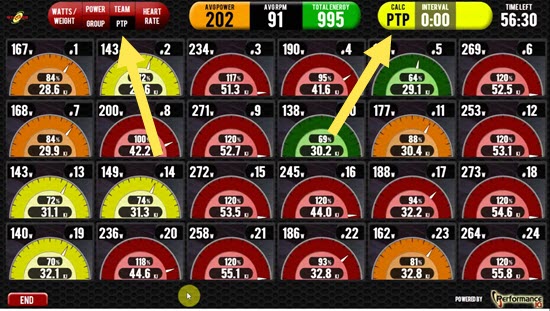
The PTP (Personal Threshold Power) mode screen in PIQ offers a quick (just three minutes) and simple tool to give your riders an approximate understanding of their maximum sustainable power wattage. Then through the wonders of technology, PIQ creates 5 power zones and displays them as different colors. The system calculates PTP as 90% of the highest sustainable power each rider can sustain for the length of the three minute test.
Is PTP as accurate as a 20 Threshold assessment? It doesn't matter to ~98.5% of your riders. What is important is that PTP answers the question that I've heard over and over the past 3 years I've been teaching with power: how hard should I be working… when you ask me to work hard?
So on to the questions:
When, or how often, should we be using using the PTP (Personal Threshold Power) mode screen?
Paul and I are in agreement here – we both feel you should be including PTP in most, if not all classes. There are of course exceptions. You may have a teams challenge scheduled or focus on a class that's directed toward handicapping everyone based on watts/pound.
What exactly should we have our riders doing, during the PTP (Calc) test/assessment?
Here's where Paul and I diverge in our thinking. I see this as a time for a focused effort in the saddle with a consistent cadence, where Paul was saying (and he demonstrated during the Master Class) that he's open to varying position and/or cadence. So who's right? I feel we both are 🙂
You see we each teach very different classes. Mine are typically focused efforts in the saddle = how I would run my PTP tests. Paul's classes are much more frenetic, with frequent changes = that's how he conducts his PTP segments.
Here's mine:
Running a PTP test isn't any different from the Best Effort intervals we suggest you use in a power class that doesn't have a Display Training system. Here's one I included in a recent Performance Cycle class.
Track #2 — the first PTP track is important. We’ll use this average wattage for each of the four PTP efforts to follow. Everyone seemed to enjoy Billy Idol — Rebel Yell — 1999 — Remaster — maybe suffered a bit as well. At 4:47 there’s plenty of time to explore PTP.
We use the Stage button to reset the averages at the beginning of what I describe as; Your Best Sustainable Effort. It’s normal for riders to miss-judge where they should be, so I’ll often have everyone make needed adjustments and hit the Stage button again to reset the averages.
My experience is that everyone will benefit from from a few mini (30-60 secs) PTP efforts to figure out where you should be. On any of the magnetic bikes I like to have find a reasonably challenging climb at around 65 RPM and then have riders accelerate to over 80RPM and observe what it feels like (RPE) and the wattage.
Two or three of these short intervals should give your peeps a watts window they can shoot for during the actual 3 minute PTP test.
I ask everyone to stand and walk, without touching the resistance, for a minute recovery.
To start the PTP test, I'll cue up a track like 83RPM Billy Idol — Rebel Yell and cue finding the cadence. Ten seconds to get everyone there and I will click Calc PTP. Encourage everyone to do whatever it takes to complete the assessment and let the technology work it's magic, figuring everyone's training zones.
I'm super excited to announce that ICI/PRO is teaming up with the owners of Full Psycle Indoor Cycling; Paul Harmeling & Shelly Scott. We are hosting our first Full Psycle/PRO Performance IQ Training on February 14th at the Full Psycle Studio in the Lincoln Park area of Chicago, IL.
1/20 update: There's just two open seats remaining.
I've taken over a dozen classes that incorporate PIQ Display Training – at studios across the country. In only one did I feel like the Instructor really understood how to effectively integrated PIQ into the class. That class was Paul Harmeling's and you now have the chance to learn from the person I see as the expert in teaching Display Training Indoor Cycling classes!
Can't make this workshop? If you would like to receive notifications of future events join this email list.
Listen to this short interview with Paul, where we discuss the details of the training we're providing February 14th.
This 6 hour, comprehensive training workshop will include two complete master classes. They'll be taught by Paul Harmeling & Shelly Scott – co-owners of Full Psycle.
To complement the Master Classes, we will be offering the following:
Understanding the basics of PIQ – presented by Tae Yoo
Troubleshooting and Best Practices
Training With Power for Indoor Cycling Classes – presented by Me John Macgowan 🙂
Maximising the functionality of Performance IQ and effectively class presentation using:
Power Screen/Race Mode
Heart Rate Training Screen
PTP (Personal Threshold Power) Screen
Watts/Lb – Weighted/Leveling/Handicapping Mode
Teams Screen
Building Entertaining Display Training Class Profiles
Creating Speciality Classes with PIQ
Get people excited about Display Training with Social Media
Using PIQ data to bring consistency to your Indoor Cycles
We are limiting attendance so we can include multiple opportunities for participants to demonstrate what they've learned. Instructors will need to conduct teach-backs throughout the workshop.
Tae Yoo is taking us all out for dinner Saturday night as the end of a great day of PIQ!
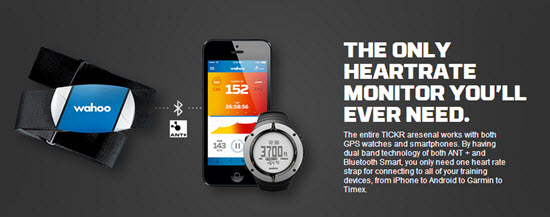
Finally a Heart Rate strap with both Bluetooth and Ant+ connectivity 🙂
I've been using a new TICKER Heart Rate Monitor straps – I'm excited to tell you about them + they'll be awesome used with the new Apple Smartwatch.
The guys at Wahoo Fitness emailed me today about their new line of HR straps that send out both BLE (Bluetooth Low Energy) and Ant+ frequencies. About time someone thought to offer both in the same monitor strap!
Up until now, your decision about what monitor strap to purchase was based on what device you wanted to connect with:
I want to connect to my iPhone / smart phone = you buy a bluetooth strap. Bluetooth is the only signal your phone can pair with.
I want to connect to a Garmin bike computer or use the strap with Performance IQ's display system = you purchase an ANT+ strap.
This new TICKR strap has both Bluetooth and ANT+ and it doesn't cost anymore than most single frequency straps – that's awesome in my book!
They've solved a second problem
How many times have you felt like saying; “IS THIS DAMN THING ON?
No Heart Rate strap, that I've ever seen, gives you any understanding that it's working. Is the battery good or dead? Do I need more spit to get it connected? I'm seeing that these new TICKR straps have two colored LED lights to show the TICKR’s device connection and heart rate detection – more awesomeness – and no more wasted trips to Walgreen's to buy one of those ridiculously expensive little flat batteries, when that isn't the problem.
I can't wait to try one and will update you once I have.
Over the past month or so we're published multiple posts related to the accuracy and consistency of the indoor cycles in our studios. Gene Nacey chronicled his experiments toward finding a method of handicapping his cycles, in the hope of addressing the differences in wattage he is seeing between bikes and my series on the results from our survey both pointed to the same conclusion; Indoor Cycle manufactures have work to do to ensure a level of consistency that will give both Instructors and participants the confidence we need to really use power as a training tool in our classes.
Last week at IHRSA, Amy and I had the chance to sit down with Keiser founder Dennis Keiser, before he formally announced that his engineering team had secured the first European EN-ISO 20957-1 accreditation for an Indoor Cycle that displays power – the new Keiser M3i.
The Keiser M3 group fitness cycle has been the first product of its kind to receive prestigious EN-ISO 20957-1 recognition for the accuracy of its power display.
“This is a big step. Our industry needs to validate the numbers that our users are seeing,” said Keiser founder and President Dennis Keiser. “This gives our customers a level of comfort at what they are seeing in our display.” The accuracy certification represents the first time that TUV Product Services, a European safety organization, has tested for accuracy in a data reporting system on an indoor group exercise cycle. To achieve EN-ISO 20957-1 recognition, TUV requires a group fitness cycle consistently perform within plus or minus 10% of accuracy. “To be the first in our industry to receive this is a great achievement and an honor,” expressed Keiser Vice President-Europe Alastair Watson. “It is important to everyone at Keiser that our customers know they are getting the best bike in the industry and the most accurate reporting system as this designation confirms.” Keiser has been the undisputed industry leader, the first to employ magnetic resistance, introduce power, and now the first to receive accuracy certification. “It’s very easy for someone to talk about the accuracy of power but this test is very difficult. To achieve what we have is significant,” explained Dennis Keiser. “We have been the leader and intend to remain the leader in indoor group cycling.”
Dennis explained to us that the primary focus of EN-ISO 20957-1 (ISO is the International Organization for Standardization) is safety. Passing is required to sell new fitness equipment in many European countries. The certification of any power displayed is a sub-category of EN-ISO 20957-1 that's been initiated to bring more consistency to our industry – something Dennis expressed is long overdue and I completely agree.
Now while a +-10% accuracy may not sound all that impressive in these days of super accurate (and expensive) bicycle power meters, that's the maximum allowable variation from any randomly sampled production M3i. To achieve that level of accuracy, while making allowances for production tolerances, Keiser's engineers designed the M3i to have single digit accuracy.
Upgrade for older Keiser M3s
So why would this be important to a club or studio who own the older versions of the Keiser M3? My understanding is that Keiser will be offering retrofit kits for older M3's. By replacing the console, a small circuit board near the magnet carrier and the magnet carrier you'll be able to bring your M3s up to this new certification's level of accuracy. Included with the kit will be the new power console that incorporates BLE Bluetooth Low Energy which will easily pair with an iPhone/Android phone + work with the new Keiser GX group exercise projection system for on-screen power and heart rate display in class. More about that soon.
Both are supposed to be available later this summer – I'll be posting the details on cost and how to order once it's been finalized.
That's Coach Robin Robinson in the pink jersey at IHRSA
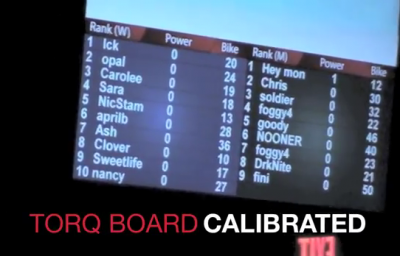
Flywheel's Torq Board – screen shot from youtube video
Updated: 11/23
Flywheel Sports is a chain of Indoor Cycling studios who started in New York city. They have had tremendous results and growth, now with 12 locations in three states; New York, Florida and Illinois. A big part of their success has come from a proprietary retro-fit system they have engineered to measure each rider's power and then display the real-time results on a screen. From their website:
… Additionally, for those who thrive on competition, Flywheel has developed the TorqBoard— an in-studio display that provides riders with the option to compare their performance against the rest of the class in real time.
The reason many students come to your class is for the community. Sure you maybe a great Instructor and include a lot of specific training into each profile you teach, but I'm convinced that the added element of friendly completion Flywheel's Torq Board brings is a big part of their success. Participants who are not achieving their personal fitness goals – read weight management goals – have a tendency to stop coming. We all understand that working harder (when appropriate) in class will increase fitness and burn additional calories. That's why so many of us are excited about power; for the first time our students can truly see what “working harder” feels like. Throw in the friendly completion part and you have the recipe for a fabulous sold out class
Beyond competition between riders, I see a remote display system like Flywheel's TorqBoard as solving multiple problems I'm hearing and seeing at clubs who have (or are considering) adding power based classes to their schedules:
Students have their heads down, completely focused on the display console – not on the instructor. With everyone riding with eyes forward they stay connected with you, the Instructor.
I can't see the display in a darkened class. A quick scan of your class will probably reveal an average participant age of 45-55 years old. Many of us (including me) have limited eyesight due to our age and when you dim the lights I'm nearly blind 🙁
Let's just add a constant back light to the console. Great idea until you realize that you will be replacing batteries at an even quicker rate than you do now.
Too many potential “computers” to fail. Henry Ford was famous for saying, “parts left off cause no service problems”. What if there was a system that eliminated the “computer” on each bike? Instead use a common system and eliminate some of the cost and maintenance concerns.
So let's say you think Flywheel's TorqBoard looks like something you would like to have in your studio… you can't have it. It's not for sale unless you are ready to become a franchised Flywheel Sports studio.
Enter Performance IQ and their new Top Power remote display system for studios using any of the Indoor Cycles with Power, including; FreeMotion S11.9, Keiser M3i, Schwinn AC or Spinner Blade Ion. Watch the shot video below to see this plug and play system at work at their second Beta site, Cycle Quest studio where I'm teaching. While it doesn't remove the existing “computer” on each cycle, it does solve the first three concerns I have listed above 🙂
To fully take advantage of Performance IQ's wonderful features, studios will want to offer a Bike Reservation system and data collection system that sends out those wonderful emails to each participant, showing them how many calories they burned in class.