My article about teaching a Cycle Sculpt class, that included using weights on the cycle, brought out a lot of strong comments on my Facebook. Understandably many of the commentators expressed concerns about safety:
I think the rub for me John is safety. Weights on a bike is an accident waiting to happen. I don't think it is responsible for me to put anyone in my club in a position where I can't keep them safe.
… but I do it safely & never use weights on the bike.
Strength train OR spin. Never both together. Lifting weights on a spinner is unsafe.
All perfectly valid concerns based on each person's perspective of what's safe and what is not safe, in an Indoor Cycling class.
We all don't have the same perspective of safety.
There's a couple in their middle 50's who've taken mine and Amy's classes for years – I will call them Doug and Linda.
Doug enjoys riding outdoors and he often joins us on group rides. He's a reasonably strong rider, with good cycling skills and I enjoy riding with him.
Although she has the fitness, Linda refuses to ride on the road – “too dangerous” she'd tell you. She'll ride in the neighborhoods and sometimes venture out on one of the many biking trails we have here. But that's it. No riding on the road for her.
So who's right here? Doug? or Linda?
A valid argument can easily be made by both. Doug may site thousands of incident free miles – does that make him right? Or if he crashed on his way down of the driveway tomorrow, would that have Linda correctly telling him “I told you cycling is dangerous”?
Is the perception of safety based on the potential of injury?
Crashing a bicycle hurts… a lot. Trust me when I say; I know exactly what it feels like to roll across the pavement at 20 miles per hour, wearing nothing but a helmet, a nylon jersey and Lycra bike shorts. There's a very real potential for serious injury every time I go on a ride. I have had friends hit (and yes unfortunately even killed) by cars/trucks and other cyclists while riding on the road.
Having intimate knowledge of the potential for getting hurt, I still head out on my road bike without a second thought. It's even worse for Amy on our tandem. She has absolutely zero control from her place as Stoker. She has to sit behind me and trust completely that I'll bring us to the finish safely. Amy has seen first hand what can happen riding with a fast group – when things go terribly wrong and next she's dialing 911 – 3 times to date. She's also the first person to ask; “are we riding tomorrow”? Oh, and Amy likes it when insists that we're leading the fastest group on the road, during any charity ride we're on.
Linda's position would be that Amy and I should stay home and take up gardening – or some other safe activity. Our response would be; while we recognise the possibility that we could get hurt, we still choose to ride outdoors. Basically we accept the potential risk and believe in our own abilities as cyclists to participate safely, in an activity that others would view as too dangerous.
But the comments weren't about your safety John, their concerns were for the safety of the participants in the class.
I've been a sort of evangelist for cycling outdoors, for years. I talk frequently in my classes about how enjoyable it is to get out and ride. I show videos of beautiful cycling destinations in almost every class. I've lead group rides consistently since the late 90s. Dozens of cyclists have been personally mentored by me, as they learned to ride properly in a group. Amy's no different. Give her the chance and she'll tell you endless stories about how much she enjoys riding our tandem with our cycling group.
Based on her perception that outdoor cycling as unsafe, couldn't Linda easily say that Amy and I (and maybe you) are promoting an unsafe activity?
As you can guess, my answer would be a firm NO!
I don't share Linda's perspective that cycling is inherently unsafe for myself, Amy or others who I encourage to take up the sport. Why? Because I have years of direct experience that cycling on the road can be safe, if done safely. Is there crazy, stupid stuff that you can do to make cycling unsafe? Of course there is – I choose not to do them, instruct those who I ride with not to do it and am the first (or second as Amy is pretty quick to voice concerns) to reprimand someone who's behavior is endangering themselves or others.
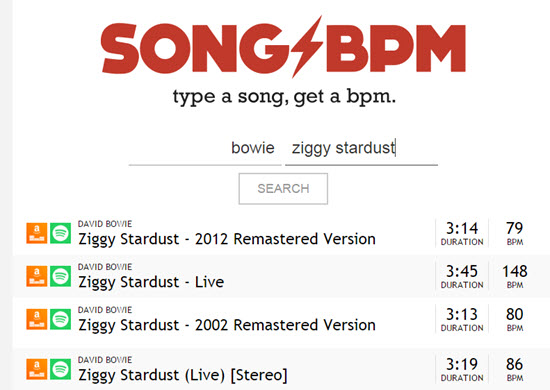
I saw this online tool, after following a link posted by Kor180 studio owner Maja Kermath on Facebook. After trying a few tracks that came to mind, it worked so well that I felt I should share it with you. https://songbpm.com
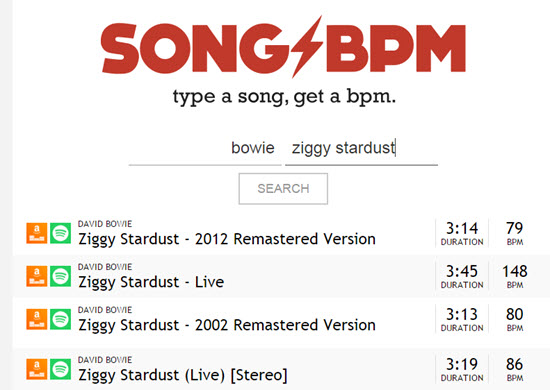
The songbpm.com tool searches the Spotify database and returns all the posibilities found. It's interesting to me how the various versions of Ziggy Stardust are all at a different BPM.
79BPM or 148BPM… what's the difference?
The live version of the song above is listed at 148BPM, while all the others are around 80BPM. Obviously the live version isn't played twice as fast. Rather if you know the original song you'll hear that the live version is a bit slower @ 74BPM – 1/2 of 148BPM. The software is counting this track differently, which is why I prefer using….
Tap-To-The-Beat Music Counting Tools
Following and riding to the beat of the music, does require you be able to hear the rhythm and then match your movement to it. That's why I've always recommended Instructors actually listen to each track and then tap out the beat using one of the simple tap-to-the-beat counters listed below.
The Windows version Tap-To-The-Beat counter isn’t pretty, but I’ve used it for years — download it here. It will show as an .exe file in your downloads folder. Double click to open it and start tapping the Enter key in time with the beat that you hear 🙂
Image of Dr. Suzuki and her team from suzukilab.com/
Here's a creative exercise for you to try.
Imagine that tomorrow you begin marketing your Indoor Cycling classes differently… Instead of focussing on physical benefits of increased strength, endurance or weight management/loss, what would happen if your marketing was directed at cerebral benefits instead?
Do you feel you could possibly attract a new/unique group of participants? Maybe those people who aren't necessarily interested in physical improvements. Computer types (geeks) come to mind. They are rarely seen in your studio, unless they're there to fix your computer of course 🙂
But what if you were able to show the Geek Squad technician that your special classes could actually improve their troubleshooting, problem solving or coding skills… things he/she might really be interested in improving?
Or how about that advertising firm officing across the street? Do you think they would be interested in a brainstorming class where their entire team could spark some additional creativity?
There's a lot of scientific research that is proving the link between exercise and improvements in the brain in the form of enhanced memory and creativity. I posted a fascinating Ted Talk video presentation last month on the subject and the presenter is my guest for this episode – neuroscientist/group fitness instructor Dr. Wendy Suzuki.
Dr. Wendy A. Suzuki is a Professor of Neural Science and Psychology in the Center for Neural Science at New York University. She received her undergraduate degree in Physiology and Human Anatomy at the University of California, Berkeley in 1987, studying with Prof. Marion C. Diamond, a leader in the field of brain plasticity. She went on to earn her Ph.D. in Neuroscience from U.C. San Diego in 1993 and completed a post-doctoral fellowship at the National Institutes of Health before accepting her faculty position at New York University in 1998.
Listen to this episode below.
Near the end of the interview, Dr. Suzuki describes a clinical trial she running on the effects Indoor Cycling has on cognitive abilities. Participants are riding three time a week at Swerve Fitness in NYC and she says that their study results should be completed by the end of the year.
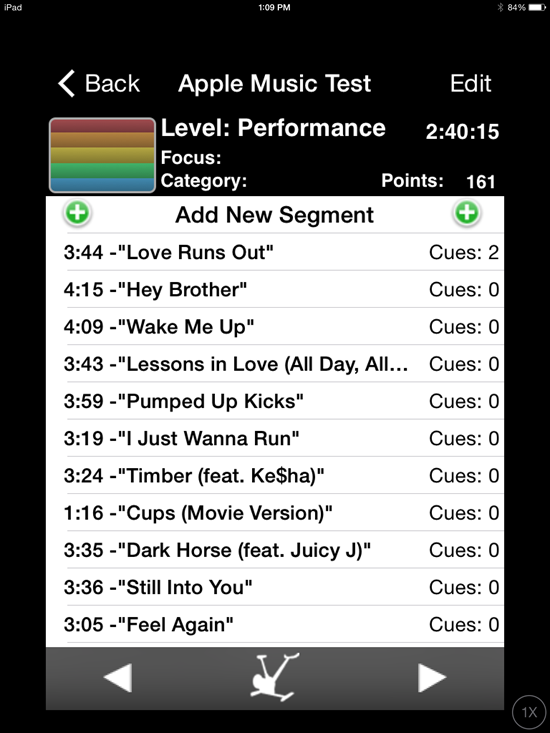
Do ClassBuilder and Schwinn's Class Tamer iPhone Apps work with Apple Music?
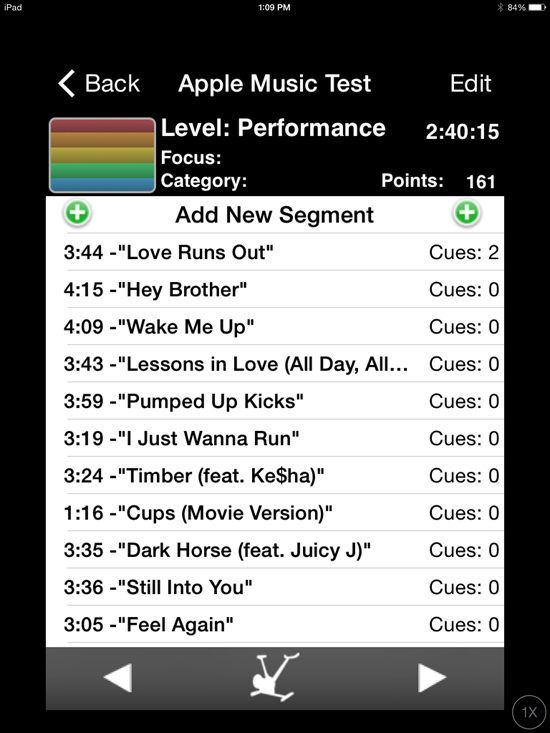
This person on Facebook said they both do… which would be very cool. So I renewed my efforts, fought through the confusion and she's right! I was able to open an Apple Music playlist that Dennis Mellon sent me, with either ClassBuilder or Class Tamer with my iPad*. I added a few cues and nearly everything worked perfectly – even in off-line mode.
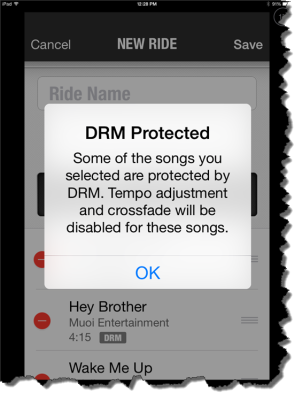
The two exceptions being the cross fade and tempo adjustment functions in Class Tamer won't work. It's because of the DRM that protects each track delivered through Apple's streaming service.
With Apple Music, that would be all of the songs you selected have DRM.
* Tempering my enthusiasm is Apple Music on my iPhone still doesn't work. It refuses to see the the Apple Music playlists in iTunes on my laptop.
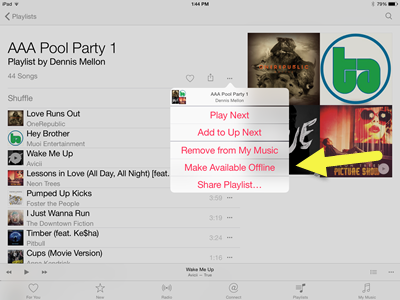
Here's that playlist from Dennis if you'd like to experiment. I'd open that link with your iPhone/iPad. Then set the playlist to Make Available Offline so ClassBuilder or Class Tamer can see the tracks. It appears to me that these downloaded tracks are normal AAC music files, except for the DRM that prevents you from copying, burning to a CD or keeping the files if you don't continue your monthly payments.
Tap the … more icon for the off-line option.
When I tried to open it on my computer it repeatedly send me to the “Download iTunes” page – even though I had iTunes open. I rebooted everything and when I re-opened iTunes I could see the new playlist… but at this point I still can't drag the playlist onto my phone and sync using wifi or the cord.
At launch, many users had trouble adding new music to their libraries, due to an apparent bug with the iCloud Music Library, which wouldn't activate for some users (myself included). This feature, which allows you to sync your collection across devices, is apparently also required to add tracks to your collection in the first place (even if you're only using Apple Music on one device). Strange. Although Apple had apparently fixed the iCloud Music Library bug within a matter of hours, the fact that the service requires this extra step for such basic functionality is a head-scratcher. Nearly 24 hours later, the songs I've been saving in the app still aren't showing up under the “My Music” tab. Presumably that will change at some point.
While it's convenient to be able to merge your existing tracks with Apple Music's library, the mechanism used to do this will madden many people: You have to use iTunes. Some of us would prefer to never see or think about iTunes ever again. And the thing is, it's totally possible to transfer music from your computer to a phone without using clunky desktop software. Spotify lets you sync your local MP3s to its mobile apps, but even that requires routing things through the Spotify desktop app.
What an interesting space streaming music has become.
Facebook has been in talks with major record labels with the intention of “getting into music”, according to reports.
Record labels including Sony Music Entertainment, Universal Music Group, and Warner Music Group have all spoken with Facebook, according to The Verge, though the exact purpose of the talks has yet to be confirmed.
Speculation around why Facebook is expressing an interest in music has centred around the possibility of a streaming service to rival the likes of Apple Music and Spotify.
Sources close to the talks claim that they are still in the early stages, but suggest that Facebook is planning something “unique”.
A separate report by Variety on 1 July detailing Facebook's intentions to test video ads could hint at the manner in which the social network plans to monetise any potential service.
Facebook's addition of listen buttons to artist's pages is as far as the firm has gone in creating its own music service and a fully developed streaming service could be seen as the next natural step.
With all the cash Facebook has, I wouldn't be surprised if they bought Spotify and/or Deezer shortly. We'll just have to wait and see.
I'm seeing that E! Entertainment Television has released a couple of trailers for their upcoming show about Indoor cycling Instructors > Hollywood Cycle. Looks like your garden variety fitness studio drama. Nothing different than what we experience every week at Life Time. Does this look like your studio as well?
The show is scheduled to begin July 7th 10/9 central on E!
We were waiting for a long traffic light to change yesterday, when one of our group asked me a question; why do you unclip your left foot? I always unclip my right… personal preference, or is one way better/more correct?
The women who asked this question is a relatively new rider. This is her second year road riding with our outdoor group. Like many who've become passionate cyclists, she has become a student of all the little details involved in cycling. So she's often curious, questioning us about things we do on the road. I remember her asking last year why I would always stop in the center of the righthand lane, rather than staying on the shoulder. She quickly understood when I explained that by claiming the lane, it would hopefully prevent a car from squeezing us into the right hand curb, as we cross the intersection 🙂
Seeing that there are a bunch of Instructors riding outdoors, I thought I would share this with you. For your benefit, and possibly some new rider you have the opportunity to mentor someday.
My view is that unclipping should always be done with your left foot, regardless of which footed you are, because it's safer.
Regular or Goofy Foot?
Lead foot choice on board sports like; Slalom Water Skiing, Wakeboarding, Skateboarding and Snowboarding are designated as;
Left foot forward = Regular Footed
Right foot forward = Goofy Footed
I have no idea when I first heard the term Goofy Foot, but I do know it was waterskiing. I always had my right (Goofy) foot in the forward binding of the ski. I just felt more natural for me, even though all my friends did the opposite. With these sports it's a matter of personal preference.
Why does it matter which foot on a bicycle?
Here are a few reasons I feel it's safer unclipping your left foot during a controlled stop. NOTE: road cyclists should be comfortable unclipping either foot in case of emergency.
#1 That front chain ring is really sharp!
Like a stationary saw blade… ready to slice open your calf!
I didn't want to post the actual picture, but this link shows what can happen when your foot slips off the pedal when you aren't successful clipping in and you're in your small chainring. Ride long enough with slippery road pedals and there'll be a time when you put pressure on an unclipped pedal. Your body weight quickly carries your sliding foot across, and then off, the front of the pedal. Do it with your left foot and you'll just be embarrassed. With your right and there's a chance you'll need stitches from your right calf scraping across those sharp teeth and a tetanus shot – those teeth are not only like little razor blades, they're also really dirty.
This actually happened to my buddy Randy Erwin a few years ago. He had been following Amy and me on our tandem. Amy looked back and saw him stopped, hunched over his bike. Once we rode back we saw all the blood – he did too and nearly passed out from it.
#2 Your right leg is probably stronger
Watch a child or new rider leave from a stop and you'll normally see them repeatedly pushing/pawing off with the unclipped foot – often with the clipped-in pedal in it's lowest position.
Experienced riders start with the clipped in pedal positioned around 2 o'clock. This allows you to power away by driving the clipped foot down, using a normal pedaling motion. The unclipped foot can help push off a little, but it's mainly for balance. This first pedal stroke needs to be powerful – so use your strongest leg! With 90%+ people being righthand dominate, your right leg is typically stronger.
You might need to complete multiple rotations with just one leg, before pausing long enough to get the second foot secured. Another reason you need as much strength as possible.
NOTE: for you “lefties” I still feel the potential danger listed in #1 should have you unclipping your left foot.
#3 Keep your down foot on the high side
This might not apply where you live – and it will be contraindicated (a new use for that term) for our friends in the UK, Oz and other British territories. Roads are often constructed with a “crown” = the center of the road is higher than the shoulders. They do this to speed rainwater runoff and it will naturally cause an initiative/sleeping driver to steer away from oncoming traffic. So for us who drive on the right/correct side, your left foot will be on the “high side” = you may have better balance than reaching down to the low side.
NOTE: for you who drive on the left/wrong side, I still feel the potential danger listed in #1 should have you unclipping your left foot.
#4 Don't get confused
Err… not sure?
After leading group rides for 20 years, it's not uncommon to see a rider who appears confused at a stop – they aren't sure which foot to unclip. As you know, confusion can lead to indecision and indecision on a stopped bicycle frequently leads to someone tipping over. Embarrassing and often painful 🙁 Not to mention any names, but I have a guy… Lee, in the “C” group I lead (my community service) with this problem. More than once a ride I'm seeing him jump out of both pedals and then slide on both feet until he stops!
Decide what you're going to do in advance. Make a conscience decision; “I'm going to go Goofy and unclip my left foot!” as you roll to the stop with your right foot at the bottom.