“I don’t stop when I’m tired. I only stop when I’m done.”
It surprised me to learn that the above quotation came from Marilyn Monroe. How many times have we heard those words in connection with athletics?
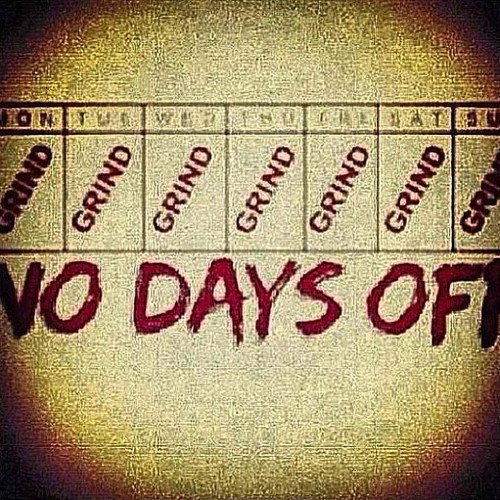
In the training and weight loss program I taught for 14 years, participants would sometimes wish for a day off, or even several days. They’d tell that to the strength-training coach, for example, and his reply was an annoyed, “There are no days off! This is it — the way you eat, the way you train — all the time.”
Men can get away with saying things like that more easily than women can, I think. Regardless, I appreciated him for saying it — and, of course, agreed with him.
One participant asked me if she could stop keeping her food log on the weekends. She acted as if (and maybe actually believed) she just wanted a break from logging.
It seemed obvious, though, that those days off would only encourage her sugar addiction. I imagined her stopping the log not on Saturday, but on Friday morning, eating sugar nonstop for three days, and re-starting her log sometime on Monday.
What I pictured most vividly, however, was her discovery that she wasn’t losing weight and asking for my help. But we’d have no records of her weekly binges.
I told her the truth: I couldn’t stop her from doing that but wasn’t going to approve it. How could I agree to help her fail and then tell others that our program didn’t work?
Toward the end of 2014, I read an article for entrepreneurs on finishing a great business year. The author explained that the only way to finish the year strong was absolutely to understand that there would “never be a day that (would) not require dedication, discipline, perseverance, accountability, and the need to execute relentlessly.”
Wow. That article may have been written about business but is all about fitness, athletic training, even weight loss. We know success in those areas depends on consistent and persistent action, not on temporary changes till the pounds are lost or the goal is reached.
I must be in a quotation kind of mood because Dan Millman comes to mind:
“There are no ordinary moments.”
Isn’t that what wishing for a day off is — a wish for moments that simply don’t count? Moments with no repercussions, when we can do what we know we shouldn’t and not suffer the consequences?
I’ve wanted those moments, too: when the alarm wakes me at some ridiculous hour to go train, for instance, or when I was flat-out tired of writing my dissertation.
We’ve probably all had moments when we wish for ordinary moments. But since I’m quoting everyone else’s wisdom today, here’s the proverb I like best in this context:
“When climbing a mountain, give up a thousand times; just keep your feet moving.”
That one really works. We can mentally go in any direction — discouraged, foolish, negative, fanciful, absurd — but never let it affect our behavior or change our plan of action.
At this point in January, some of our participants or clients may already be struggling with a motivation slow-down. Instead of trying to recharge everyone’s battery, which will need to be done over and over, why not encourage them just to keep their feet moving, no matter what?
And on that note, how about one final quote:
I do not believe in a fate that falls on men however they act, but I do believe in a fate that falls on them unless they act. — G.K. Chesterton
Can an argument be made for deemphasizing “Outdoor Cycling” in your Indoor Cycling class?
Or asked differently; would it ever make sense to remove many (if not all) of the references, imagery and cuing related to riding outdoors?
Life Time Fitness thinks we should and for some class times and populations, I agree with them.
Evolution Cycle is the latest branded cycling class format from Life Time Fitness. As part of the training, we were asked specifically to reduce/limit references to riding outdoors. Why? Because a large percentage of our members do not ride outdoors.
Have you ever had an experience like this?[wlm_private ‘PRO-Platinum|PRO-Monthly|PRO-Gratis|PRO-Seasonal|Platinum-trial|Monthly-trial|PRO-Military|30-Days-of-PRO|90 Day PRO|Stages-Instructor|Schwinn-Instructor|Instructor-Bonus|28 Day Challenge']
Do I look like a person who uses coupons?
Have you ever been in a situation where some passionate person is extolling the virtues of an activity, one where you have absolutely no interest? They go on and on, almost to the point of lecturing you, about how they know what's best for you.
I met one of these folks recently… a female cashier at the grocery store:
Her: Do you have any coupons, sir?
Me: Uh, no, no I don't.
Her: They could save you a bunch of money.
Me: I don't have any coupons.
Her: They're easy to find… we have a supplement in each Sunday paper.
Me: (getting annoyed) I don't subscribe to the paper.
Her: We're happy to mail them to your home – big smile – can I get your address?
Me: Can I just pay, so I can go?
Her (sensing my annoyance): I was just trying to help you save some money, sir. I can't understand why you wouldn't be interested in that!
Me: (losing it) I'm sorry, but do I look like a guy who uses coupons? I hate coupons. I have a lot of anxiety whenever someone gives me a coupon for my next visit. Will I remember to bring it? Of course I don't. Then I'll be standing here in line, dreading the inevitable question I know you'll ask, BECAUSE I WILL HAVE FORGOTTEN THE DAMN COUPON AT HOME.
Do you think that just possibly, there are a few participants in your class who are disinterested in outdoor cycling? Maybe they're a bit over weight and intimidated by a fit peer their same age? Or they are afraid to ride outside? Or they don't want to be told they're missing out by not riding on the road?
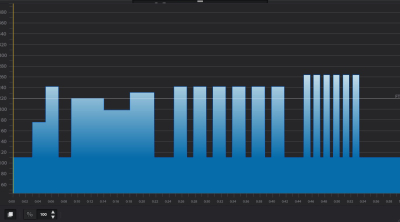
The change from the previous 60 minute “Studio Cycle” format, to the new 45 minute Evolution format, is based on the competition Life Time is feeling from boutique studios. The goal is to appeal to everyone, cyclist and non-cyclist alike and fill the studio with people. As an Evolution Instructor, I now use slightly different language ad let the music do most of the talking. The class, now shorter, is supposed to be harder (above threshold work) and more energetic/entertaining than the old Studio Cycle classes were.
LTF has also added an official Rhythm/SoulCycle like ride they call Cycle Sculpt at select clubs. I taught one of these classes a year ago and wrote about my experience here (complete with the profile and playlist).
So how can I tell if I'm too much outdoor cycling?
When I consult or talk with Studio Owners I'll ask them this question. Overall, what is your participant split between cyclists and non-cyclists? My observation is that having a high percentage of cyclists – over ~30% across all your classes – is an indication that something is wrong. This high percentage of cyclists tends to correlate with smaller overall participation rates, especially in the summer months when cyclists abandon you for riding outside.
IMO a large percentage of cyclists is an indicator of who's not in the studio. It's my impression that Life Time is seeing and acting to make our classes feel more inclusive.
Please don't get me wrong here. Your studio should have cycling specific classes on the schedule, especially during the winter months. But even with all the cyclists coming inside, your participation levels of non-cyclists should remain healthy throughout the year. If it's not, there are a few things you could consider changing.
What have I done to change?
I started by looking in the mirror just before I started my class. Looking back at me was a fit, 53 years old cyclist, standing there in his coordinated Life Time kit. Then I asked myself a question; am I dressed like the typical participant I have in class? Yes and No were my answers.
Yes – I do look like my Performance Cycle class participants. Then again they are comprised mainly by cyclists, so it would make sense that I continue wearing my kit for these classes.
No – I don't look like most of my morning class. Not for when I participate in, or sub, Amy's Saturday morning class either. This class of Amy's is one of the most popular at the club. It's normally a 50/50 split men/women, but very few are recognisable as cyclists. For these classes and classes that I participate, I wear my pearl izumi bibs and a workout shirt. I miss not having a back pocket for my mic transmitted, but I do feel I fit in better. I look like everyone else 🙂
I'm changing my language. It's been hard, but I'm slowly removing words that have an outdoor cycling connotation. Gone are; climb, flat, mountain, draft, peloton, race and time trial. Now I'm cuing on different “challenges” like strength, speed, stamina, etc.
Over the past few weeks I have been fascinated with the HBO series “Sonic Highways”, which features one of my favorite bands, the Foo Fighters.
“In this new series, Foo Fighters commemorate their 20th anniversary by documenting the eight-city recording odyssey that produced their latest, and eighth, studio album. Foo Fighters founder Dave Grohl directs the series, which taps into the musical heritage and cultural fabric of eight cities: Chicago, Austin, Nashville, Los Angeles, Seattle, New Orleans, Washington D.C. and New York. The band based themselves at a legendary recording studio integral to the unique history and character of each location. One song was recorded in each city, and every track features local legends. Even the lyrics were developed in an experimental, unprecedented way: Grohl held off on writing them until the last day of each session, letting himself be inspired by the experiences, interviews and personalities that became part of the process.” (from: http://www.hbo.com/foo-fighters-sonic-highways#/foo-fighters-sonic-highways/about/index.html)
What fascinated me most about this series was watching the creative process at work. Every person, city, studio and experience had profound effects on the writing of each song.
I have found that the different times, facilities and riders I teach affect the “energy” of each class and though I may have the exact same profile for each class they all “feel” different. This is where I use my music to match the “energy” of the class. I have a much different playlist for my 5:00am classes then I do for my noon classes and my 6:00pm playlist is different as well.
I believe the best instructors can feel this “energy” and use it to connect with their class.[wlm_private ‘PRO-Platinum|PRO-Monthly|PRO-Gratis|PRO-Seasonal|Platinum-trial|Monthly-trial|PRO-Military|30-Days-of-PRO|90 Day PRO|Stages-Instructor|Schwinn-Instructor|Instructor-Bonus|28 Day Challenge']
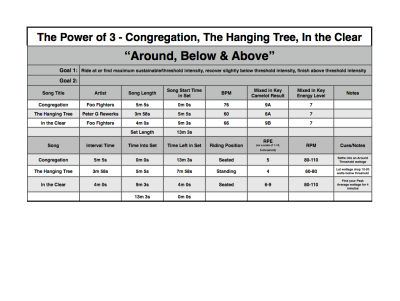
3 song harmonically mixed track, to download Right Click > Save As / Save Target As to download. Open in iTunes and then you'll see this in your Spotify Local File folder.
With over 1800 articles in our archives there's a good chance that our ICI/PRO members may have missed some of our best stuff. So every Wednesday we are republishing some of our favorite articles and podcasts – enjoy!
By Team ICG® Master Trainer Jim Karanas
I love looking for music for my class. I’ll spend hours searching. When I find a good song, I’m ecstatic. I’ve always loved listening to, hearing and feeling certain rhythms. There’s even a hierarchy in my appreciation of a song: first, listening to it; second, riding my bike to it. But the absolute best is leading a class to it. It’s an awesome feeling.
I’m not the only one. Many indoor-cycling instructors feel the same way.
If you teach indoor cycling, you’re an Exercise to Music (ETM) instructor. ETM instructors work in fitness centers, health clubs, community centers, church halls, schools — in fact, wherever there's a suitable space and some sort of sound system. Most of us work freelance, delivering several classes a week and enjoying the flexibility of working around our existing lifestyle. Some teach full-time and often become involved in running a club as studio coordinators. Wherever ETM instructors go career-wise, however, they share a love of teaching to music.
Music influences us so deeply that the body reacts. Our pupils dilate, our pulse and blood pressure rise, the electrical conductance of our skin drops, and the cerebellum, a brain region associated with bodily movement, becomes more active. Blood is even re-directed to the leg muscles. Some speculate that this is why we tap our feet (or ride harder). It’s obvious that music evokes emotion, but it’s still not clearly understood why.
Recently, a team of Montreal researchers screened 217 respondents to ads seeking people who experience “chills to instrumental music.” The researchers asked the subjects to bring in a playlist of favorite songs and monitored their brain activity while the music played.
The music triggered the release of dopamine in the dorsal and ventral striatum. No surprise. Those regions have long been associated with response to pleasurable stimuli. The more interesting finding emerged from a close study of the timing of this response, what happened seconds before the subjects got the chills.
Just before the participants’ favorite moments in the music, dopamine activity increased in a different portion of the brain called the caudate. Researchers called this the “anticipatory phase” and suggested that it signals the coming of a pleasurable auditory sequence, triggering expectation of euphoria, a “reward prediction.” The reward was the sense of resolution — hearing what they expected to hear.
We typically associate surges of dopamine with the processing of actual rewards. And yet, in the caudate, while listening to music, dopamine release is most active when the chills have yet to arrive, when the melodic pattern is still unresolved.
This is why musicians sometimes introduce a theme or note in the beginning of a song and then avoid it. The longer we’re denied the pattern we expect, the greater the emotional release when the pattern returns. That’s when we get the chills.
But that’s just listening to music. Why is teaching to it even more pleasurable? When we know a song really well, it becomes more predictable. Yet, when we teach to it, that doesn’t seem to matter. Or maybe we like teaching to music we love because it’s familiar, not despite that. We’re anticipating our favorite parts and getting the reward when we ride as they play.
There’s no research that explains this phenomenon in ETM instructors, so I tried to think of a similar situation.
Teaching indoor-cycling to music is not unlike a musician’s performance. I’m not creating the music, but I’m channeling my feelings for it into classes. I build and repeat patterns. They’re biomechanical, but they’re still patterns.
So I checked the forums and found statements on why musicians like to play and perform. These were some of the accounts I found:
I play simply because it brings me a kind of enjoyment that I can’t find anywhere else.
There’s no better feeling than creating something that cannot be recreated.
Because I have ideas and feelings that I can't express any other way.
To bring an audience into the moment is satisfying.
It's like a body part. I was just born with it. I can try to ignore it, but it will always be there. I can enjoy myself and do what I was born to do and love to do, or I can stop doing it and be miserable.
By the pure manipulation of sound, you can bring out emotion in yourself and others and express yourself when words fail. Well, that, and chicks.
For me, playing music reaffirms that there is magic and wonder in this world.
To end war and poverty, to align the planets and bring universal harmony and contact with all life forms from aliens to household pets.
Every one of the above statements describes my feeling about teaching indoor cycling to music. The last one is my favorite because the musician can’t identify why he/she loves to play. People ask me why I’ve taught exercise to music for over 30 years, why I spend hours looking for the right song to create what I hope will be a good ride. I can’t quite explain it, either.
Becoming a good indoor-cycling instructor requires an incredible amount of work, and having a passion for music helps to motivate us to put in the many required hours. Studying music, staying open to sources of new music (e.g., a movie soundtrack), learning to play an instrument, or just listening to musicians perform are powerful ways to improve our craft.
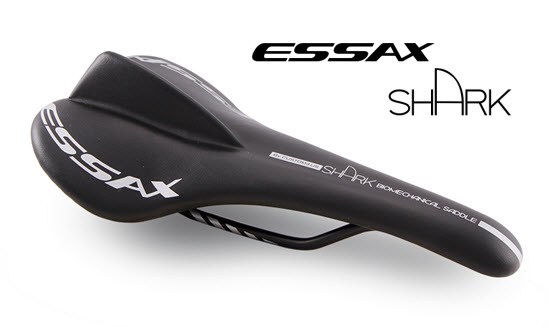
Essax is a brand of bicycle saddles located in the province of Alicante (Spain). Our company has over 25 years experience in the manufacturing of technical products in polyurethane foam and leather, which assures our knowledge and experience.
Above all, we are cyclists who manufacture for cyclist, which means that we make from our passion our work. Therefore we know from first hand what users needs and what the requirements of the sector are.
http://youtu.be/f6gnUTNbaWQ
What is the fin for?
This is the key to this whole Bike Fitters ensemble. Its position indicates the rider how to place his sit bones so that they are well supported in the seat. It interacts with the user giving information how to be seated on the saddle. In the hundreds of biomechanical studies for the development of this product, the result of them told us that the vast majority of riders had sensory perception being well positioned on their saddle as where reality showed they were rotated or only supported one of the two Ischia
So the purpose of the fin is to locate you and your sit bones correctly, fore/aft on the saddle. This, Essax is saying, is super critical on multiple levels; comfort over time, pedal force imbalances, hip stability and overall power development. That sounded really familiar…
There are multiple factors that affect how you produce power and what ultimately gets displayed by the console. A few months ago I wouldn’t have believed you, if you tried to convince me that (beyond the level of comfort you feel) a bike’s saddle design could add or subtract to the power I could create.
I believe it now.
Back in March I had a professional bike fitting on my new VeloVie with none other than the Bike Fit Guru Chris Balser. I figured that I had a few dollars left because of the incredible deal I got and, with one kid graduating for college this Friday, why the heck not?
I was a bit naive about what all was entailed in a 2 hour fitting. I thought Chris would be super focused on getting my seat height exactly right, maybe futz with the tilt of the handlebars. Stuff like that. Nope. For close to an hour we tried out different saddles, 11 in total. That’s right, Chris had me ride on a trainer, trying 11 different saddles, to find the perfect saddle that (his words) your ass can find easily. Here’s what we finally decided on… a Fizik Kurve.
As a sidenote – I have two years/~6500 miles on my Fizik Kurve Chameleon Saddle and absolutely love it. Chris was exactly right to choose it for me > Everytime I sit on it my butt finds exactly where it belongs.
Can you effectively cue proper saddle position?
Short answer IMO is you can try, but my personal feelings are that most Indoor Cycle saddles are too big (FreeMotion being the exception) and too soft, to be really “findable” for most people's derrieres. That doesn't mean you shouldn't make the suggestion to move around and see if you're in the best position.
Just don't cue this once, early in the class and then forget about it. Give everyone time to settle into their positions and then ask everyone to reacquaint themselves with the saddle. If you've taught for any length of time (and you're paying attention to small details) you have seen how many of your riders visually appear to relax at some point in class. For me, I notice it during the first welcomed recovery I give them > typically following the first “Best Effort” interval they've completed.
Like everything else you do as an Instructor, you should be experimenting on yourself and then decide what & when makes the most sense.
As a nutritionist, I hear many clients say they want to lose weight — to look better, have more energy, improve their health. But losing weight can also help you increase your power on the bike.
Ratios intrinsically provide two ways to improve the ratio — by manipulating either variable. The results of improving both variables can be dramatic.
As covered in a previous post, efficiency — the ratio of work output to expended energy — can improve with increased work output or decreased energy expenditure (or both).
In the same way, your power-to-weight ratio on the bike (measured in watts per kg) can improve with increased power or decreased body weight, or both.
Power is itself another ratio, of work to time. If work increases or time decreases, the result is greater power. ICI/PRO is currently covering this topic in depth.
So that provides 3 variables in the power-to-weight ratio: increase your strength (work), increase your speed, or decrease your body weight (or all of them).
Why Lose Weight?
Even if you’re not overweight, weight loss may improve your power-to-weight ratio. It need not — and shouldn’t — involve a strict “diet” that leaves you hungry most of the day.
It does involve careful monitoring of your numbers — how many calories you burn (using your power meter or, preferably, a wearable calorie counter 24 hours a day), and your calorie intake.
The goal is to eat fewer calories per day than you burn, but not by much, just 150 to 300 calories. If that feels too restrictive, drop the deficit to 100 calories. The result would be a slow decrease in weight that you can stop or reverse at any time.
These days, the general recommendation for weight loss is rapid loss. (Is that to match up with HIIT and the shorter-and-harder approach to fitness, I wonder?) Rapid weight loss is said to keep the “loser’s” motivation high.
Yet gradual weight loss — while also training for power — has the advantage of maintaining fat-free mass (FFM) so you won’t lose strength, an important variable in the power ratio.
Holding On To FFM
Weight loss often decreases muscle mass, especially rapid loss. But in the long-running (13-plus years) weight-loss program for which I was both the nutritionist and a training coach, we typically saw steady or increased FFM while the participants lost weight at a slow, sustainable rate.
That helped them maintain strength and power so they could do the training, which was frequently high-intensity. The intense training, of course, was designed to increase strength and power.
Maintaining FFM also prevented participants from having to drop calorie intake more and more (and more) for continued weight loss.
Don’t Bonk
Make sure you don't restrict calories on the ride itself. Whether you’re riding outdoors or doing tough power training in the studio, under-fueling before or during the ride could cause you to bonk.
Even without bonking, you may still feel week and have difficulty working up to your capacity — the power you’re trying to improve. Fuel as usual while riding.
Keep the calorie restriction small. Cut back a little more on days that you’re not training hard, or at least save the restriction for after the ride. If your power ride is late in the day, early A.M. calorie cutbacks may work. Just keep your pre-ride meal about the same as usual, and eat or drink whatever you need on the bike.
Be strict about post-training refueling (covered in a previous post) so you can train well the next day.
Technique and Efficiency
In all of this, don’t forget that better technique on the bike will help you waste less energy by reducing the energy needed for pedaling, reducing energy lost as body heat, and retaining more energy for your next pedal stroke. Your functional strength, a power variable, will increase.
Combining good technique, all the power training tips you’re currently getting here on ICI/PRO, and gradual weight loss will help you dramatically increase your power-to-weight ratio on the bike.