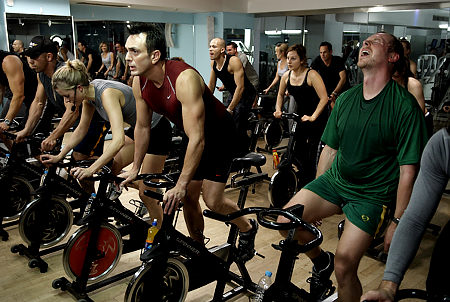
Glamour Magazine recently published an articleThe 6 Secrets to Burning Major Calories in Spin[sic] Class written by Faith Cummings. Four of the points raised are solid. One is iffy and another is IMO boarding on BS.
Their suggestions; Don't stop moving, Make sure you have enough resistance, Push yourself and Prep your body before class (that last one is my favorite and I'll expand on the idea below) are all solid and sound advice.
These other two, not so much:
Turn up the heat.
We're going to sweat while we workout anyway, so why not turn the temperature up a bit and really get it going? “Riding in a heated room torches calories,” says The Sweat Shoppe co-owner Mimi Benz. “You can burn up to 1,000 calories in 55 minutes.”
While technically accurate (yes your body expends additional calories staying cool… actually more than staying warm) what's missing is how our body's ability to create work decreases, as our core temperature increases. So if you can't work as hard because you're overheating, I find it hard to believe that a hot room has a positive effect on calories burned. I'll respond to the 1000 calories in 55 minutes BS below.
Remove the bounce.
“Bouncing stresses our joints and actually takes away from the calorie burn,” says Flywheel cofounder and creative director Ruth Zukerman. “When riding out of the saddle, hovering closer to the saddle relies on the use of your muscles more, resulting in more calories burned.”
I've love to see an actual study showing this – it's actually the first time I've ever heard it. My perception is bouncing out of the saddle is the result of improper pedaling technique – so technically she could be right > better technique could result in more muscle recruitment = more work accomplished / calories burned… or it could go the other way > better technique = more efficient, which could result in less work/calories expended. Either way I have a hard time believing that hovering will contribute to you being swimsuit ready anytime sooner.
My six secrets to Burning Major Calories in Indoor Cycling class.
[wlm_private ‘PRO-Platinum|PRO-Monthly|PRO-Gratis|PRO-Seasonal|Platinum-trial|Monthly-trial|PRO-Military|30-Days-of-PRO|90 Day PRO|Stages-Instructor|Schwinn-Instructor|Instructor-Bonus|28 Day Challenge']
#1 Dump the assumptions, they're unhelpful and potentailly destructive
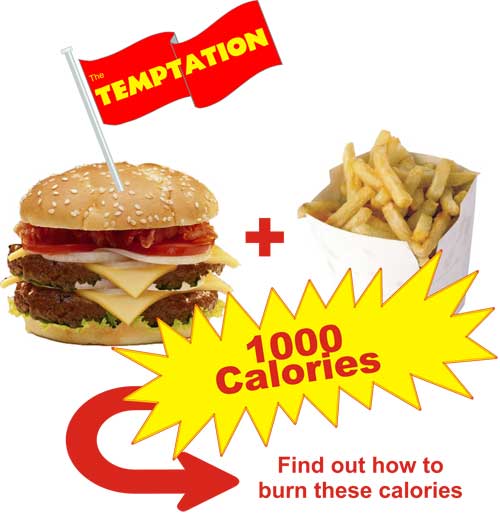
No, Ms. Benz, the typical participant in one of your Indoor Cycling classes CAN NOT BURN 1,000 calories in 55 minutes. Yes there may be a few in your classes who can. But unless you're looking at a room full of very fit 200lb men in every class, burning even half that amount (500 calories) will be a huge result for most participants.
Knowingly setting unrealistic expectations (BURN up to 1,000 Calories!) for riders in a class is unethical and is sleazy marketing of the worst type.
So what happens when a rider thinks they will burn 1,000 calories (no one hears the “up to” part) in a 55 minute class? Lots of things and none of them good:
They'll feel free to eat more post-class as a reward. This post describes what's called hedonic snacks which are those little treats we use to reward ourselves for a job well done. “I just burned 1,000 calories!” “Say, doesn't the blueberry muffin look like the perfect reward?” Congratulating folks for expending way more calories than they really did, sets up a destructive cycle of behavior that results in weight gain, not weight loss.
They won't work as hard in class, so their actual caloric expenditure will be even less than it could be. “I'll be happy with just 600 calories today, so I'll take it easy and chat with my new friend riding next to me.”
They're set up for failure. Consider a studio equipped with Indoor Cycles with power indication. The studio's marketing materials tell riders they can burn 700/800/1,000 calories a class. At the end of the 60 minute ride the customer hits the avg/end button and sees; ‘Total Calories = 287'. How do you think they'll feel? “What happened to 1,000 calories?” “I must be a failure” “I'm never coming back here”🙁
OR – consider a studio without power who tells their customers; today we burned 700/800/1,000 calories! And then one day they ride a competitor's Indoor Cycle with power and learn the truth. Whoever lied to them will have lost a customer…
Image from http://www.wired.com/2012/08/fitness-trackers/
#2 Find some technology
I'm not talking about a wearable fitness tracker or heart rate monitor that offers estimated calories – they've been shown to display wildly optimistic calorie counts > Instead find a club or studio where you can ride an Indoor Cycle with Power/Watts indication – so you can observe a real measurement of how much work you're actually doing in class.
Indoor cycle power meters
At the risk of losing you here, there's a Law of Physics that can be applied to exercise and calorie expenditure. In layman's terms, the law; Conservation of Energy says you can't get more energy out of a machine… than what you put into it. Makes sense, right?
The power meter on an Indoor Cycle will record the the amount of energy your body expends turning the pedals x the amount of time you're working. Through some fancy math, any brand's power meter will display a reasonably accurate estimate of the amount of energy that went into powering your ride, expressed as Kilocalories (kcal), kilojoules (kJ) or both.
There are still a number of unknowns with these estimates of calories expended. The cycle doesn't know your gender, body weight or fitness level. My understanding is that the estimates used by manufacturers are based on a reasonably fit, 160 lb male.
Don't let these minor variables trip you up. The most important benefit of riding an Indoor Cycle with power/watts is how you can see today what you burned during the total class. Your next ride you'll have the chance to work a little harder and then you'll get to see your actual success!
#3 Stick with water
Nothing drives me crazier than seeing a participant, who I know is in class for weight management, with two bottles of energy drinks on her/his bike. 12 ounces of Gatorade has about 80 calories > the typical water bottle holds 20/24 = 160 calories for one and 340 calories for two bottles or more. So there's the potential to replace every calorie you've burned, and then some.
Depending on the time of your class, participants and instructors should be consuming a small meal of ~200 calories, that consists of a blend of carbs/fats and proteins. My favorite is a slice of whole wheat peanut butter toast.
Side note: Dr. Joan Kent, who's our resident nutritionist here at ICI/PRO, has been battling the addictive properties of sugar for years. She's written extensively about how you don't need sugar before, during or after exercise of any form. Endurance Nutrition Coach Ben Greenfield offers his own similar suggestions here.
Don't be left at the start
#4 Get there early… and get after it
Fitness can be expensive and if you're anything like me – you hate to waste your hard earned dollars. So with popular boutique studios charging $30 or more per class, what's the secret to ensuring youget your money's worth + maximizing your calorie burn? Don't waste your pre-class time! Instead of sitting there, slowly pedaling and chatting with your neighbor, take yourself through a purposeful, self directed warm up. The objective is to be warm and aerobic by the time class begins.
Find a comfortable pedal cadence around 80-90 RPM and quickly add resistance until you're feeling productive. Wait until you feel the workload get easier (as you warm up you'll feel stronger) and add another gear. Ride there for a few minutes and then recover until you can breath easily. That's your cue to start the process again. This isn't anything crazy. Unless this is your first class, you know what you can (and need) to do to raise your body temp and elevate your heart rate to the point where you'd rather breath, than talk. I call this working above the Chatty Zone – that's the training zone you want to stay above to burn the greatest number of calories.
Again your goal is to be warm and ready to work the moment the music starts. You'll be burning major calories, while your neighbor is still organizing her towel.
Shut up
People who chat constantly during class burn 50% fewer calories than those who don't. OK, I made that statistic up out of thin air. As far as I know it's actually closer to 80% for the simple fact that burning calories requires a lot of Oxygen (O2) and talking can only occur when you don't need the O2 in the air you're breathing for anything else.
Just how much O2? The chemical conversion of the stored fuel in your body (fats & sugars) to usable muscular energy is around 3 to 1. So to burn 1 pound of body fat, you need to consume (breath in) 3 pounds of O2. Think about that for a moment. Oxygen is a gas that's only ~14% of the air you breath. O2 doesn't really appear to weigh anything and yet you need huge amounts of it absorbed into your bloodstream, to support the chemical reactions that turn stored body fat into energy.
Anything you do, that limits your ability to breath, will reduce the amount of calories you can burn. Choosing to talk during a workout subconsciously tells your body not to work hard = you might have had fun catching up with your friend, but you just wasted 60 minutes of calorie burning time – plus you probably irritated those riding around you 🙁
Here's a fun fact: do you know how those burned calories leave your body? Through your mouth! Fats and Sugars that have been “burned” (a more accurate description would be oxidized) are long chain carbon molecules that are broken up – one carbon atom combines with two oxygen atoms, to form CO2 carbon dioxide. So that toast you had for breakfast this morning leaves your body, a little bit at a time, with each exhale.
Stay down
I call it, “bailing out” – the act of sitting up, to recover completely after an interval. If your objective is to burn the maximum # of calories, then you need to work at your highest sustainable level for as much of the class as possible. Killing yourself in a short burst, only to back way off has a negative affect on your total work accomplished during the class. Instead, to expend a larger amount of calories, try working not so hard > but for a longer period of time. Physical endurance will come over time, so stick with it. Stay down in the riding position for as long as possible, while managing your workload to you can complete each interval segment. If you need another reason to stay down… consider that everyone watching you bail out, is secretly chuckling at your lack of stamina 🙁
Come consistently
A focus on “burning calories” kind of misses the point. The objective is to reduce stored body fat, right? Just as you can't effectively train for a marathon, by randomly running across the street – reaching your weight loss and/or fitness goals requires a lot more than riding in a cycling class where you burning major calories. Weight loss will only come to those who attend fitness classes consistently.
If you're a little weak in self-discipline, I suggest finding a friend with a similar schedule and fitness objectives. Plan to meet together at a few specific classes, so someone will miss you if you're not there.[/wlm_private]
I'll often tell new riders:
The most important class you'll ever take… will be the next one.
Over the past few weeks there have been some questions on the ICI/Pro website that gave me the idea for this week's post. One question was about music flow and another was asked which comes first, playlist or profile?
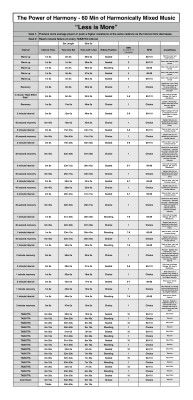
To show one way to make music flow I decided to put together a playlist of songs that are all in the same harmonic key, this is technique is called “Harmonic Mixing” and is used by many of the world's top DJ's. I use a software named “Mixed in Key” (http://www.mixedinkey.com) that automatically analyzes all my music files and determines the key and tempo of each song. Mixing harmonically enables you to create smooth transitions between songs and ensure that all songs sound great together. I put this playlist together without any consideration of the profile. I chose popular, high energy, songs and let the Harmonic Mixing create the flow. This is a playlist that can be used with, just about, any interval based profile where the profile, not the music, is the focus.
Next I put together a killer profile using a technique known as “anchoring time and effort”. This is a very simple tactic where riders should be able push higher intensities as interval length gets shorter. Less Time = More Work.
[wlm_private ‘PRO-Platinum|PRO-Monthly|PRO-Gratis|PRO-Seasonal|Platinum-trial|Monthly-trial|PRO-Military|30-Days-of-PRO|90 Day PRO|Stages-Instructor|Schwinn-Instructor|Instructor-Bonus|28 Day Challenge']
You can join my TrainerRoad Team at : http://www.trainerroad.com/teams/2484-dennis-mellon-s-indoor-cycling-team
60 minute harmonically mixed track, to download Right Click > Save As / Save Target As to download. Open in iTunes and then you'll see this in your Spotify Local File folder.
This is just one example of how I put together my classes. Other times I try to match the music and profile exactly and let the music dictate the terrain. I would recommend instructors get proficient at both methods. This way you don’t pigeonhole yourself and you keep your participants on their toes. It also keeps things fresh and exciting for you.[/wlm_private]
Master Educator Cameron Chinatti with Stages Indoor Cycling joins me for a fun followup to their very successful IHRSA convention where they launched the new Stages SC3 Indoor Cycle. We've got a bunch of videos that relate to my interview, which you'll find below.
One of the highlights from the show was the amazing efforts of two cyclists, during their 60 sec challenge.
First there was
Junior Nationals competitor Dominic Suozzi decided to try his hand at the #60secchallege today. The kid's wearing Converse and he destroyed everyone. 1100 Watts!! That's crazy-ville!
Then how about the huge effort from Kat Haskins … aka TheBarnKat > she's an Instructor at CB Cycle Barn and wasn't an outdoor cyclist, up until now. She won a new Giant bicycle with Stages Power Meter for her efforts 🙂
Here's my interview with Cameron. Enjoy!
Cameron and I discuss their new “Sprint Shift” innovation. Here's a quick video showing how it works. You can read more about how I used this new feature at my review of the Stages SC3 Indoor Cycle.
Before I get a bunch of hate mail from Schwinn Instructors. I make the comment that Stages is the first Indoor Cycling company that is focused on both Indoor and outdoor cycling. Yes I realise that the brand “Schwinn” was first a bicycle company – my first road bike was a green Schwinn Varsity, second was a white and purple Schwinn Paramount. But the Schwinn Indoor Cycling brand has/had no connection with the bicycle company known as Schwinn bicycles. Stages is currently selling products to outdoor cyclists (the Stages Power Meter+ Endurance Training Education) as well as Indoor Cycling studios (the Stages SC3 Indoor Cycle + Instructor Education) Does my comment make sense now?
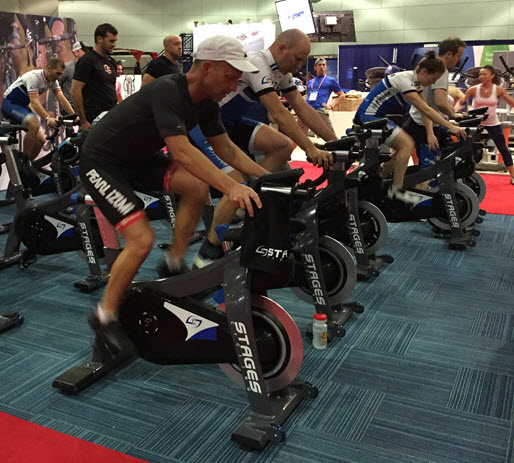
I got about 75 minutes of saddle time on the Stages SC3 during the conference. Two morning classes, a 60 sec challenge (445 watts – 2.78 watts/lb which I felt was OK for a 53 year old) and some undirected free time when I experimented with the SprintShift.
Quick aside:Why does everyone look like they're setup too low in the videos? I had a Facebook comment asking this question and she's right, they do look low. But I can assure you that neither Dunte Hector or Cameron Chinatti riding in this video are set up incorrectly. Over the years, I have developed an eagle-eye for improperly adjusted riders = they looked right to me, riding there in front of them. So why do they look low? I have no idea. Might be an optical illusion, or the shutter speed of the camera is too slow. Do you have any idea why?
Fit – I'm 5′-10″ and I like a long & low reach to the bars. On a bicycle, this is determined by top-tube length. On most Indoor Cycles without handlebar fore/aft adjustment I feel a little cramped. With adjustability an option, I will normally push the bars all the way out – to increase the reach. On the SC3 I felt very comfortable with the reach with the fore/aft centered = this IC appears to have a longer top-tube length. (I didn't measure anything, this is just my general feeling)
I also have long femurs, (thigh bones) which require my saddle position to be biased quite a bit rearward, to keep my knee over pedal. My road bike needed a special setback seatpost to get me in the correct position. Here too I found that there was plenty of room and found the perfect position with the saddle set about 1/4″ back from the center point on the adjuster.
I really like the road bars they are using. They offer some new options for hand positions, while at the same time creates limits – no more seated riders looking goofy with their hands extended way out to the bar ends. The imitation brake hoods (the bump at the end) form a very natural/secure place to rest your hands while standing, hopefully removing the temptation to tightly grip the bars.
All the adjustments include easy to read measurement scales = your participants will be able to quickly make their pre-class adjustments, after their initial fitting. The saddle/handlebar fore/aft are micro adjustable and use a nicely shaped knob that you tighten down to fix your settings. Height at both ends use the new FitLoc over-center lever to place setting pins into very closely spaced adjustment holes.
There are two water bottle holders attached to the frame, which are very easy to reach seated or standing. Why not include them as part of the handlebars? I asked that question to Cameron and she told me that they wanted to keep the bars as light as possible, so they're easy for small people to adjust with only one hand 🙂
The Ride– Smooth / Solid and very Quiet. As I discussed in Part 1, the aluminum frame is very strong and I couldn't detect any flex. All the adjusters stayed securely fastened = I never felt I needed to re-tighten anything during my rides.
The SC3's belt isn't under any tension, which is unique. It's hard to describe this in words… there isn't the feeling like you need to overcome some internal force in the drivetrain. The result is a very light feel, almost frictionless, with just a touch of chain like vibration coming through the peddals.
I'm a big fan of magnetic resistance on Indoor Cycles – you can read why here. The SC3 didn't disappoint as their drive uses this resistance system. The large, screw type, adjuster knob made for predictable and progressive adjustments in the amount of load added. Pushing down on the knob is the safety brake.
Using the SprintShift lever
If you do a lot of timed below/@/Above PTP intervals, where everyone is recording their average watts using a stage button, you'll love using the SprintShift lever. With apologies to Ron (pocket fisherman) Popeil – when you're running a series of intervals all you need to do is; “Set it… and forget it!”
Here's one way I found to use SprintShift: The Stages Instructors had us doing a fun relay race, as part of each class I attended. Each row competed to see how fast each rider in turn could complete 0.2 of a mile. They had some fun inflated batons that we passed, after completing our two tenths.
To prepare for the race, I practiced to get a feel for the proper resistance I could sustain, for what turned out to be about 25 seconds of work. With the SprintShift lever fully to the right, I set the level so I would see ~500 watts @ 100 RPM (where I work best during a short sprint) and then flipped the lever full left (making it lighter/easier) to wait for my turn. I maintained my 100 RPM cadence until I was passed the baton. Snapping the lever full right brought me to the perfect gear. I punched the stage button and was off. Did I mention I was the anchor person on our team? And that there were two very fit people behind me? So yes, I felt a ton of pressure to get my 0.2 done as quickly as possible.
We talk a lot about including “Best Efforts” (and below/@/Above PTP intervals) as part of your classes here at ICI/PRO. I feel they are an important components of every class I teach – they give my riders a quick understanding of PTP Personal Threshold Power. This answers the question for them; “how much power/watts should I be making, when I want to work hard?” without waiting for a scheduled 20 minute FTP class in the future.
Think forward to the (hopeful) day when I can teach on the SC3, I would have everyone dial in their PTP resistance with the SprintShift lever in the middle position. Then moving it to the left would give me a “Below PTP” working resistance. Bringing it fully to the right would add the “Above PTP” resistance. Cuing a return to whatever cadence we've been using should make for an easily understandable and challenging class 🙂
Power Observations
The power/watts readings seemed steadier/ didn't bounce around as much as what I'm used to on a competing bike. The absolute watts readings I was seeing was very similar to what I'm accustomed to.
I really like how your averages remain displayed for 5 seconds after you hit the stage button. It always takes me a moment to refocus after an all out effort = I enjoyed see my averages before they disappeared.
Bottom Line
I see the Stages SC3 as an excellent Indoor Cycle and it should be on your short list of cycles to choose from if/when you're planning a purchase.
If you have additional questions, or would like to be connected with them for more information, use this contact form.
Accessories
Custom painted Indoor Cycles can make a huge difference to the look of your room. Your Instructors will feel special with a uniquely painted Instructor bike, possibly one that matches your studio's colors. Contact us for pricing and lead times.
The Stages SC3 can be custom painted without affecting the warranty.
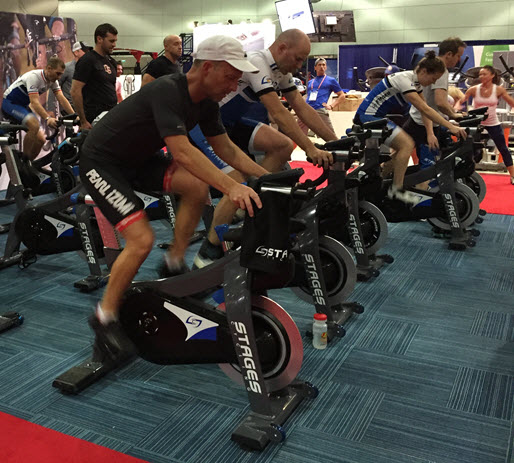
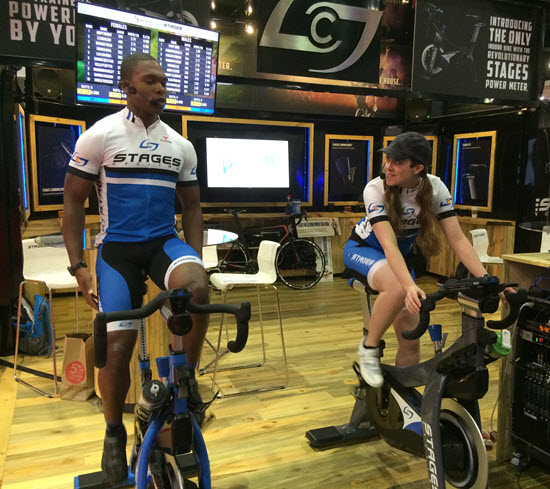
Stages Master Educators Dunte Hector and Cameron Chinatti leading the morning ride at IHRSA
IHRSA 2015 was the first public appearance of the Stages Cycling SC3 Indoor Cycle. This was a total surprise to me and I have no idea how Stages Master Educator Dennis Mellon was able to keep his mouth shut for so long. We talk weekly and it must have been killing him not to be able to tell me about their latest project 🙂
Going forward, I feel it's important to disclosure that Stages Cycling sponsored (paid) my and Amy's travel to, and lodging in, Los Angeles to take part in the launch of their new Stages SC3 at IHRSA 2015.
If parts of the Stage SC3 look familiar, there's a good reason. The engineers who designed this Indoor Cycle have a long and storied history of product development with indoor cycles and power consoles. It was explained to me that the design criteria for the SC3 was; take all of the engineering team's collective experience and build the ultimate, commercial Indoor Cycle. Did they succeed? Let's find out…
The Basics
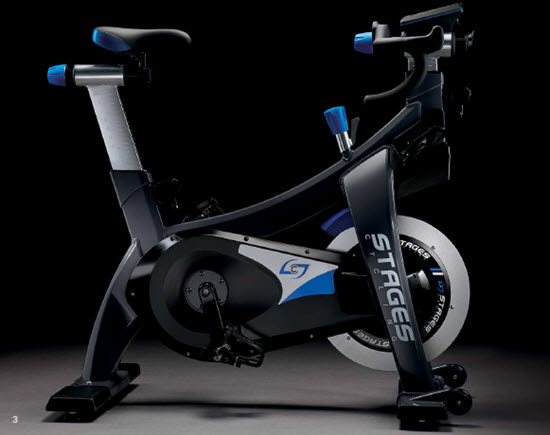
Frame – Aluminum… and lots of it. This is a very solid/substantial IC > perfect for studios with big, powerful riders – or – those offering unconventional classes with a lot of movement.
Drive – CarbonGlydeâ„¢ drive system. Yes, this is the same Gates belt as other manufacturers are using, but there are fundamental differences with the other components of the drive train, that give the SC3 a very different feel. Because they don't run the belt under tension (there's a tiny bit of slack you can feel as you move the pedals back and forth) the SC3 is noticeably quieter than the Schwinn AC and it's tensioned Gates belt. It also retains a slight, chain-like vibration, but doesn't buzz like the AC. Stages is so confident in their drive system that they offer a 10 year warranty on the CarbonGlydeâ„¢ belt. Correction: Stairmaster's engineer Travis Vaughan alerted me to my error describing the Schwinn AC's Gates belt as “tensioned” – which it's not. I didn't intend to infer that they used a tensioner like what's used with Poly “V” belts. Instead I should have described the differences as; the AC runs it's belt taut (zero slack) vs. the SC3 which, when properly tensioned, has a very small amount of slack.
Resistance – Magnetic > surrounding an aluminum flywheel. Screw style adjustment and includes the new Stages SprintShiftâ„¢ three position lever . More on that below.
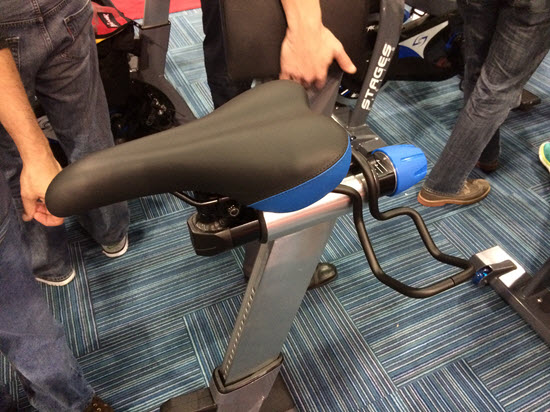
Handlebars – Road Bike Style Drop Bars – there's a reason that handlebars on road bikes haven't changed over the last 100 years > these fit us (humans) the best. Please don't ask me; “butwhere is position #3 John?” It's standing, with your hands surrounding the brake hoods, exactly where your hands belong when you're out of the saddle 🙂 It's here where you have the most leverage to power through a steep climb and it eliminates the temptation to “over reach” while seated.
Saddle – nice. Not too narrow… and not to wide/fat. Forgive me for saying it this way, it's very close to (might be exactly the same as) the saddle on the Schwinn AC > we have one on the back of our Trek Tandem. Amy loves this saddle and it's been comfortable for her for thousands of miles. Trust me on this one… I'd have heard all about an uncomfortable saddle.
The Power Meter
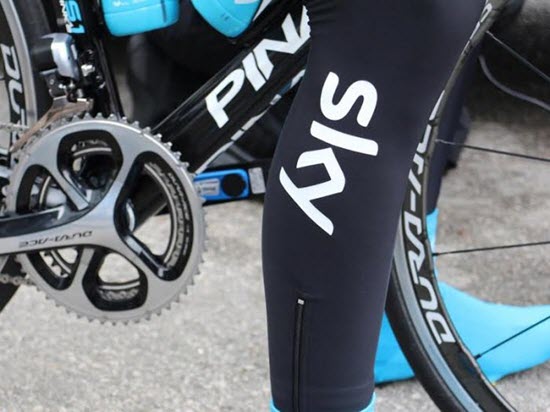
Good enough for TDF winning Team Sky Professional Racing Team
The heart of an Indoor Cycle that features power measurement is, of course, the power meter. The new SC3 is using the same technology used by Team Sky – winners of two Tour de France bicycle races and they're going to continue to use these power meters in 2015.
I could devote an entire article on just this topic and will have more as part of the ride portion of this review. In the interest of time I'll give you the important bits:
2,000 hours of battery life using two AA's – yes the display console is self-charging.
Same hardware, design, and accuracy found in the Stage Power® meter, which is used by professional cyclists’ and used in the world’s most famous cycling races, including the Tour de France.
ANT+â„¢ and Bluetooth – so it will connect with your iPhone or Android without any adapters.
Supposedly accurate to +/- 2.5%. I say “supposedly” because I have no way to verify their claims – but I bet Team Sky does 🙂
Display Console
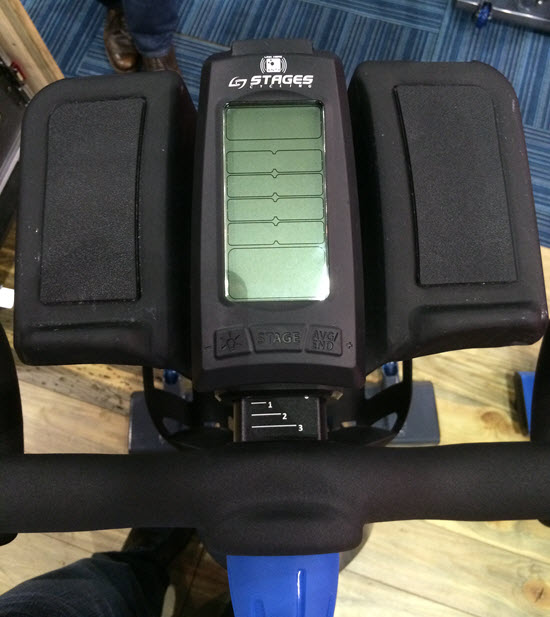
It's important to separate the power meter, from the display console. Although most studios will choose to purchase their new SC3's with the new Stages EcoSCRNâ„¢ console, you don't have to. The Stages power meter will work with any Bluetooth or Ant+ device, like an iPhone or Garmin. You could also choose to wirelessly connect the Stages power meter directly to Display Training systems from Performance IQ or Spivi.
Here's a short video showing it in action during one of the 60 sec challenges.
The EcoSCRNâ„¢ console is self-powered = no batteries to replace ever… that's the Eco part 🙂
No exposed wires > I was told they've very neatly packaged the cable that connects the flywheel generator to the console = a long life of raising the handlebars up and down.
Constant backlight if you choose 🙂
Stage button to record intervals > there's also a nice feature that your averages remain displayed for 5 seconds after you end a stage.
Stages SprintShiftâ„¢ is a three position “shifter”, that provides course adjustments quickly. I want to describe it as a sort of cruise control, where you flick your finger and instantly resume your previous speed/resistance level.
Think of doing a repeating series of intervals. We cue everyone to add load, ride the segment and then recover. Now repeat it again. With SprintShift you can set your initial load with the lever full right. Move it left for recovery and then return back to the exact resistance instantly, by moving the lever all the way to the right.
There's some interesting physics at work here. If you use the SprintShift at lower resistance levels, the amount of change between each level remains relative & realistic. But start with a big gear and the changes are incrementally larger.
There are multiple ways you could incorporate this in your class and we'll find more over time. I'll describe a relay race we did in the ride part of the review where it was very helpful > we won! I'm sure Cameron and Co. will have some fun suggestions for using SprintShift when I interview her in the next few weeks.
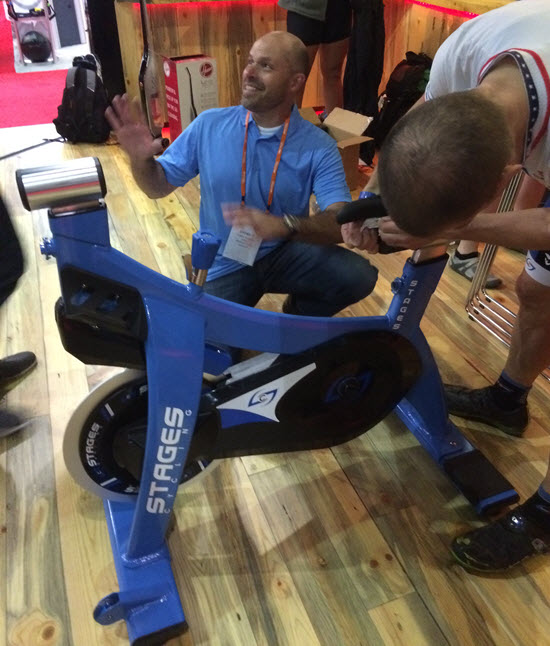
If you've ever fought over a stubborn screw type seatpost of handlebar adjuster, you'll enjoy these new FitLoc cam style adjusters. Watch the video and you will see how quick and easy they are to operate. Also, they've kept the weight of the bars low, so it takes very little strength to raise them, using only one hand.