I had the privilege of visiting the Stages Cycling HQ and factory in Boulder Colorado with my buddy Randy Erwin. Director of Indoor Cycling education Cameron Chinatti, along with Stages vice president Pat Warner, were our tour guides. We spent a fascinating couple of hours learning exactly what goes into building the Stages single side crank arm power meter used on the new Stages SC3 Indoor Cycle and available for most road/mountain bicycles.
You know these people are cyclists the moment you walk into the place. Everywhere you look there are bicycles; tucked into every corner, hanging from the ceiling, along every wall – heck, their conference room has probably the coolest table I've ever seen. Instead of legs, the table top is supported by a pair of 70's vintage Schwinn Sting-Ray bicycles.
Cameron explained the hiring process, “you pretty much have to be a passionate cyclist to even be considered… many of these guys have been riding buddies for years.” And I'll add that these “cyclists” are also some of the most brilliant people I've ever met 🙂
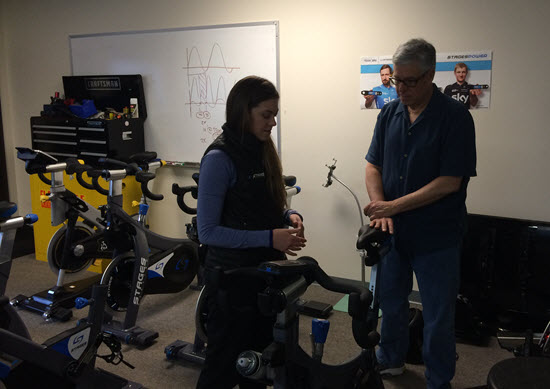
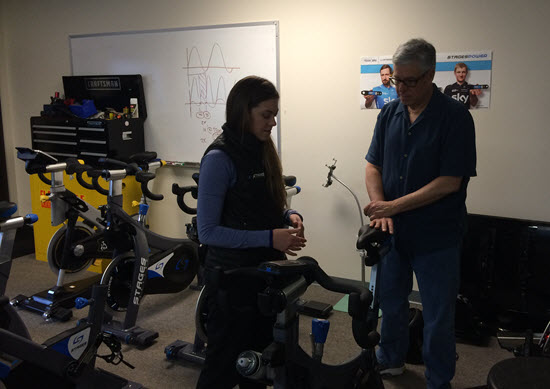
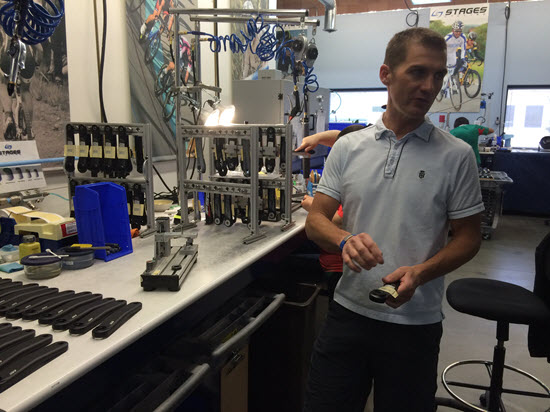
Cameron explaining all the cool features of the Stages SC3 to cyclist Randy Erwin
Cameron met Randy and me and our tour started in their official “training room” except it won't be for long. Stages is growing so fast that half of this room has been taken over by manufacturing stations. My friend Randy was very interested in the new SC3 because the Westminster, CO Life Time Fitness (where he's a member) will be the very first location to get these new cycles. Now if we could get Dennis Mellon in there as an instructor…
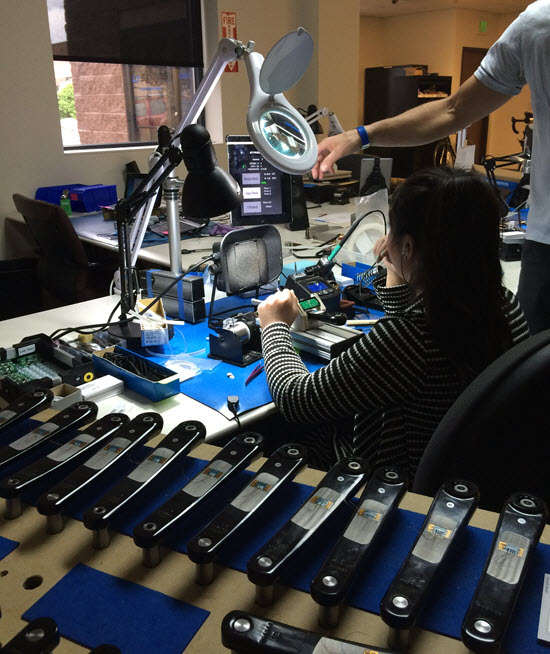
New power meters being installed and tested – this is super technical stuff.
Early in the our factory tour, I asked Pat; “why aren't your power meters built in Asia, like most other technology companies?” His responses made perfect sense to me; “there are multiple reasons actually.” “Stages has become the leading provider of bicycle power meters, after only a few years. We can't afford any preventable issues when it comes to quality or availability. It's critically important that we control the quality of these power meters… we can't if we're dependent on a third party supplier's factory, regardless of where it's located.”
Pat explained how keeping everything in-house provided a solution to a unique challenge they faced. “We manufacture power meters for 16 different model bicycle crank arms, from major suppliers (Shimano, SRAM, Cannondale and FSA) plus the power meter for the SC3 Indoor Cycle. Bicycle cranks aren't made just one size. Multiply each model bicycle crank by the four or more available crank arm lengths and we have to stock over 60 part numbers. Sure, 172.5 is the most common size for a road bike, but how many of each should we be building? The lead time for overseas manufacturers is measured in months – customer's won't accept waiting that long. We have thousands of stock crank arms on hand and we're setup to quickly change production. So if we receive an order for an out of stock power meter, we can normally build one and ship it within a few days!”
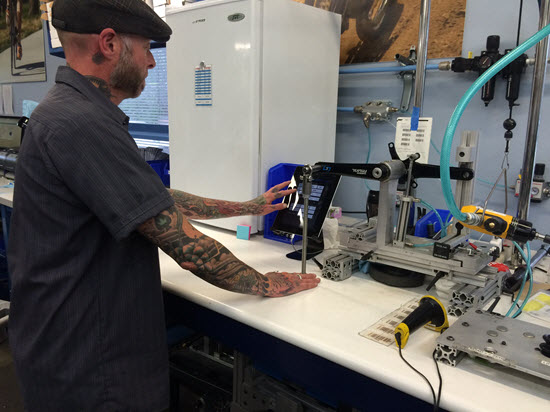
Pat Warner explaining the complicated process that attaches the power meter to the crank arm.
Every power meter is checked for proper calibration and the results captured using a iPad with custom software that's developed in-house too!
The Stages SC3 is build by Giant Bicycles in Taiwan – Pat told me,”those Giant guys are experts at mass producing high quality bicycles and fitness equipment, so we leave that part to the experts. We still produce the SC3's power meter here in Boulder and then ship them out for installation on the cycle.”
Stages has a separate facility, near their main offices, that's use for product endurance and destructive testing. We just missed the completion of a test rig that repeatably pressed down on a handle bar, tens of thousands of times without any failure.
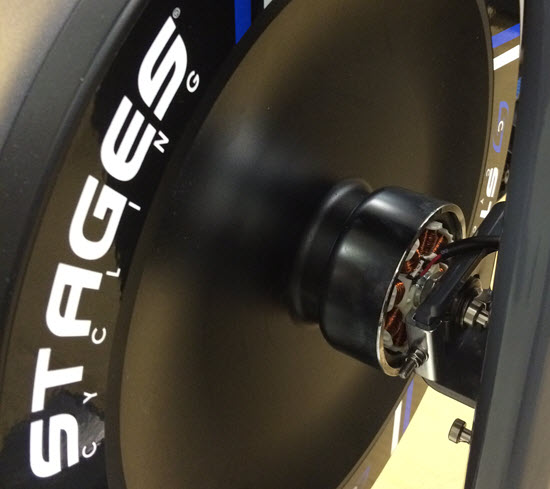
Want to know how long the drive train will last pedaling at a continuous 360 watts? This video shows the test rig that pedals 24/7 for weeks at a time. Not only are they watching to see if something will break, or wear out, but they also record the actual power readings vs what they know their electric motor is pushing.
Quality control – Early production Stages SC3 cycles are unboxed and checked for any defects.
Feel free to leave the lights on! There's the battery charger for the Stages SC3 power meter.
Ever notice how, if you teach on multiple brands of Indoor Cycle, your class presentation changes a little from one to the other? From the distance all the IC's from FreeMotion, Keiser, Schwinn and Star Trac, look pretty much the same. But you know better if you're teaching at more than one location. Each brand's bikes have their own unique characteristics:
The resistance systems react differently and the method for adding and subtracting load is different.
The consoles are all different in what information they display during and after class.
Is there a lap/stage button? How do you use it?
Hand locations & positions vary.
So why not help our ICI/PRO members learn the differences?
Do you spend any time practicing your classes? I realize that few of us have a lot of extra time. If you do – why not spend an hour of “ME” time, riding along with Dennis leading your ride. This may be the best 60 minutes you'll spend this week 🙂
Our membership really grows this time of year. So if you've been contemplating joining us here at ICI/PRO, you won't be alone.
Start your PRO/Monthly subscription $9.95 – no minimum. [wlm_paypalps_btn name=”Monthly-trial Product” sku=”E90D58D12B” btn=”pp_pay:s”]
I edit many of my interviews. When my guest misspeaks, has a few too many ums/ahs/likes/you knows or they run off topic. They tend to say “stop” and then ask “please edit that out”.
Although I've been asked multiple times, I never agree to let a guest listen and then approve the final recording. I also never agree to edit or delete anything just because a guest says; “I sound awful!” I've learned that people are just too critical of themselves > especially when they're not used to hearing a recording of themselves in conversation
But more frequently I'm editing myself out of the recording. That's right. Even after recording over 300 interviews I still; talk way too fast and my tongue get's all tied up, signal my agreement with the same, tired; “that's awesome” or “OK, so…” and it drives me crazy!!!!
So I edit it much of it out and you never hear it 🙂
Unfortunately none of us has an edit button we can hit during a live conversation or class presentation.
Like you, I love learning and improving. I've recently been going through an online training course to improve my speaking and presenting skills. The course is called How to Create a 1000 Watt PresenceLearn business communication skills for personal and career success by actress and communication coach Alexa Fischer. I really enjoyed this particular video (one of over 40 in the course) and Alexa has given me permission to offer it to you.
What grabbed me during the intro of this video is when Alexa says; “But unless you're a professional performer….” Aren't we all are Professional Performers? The PRO in ICI/PRO is short for Professional…. as in Indoor Cycle Instructor Professional.
I feel I am a Professional. Do you?
Here is the PDF she refers to that you can use to (as she says) compassionately critique your recording and then begin the process of improving your communication skills through changing how you speak. NOTE: the correct link to the Fricken Fillers video is here > it's broken in the PDF.
Here is a past Podcast that explains an easy way you can record your own class, using your iPhone or Android phone.
You can check out Alexa's complete training program here at Udemy.
“Why do I make less power (fewer watts) standing, then when I'm seated, John?”
A great question from one of the riders in yesterday's Performance Cycle class. An observation that shows he's paying attention + it gives me the chance to clear this up, so you can properly explain this anomaly to your participants.
The short answer is you don't* If resistance and cadence remains the same, in or out of the saddle doesn't matter. The amount of power/watts you are creating doesn't change… because it can't.
The bike decides the right amount of power
You know that Power = Force x Cadence. So let's assume this participant is riding seated and pedaling @80RPM. Their resistance is set to a level that results in the console display showing 150 watts.
Our legs create the perfect amount of force required to get the job done, which in this instance is overcoming the resistance to pedal @ 80RPM. If your resistance setting on the cycle requires “X” amount of force to push down the pedal, your muscles will create exactly “X” – no extra force is created and no less. The combination of that force, multiplied by a cadence of 80 RPM results in the power meter showing 150 watts.
In fact there's an actual law of physics that says that it's impossible to get the same amount of power out of a machine with a reduced amount of power added into it – which is why I'm saying the amount of power/watts you are creating stays exactly the same, if you make no change other than to stand and ride out of the saddle.
“But then why does the power meter show my watts lower, when I'm standing.”
My response was; “you're right it does and there's a simple answer why…**[wlm_private ‘PRO-Platinum|PRO-Monthly|PRO-Gratis|PRO-Seasonal|Platinum-trial|Monthly-trial|PRO-Military|30-Days-of-PRO|90 Day PRO|Stages-Instructor|Schwinn-Instructor|Instructor-Bonus|28 Day Challenge']
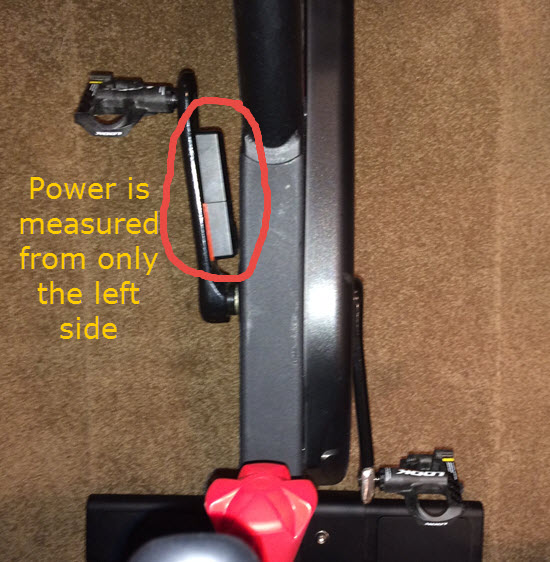
Let me begin with the basics. I teach at a Life Time Fitness Athletic Club and we ride FreeMotion S11.9 with the Carbon Drive belts. FreeMotion's measure power only through the left crankarm as you can see here.
This is my personal S11.0 (the home version) which is why it's black and not the normal silver color. The electronics are identical across all models.
Yes, the meter shows a drop in power…
Many of us who teach or ride on this Indoor Cycle have noticed that the power meter will show a lower wattage number when you transition out of the saddle, without giving any thought as to why. As I explained above, it shouldn't > the wattage number should remain the same. Again; Power is equal to force times cadence. If you didn't change the resistance setting, and you're maintaining the same cadence, the power meter should continue to show the same wattage… but it doesn't because >>>> your legs aren't the same strength.
Your dominate (stronger) leg does more work
The force required to pedal is divided between your two legs – but not equally. Because many (if not all) of us have one leg that's stronger than the other, our brains automatically proportion the amount of force from each. Remember: our legs only create exactly what's needed. Unless you consciously choose otherwise > more force is unconsciously asked from the stronger leg and the opposite leg adds what's left, equaling the total required.
Some quick research showed me that it's very common for one leg to be stronger in most people. Your dominant/stronger leg is typically the same as your writing hand. Since ~90% of people are right handed, the majority of your class will be seeing lower wattages when the come out of the saddle > because they are doing more work with their right leg. The FreeMotion's left hand power meter sensors are seeing a lower amount, of the total amount of work, as coming from your left leg.
Because this IC can only sense force on the left side, when you stand your stronger leg carries a greater percentage of your body weight = the wattages appear lower.
So standing or seated at the same cadence, you continue to create the exact same amount of power. It's just that the power meter doesn't see all of it and displays the reduced amount = the misperception that we create less power standing… which you now understand isn't true 🙂
Make this a feature (not a bug) in your class
Since the Freemotion can show leg strength disparity, why not use it as a training tool?
Novel idea, right?
Start by teaching everyone which leg is their stronger/dominate leg. The simplest way I know is by doing Step-Ups on a box or step raised to the proper level as shown in this short video.
This exercise was eye opening to me, when we did them in Boot Camp. Learning that my right leg is considerably stronger, I'm now really focusing on making my left leg do more work. Hopefully over time, a stronger left leg will result in me having a higher FTP and greater overall muscular endurance.
I suggest having your riders do this as an after class activity > or you could bring a box into your studio and have everyone take a turn.
Using a pair of reasonably sized dumbbells, perform 8-12 reps all on one side and then the other. It should be quickly apparent which (or if) they have a leg strength disparity.
We'll explore drills to exploit this feature and help riders train their weaker leg in future posts! [/wlm_private]
* I'm not referring to pedaling efficiency here, which is a completely different subject.
** Please let me know if this isn't clear, if I've confused you or you have an alternate method of explaining this.
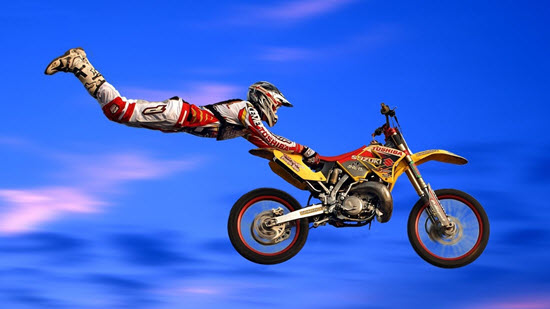
No stunt is too dangerous for extreme motocross competitions.
What caused the SoulCycle phenomenon? Why are their riders so passionate, loyal and willing to spend $34 dollars a class, when clubs and studios had been offering Indoor Cycling classes for 10 or more years – long before SoulCycle's launch in 2007? The research done (and reported here) by future studio owner Callie Bowling finds Cycling Studios that are offering class formats similar SoulCycle's appear to be doing well, but studio startups following traditional / cycling specific formats are struggling. Sadly many have already closed. Why?
One plausible explanation is that for a long time now, Indoor Cycling has been too focused on the negatives, “don't do this [contraindicated] … and don't do that [contraindicated]” while at the same time asserting rules and restrictions on the sport, [if you don't do it outside…]. Now I get that the intent here has been to try and ensure our rider's safety, butcould all of these rules/limitations/contraindications be causing unintended consequences?
My theory
So let me throw out a possible theory for you to consider. NOTE: my intent here at ICI/PRO is never to tell you what to think… you're too smart for that. Rather, my hope is that you thoughtfully consider what's written and come to your own conclusions.
Is it possible that people are turning to SoulCycle classes, for reasons similar to the rise in popularity of Extreme Sports?
Growing up in the late 60's and 70's there were no “Extreme Sports” – although I should probably be dead based on how much danger I was exposed to daily. That is, I enjoyed a lot of freedom as a kid – if you're of a similar age, I'll bet this was the same for you. We spent summer days in the suburbs pretty much unsupervised. Neither my mom, summer sitter, or my neighborhood friend's moms, knew where we were most of the day. We did pretty much whatever we wanted and created our own play. We got everyone together for pickup games of all types daily. Yes we got in trouble on occasion. Yes we got hurt a few times, doing dumb things like falling out of trees we shouldn't have climbed, crashing our mini-bikes without wearing a helmet, etc. We survived. Sure we had youth sports (little league baseball and football) but there was very little parental involvement. I rode my bike to practices/games and, with the exception of my grandmother who seemed to attend every game, my parents were rarely involved in my play while I was growing up.
Everything was different for my two daughters and kids across America, growing up in the 1990's. Amy and I parented like every other parent our age. We knew where our kids were pretty much every minute of the day. “Play time” was often initiated, structured and supervised by us. Why? Because we wanted to ensure our kids safety, based on concerns that I now see were really overblown.
Organised youth sports (soccer and later softball) started at age 5. Games and practices were religiously attended by both parents. I coached both my girls until they were teenagers. As a youth sports coach, I had first hand knowledge (very intense phone calls and on-field conversations) of how incredibly involved and controlling some parents were in their daughters lives.
Thankfully, Amy and I recognised the negative impact our actions were/or could have on our girls and we backed way off. For many who didn't, all of that parental supervision and control didn't end well. Multiple friends of my daughters quit sports completely, having been burnt out by excessive amounts of structured practice. These kids just wanted to play and have fun. But their parents never gave them the chance.
What should have been enjoyable, playtime activities with friends, became joyless, purposeful, objective driven work. And a lot of kids grew to hated it.
The problem isn't limited to moms and dads. Schools, for a multitude of reasons*, have imposed restrictions and limitations on “play time” during recess to the point where it's hard to believe you actually could have fun. Don't believe me? Try teaching your five year old to follow all these playground rules I found for an elementary school in California. After reading through the very detailed list of playground rules, I'm thinking I would give up and just instruct my child to sit quietly on his hands 🙁 Here's how the list of rules begins:
Playground Rules
Play Structure
Play with SAFETY in mind at all times. Students are always to walk in the playground equipment area. Those running will be removed from the area. No tag games are allowed in the playground area.
Swings: * Students sit on swings facing the field area
* Students can swing to a count of 50
(1 swing consists of a forward and backward motion)
* Students wait behind the green pole to take turns on the swing
* Students should never be allowed to jump over the swing seats, twist swings, or
stand on swings
* Students must swing independently. No pushing from a friend!
Enter Extreme Sports
It no secrete that youth have a tendency to rebel against authority. Sociologists have figured out that many young adults are acting out their rebellion at the parental and societal intrusion on their play, by participating in Extreme Sports. Now, instead of climbing trees, doing an oly-under while pushing your friend on a swing and occasionally sneaking out at night as kids, we have people jumping off buildings and doing flips with motocross bikes 🙂
I did some research and I found a book that you can read at this link; The Sociology of Sports: An Introduction. The author makes a compelling argument > Extreme Sports are in fact a response to the excessive structure imposed on children's play.
Excerpt from The Sociology of Sports: An Introduction – page 53
Many sports have become so rule-oriented that people have sought alternatives to “traditional” sports.
So, are people flocking to SoulCycle because it's the alternative to rule intensive Indoor Cycling programs? I believe in part they are. After taking a few SoulCycle classes last fall, I wrote a series of reviews that you can find here, here and here > opens in new tabs. I came away thinking that part of the appeal of SoulCycle is that the class is very challenging physically – and I don't mean just cardiovascularly…
Is there purpose to all of these extraneous movements?
Critics of SoulCycle (and similar) classes point to how non-cycling specific movements; jumps, push ups/rhythm presses, “tap-backs”, figure eights, etc… have no proven training value and/or diminish the potential training value of riding an Indoor Cycle… like an Outdoor Cyclist would. For those reasons, along with perceptions the some of these movements may be potentially dangerous, we’re told we should not include these movements in our classes as they’re “Contraindicated”.
Based on what I saw at SoulCycle (and other similar classes I’ve taken) my feeling is that critics are completely missing the point. IMO these movements are a critical part to the appeal of these classes. It is a thing of beauty, watching a room full of people exactly on the beat and rising and falling in unison. I’ve heard this described as “tribal” behaviour, similar to fans doing the ‘wave’ at a sporting event. It’s a very powerful way to connect a group of people together. And at the same time, these jumps are very challenging to perform correctly — which I feel is another reason for the success of SoulCycle that I explained in this post.
In case you're wondering, what started my thought process here was a provocative post from CB Cycle Barn's Owner Karen Casler. She made a statement, by way of the below image, in this post at the Indoor Cycling Instructors Facebook group. You might be interested in reading the 100+ comments, including mine near the end where this theory first popped into my head.
Are you an independent thinker when it comes to conducting a fun, effective, entertaining and motivating Indoor Cycling class? If so please consider joining us here as an ICI/PRO memberwhereeveryone is welcome — no matter where, our how, you choose to teach!
*Yes, I agree that there are a lot of legal liability issues that drive institutional decisions. It's just that I've talked to too many school administrators, who's personal interest in “protecting the children” seemed more important than whether or not the kids will actually have any fun.